ChAR-seq — chromatin-associated RNA sequencing

Protocol relationships

Some predecessor or candidate links are withheld until the corresponding protocol pages are available.

No formal ancestor assigned in this review. The earlier method is a loose chemistry analogue only, not evidence of inspiration or descent; guessed candidates remain separately labelled.

Explore relationships and sequence similarity

Research notes

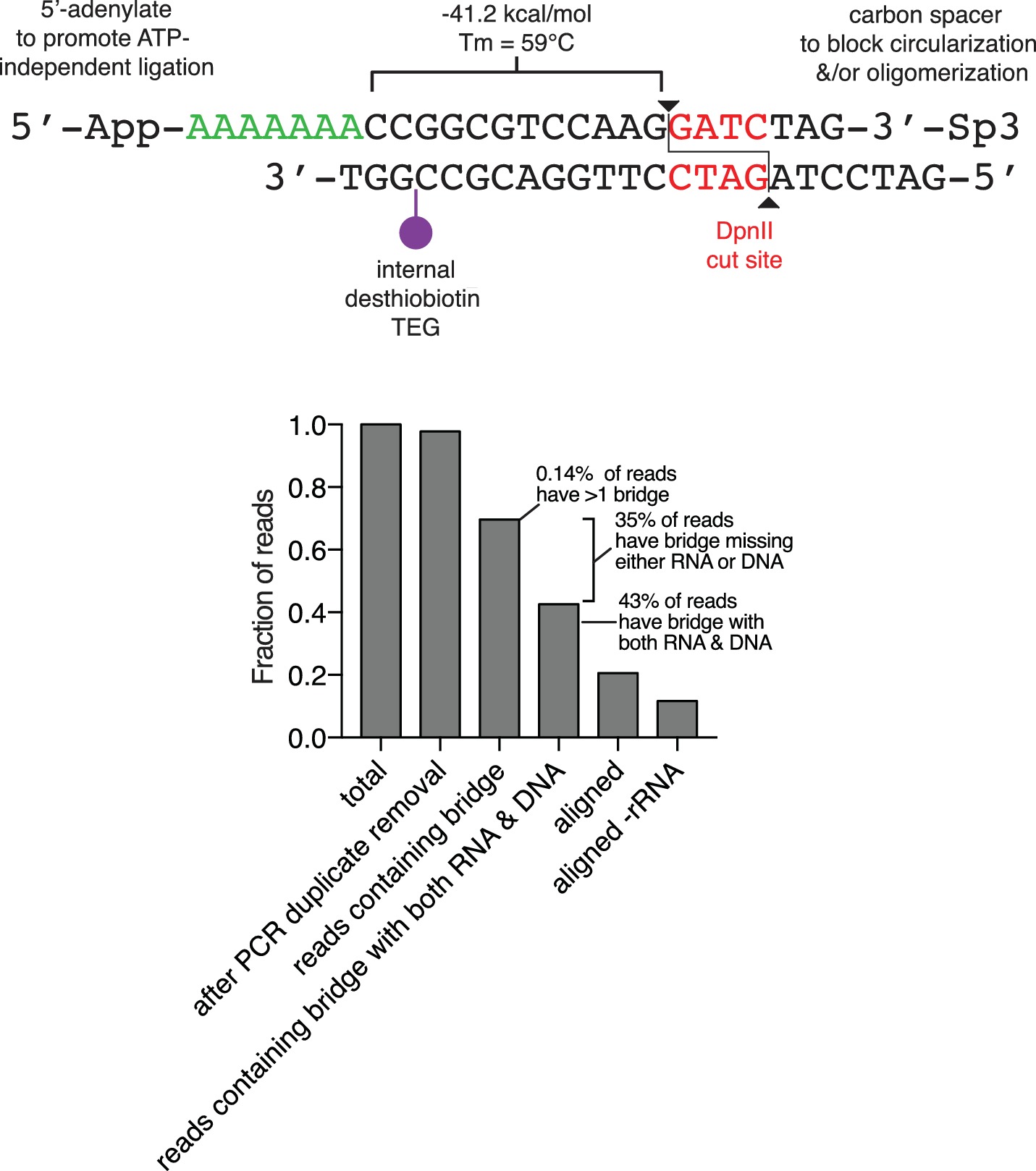
Defining source: Bell et al., eLife (2018), Figure 1—figure supplement 1 and caption.

A pre-adenylated, desthiobiotinylated DNA bridge first captures an RNA 3′ end. DpnII then opens the bridge's DNA-facing end and cuts nearby genomic DNA, creating a directional RNA–DNA chimera.

Published bridge variants: Bell et al. 2018 Figure 1—figure supplement 1 draws 5′-App-AAAAAAACCGGCGTCCAAGGATCTAG-3′-Sp3 paired with 3′-TGGCCGCAGGTTCCTAGATCCTAG-5′, with internal desthiobiotin-TEG and no UMI. Limouse et al. 2020, Methods in Molecular Biology §2.3 instead prints top /5rApp/AANNNAAACCGGCGTCCAAGGATCTTTAATTAAGTCGCAG/3SpC3/ and bottom /5Phos/GATCTGCGACTTAATTAAAGATCCTTGGACGCCGG/iBiodT/T, adding NNN and a PacI site. This page models the defining 2018 bridge; the figure does not resolve the exact TEG attachment bond. The 2018 Methods name a NEBNext USER hairpin and TruSeq-compatible indexing, but give no kit revision or selected index; the sequencing shell is inferred from the NEBNext family, not assigned to a particular E7335 or E7600 member.

Key oligos

2018 bridge top — 5′-App-AAAAAAACCGGCGTCCAAGGATCTAG-3′-Sp3

2018 bridge bottom — 5′-GATCCTAGATCCTTGGACGCCGGT-3′ (internal desthiobiotin-TEG; precise attachment bond unresolved)

Reaction workflow

final source-described~100–500bp eluate; conditional shell is a reference

nearby DpnII-cut genomic DNA — continues from “Open the bridge and cut nearby genomic DNA with DpnII”

nearby DpnII-cut genomic DNA DpnII-cut genomic DNA 5'- genomic DpnII overhang · 4 bpGATCgenomic DNA bodyDDDDDDDDDDDDDDDDDDDDDDDDDDDDDD -3' genomic complementary strand 3'- genomic DNA complementdddddddddddddddddddddddddddddd -5' genomic 5-prime GATC end
fixed chromatin-associated RNA–DNA contact [fixed chromatin-associated RNA–DNA contact] Fragment chromatin-associated RNA [fragmented RNA beside chromatin DNA] Present adapter and substrate ends 5′-adenylated top 5'-App 5-prime RNA-ligation tail · 6 bpAAAAAApaired bridge top · 20 bp · Tm 58.7 °CACCGGCGTCCAAGGATCTAG -3' Sp3 bottom strand with internal desthiobiotin-TEG 3'- paired bridge bottom · 20 bp · Tm 59.0 °CTGGCCGCAGGTTCCTAGATC5-prime DpnII-side tail · 4 bpCTAG -5' internal desthiobiotin-TEG; exact bond unresolved 5′-App end ligates an RNA 3′-OH 5-prime RNA-ligation tail paired bridge top fragmented chromatin RNA 5'- chromatin RNARRRRRRRRRRRRRRRRRRRRRRRRRRRR -3' RNA 3′-OH Ligate RNA 3′ ends to the bridge RNA covalently joined to bridge DNA 5'- chromatin RNARRRRRRRRRRRRRRRRRRRRRRRRRRRRbridge RNA-ligation tail · 6 bpAAAAAAbridge remainder · 20 bp · Tm 58.7 °CACCGGCGTCCAAGGATCTAG -3' Sp3 ** T4 Rnl2(tr) ligation original DNA bridge primer 3'- bridge bottom core · 20 bp · Tm 59.0 °CTGGCCGCAGGTTCCTAGATCoriginal bottom 5-prime tail · 4 bpCTAG -5' internal desthiobiotin-TEG; attachment bond unassigned genomic DNA population 5'- nearby chromatin DNA; separate from RNA–bridge[nearby chromatin DNA; separate from RNA–bridge] -3' Extend the bridge across RNA RNA covalently joined to bridge DNA 5'- chromatin RNARRRRRRRRRRRRRRRRRRRRRRRRRRRRbridge RNA-ligation tail · 6 bpAAAAAAbridge remainder · 20 bp · Tm 58.7 °CACCGGCGTCCAAGGATCTAG -3' Sp3 ** T4 Rnl2(tr) ligation Bst-extended DNA 3'- RNA-derived cDNArrrrrrrrrrrrrrrrrrrrrrrrrrrrcopied RNA-ligation tail · 6 bpTTTTTTbridge bottom core · 20 bp · Tm 59.0 °CTGGCCGCAGGTTCCTAGATCoriginal bottom 5-prime tail · 4 bpCTAG -5' internal desthiobiotin-TEG; attachment bond unassigned genomic DNA population 5'- nearby chromatin DNA; separate from RNA–bridge[nearby chromatin DNA; separate from RNA–bridge] -3' Open the bridge and cut nearby genomic DNA with DpnII RNA covalently joined to bridge DNA 5'- chromatin RNARRRRRRRRRRRRRRRRRRRRRRRRRRRRbridge RNA-ligation tail · 6 bpAAAAAAbridge remainder · 13 bp · Tm 50.1 °CACCGGCGTCCAAG -3' ** T4 Rnl2(tr) ligation Bst-extended DNA 3'- RNA-derived cDNArrrrrrrrrrrrrrrrrrrrrrrrrrrrcopied RNA-ligation tail · 6 bpTTTTTTbridge bottom core · 13 bp · Tm 50.5 °CTGGCCGCAGGTTCDpnII overhang · 4 bpCTAG -5' internal desthiobiotin-TEG; attachment bond unassigned DpnII-compatible bridge end Present adapter and substrate ends RNA covalently joined to bridge DNA 5'- chromatin RNARRRRRRRRRRRRRRRRRRRRRRRRRRRRbridge RNA-ligation tail · 6 bpAAAAAAbridge remainder · 13 bp · Tm 50.1 °CACCGGCGTCCAAG -3' ** T4 Rnl2(tr) ligation Bst-extended DNA 3'- RNA-derived cDNArrrrrrrrrrrrrrrrrrrrrrrrrrrrcopied RNA-ligation tail · 6 bpTTTTTTbridge bottom core · 13 bp · Tm 50.5 °CTGGCCGCAGGTTCDpnII overhang · 4 bpCTAG -5' internal desthiobiotin-TEG; attachment bond unassigned DpnII-compatible bridge end DpnII-cut genomic DNA 5'- genomic DpnII overhang · 4 bpGATCgenomic DNA bodyDDDDDDDDDDDDDDDDDDDDDDDDDDDDDD -3' genomic complementary strand 3'- genomic DNA complementdddddddddddddddddddddddddddddd -5' genomic 5-prime GATC end Ligate the opened bridge to nearby genomic DNA RNA/DNA strand paired to DNA; RNA persists 5'- retained RNARRRRRRRRRRRRRRRRRRRRRRRRRRRRbridge RNA-ligation tail · 6 bpAAAAAAretained desthiobiotin bridge · 13 bp · Tm 50.1 °CACCGGCGTCCAAGDpnII genomic junction · 4 bpGATCnearby genomic DNADDDDDDDDDDDDDDDDDDDDDDDDDDDDDD -3' RNA/DNA strand paired to DNA; RNA persists 3'- retained RNA'rrrrrrrrrrrrrrrrrrrrrrrrrrrrbridge RNA-ligation tail' · 6 bpTTTTTTretained desthiobiotin bridge' · 13 bp · Tm 50.5 °CTGGCCGCAGGTTCDpnII genomic junction' · 4 bpCTAGnearby genomic DNA'dddddddddddddddddddddddddddddd -5' Mixed-polymer strand: RNA persists on the RNA side; bridge and genomic portions are DNA. DNA strand: Bst-generated cDNA across the RNA side, with bridge/genomic DNA at the other end. ** RNA-side bridge ** DpnII cohesive ligation streptavidin capture retained RNA bridge RNA-ligation tail retained desthiobiotin bridge DpnII genomic junction nearby genomic DNA Make the second DNA strand cDNA–bridge–genomic DNA chimera 5'- RNA-derived cDNARRRRRRRRRRRRRRRRRRRRRRRRRRRRbridge RNA-ligation tail · 6 bpAAAAAAretained desthiobiotin bridge · 13 bp · Tm 50.1 °CACCGGCGTCCAAGDpnII genomic junction · 4 bpGATCnearby genomic DNADDDDDDDDDDDDDDDDDDDDDDDDDDDDDD -3' cDNA–bridge–genomic DNA chimera 3'- RNA-derived cDNA'rrrrrrrrrrrrrrrrrrrrrrrrrrrrbridge RNA-ligation tail' · 6 bpTTTTTTretained desthiobiotin bridge' · 13 bp · Tm 50.5 °CTGGCCGCAGGTTCDpnII genomic junction' · 4 bpCTAGnearby genomic DNA'dddddddddddddddddddddddddddddd -5' ** RNA-side bridge ** DpnII cohesive ligation streptavidin capture RNA-derived cDNA bridge RNA-ligation tail retained desthiobiotin bridge DpnII genomic junction nearby genomic DNA Reverse crosslinks and precipitate the DNA cDNA–bridge–genomic DNA chimera 5'- RNA-derived cDNARRRRRRRRRRRRRRRRRRRRRRRRRRRRbridge RNA-ligation tail · 6 bpAAAAAAretained desthiobiotin bridge · 13 bp · Tm 50.1 °CACCGGCGTCCAAGDpnII genomic junction · 4 bpGATCnearby genomic DNADDDDDDDDDDDDDDDDDDDDDDDDDDDDDD -3' cDNA–bridge–genomic DNA chimera 3'- RNA-derived cDNA'rrrrrrrrrrrrrrrrrrrrrrrrrrrrbridge RNA-ligation tail' · 6 bpTTTTTTretained desthiobiotin bridge' · 13 bp · Tm 50.5 °CTGGCCGCAGGTTCDpnII genomic junction' · 4 bpCTAGnearby genomic DNA'dddddddddddddddddddddddddddddd -5' ** RNA-side bridge ** DpnII cohesive ligation streptavidin capture RNA-derived cDNA bridge RNA-ligation tail retained desthiobiotin bridge DpnII genomic junction nearby genomic DNA Shear the contact duplexes cDNA–bridge–genomic DNA chimera 5'- RNA-derived cDNARRRRRRRRRRRRRRRRRRRRRRRRRRRRbridge RNA-ligation tail · 6 bpAAAAAAretained desthiobiotin bridge · 13 bp · Tm 50.1 °CACCGGCGTCCAAGDpnII genomic junction · 4 bpGATCnearby genomic DNADDDDDDDDDDDDDDDDDDDDDDDDDDDDDD -3' cDNA–bridge–genomic DNA chimera 3'- RNA-derived cDNA'rrrrrrrrrrrrrrrrrrrrrrrrrrrrbridge RNA-ligation tail' · 6 bpTTTTTTretained desthiobiotin bridge' · 13 bp · Tm 50.5 °CTGGCCGCAGGTTCDpnII genomic junction' · 4 bpCTAGnearby genomic DNA'dddddddddddddddddddddddddddddd -5' ** RNA-side bridge ** DpnII cohesive ligation streptavidin capture RNA-derived cDNA bridge RNA-ligation tail retained desthiobiotin bridge DpnII genomic junction nearby genomic DNA Enrich biotin-bearing contacts cDNA–bridge–genomic DNA chimera 5'- RNA-derived cDNARRRRRRRRRRRRRRRRRRRRRRRRRRRRbridge RNA-ligation tail · 6 bpAAAAAAretained desthiobiotin bridge · 13 bp · Tm 50.1 °CACCGGCGTCCAAGDpnII genomic junction · 4 bpGATCnearby genomic DNADDDDDDDDDDDDDDDDDDDDDDDDDDDDDD -3' cDNA–bridge–genomic DNA chimera 3'- RNA-derived cDNA'rrrrrrrrrrrrrrrrrrrrrrrrrrrrbridge RNA-ligation tail' · 6 bpTTTTTTretained desthiobiotin bridge' · 13 bp · Tm 50.5 °CTGGCCGCAGGTTCDpnII genomic junction' · 4 bpCTAGnearby genomic DNA'dddddddddddddddddddddddddddddd -5' ** RNA-side bridge ** DpnII cohesive ligation streptavidin capture RNA-derived cDNA bridge RNA-ligation tail retained desthiobiotin bridge DpnII genomic junction nearby genomic DNA End-repair the captured contacts [end-repaired contact duplexes] Add one 3′ dA to each end dA-tailed contact duplex 5'-p RNA-derived cDNARRRRRRRRRRRRRRRRRRRRRRRRRRRRbridge RNA-ligation tail · 6 bpAAAAAAretained bridge · 13 bp · Tm 50.1 °CACCGGCGTCCAAGDpnII genomic junction · 4 bpGATCnearby genomic DNADDDDDDDDDDDDDDDDDDDDDDDDDDDDDDtop 3-prime dA · 1 bpA -3' dA-tailed contact duplex 3'- bottom 3-prime dA · 1 bpARNA-derived cDNA'rrrrrrrrrrrrrrrrrrrrrrrrrrrrbridge RNA-ligation tail' · 6 bpTTTTTTretained bridge' · 13 bp · Tm 50.5 °CTGGCCGCAGGTTCDpnII genomic junction' · 4 bpCTAGnearby genomic DNA'dddddddddddddddddddddddddddddd p-5' 3′ dA 3′ dA Present adapter and substrate ends source limitation 5'- adapter overhang not reported[adapter overhang not reported] -3' The exact two-ended hairpin product is topological and cannot be flattened into this compact single-junction Scene. Ligate NEBNext hairpin adapters [hairpin-adapted contact library] Open the hairpins with USER topology/adapter ends unassigned; not the completed PCR duplex 5'- actual USER-opened adapter/contact precursor; strand ends unassigned[actual USER-opened adapter/contact precursor; strand ends unassigned] -3' Wash the USER-treated on-bead library topology/adapter ends unassigned; not the completed PCR duplex 5'- actual USER-opened adapter/contact precursor; strand ends unassigned[actual USER-opened adapter/contact precursor; strand ends unassigned] -3' Amplify on bead with the Universal and Indexing primers (8 cycles) eight-cycle PCR1 amplicon strand 1 5'- indexed contact amplicon strand; terminal sequences unassigned[indexed contact amplicon strand; terminal sequences unassigned] -3' Source-described PCR duplex; exact primer members, ends and base-level pairing geometry remain unassigned. eight-cycle PCR1 amplicon strand 2 3'- complementary amplicon strand; terminal sequences unassigned[complementary amplicon strand; terminal sequences unassigned] -5' Collect PCR1 supernatant after magnetic separation eight-cycle PCR1 amplicon strand 1 5'- indexed contact amplicon strand; terminal sequences unassigned[indexed contact amplicon strand; terminal sequences unassigned] -3' Source-described PCR duplex; exact primer members, ends and base-level pairing geometry remain unassigned. eight-cycle PCR1 amplicon strand 2 3'- complementary amplicon strand; terminal sequences unassigned[complementary amplicon strand; terminal sequences unassigned] -5' Clean PCR1 supernatant with1:1 AMPure and elute30µl eight-cycle PCR1 amplicon strand 1 5'- indexed contact amplicon strand; terminal sequences unassigned[indexed contact amplicon strand; terminal sequences unassigned] -3' Source-described PCR duplex; exact primer members, ends and base-level pairing geometry remain unassigned. eight-cycle PCR1 amplicon strand 2 3'- complementary amplicon strand; terminal sequences unassigned[complementary amplicon strand; terminal sequences unassigned] -5' Allocate5µl to qPCR and25µl to production amplification eight-cycle PCR1 amplicon strand 1 5'- indexed contact amplicon strand; terminal sequences unassigned[indexed contact amplicon strand; terminal sequences unassigned] -3' Source-described PCR duplex; exact primer members, ends and base-level pairing geometry remain unassigned. eight-cycle PCR1 amplicon strand 2 3'- complementary amplicon strand; terminal sequences unassigned[complementary amplicon strand; terminal sequences unassigned] -5' Re-amplify the25µl production aliquot off bead for qPCR-determined cycles off-bead PCR2 product strand 1 5'- indexed contact amplicon strand; terminal sequences unassigned[indexed contact amplicon strand; terminal sequences unassigned] -3' Source-described PCR duplex; exact primer members, ends and base-level pairing geometry remain unassigned. off-bead PCR2 product strand 2 3'- complementary amplicon strand; terminal sequences unassigned[complementary amplicon strand; terminal sequences unassigned] -5' Bind the high-size fraction at0.5× and retain supernatant off-bead PCR2 product strand 1 5'- indexed contact amplicon strand; terminal sequences unassigned[indexed contact amplicon strand; terminal sequences unassigned] -3' Source-described PCR duplex; exact primer members, ends and base-level pairing geometry remain unassigned. off-bead PCR2 product strand 2 3'- complementary amplicon strand; terminal sequences unassigned[complementary amplicon strand; terminal sequences unassigned] -5' Bind the target fraction at cumulative1:1; save low-size supernatant off-bead PCR2 product strand 1 5'- indexed contact amplicon strand; terminal sequences unassigned[indexed contact amplicon strand; terminal sequences unassigned] -3' Source-described PCR duplex; exact primer members, ends and base-level pairing geometry remain unassigned. off-bead PCR2 product strand 2 3'- complementary amplicon strand; terminal sequences unassigned[complementary amplicon strand; terminal sequences unassigned] -5' Wash and elute the final~100–500bp production library final source-described~100–500bp eluate; conditional shell is a reference 5'- P5 · 25 bp · Tm 62.3 °CAATGATACGGCGACCACCGAGATCTRead 1 arm · 33 bp · Tm 66.9 °CACACTCTTTCCCTACACGACGCTCTTCCGATCTRNA-derived cDNARRRRRRRRRRRRRRRRRRRRRRRRRRRRRRRRRRRRRRbridge RNA-ligation tail · 6 bpAAAAAAretained bridge through DpnII junction · 13 bp · Tm 50.1 °CACCGGCGTCCAAGDpnII genomic junction · 4 bpGATCnearby genomic DNADDDDDDDDDDDDDDDDDDDDDDDDDDDDDDDDDDDDDDDDDDsource dA junction · 1 bpAconditional Index 1 / Read 2 arm · 33 bp · Tm 66.8 °CGATCGGAAGAGCACACGTCTGAACTCCAGTCACi7 index; length/member unassigned[i7 index; length/member unassigned]P7 reverse complement · 24 bp · Tm 59.8 °CATCTCGTATGCCGTCTTCTGCTTG -3' final source-described~100–500bp eluate; conditional shell is a reference 3'- P5' · 25 bp · Tm 61.7 °CTTACTATGCCGCTGGTGGCTCTAGARead 1 arm' · 33 bp · Tm 67.3 °CTGTGAGAAAGGGATGTGCTGCGAGAAGGCTAGARNA-derived cDNA'rrrrrrrrrrrrrrrrrrrrrrrrrrrrrrrrrrrrrrbridge RNA-ligation tail' · 6 bpTTTTTTretained bridge through DpnII junction' · 13 bp · Tm 50.5 °CTGGCCGCAGGTTCDpnII genomic junction' · 4 bpCTAGnearby genomic DNA'ddddddddddddddddddddddddddddddddddddddddddsource dA junction' · 1 bpTconditional Index 1 / Read 2 arm' · 33 bp · Tm 66.6 °CCTAGCCTTCTCGTGTGCAGACTTGAGGTCAGTGi7 index; length/member unassigned'[i7 index; length/member unassigned]P7 reverse complement' · 24 bp · Tm 59.3 °CTAGAGCATACGGCAGAAGACGAAC -5'
  1. Fragment chromatin-associated RNA. Inputs: RNA-fragmentation condition
  2. Present adapter and substrate ends. The printed 5′-App bridge top is selectively ligated to fragmented RNA 3′-OH ends by truncated T4 RNA ligase 2.
  3. Ligate RNA 3′ ends to the bridge. Inputs: 2018 pre-annealed desthiobiotinylated ChAR-seq bridge; truncated T4 RNA ligase 2 (R55K K227Q, trKQ) in 25% PEG
  4. Extend the bridge across RNA. Inputs: RNA-ligated bridge; Bst 3.0 reverse transcriptase
  5. Open the bridge and cut nearby genomic DNA with DpnII. Inputs: DpnII. Other outputs: nearby DpnII-cut genomic DNA; DpnII-detached distal bridge fragment retaining the C3 block → unresolved
  6. Present adapter and substrate ends. DpnII removes the bridge's 3′ C3-blocked distal piece and produces a GATC-compatible bridge end while cutting nearby genomic DNA to the same cohesive-end class.
  7. Ligate the opened bridge to nearby genomic DNA. Inputs: nearby DpnII-cut genomic DNA; T4 DNA ligase
  8. Make the second DNA strand. Inputs: E. coli DNA polymerase I with limiting RNase H
  9. Reverse crosslinks and precipitate the DNA. Inputs: SDS/NaCl with proteinase K, 70 C overnight
  10. Shear the contact duplexes. Inputs: Covaris shearing to ~200 bp
  11. Enrich biotin-bearing contacts. Inputs: Dynabeads MyOne Streptavidin T1. Other outputs: non-bridge-bearing fragments → discard
  12. End-repair the captured contacts. Inputs: NEBNext End Prep enzyme mix (on bead)
  13. Add one 3′ dA to each end. Inputs: NEBNext End Prep enzyme mix (dA tailing)
  14. Present adapter and substrate ends. The exact two-ended hairpin product is topological and cannot be flattened into this compact single-junction Scene.
  15. Ligate NEBNext hairpin adapters. Inputs: NEBNext USER hairpin adapter; T4 DNA ligase
  16. Open the hairpins with USER. Inputs: USER enzyme
  17. Wash the USER-treated on-bead library. Inputs: Step22: twice750µl1×TWB; first wash warmed50°C2min. Other outputs: post-ligation/USER supernatant and TWB washes → discard
  18. Amplify on bead with the Universal and Indexing primers (8 cycles). Inputs: NEBNext Universal PCR primer; NEBNext indexed P7 PCR primer; NEBNext High-Fidelity PCR master mix
  19. Collect PCR1 supernatant after magnetic separation. Inputs: Step23: magnetically pellet original streptavidin beads after PCR1. Other outputs: original streptavidin beads and remaining bound material → unresolved
  20. Clean PCR1 supernatant with1:1 AMPure and elute30µl. Inputs: Step24: equal-volume1:1 AMPureXP;70%EtOHwash;30µl10mMTrispH8eluate. Other outputs: Step24 AMPure supernatant retained until completed-library QC → stored intermediate; Step24 70%ethanol wash supernatant → discard
  21. Allocate5µl to qPCR and25µl to production amplification. Other outputs: 5µl Step24 eluate for cycle-determination qPCR
  22. Re-amplify the25µl production aliquot off bead for qPCR-determined cycles. Inputs: NEBNext Universal PCR primer; NEBNext indexed P7 PCR primer; NEBNext High-Fidelity PCR master mix
  23. Bind the high-size fraction at0.5× and retain supernatant. Inputs: Step26:0.5×AMPureXP (30µl beads per60µl PCRmix), RT5min. Other outputs: Step26 first-bind high-size beads with70%EtOH added → stored intermediate
  24. Bind the target fraction at cumulative1:1; save low-size supernatant. Inputs: Step26:add another30µl beads (0.5×original60µl; cumulative1:1). Other outputs: Step26 second-bind low-size/adaptor-dimer supernatant → stored intermediate
  25. Wash and elute the final~100–500bp production library. Inputs: Step26:two700µl70%EtOHwashes;dry~5min;elute50µl20mMTrispH8. Other outputs: Step26 discarded ethanol wash supernatants → discard

Other material outcomes

DpnII-detached distal bridge fragment retaining the C3 block — unresolved

DpnII cleavage releases this distal bridge piece; no separate physical removal is assigned at this step.

DpnII-detached distal bridge fragment retaining the C3 block — unresolved
detached C3-blocked bridge piece 5'- new DpnII 5-prime tail · 4 bpGATCdistal top paired core · 3 bpTAG -3' Sp3 distal bottom 3'- distal bottom paired core · 3 bpATCoriginal bottom 5-prime tail · 4 bpCTAG -5' new DpnII 5-prime tail distal top paired core

non-bridge-bearing fragments — discard

fragments lacking the internal biotin bridge are washed away

Molecular structure is not represented in this graph.

post-ligation/USER supernatant and TWB washes — discard

Step22 explicitly discards the supernatant and wash fractions

Molecular structure is not represented in this graph.

original streptavidin beads and remaining bound material — unresolved

Step24 processes PCR supernatant; no later disposition of the original magnetic beads is assigned.

Molecular structure is not represented in this graph.

Step24 AMPure supernatant retained until completed-library QC — stored intermediate

Step24 explicitly saves this supernatant until library validation by qPCR/Bioanalyzer, for troubleshooting.

Molecular structure is not represented in this graph.

Step24 70%ethanol wash supernatant — discard

Step24 removes the ethanol wash supernatant before elution

Molecular structure is not represented in this graph.

qPCR-amplified analytical5µl aliquot — QC

Analytical qPCR aliquot sets the additional-cycle count; it is not returned to production PCR2.

qPCR-amplified analytical5µl aliquot — QC
cycle-determination qPCR product strand 1 5'- indexed contact amplicon strand; terminal sequences unassigned[indexed contact amplicon strand; terminal sequences unassigned] -3' Source-described PCR duplex; exact primer members, ends and base-level pairing geometry remain unassigned. cycle-determination qPCR product strand 2 3'- complementary amplicon strand; terminal sequences unassigned[complementary amplicon strand; terminal sequences unassigned] -5'

Step26 first-bind high-size beads with70%EtOH added — stored intermediate

Step26 adds70%EtOH to the larger-fragment beads and sets them aside.

Molecular structure is not represented in this graph.

Step26 second-bind low-size/adaptor-dimer supernatant — stored intermediate

Step26 explicitly saves this low-size supernatant just in case; it is not recorded as discarded.

Molecular structure is not represented in this graph.

Step26 discarded ethanol wash supernatants — discard

Step26 explicitly discards both ethanol wash supernatants

Molecular structure is not represented in this graph.

Final sequencing library

INFERRED — The source-defined bridge separates the RNA-derived cDNA from nearby genomic DNA. The defining experiment used single-end 152-base sequencing; the TruSeq-compatible shell depicts an unverified NEBNext index-kit member, and the opposite site is not a reported second read.
library 5'- P5 · 25 bp · Tm 62.3 °CAATGATACGGCGACCACCGAGATCTRead 1 arm · 33 bp · Tm 66.9 °CACACTCTTTCCCTACACGACGCTCTTCCGATCTRNA-derived cDNARRRRRRRRRRRRRRRRRRRRRRRRRRRRRRRRRRRRRRbridge RNA-ligation tail · 6 bpAAAAAAretained bridge through DpnII junction · 13 bp · Tm 50.1 °CACCGGCGTCCAAGDpnII genomic junction · 4 bpGATCnearby genomic DNADDDDDDDDDDDDDDDDDDDDDDDDDDDDDDDDDDDDDDDDDDsource dA junction · 1 bpAconditional Index 1 / Read 2 arm · 33 bp · Tm 66.8 °CGATCGGAAGAGCACACGTCTGAACTCCAGTCACi7 index; length/member unassigned[i7 index; length/member unassigned]P7 reverse complement · 24 bp · Tm 59.8 °CATCTCGTATGCCGTCTTCTGCTTG -3' library 3'- P5' · 25 bp · Tm 61.7 °CTTACTATGCCGCTGGTGGCTCTAGARead 1 arm' · 33 bp · Tm 67.3 °CTGTGAGAAAGGGATGTGCTGCGAGAAGGCTAGARNA-derived cDNA'rrrrrrrrrrrrrrrrrrrrrrrrrrrrrrrrrrrrrrbridge RNA-ligation tail' · 6 bpTTTTTTretained bridge through DpnII junction' · 13 bp · Tm 50.5 °CTGGCCGCAGGTTCDpnII genomic junction' · 4 bpCTAGnearby genomic DNA'ddddddddddddddddddddddddddddddddddddddddddsource dA junction' · 1 bpTconditional Index 1 / Read 2 arm' · 33 bp · Tm 66.6 °CCTAGCCTTCTCGTGTGCAGACTTGAGGTCAGTGi7 index; length/member unassigned'[i7 index; length/member unassigned]P7 reverse complement' · 24 bp · Tm 59.3 °CTAGAGCATACGGCAGAAGACGAAC -5' P5 Read 1 arm RNA-derived cDNA bridge RNA-ligation tail source dA junction i7 index; length/member unassigned P7 reverse complement retained bridge through DpnII junction conditional Index 1 / Read 2 arm DpnII genomic junction nearby genomic DNA ^ sample index

Sequencing primers

The source names a NEBNext USER-opened TruSeq-compatible library. Its exact kit revision and index member are unverified; the paper reports single-end 152-base sequencing. Actual index acquisition and its cycle count remain unassigned.

Sequences come from lib/; the landing site and the first bases of each read are computed from this page's final library, so they cannot drift from it.
Sequencing primers on the final library
Read 1 / TruSeq Read 1 5'- TruSeq Read 1 · 33 bp · Tm 66.9 °CACACTCTTTCCCTACACGACGCTCTTCCGATCT -3' final library 5'- P5 · 25 bp · Tm 62.3 °CAATGATACGGCGACCACCGAGATCTRead 1 arm · 33 bp · Tm 66.9 °CACACTCTTTCCCTACACGACGCTCTTCCGATCTRNA-derived cDNARRRRRRRRRRRRRRRRRRRRRRRRRRRRRRRRRRRRRRbridge RNA-ligation tail · 6 bpAAAAAAretained bridge through DpnII junction · 13 bp · Tm 50.1 °CACCGGCGTCCAAGDpnII genomic junction · 4 bpGATCnearby genomic DNADDDDDDDDDDDDDDDDDDDDDDDDDDDDDDDDDDDDDDDDDDsource dA junction · 1 bpAconditional Index 1 / Read 2 arm · 33 bp · Tm 66.8 °CGATCGGAAGAGCACACGTCTGAACTCCAGTCACi7 index; length/member unassigned[i7 index; length/member unassigned]P7 reverse complement · 24 bp · Tm 59.8 °CATCTCGTATGCCGTCTTCTGCTTG -3' 3'- P5 · 25 bp · Tm 62.3 °CTTACTATGCCGCTGGTGGCTCTAGARead 1 arm · 33 bp · Tm 66.9 °CTGTGAGAAAGGGATGTGCTGCGAGAAGGCTAGARNA-derived cDNArrrrrrrrrrrrrrrrrrrrrrrrrrrrrrrrrrrrrrbridge RNA-ligation tail · 6 bpTTTTTTretained bridge through DpnII junction · 13 bp · Tm 50.1 °CTGGCCGCAGGTTCDpnII genomic junction · 4 bpCTAGnearby genomic DNAddddddddddddddddddddddddddddddddddddddddddsource dA junction · 1 bpTconditional Index 1 / Read 2 arm · 33 bp · Tm 66.8 °CCTAGCCTTCTCGTGTGCAGACTTGAGGTCAGTGi7 index; length/member unassigned[i7 index; length/member unassigned]P7 reverse complement · 24 bp · Tm 59.8 °CTAGAGCATACGGCAGAAGACGAAC -5' ^ sample index
ReadPrimerSequenceLands onFirst bases read
Read 1TruSeq Read 1
Illumina "Illumina Adapter Sequences" #1000000002694
5'-ACACTCTTTCCCTACACGACGCTCTTCCGATCT-3'anneals to the bottom strand over Read 1 armRRRRRRRRRRRR… (from RNA-derived cDNA)

Read content and handling

The defining experiment reports single-end152; the conditional outer shell does not establish actual index acquisition.

ReadCyclesContentInclude in sequence analysis?
Read 1152RNA-derived cDNA, bridge junction and nearby genomic DNA when reachedYes — include in sequence analysis
Index 1 (i7)unassignedSelected index and acquisition/cycles unassignedUndetermined
Sequencing-primer binding on the final library
final library 5'- P5 · 25 bp · Tm 62.3 °CAATGATACGGCGACCACCGAGATCTRead 1 arm · 33 bp · Tm 66.9 °CACACTCTTTCCCTACACGACGCTCTTCCGATCTRNA-derived cDNARRRRRRRRRRRRRRRRRRRRRRRRRRRRRRRRRRRRRRbridge RNA-ligation tail · 6 bpAAAAAAretained bridge through DpnII junction · 13 bp · Tm 50.1 °CACCGGCGTCCAAGDpnII genomic junction · 4 bpGATCnearby genomic DNADDDDDDDDDDDDDDDDDDDDDDDDDDDDDDDDDDDDDDDDDDsource dA junction · 1 bpAconditional Index 1 / Read 2 arm · 33 bp · Tm 66.8 °CGATCGGAAGAGCACACGTCTGAACTCCAGTCACi7 index; length/member unassigned[i7 index; length/member unassigned]P7 reverse complement · 24 bp · Tm 59.8 °CATCTCGTATGCCGTCTTCTGCTTG -3' 3'- P5 · 25 bp · Tm 62.3 °CTTACTATGCCGCTGGTGGCTCTAGARead 1 arm · 33 bp · Tm 66.9 °CTGTGAGAAAGGGATGTGCTGCGAGAAGGCTAGARNA-derived cDNArrrrrrrrrrrrrrrrrrrrrrrrrrrrrrrrrrrrrrbridge RNA-ligation tail · 6 bpTTTTTTretained bridge through DpnII junction · 13 bp · Tm 50.1 °CTGGCCGCAGGTTCDpnII genomic junction · 4 bpCTAGnearby genomic DNAddddddddddddddddddddddddddddddddddddddddddsource dA junction · 1 bpTconditional Index 1 / Read 2 arm · 33 bp · Tm 66.8 °CCTAGCCTTCTCGTGTGCAGACTTGAGGTCAGTGi7 index; length/member unassigned[i7 index; length/member unassigned]P7 reverse complement · 24 bp · Tm 59.8 °CTAGAGCATACGGCAGAAGACGAAC -5' ^ sample index Read 1 primer: ? No second biological read was collected in the defining experiment, actual index acquisition/cycles remain unassigned, and the vendor hairpin adapter's exact bases are not asserted here. Index primer: ? No second biological read was collected in the defining experiment, actual index acquisition/cycles remain unassigned, and the vendor hairpin adapter's exact bases are not asserted here. Read 2 primer: ? No second biological read was collected in the defining experiment, actual index acquisition/cycles remain unassigned, and the vendor hairpin adapter's exact bases are not asserted here.