Error and uncertainty
Separate spread, bias and uncertainty in a result
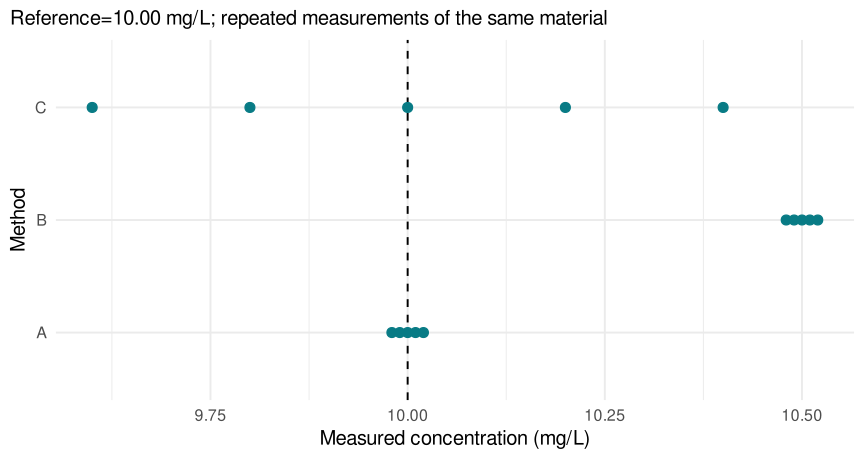
Which method would you trust?
![Repeated reference measurements: A is near 10 mg/L, B is tightly grouped near 10.5, and C is spread around 10.]()
The reference is 10.00 mg/L. Compare both location and spread.
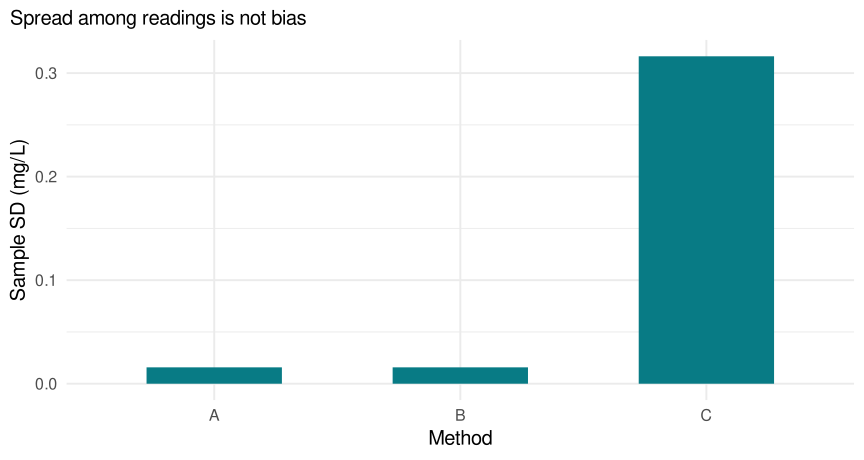
Precision concerns repeated results
![A and B both have SD about 0.0158 mg/L, while C has SD about 0.316 mg/L.]()
A and B both have SD ≈ 0.0158 mg/L.
Bias concerns a suitable reference
![Repeated reference measurements: A is near 10 mg/L, B is tightly grouped near 10.5, and C is spread around 10.]()
B mean = 10.50 mg/L: estimated bias +0.50 mg/L.
A mean close to the reference is not a guarantee
![Repeated reference measurements: A is near 10 mg/L, B is tightly grouped near 10.5, and C is spread around 10.]()
C mean = 10.00 mg/L, but its SD ≈ 0.316 mg/L.
Uncertainty describes doubt under a model
It is not the observed difference from a secretly known true value.
Retrieve grouped summaries
summarise(n = n(), mean_mg_l = mean(measured_mg_l),
          sd_mg_l = sd(measured_mg_l))
Spread of readings and uncertainty in a mean differ
For independent stable readings: u_{reading}(\bar x)=s/\sqrt n.
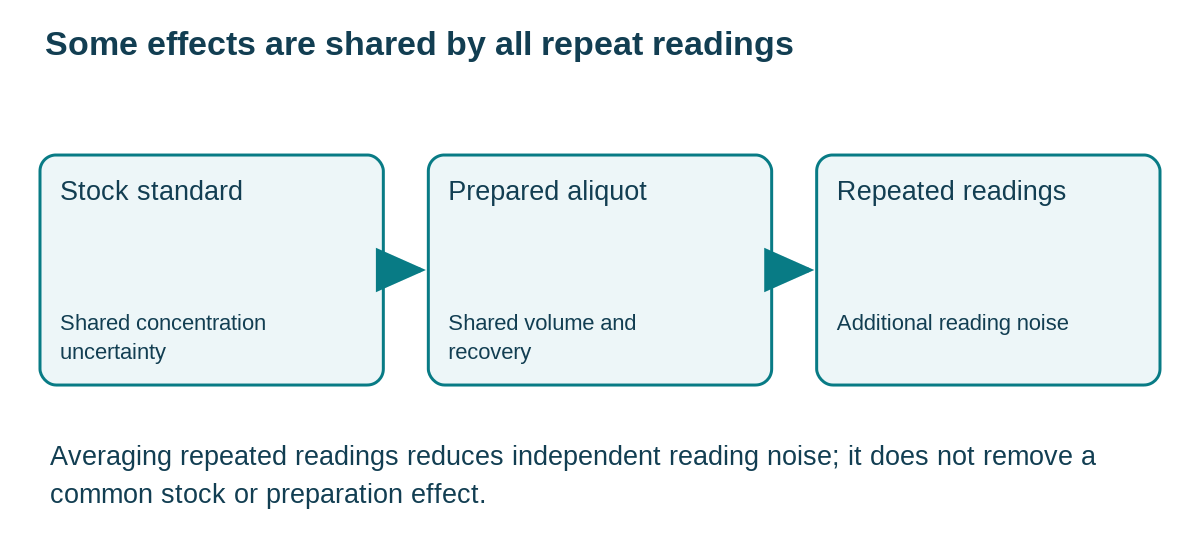
Do not divide shared effects by square root of n
![Averaging repeated readings reduces independent reading noise; it does not remove a common stock or preparation effect.]()
A stock error is shared by every reading made from that stock.
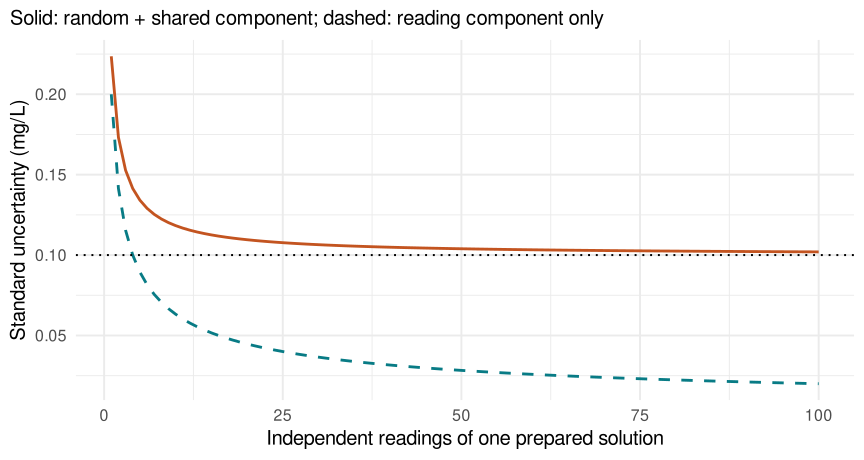
More readings approach a floor
![Reading uncertainty decreases with more independent readings, while the combined uncertainty approaches a shared 0.10 mg/L floor.]()
Which curve keeps decreasing? Which levels off?
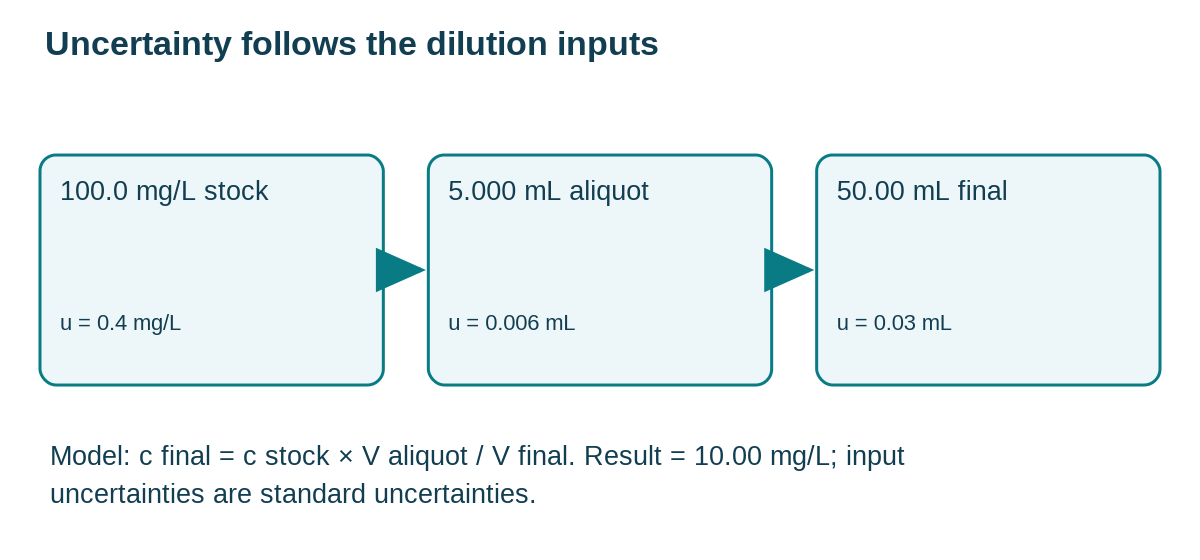
Write the dilution model
![Model: c final = c stock × V aliquot / V final. Result = 10.00 mg/L; input uncertainties are standard uncertainties.]()
c=c_sV_a/V_f.
Propagate each contribution onto the output scale
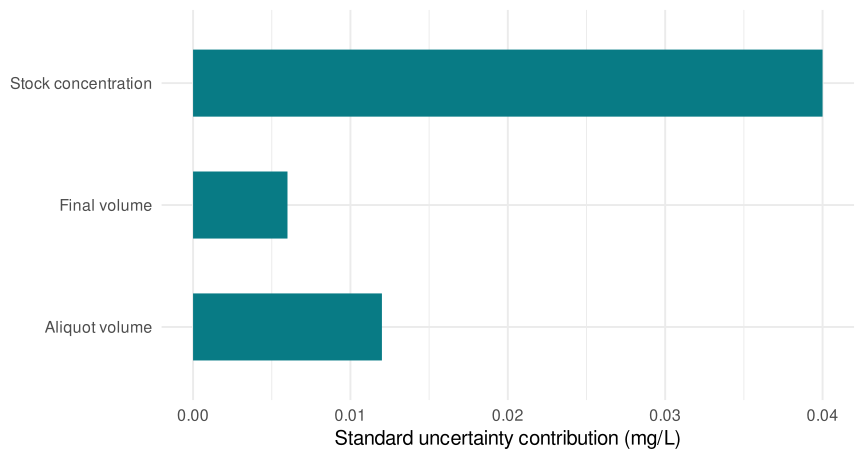
![Dilution standard uncertainty contributions: stock 0.040, aliquot 0.012 and final volume 0.006 mg/L.]()
Stock contributes 0.040 mg/L.
Volume contributions also survive averaging
![Dilution standard uncertainty contributions: stock 0.040, aliquot 0.012 and final volume 0.006 mg/L.]()
Aliquot: 0.012 mg/L; final volume: 0.006 mg/L.
Combine independent contributions in quadrature
![Dilution standard uncertainty contributions: stock 0.040, aliquot 0.012 and final volume 0.006 mg/L.]()
u(c)=\sqrt{0.040^2+0.012^2+0.006^2} = 0.04219 mg/L.
Improve the dominant source first
![Dilution standard uncertainty contributions: stock 0.040, aliquot 0.012 and final volume 0.006 mg/L.]()
Would a more precise final flask solve most of this budget?
Averaging is useful within its scope
![Reading uncertainty decreases with more independent readings, while the combined uncertainty approaches a shared 0.10 mg/L floor.]()
More independent readings reduce the reading component.
An interval needs a meaning
Standard uncertainty u; expanded uncertainty U=ku; confidence interval for a mean.
A small-sample mean uses its sampling model
\bar x\pm t_{0.975,n-1}s/\sqrt n.
Treat a known bias as a problem to investigate
![Repeated reference measurements: A is near 10 mg/L, B is tightly grouped near 10.5, and C is spread around 10.]()
An arbitrary error bar does not correct a systematically displaced method.
Report precision that the uncertainty supports
10.000 mg/L; standard uncertainty 0.042 mg/L under the stated model.
Transfer: halve the stock uncertainty
![Dilution standard uncertainty contributions: stock 0.040, aliquot 0.012 and final volume 0.006 mg/L.]()
Replace 0.4 by 0.2 mg/L. What happens to combined uncertainty?
What still lies outside the budget?
![Averaging repeated readings reduces independent reading noise; it does not remove a common stock or preparation effect.]()
Sampling, recovery, matrix effects and unmodelled preparation variation.
Practise the chemical argument
Open the exercise.
Save the calculation and a chemical interpretation in your reproducible report.
Interactive experiment · Predict, change, explain.