From sample to answer
Define the chemical quantity before calculating it
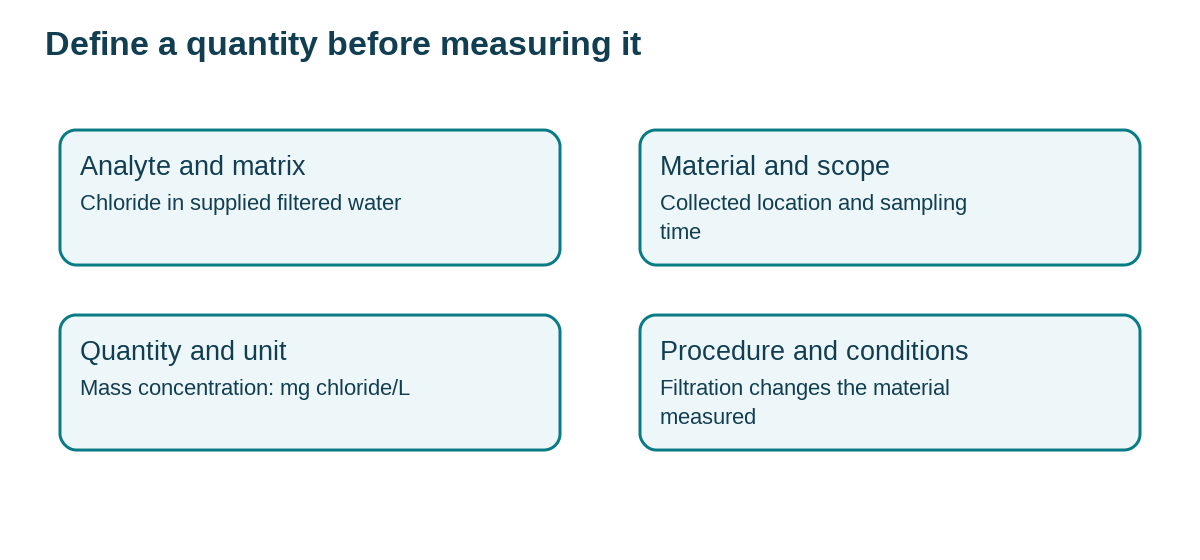
A number needs a chemical question
![Four parts of a measurand: analyte and matrix, material scope, quantity and unit, and procedure.]()
What quantity will our result describe?
Separate analyte from matrix
![A selective chloride procedure and conductivity do not have the same measurand.]()
Chloride is the analyte. Water and other dissolved components form the matrix.
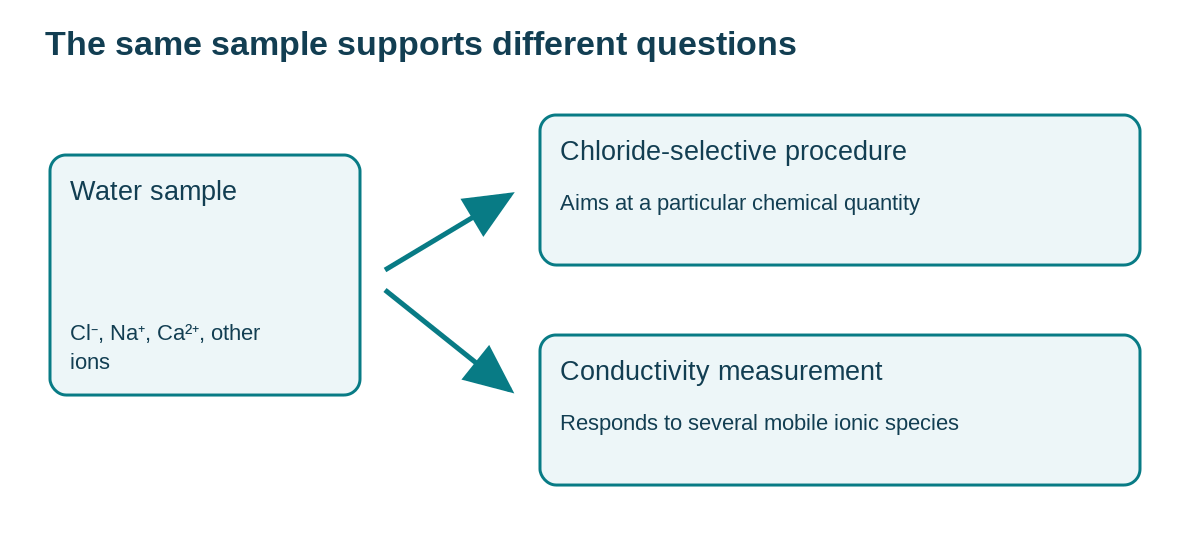
The same sample can answer different questions
![A selective chloride procedure and conductivity do not have the same measurand.]()
Conductivity and chloride concentration are different measurands.
Include place and time
![Four parts of a measurand: analyte and matrix, material scope, quantity and unit, and procedure.]()
A result from the supplied bottle is not automatically a river-wide mean.
Preparation belongs in the definition
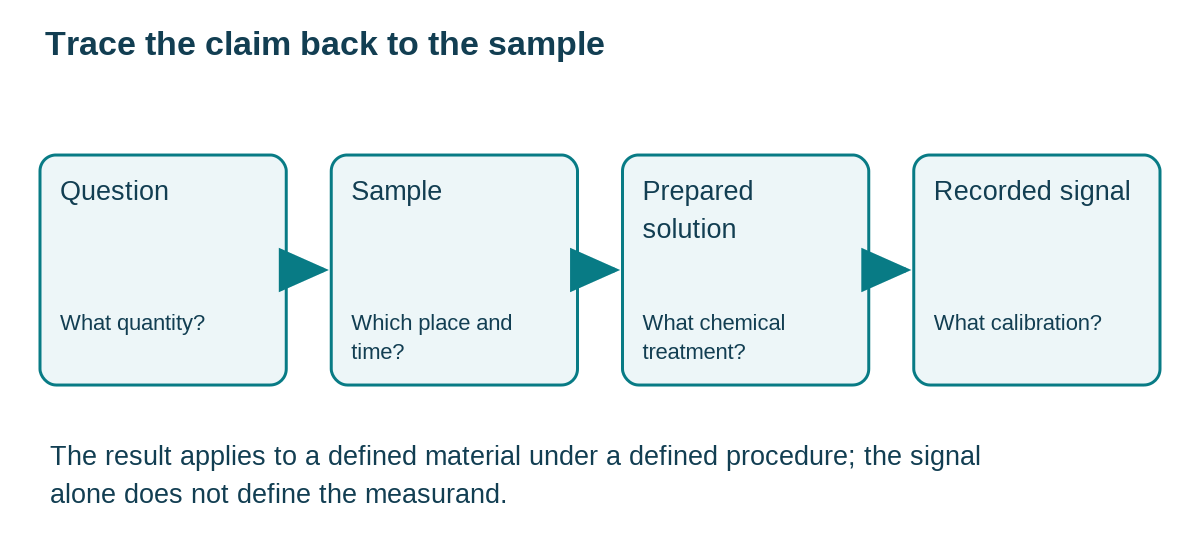
![The result applies to a defined material under a defined procedure; the signal alone does not define the measurand.]()
Filtered iron, unfiltered iron and original Fe(II) need different evidence.
Qualitative and quantitative claims
Identity: what evidence supports the substance?
Amount: what relates the selective response to a quantity?
Follow the result backwards
![The result applies to a defined material under a defined procedure; the signal alone does not define the measurand.]()
Which record connects this reported concentration to the collected material?
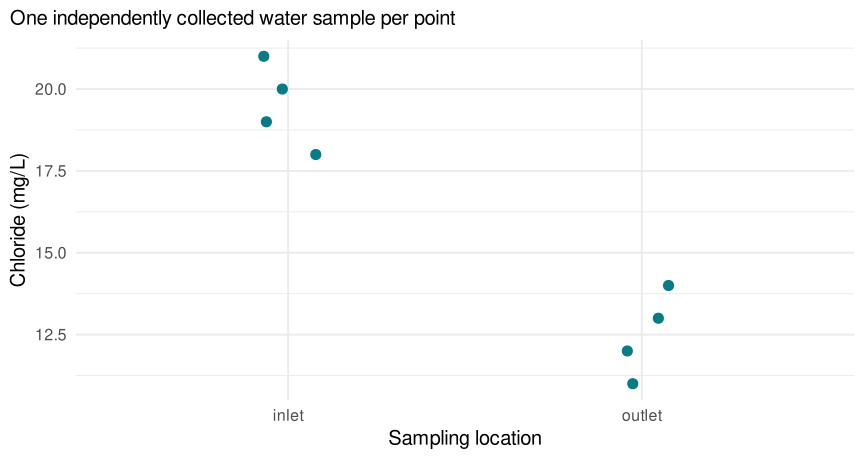
One row means one collected sample
![Eight collected waters show inlet chloride of 18–21 mg/L and outlet chloride of 11–14 mg/L.]()
Eight rows: four inlet samples and four outlet samples.
Retrieve the familiar import
water <- read_csv("data/course/water.csv")
glimpse(water)
Show the observations first
![Eight collected waters show inlet chloride of 18–21 mg/L and outlet chloride of 11–14 mg/L.]()
What is the difference between the locations? What variation remains?
Summarise with a count
water |> group_by(location) |>
  summarise(n = n(), mean_mg_l = mean(chloride_mg_l))
Make a restrained claim
![Eight collected waters show inlet chloride of 18–21 mg/L and outlet chloride of 11–14 mg/L.]()
The descriptive difference is 7.0 mg/L for these samples.
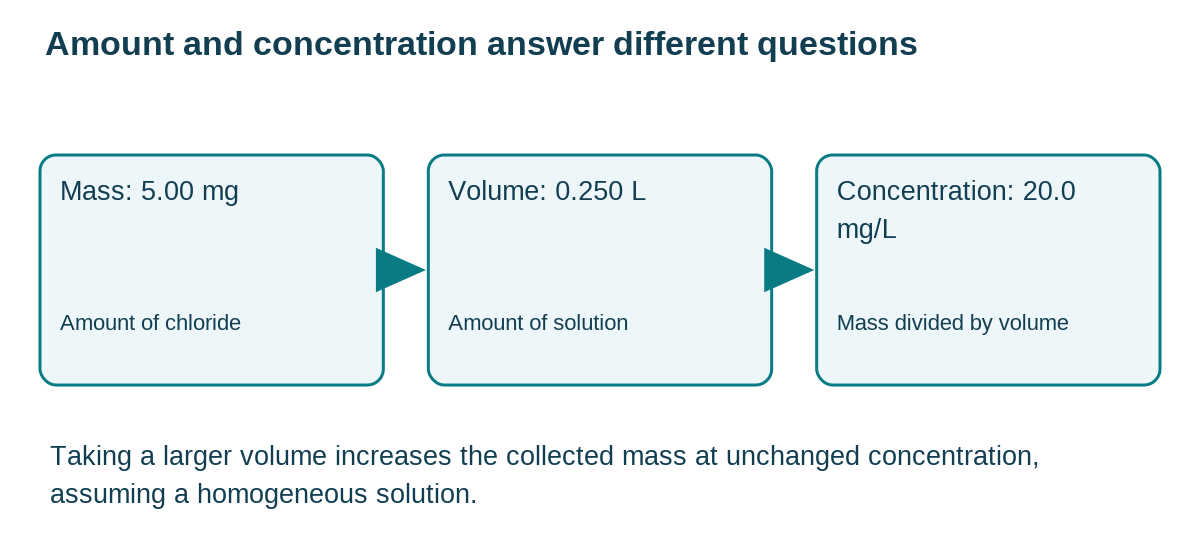
Concentration is amount per volume
![Taking a larger volume increases the collected mass at unchanged concentration, assuming a homogeneous solution.]()
c=m/V; therefore m=cV.
Calculate the collected amount
![Taking a larger volume increases the collected mass at unchanged concentration, assuming a homogeneous solution.]()
20.0 mg/L × 0.250 L = 5.00 mg.
Convert the unit and the number together
20 mg/L = 0.020 g/L.
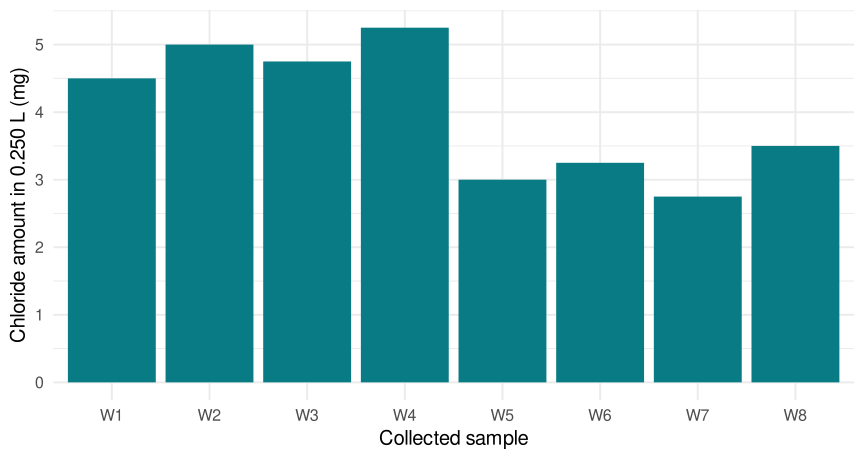
A different graph answers a different question
![Calculated chloride amount in equal quarter-litre collected samples, retaining each sample ID.]()
This axis is amount in a collected portion, not concentration.
Keep evidence portable
![The result applies to a defined material under a defined procedure; the signal alone does not define the measurand.]()
Raw data → saved code → derived table → rendered report.
Transfer: a new portion
![Taking a larger volume increases the collected mass at unchanged concentration, assuming a homogeneous solution.]()
0.0750 mg in 25.00 mL. What is the concentration?
What would make this conclusion wrong?
Name one sampling, chemical and computing failure.
Practise the chemical argument
Open the exercise.
Save the calculation and a chemical interpretation in your reproducible report.
Interactive experiment · Predict, change, explain.