Sampling and preparation
Follow the material through sampling, extraction and dilution
Precision cannot rescue an unrepresentative sample
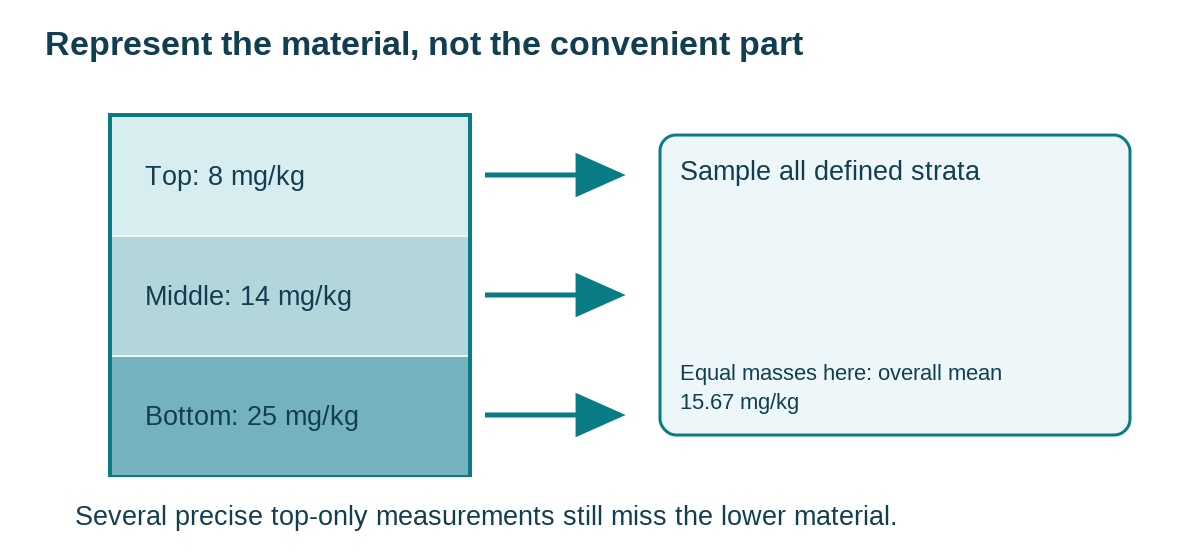
![Equal-mass top, middle and bottom strata have different iron concentrations. Top-only sampling is biased.]()
Where would you take material from this container?
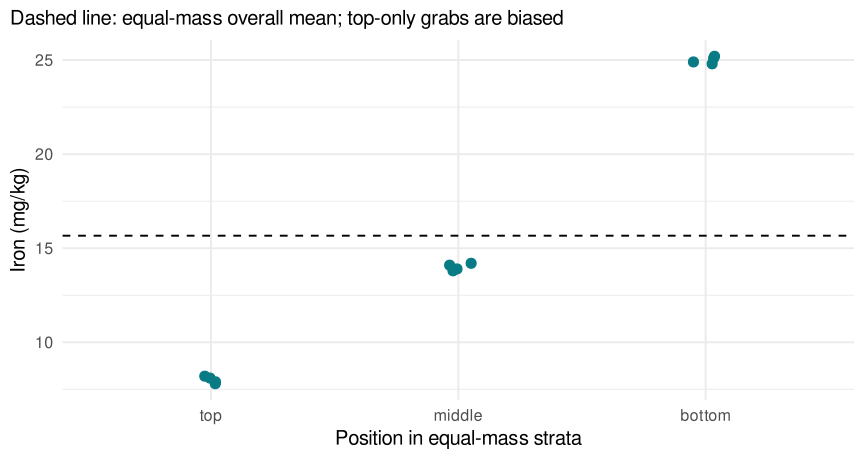
Look within and between positions
![Iron averages 8, 14 and 25 mg/kg in equal-mass top, middle and bottom strata, with small within-stratum scatter.]()
Which variation dominates?
Define the sampling target
![Equal-mass top, middle and bottom strata have different iron concentrations. Top-only sampling is biased.]()
Bulk mean, spatial variation and maximum are different questions.
Weight the material you mean to represent
![Equal-mass top, middle and bottom strata have different iron concentrations. Top-only sampling is biased.]()
Equal masses: (8+14+25)/3=15.67 mg/kg.
More top-only grabs repeat the same mistake
![Iron averages 8, 14 and 25 mg/kg in equal-mass top, middle and bottom strata, with small within-stratum scatter.]()
A small SD can coexist with a large sampling bias.
A composite is one combined material
![Equal-mass top, middle and bottom strata have different iron concentrations. Top-only sampling is biased.]()
Combining increments does not create independent collected samples.
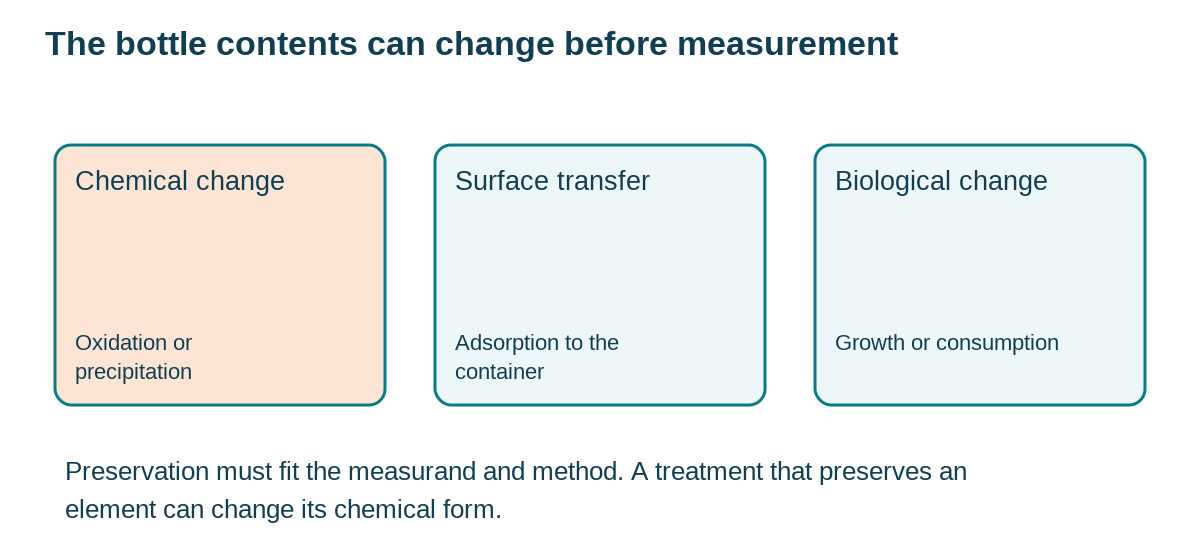
Storage can change what reaches the instrument
![Storage can change composition by reactions, adsorption or biological processes. Preservation is method dependent.]()
Which process could change an oxidation-state result?
Preservation must fit the measurand
![Storage can change composition by reactions, adsorption or biological processes. Preservation is method dependent.]()
An acid treatment can preserve an elemental amount while changing chemical form.
Filtration, extraction and digestion differ
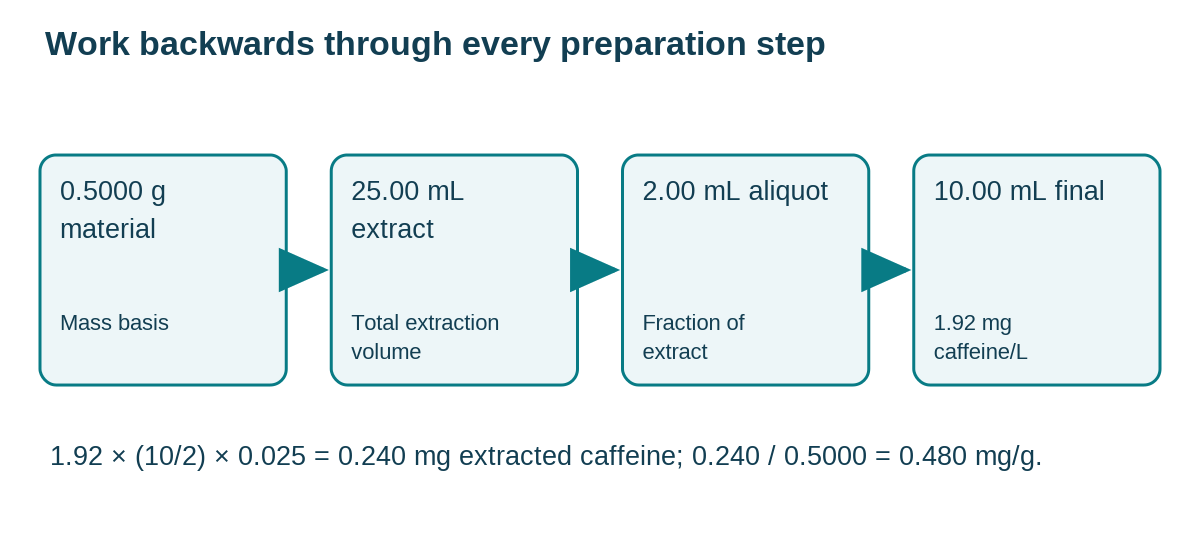
![1.92 × (10/2) × 0.025 = 0.240 mg extracted caffeine; 0.240 / 0.5000 = 0.480 mg/g.]()
A clear solution is not proof of complete analyte recovery.
Keep the whole preparation chain
![1.92 × (10/2) × 0.025 = 0.240 mg extracted caffeine; 0.240 / 0.5000 = 0.480 mg/g.]()
What unit belongs at each stage?
Begin at the measured flask
![1.92 × (10/2) × 0.025 = 0.240 mg extracted caffeine; 0.240 / 0.5000 = 0.480 mg/g.]()
T1a final concentration: 1.92 mg caffeine/L.
Undo the aliquot dilution
![1.92 × (10/2) × 0.025 = 0.240 mg extracted caffeine; 0.240 / 0.5000 = 0.480 mg/g.]()
1.92 × 10.00/2.00 = 9.60 mg/L extract.
Report on the original material basis
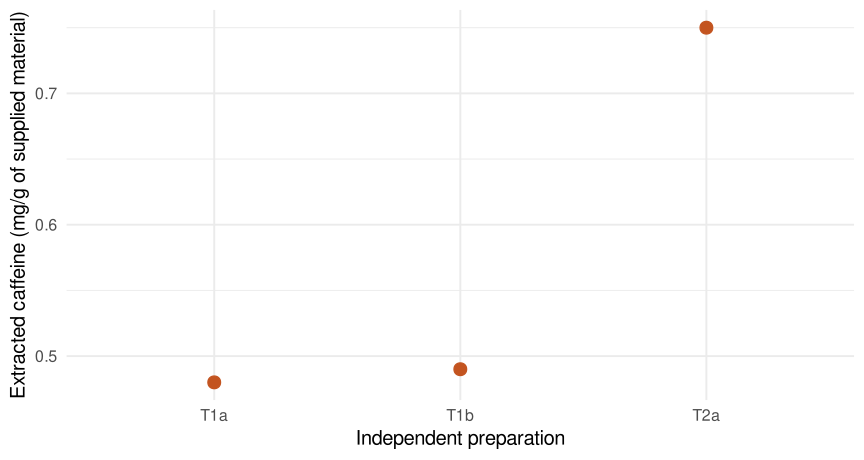
![Extracted caffeine results of 0.480, 0.490 and 0.750 mg/g for three identified preparations.]()
0.240 mg / 0.5000 g = 0.480 mg/g.
Keep preparation identities
![Extracted caffeine results of 0.480, 0.490 and 0.750 mg/g for three identified preparations.]()
T1a and T1b are two preparations of T1.
Write the mass balance in R
mutate(extract_mg_l = final_caffeine_mg_l * final_ml / aliquot_ml,
       extracted_mg = extract_mg_l * extract_ml / 1000,
       caffeine_mg_g = extracted_mg / mass_g)
Partitioning depends on concentrations and volumes
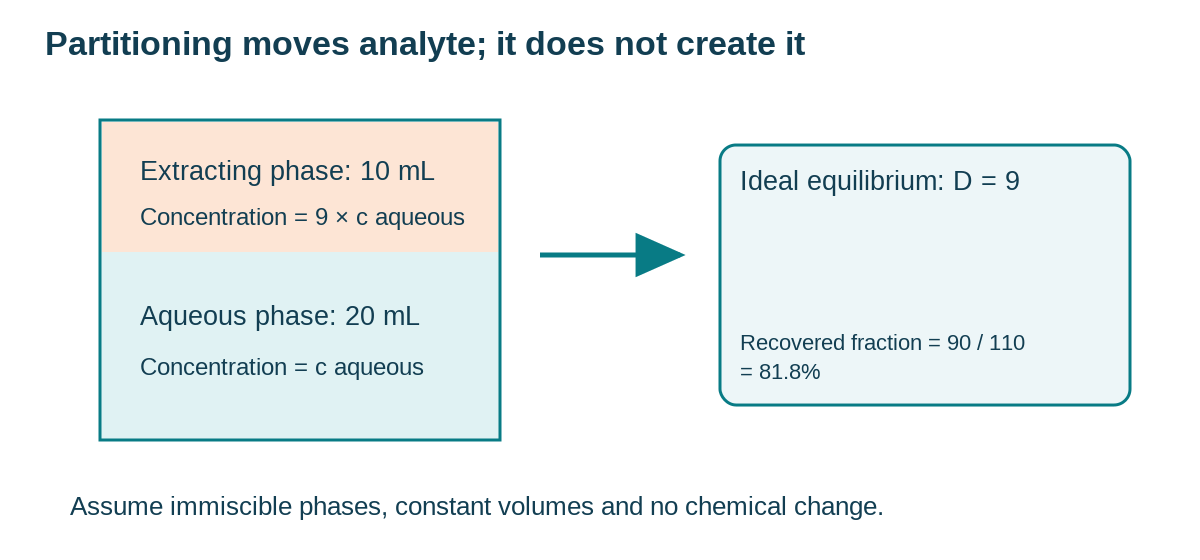
![Two immiscible phases share analyte at distribution ratio nine. The organic ten millilitres holds 81.8 percent of the mass.]()
D=c_o/c_a; analyte amount exists in both phases.
Recover the fraction from a mass balance
![Two immiscible phases share analyte at distribution ratio nine. The organic ten millilitres holds 81.8 percent of the mass.]()
f_o=DV_o/(V_a+DV_o).
Use the same total solvent differently
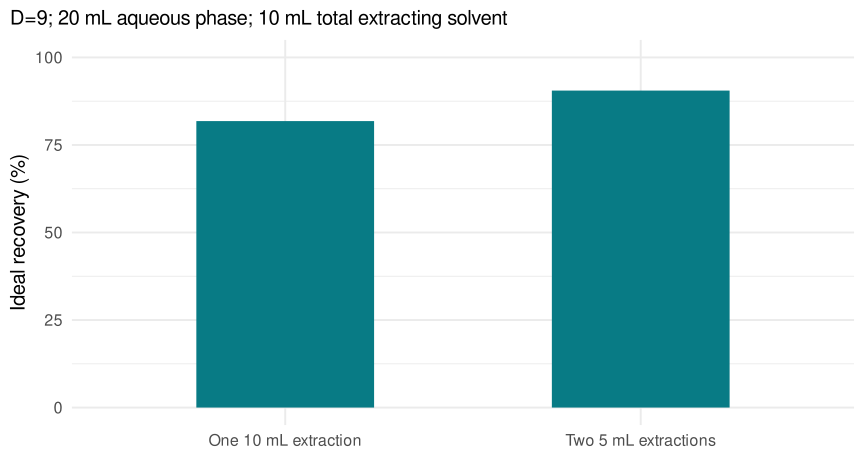
![Ideal recovery rises from 81.8 percent for one 10 mL extraction to 90.5 percent for two 5 mL extractions.]()
One 10 mL extraction: 81.8%. Two 5 mL extractions: 90.5%.
Recognise the idealisation
![Two immiscible phases share analyte at distribution ratio nine. The organic ten millilitres holds 81.8 percent of the mass.]()
What could invalidate the simple partition calculation?
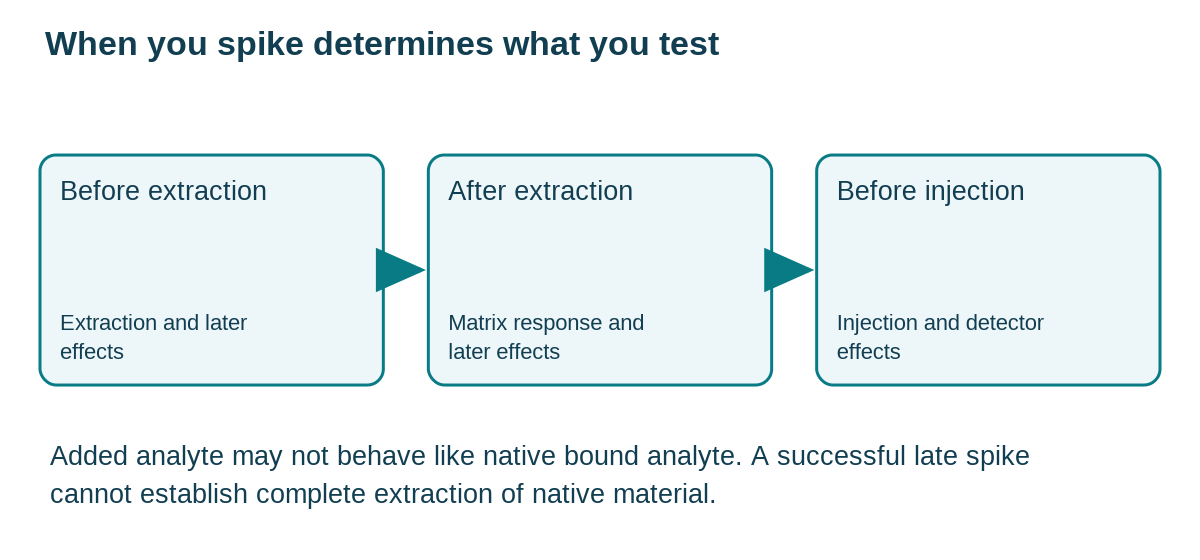
A late spike misses early losses
![Added analyte may not behave like native bound analyte. A successful late spike cannot establish complete extraction of native material.]()
Adding analyte after extraction cannot establish extraction recovery.
Transfer the volume chain
![1.92 × (10/2) × 0.025 = 0.240 mg extracted caffeine; 0.240 / 0.5000 = 0.480 mg/g.]()
0.4000 g → 40.00 mL extract → 1.00 mL to 10.00 mL → 1.50 mg/L.
Choose an improvement that addresses the failure
Would you change sampling, extraction, or repeat readings?
Practise the chemical argument
Open the exercise.
Save the calculation and a chemical interpretation in your reproducible report.
Interactive experiment · Predict, change, explain.