Equilibrium and titration
Use a reaction and a justified endpoint
About this lecture
- Distinguish stoichiometric equivalence from an observed endpoint.
- Calculate acid concentration and EDTA hardness on their stated bases.
- Use pH curves and blank evidence to defend a result.
A known reagent counts an unknown amount
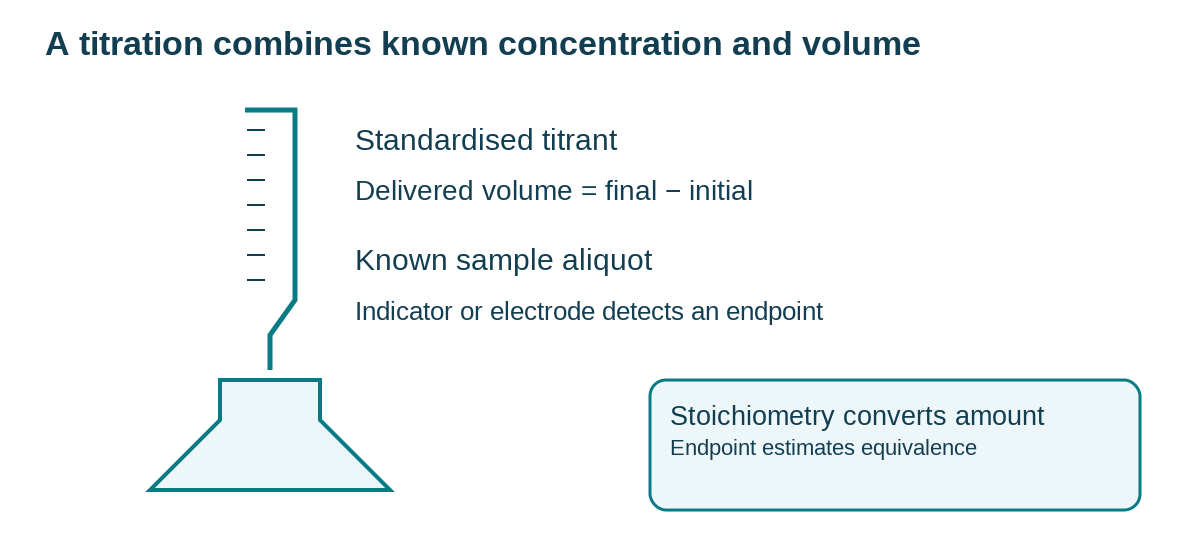
![A burette delivers standardised titrant to a known sample aliquot. Endpoint detection estimates the stoichiometric equivalence point.]()
What makes delivered volume chemically meaningful?
Know the titrant concentration
A nominal concentration is not automatically a standardised concentration.
Read delivered volume
![A burette delivers standardised titrant to a known sample aliquot. Endpoint detection estimates the stoichiometric equivalence point.]()
Delivered volume = final reading − initial reading.
Separate equivalence from endpoint
![A burette delivers standardised titrant to a known sample aliquot. Endpoint detection estimates the stoichiometric equivalence point.]()
Equivalence is stoichiometric. The endpoint is observed or estimated.
Write the reaction first
\mathrm{H^+ + OH^- \rightarrow H_2O}. One mole consumes one mole.
Calculate a worked acid concentration
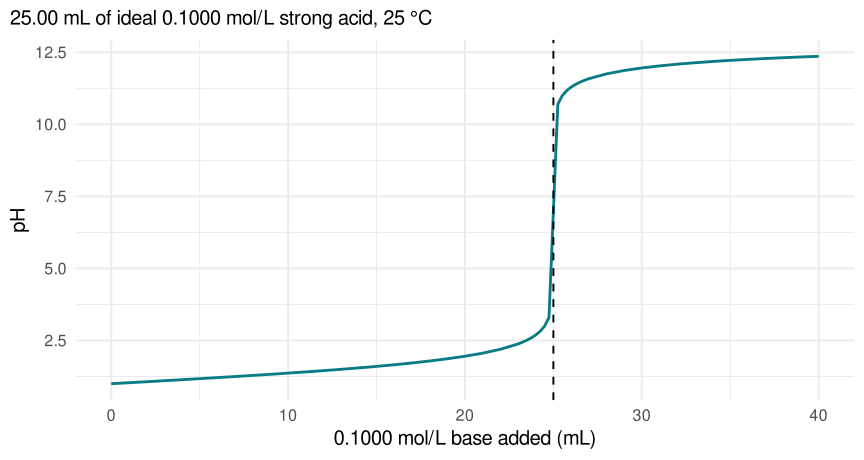
![Ideal strong-acid titration pH rises sharply near 25 mL base added; equivalence pH is seven at 25 degrees Celsius.]()
c_a=c_b V_{eq}/V_a = 0.1000 × 25.00/25.00 = 0.1000 mol/L.
Explain the curve before equivalence
![Ideal strong-acid titration pH rises sharply near 25 mL base added; equivalence pH is seven at 25 degrees Celsius.]()
What species mainly determines pH here?
Explain the curve after equivalence
![Ideal strong-acid titration pH rises sharply near 25 mL base added; equivalence pH is seven at 25 degrees Celsius.]()
What now controls pH?
Neutrality is conditional
![Ideal strong-acid titration pH rises sharply near 25 mL base added; equivalence pH is seven at 25 degrees Celsius.]()
This ideal strong-acid/strong-base equivalence has pH 7 at 25 °C.
Differentiate using the actual volume spacing
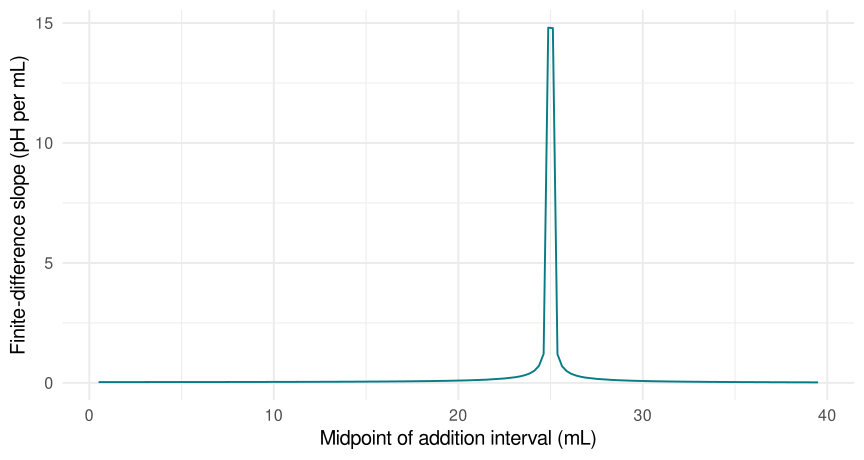
![Finite-difference pH slope peaks close to 25 mL, with the actual addition spacing included.]()
Finite difference: \Delta pH/\Delta V.
A numerical maximum is not complete validation
![Finite-difference pH slope peaks close to 25 mL, with the actual addition spacing included.]()
Noise and step spacing affect the slope peak.
Same amount, different equilibrium
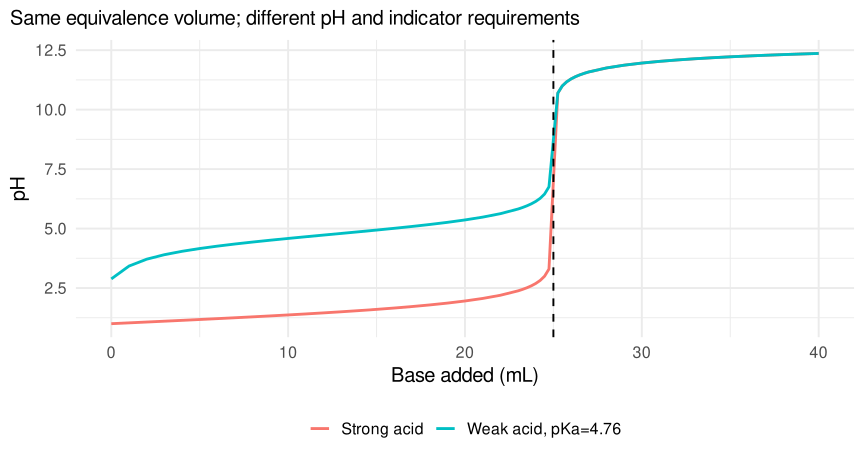
![Strong and weak acids have the same equivalence volume here but different pH curves and indicator requirements.]()
Which acid requires more base at equivalence?
Choose an indicator for the actual curve
![Strong and weak acids have the same equivalence volume here but different pH curves and indicator requirements.]()
A transition interval must lie in an appropriate steep region.
The buffer region has a chemical cause
![Strong and weak acids have the same equivalence volume here but different pH curves and indicator requirements.]()
Weak acid and its conjugate base coexist before equivalence.
EDTA gives another stoichiometric count
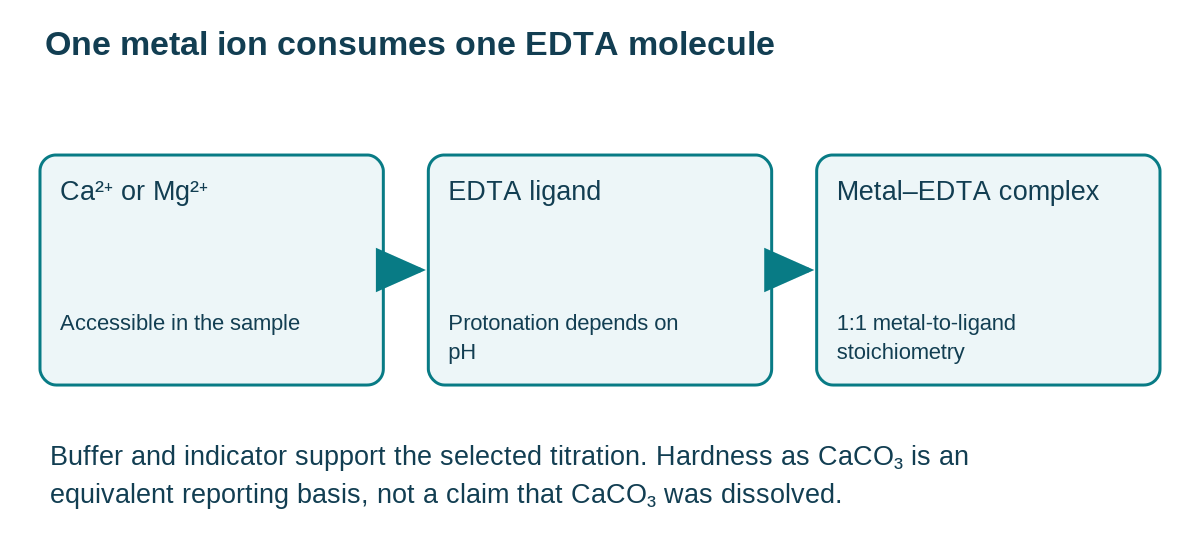
![Buffer and indicator support the selected titration. Hardness as CaCO₃ is an equivalent reporting basis, not a claim that CaCO₃ was dissolved.]()
One accessible metal ion consumes one EDTA ligand.
pH changes effective binding
![Buffer and indicator support the selected titration. Hardness as CaCO₃ is an equivalent reporting basis, not a claim that CaCO₃ was dissolved.]()
Ligand protonation and metal side reactions affect the conditional equilibrium.
Name the reporting basis
![Buffer and indicator support the selected titration. Hardness as CaCO₃ is an equivalent reporting basis, not a claim that CaCO₃ was dissolved.]()
Hardness as CaCO₃ uses an equivalent molar mass.
Correct the measured consumption
![A burette delivers standardised titrant to a known sample aliquot. Endpoint detection estimates the stoichiometric equivalence point.]()
H1a: 6.30 − 0.10 − 0.05 = 6.15 mL.
Convert to the sample basis
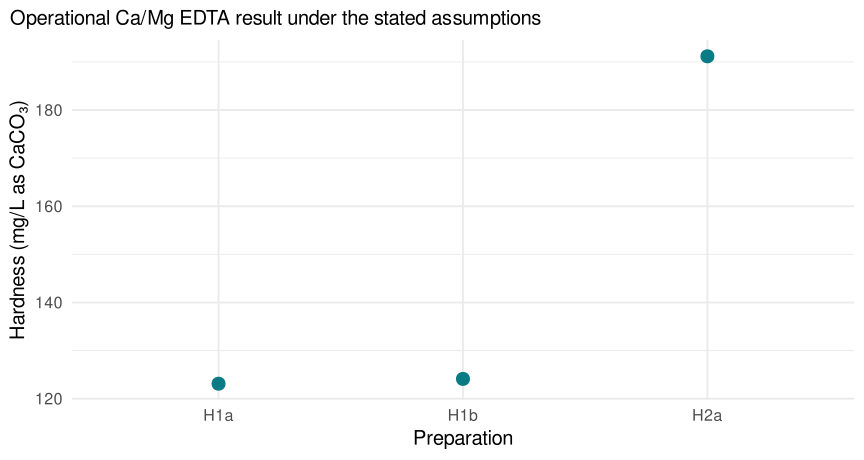
![Three preparations give about 123, 124 and 191 mg/L hardness as calcium carbonate.]()
6.15 × 10⁻⁵ mol × 100.09 g/mol / 0.05000 L = 123.11 mg/L as CaCO₃.
Keep repeated preparations distinct
![Three preparations give about 123, 124 and 191 mg/L hardness as calcium carbonate.]()
H1a and H1b are separate preparations of H1.
What can bias a titration result?
![A burette delivers standardised titrant to a known sample aliquot. Endpoint detection estimates the stoichiometric equivalence point.]()
Endpoint overrun, wrong titrant concentration, blank consumption, interference.
Transfer the reaction and basis
![Buffer and indicator support the selected titration. Hardness as CaCO₃ is an equivalent reporting basis, not a claim that CaCO₃ was dissolved.]()
25.00 mL water; 4.10 mL delivered EDTA; 0.10 mL blank; 0.01000 mol/L.
Take the reasoning into R
By hand, embedded experiment and R tasks · Practice quiz.
Save the calculation and a chemical interpretation in your reproducible report.
Interactive experiment · Predict, change, explain.