P3 — Light, carbon and the whole-plant budget
Week 8 — How light becomes sugar for the whole plant
Animal and Plant Physiology
About this lecture
At noon a sunlit leaf takes up CO₂ and exports sugar. At midnight the same leaf gives off CO₂. Its roots never see light, yet they grow, take up ions and feed fungal partners day and night. How does a leaf turn light into sugar, and how does that sugar pay for the whole plant? In P2 we opened the stomata and paid ~500 water molecules for every CO₂ molecule fixed. Today we follow that CO₂ into the chloroplast and out to the roots.
Light reactions: light, water and electron transport make ATP, NADPH and O₂.Calvin–Benson cycle: ATP and NADPH fix CO₂ into sugar, and what it costs.Rubisco’s flaw: photorespiration, and the C4 and CAM solutions.Measuring photosynthesis: light-response curves and units.Transport: sources, sinks and pressure flow in the phloem.Using the sugar: respiration, fermentation and nitrogen assimilation.
The running example is one CO₂ molecule entering a leaf through an open stoma (P2) and ending up in a root, either respired or built into an amino acid. The lecture follows it in order: energy capture, fixation, the problems of fixation in hot dry conditions, measurement, transport, and use. The opening observation (a leaf releasing CO₂ at night) is explained by the light-response curve.
One equation, two stages
6\,\text{CO}_2 + 12\,\text{H}_2\text{O} \xrightarrow{\text{light}} \text{C}_6\text{H}_{12}\text{O}_6 + 6\,\text{O}_2 + 6\,\text{H}_2\text{O}
Where
thylakoid membranes stroma
Inputs
light, H₂O, ADP + Pᵢ, NADP⁺
CO₂, ATP, NADPH
Outputs
O₂, ATP, NADPH
triose phosphate, ADP + Pᵢ, NADP⁺
Linked by ATP and NADPH : one stage makes them, the other spends them.
Start with the light reactions: where does the O₂ come from?
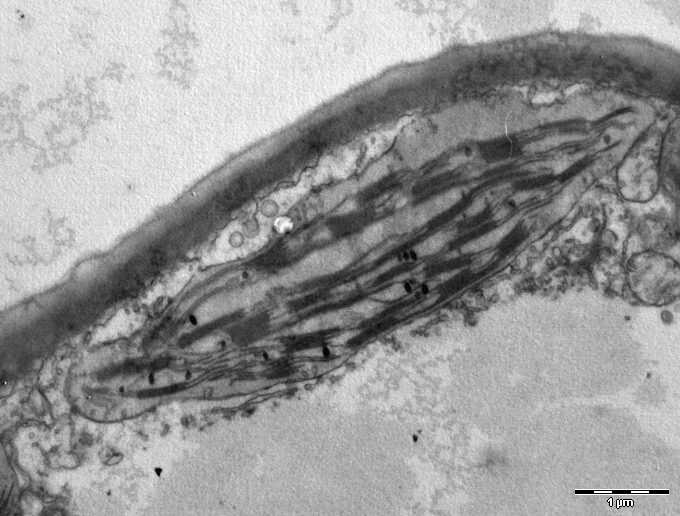
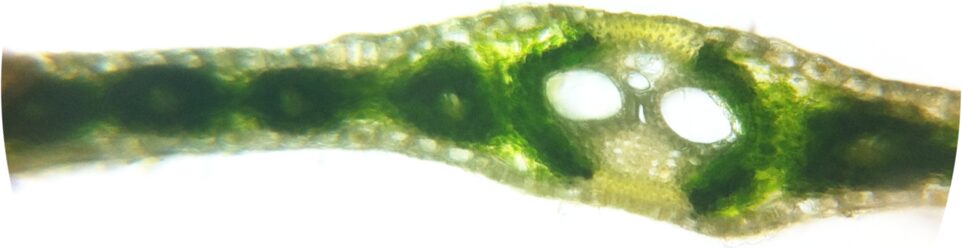
Exercise 1.1 is this table. The overall equation hides two separate machines, one in the membrane and one in the soluble stroma, joined by an energy currency. Point to the micrograph: the dark stacked lines are the thylakoid membranes (grana), where the light reactions run; the paler background is the stroma, where the Calvin–Benson cycle runs. The jobs: the light reactions convert light energy to chemical energy, the cycle uses that energy to reduce CO₂. The extra water on both sides of the equation is deliberate: it shows that all 12 O atoms of the released O₂ come from water, which is the next slide.
Capturing light and splitting water
Chlorophyll absorbs blue (~430 nm) and red (~660 nm) and reflects green.An antenna of hundreds of pigments funnels energy to a reaction centre : P680 (photosystem II), P700 (photosystem I).
At photosystem II , water is split:
2\,\text{H}_2\text{O} \rightarrow \text{O}_2 + 4\,\text{H}^+ + 4\,e^-
The O₂ comes from water , not CO₂ (¹⁸O-labelled water, Ruben and Kamen, 1941).
Where do the electrons from water go?
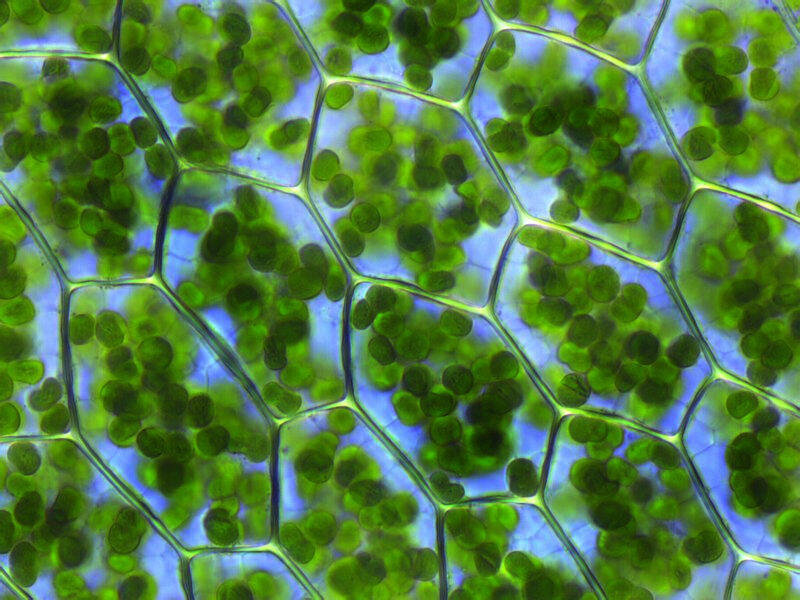
Exercise 1.2. The photo shows living leaf cells of a moss, one cell layer thick, so the chloroplasts are visible without sectioning: each green disc is one chloroplast, and each holds the thylakoid membranes of the previous slide. The classic error is that O₂ comes from CO₂. The isotope experiment settles it: label the water and the O₂ is labelled; label the CO₂ and it is not. CO₂ supplies the carbon of the sugar. The electrons replace those lost by P680, and the H⁺ is released into the thylakoid lumen. Full sunlight is about 2000 µmol photons m⁻² s⁻¹, the x-axis unit of the light-response curve later in the lecture.
Linear electron flow
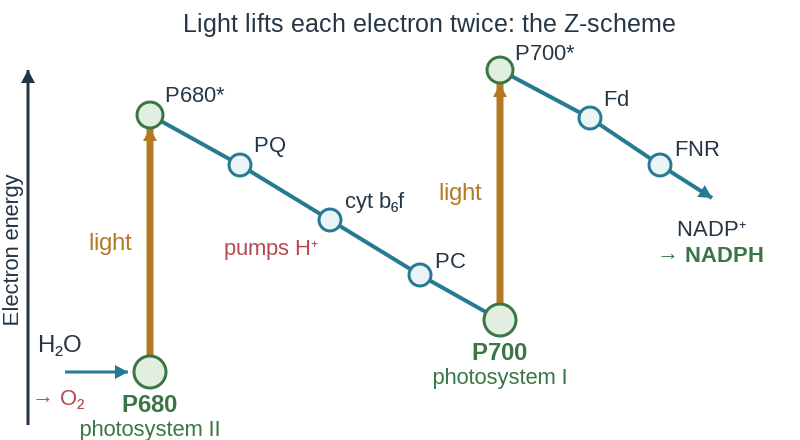
Light lifts electrons twice : at photosystem II and at photosystem I (the “Z-scheme”).
Between them, electrons flow downhill: plastoquinone (PQ) → cytochrome b ₆f → plastocyanin (PC).
b ₆f pumps H⁺ into the lumen .Ferredoxin (Fd) and FNR reduce NADP⁺ to NADPH .
Result: O₂, NADPH and a proton gradient. How does the gradient make ATP?
Exercise 1.3 asks for this order: H₂O → PSII → PQ → cyt b₆f → PC → PSI → Fd → NADP⁺. Students do not need redox potentials, but should know the sequence and that two photosystems act in series; the vertical axis of the figure is electron energy, not a measured scale. Point out the two sources of lumen protons: water splitting at PSII and the cytochrome b₆f complex. The chain is structurally similar to the mitochondrial electron transport chain students know from A2.
ATP synthase and cyclic electron flow
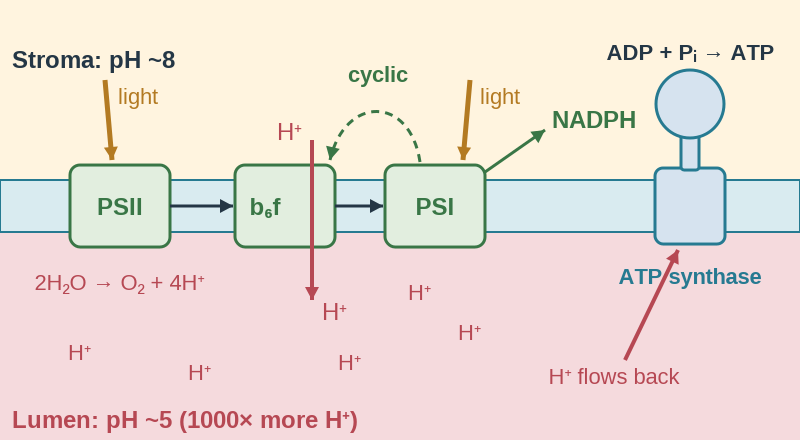
Lumen pH ~5, stroma pH ~8: a 1000-fold H⁺ gradient.
ATP synthase : H⁺ flows lumen → stroma; ATP is made in the stroma .Linear flow gives ~1.3 ATP per NADPH; the cycle needs 1.5 .
PSII, O₂
yes
no
NADPH
yes
no
ATP
yes
yes
The stroma now holds ATP and NADPH. What does the Calvin–Benson cycle do with them?
Exercises 1.4 and 1.5. The mechanism is the same chemiosmotic principle as in mitochondria (A2), with the membrane orientation reversed: protons are pumped into the lumen and flow out into the stroma. Cyclic flow (PSI → ferredoxin → back to the cytochrome b₆f complex, dashed arrow) pumps protons without passing electrons to NADP⁺, so it adds ATP without making NADPH or O₂. That fixes the ATP:NADPH mismatch; the 1.5 ratio is derived on the next-but-one slide.
The Calvin–Benson cycle: three phases
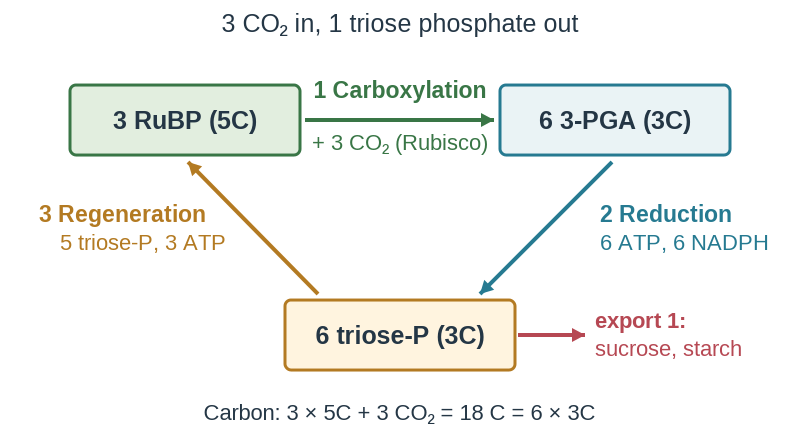
Carboxylation: Rubisco adds CO₂ to ribulose 1,5-bisphosphate (RuBP), giving two 3-phosphoglycerate (3-PGA).Reduction: ATP and NADPH reduce 3-PGA to triose phosphate .Regeneration: five of every six triose phosphates rebuild three RuBP.
Count the cost: how much ATP and NADPH does one sugar take?
Exercise 2.1 asks for the phases in order and the enzyme. Walk around the figure with three CO₂ so the carbon balances: 3 × 5 C + 3 C = 18 C in six triose phosphates; 15 C regenerate RuBP and 3 C leave as one net triose phosphate. Rubisco is the enzyme from P1 encoded by two genomes, and the most abundant protein on Earth.
The cost of one sugar, and why it needs light
3
9
6
1 triose phosphate
6
18 12 1 hexose
ATP : NADPH = 9 : 6 = 3 : 2 (1.5).
Per CO₂: 3 ATP and 2 NADPH.
Not a “dark reaction”
The cycle needs ATP and NADPH from the light reactions.
Several of its enzymes (including Rubisco, via Rubisco activase) are switched on by light and off in darkness.
In the dark, the cycle stops within minutes .
Rubisco has a second problem: it does not only react with CO₂.
Exercise 2.2 (18 ATP and 12 NADPH, ratio 3:2) and 2.3a. The name “dark reactions” means only that the cycle does not absorb photons itself; it runs in the light and stops in darkness because its substrates run out and its enzymes are deactivated. This explains the opening observation in part: at night the leaf fixes no CO₂ and only respiration remains.
Rubisco’s flaw: photorespiration
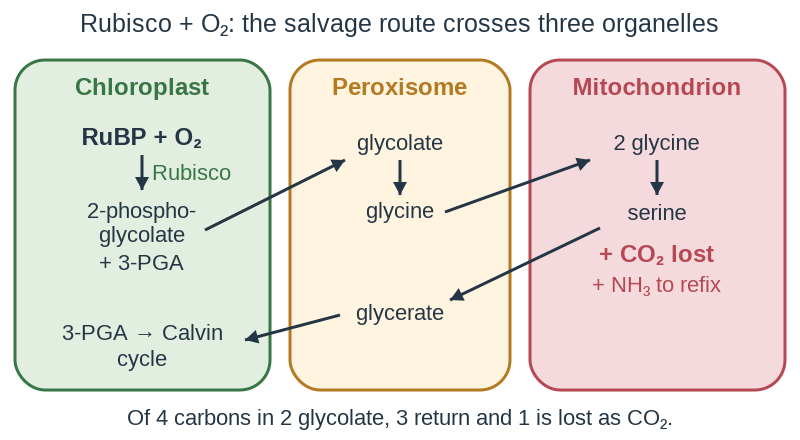
Rubisco is slow (~3 reactions s⁻¹) and can use O₂ instead of CO₂ , giving 2-phosphoglycolate , which the cycle cannot use.
Salvage runs through chloroplast → peroxisome → mitochondrion , and releases CO₂ already fixed.
25 °C, air: ~1 oxygenation per 3 carboxylations ; ~25 % less C3 photosynthesis.
Photorespiration ≠ respiration.
When does Rubisco make this mistake more often?
Exercises 2.3b–d and 2.4. Rubisco evolved when the atmosphere had almost no O₂, so discrimination against O₂ was not needed. Photorespiration is a salvage pathway: it recovers three of every four carbons in 2-phosphoglycolate but loses one as CO₂, releases NH₃ that must be refixed, and costs ATP and NADPH. Leaves contain so much Rubisco (up to half of their soluble protein) because it is slow. Stress the distinction from mitochondrial respiration, which is a common exam error: photorespiration starts with Rubisco and recycles 2-phosphoglycolate; respiration oxidises sugar to make ATP.
What increases photorespiration?
Higher leaf temperature
increases CO₂ solubility falls more than O₂ solubility; Rubisco’s CO₂ specificity falls
Stomatal closure in drought
increases CO₂ inside the leaf falls while O₂ stays at 21 %
Higher atmospheric CO₂
decreases more CO₂ competes with O₂ at the active site
The problem is worst in hot, dry, bright conditions: exactly when P2’s stomata close to save water.
Some plants have evolved a fix: raise the CO₂ concentration at Rubisco.
Exercise 2.5. Connect directly to P2: ABA closes stomata in drought, the CO₂ inside the leaf is used up, and Rubisco increasingly fixes O₂. So the water-saving response worsens the carbon problem. Greenhouse growers raise CO₂ to about 1000 ppm partly for this reason. Transition to the CO₂-concentrating mechanisms.
C4: separating fixation in space
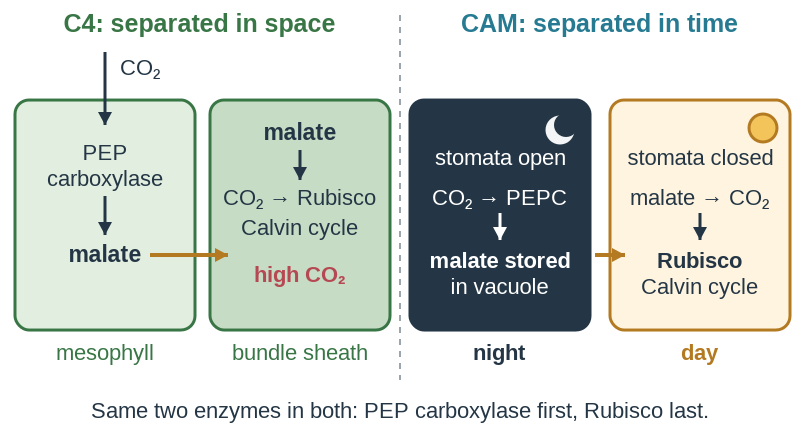
Mesophyll: PEP carboxylase fixes HCO₃⁻ into oxaloacetate (4C), then malate. It ignores O₂.Malate moves to the bundle sheath and releases CO₂ next to Rubisco at ~10× the air concentration.
Regenerating PEP costs 2 ATP per CO₂ : 5 instead of 3.
Kranz anatomy ; maize, sugarcane, sorghum.
Desert succulents use the same enzymes but separate the steps in time.
Exercises 3.4 (advantage and cost) and part of 3.1. Kranz is German for wreath: in the section, find a vein and the ring of large bundle-sheath cells around it, with mesophyll cells outside. C4 is a pump that concentrates CO₂ at Rubisco, paid for in ATP. Advantage: almost no photorespiration, so higher photosynthesis and water-use efficiency in warm, bright conditions. Cost: 5 ATP per CO₂ instead of 3, so C4 is no better in cool or shaded conditions. C4 plants are only about 3 % of species but carry out about a quarter of land photosynthesis, mostly tropical grasses. The Calvin–Benson cycle and Rubisco are still there; C4 only changes how CO₂ is delivered.
CAM: separating fixation in time
Night, stomata open: PEP carboxylase fixes CO₂ → malate , stored as malic acid in the vacuole . Acidity rises .
Day, stomata closed: malate is decarboxylated and Rubisco fixes the CO₂ using light energy. Acidity falls .
Cool night air: very little water lost per CO₂.
Slow growth: the vacuole limits storage.
Fingerprint: acid at dawn, not at dusk .
Side by side: C4 separates the two steps in space, CAM in time.
Exercise 3.3: the acidity rhythm is the CAM fingerprint; Kranz anatomy is the C4 fingerprint. CAM solves the water problem from P2 by opening stomata only when evaporation is low. The cost is capacity: the night’s CO₂ store sets the day’s photosynthesis. Pineapple is the main CAM crop; others are prickly pear (Opuntia), Agave and many orchids. Again, Rubisco is still present and does the final fixation.
C4 and CAM: space versus time
Both use PEP carboxylase first, to make malate, and Rubisco last.
C4: two cell types, both steps by day.CAM: one cell, steps at night and by day.Both raise CO₂ at Rubisco, so photorespiration stays low .
This figure is the one-sentence summary of the last two slides: the same two enzymes, separated either between cells (C4) or between night and day (CAM). Ask students where the stomata are open in each case and why that matters for water loss; the next slide puts numbers on it.
C3, C4 and CAM compared
Enzyme of initial CO₂ fixation
Rubisco
PEP carboxylase
PEP carboxylase
First stable product
3-PGA (3C)
oxaloacetate (4C)
oxaloacetate (4C), stored as malate
Separation of initial fixation and Calvin cycle
none
space : mesophyll / bundle sheathtime : night / day
Stomata open mainly
day
day
night
Photorespiration
high in warm conditions
low
low
Water lost per CO₂ fixed (molecules)
~500
~250
~50
Examples
wheat, rice, most trees
maize, sugarcane
pineapple, Opuntia
In all three, CO₂ is finally fixed by Rubisco in the Calvin–Benson cycle.
How do we measure how fast a leaf is fixing carbon?
Exercises 3.1 and 3.2. The water row links the three pathways back to P2’s transpiration ratio. Students should classify the six crops in 3.2 from this table. Transition from mechanism to measurement: a gas-exchange instrument measures the net CO₂ flux of a leaf.
The light-response curve
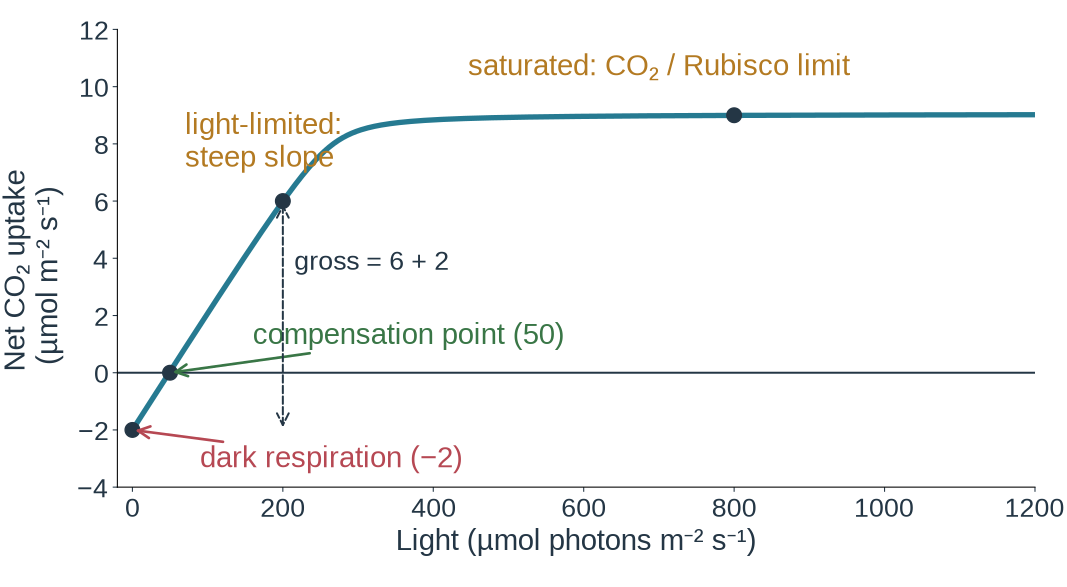
Dark respiration: 2 µmol m⁻² s⁻¹.Compensation point: 50 µmol photons m⁻² s⁻¹.Gross at 200 = 6 + 2 = 8 .
Net = gross − respiration. Below compensation the leaf loses carbon: midnight.
Exercise 4.1. Units: light in µmol photons m⁻² s⁻¹, net CO₂ in µmol m⁻² s⁻¹ (positive = net uptake). Slopes: 50 → 200 is 6/150 = 0.04 CO₂ per photon; 200 → 800 is 3/600 = 0.005, so the curve saturates. The curve answers the opening observation: in darkness only respiration remains, so net exchange is negative. At low light, rate is limited by light; at high light, by CO₂ supply and Rubisco capacity, so extra photons add little. Shade leaves have lower compensation points and lower respiration than sun leaves. Assume respiration is unchanged in light to get gross photosynthesis. The plotted curve is a smooth fit through the four table points.
Try it: a leaf under changing light, CO₂ and heat
Live version of the light-response curve, for a sun leaf (a standard leaf photosynthesis model, so the numbers are larger than the shade-leaf table on the previous slide). Drag the round handle along the curve or use the Light slider; the readout gives net and gross photosynthesis, dark respiration, the CO₂ released by photorespiration and what limits the rate. Suggested sequence, about 5 minutes. (1) Tick “Zoom in on low light”: find the compensation point and the respiration line, then untick. (2) Press “Keep this curve”, then “Hot, dry”: the curve drops, photorespiration rises (more O₂ per CO₂) and respiration doubles; this is P2’s closed stomata meeting Rubisco’s flaw. (3) Press “1000 ppm” (greenhouse): photorespiration falls and the plateau rises. (4) Switch to “C4 leaf (maize)” and repeat “Hot, dry”: C4 keeps most of its rate because PEP carboxylase concentrates CO₂. (5) Press “Cool, 12 °C” for both C3 and C4: now C3 wins, because C4 pays 2 extra ATP per CO₂ and its enzymes are cold-sensitive. Ask the room to predict each change before you press. Reset restores the start. The figure on the previous slide is the static fallback for PDF.
From a rate to an amount
A leaf of 0.02 m² takes up CO₂ at 6 µmol m⁻² s⁻¹ for 10 min :
6\ \frac{\mu\text{mol}}{\text{m}^2\,\text{s}} \times 0.02\ \text{m}^2 \times 600\ \text{s} = 72\ \mu\text{mol CO}_2
72\times10^{-6}\ \text{mol} \times 44\ \text{g mol}^{-1} = 3.2\times10^{-3}\ \text{g} = 3.2\ \text{mg CO}_2
Multiply by area and by time in seconds ; the m⁻² and s⁻¹ cancel.
Carry the units through every step; most errors are in minutes → seconds.
That carbon is made in the leaf. How does it reach a root or a fruit?
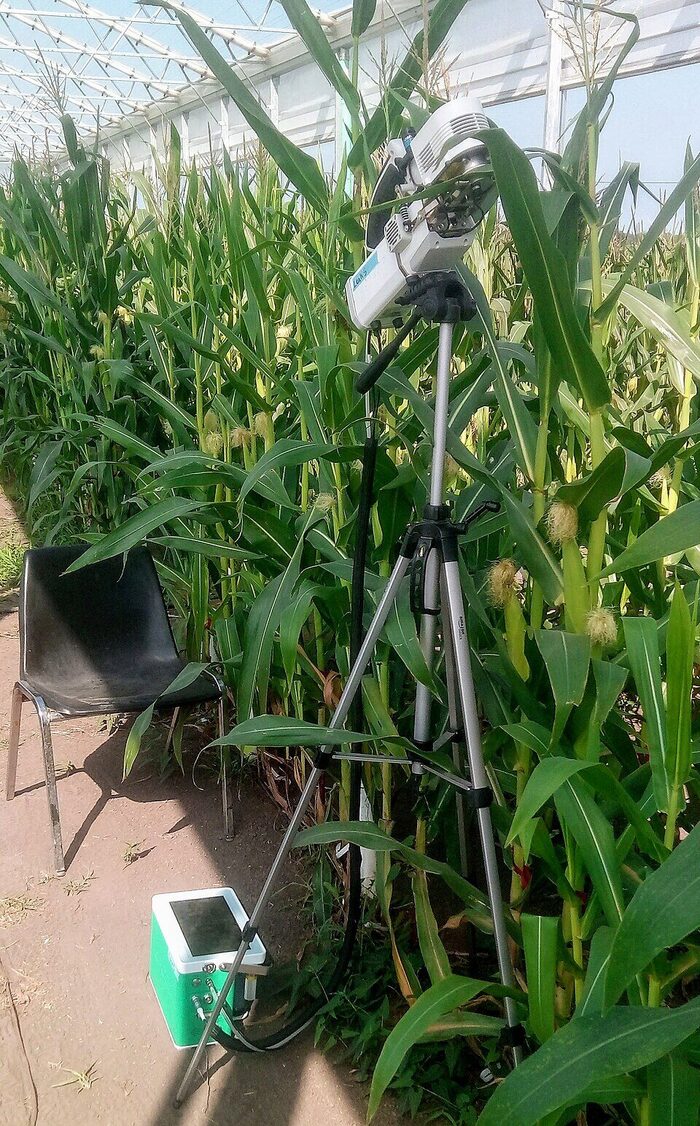
The photo shows where such numbers come from: a portable gas-exchange system (LI-6800) clamped onto a maize leaf in a field trial. The chamber encloses a known leaf area, sets light and CO₂, and measures the CO₂ and water-vapour difference between incoming and outgoing air, so it reports net photosynthesis directly in µmol CO₂ m⁻² s⁻¹; the light-response curve on the previous slides is made with such an instrument. Exercise 4.2. This is the same unit logic as the transpiration calculation in P2. Show the cancellation of units explicitly. Transition to transport: carbon fixed in a leaf is exported as sucrose through the phloem from P1.
Sources and sinks
Source: exports sugar. Sink: imports it.The phloem carries mainly sucrose .
Roles change with development.
Mature, illuminated leaf
source
Developing fruit, root tip
sink
Young, expanding leaf
sink
Tuber sprouting in spring
source
What pushes sap from a source to a sink?
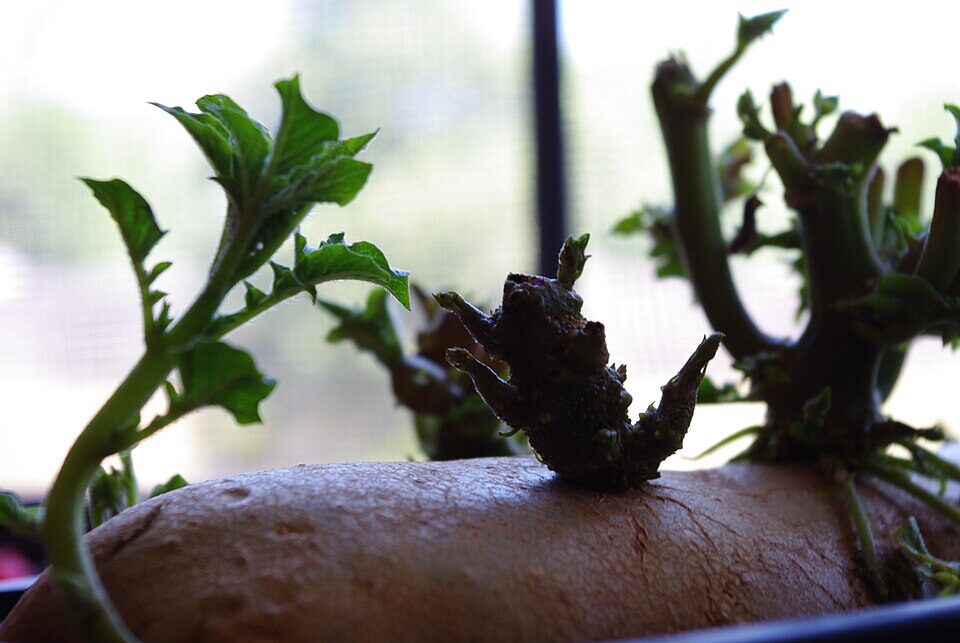
Exercises 5.1 and 5.3. The sprouting tuber in the photo is the important case: a storage organ that was a sink last summer becomes a source when its starch is mobilised for the new shoots. Source and sink describe current carbon flow, not organ type. A young leaf is a sink until it is roughly half expanded, then becomes a source. Chloroplasts store starch during the day and break it down at night to keep sucrose export going.
Pressure flow in the phloem
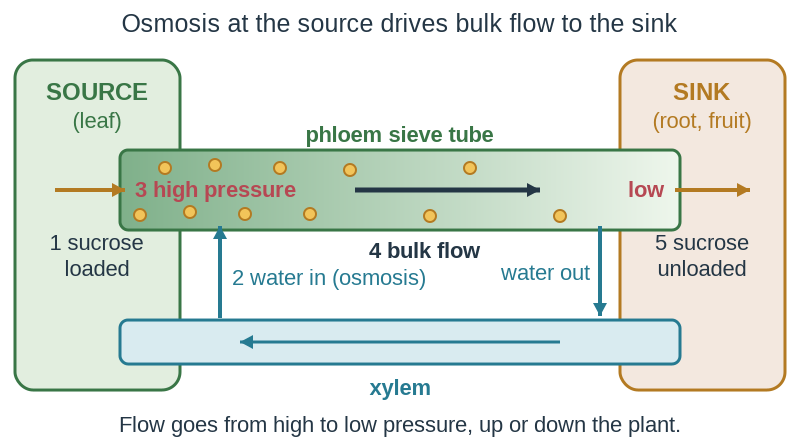
Sucrose is loaded into sieve tubes (often H⁺-coupled).
Ψs falls; water enters from the xylem.
Pressure rises at the source (~1 MPa).Sap moves by bulk flow , ~1 m h⁻¹.
Sucrose is unloaded at the sink; water leaves.
Water potential (P2) running a second transport system.
Exercise 5.2 asks for this order. This is the Münch pressure-flow model. It reuses every idea from P2: Ψs = −cRT drives water entry, Ψp builds up, and flow goes from high to low pressure. Loading uses the proton gradient from P2. Direction is set by where sources and sinks are, so phloem can move sap up or down, unlike xylem. Next: how do we know the sap is under pressure?
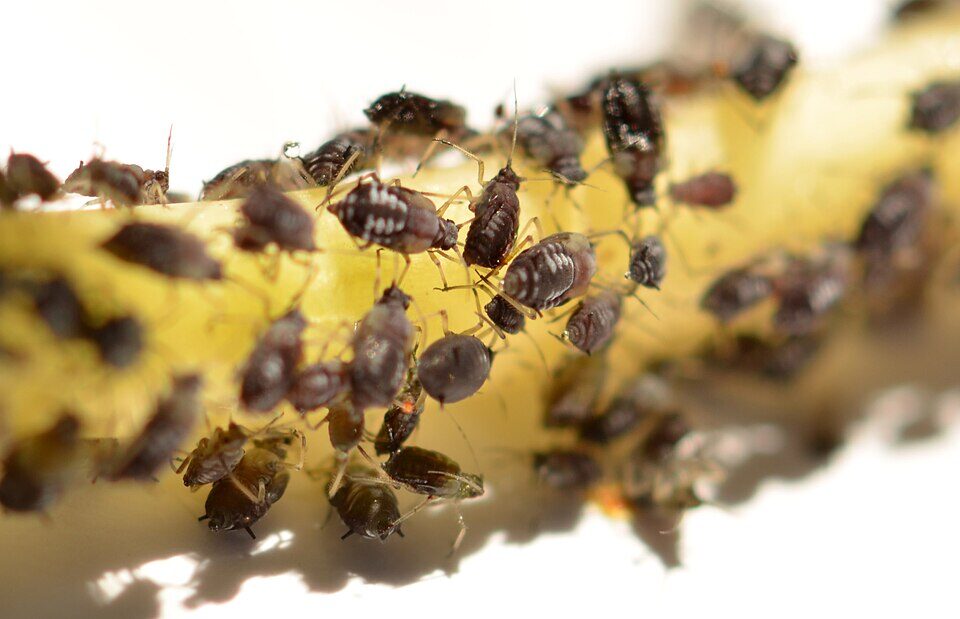
Evidence: aphids tap the sieve tubes
An aphid’s mouthparts (stylet ) enter one sieve element .
Cut the stylet: sap keeps flowing out for hours , pushed by the pressure inside.
The sap is mostly sucrose , often 0.3–1 M.
Aphids excrete surplus sugar as honeydew drops.
Then what does the sink do with the sugar?
The aphid stylet technique is the classic evidence for the pressure-flow model: the aphid does not pump, the sap is forced into its gut by the sieve-tube pressure, and a severed stylet bleeds pure phloem sap that can be collected and analysed. The sap is a concentrated sucrose solution with amino acids and ions, so aphids take in far more sugar than they need and excrete the rest as honeydew, which ants collect. The photo shows a colony on a nasturtium stem: every aphid has its stylet in a sieve element. Transition: the sink uses the sugar, either in respiration or as carbon skeletons.
Using the sugar: respiration
Glycolysis
cytosol (and plastids)
pyruvate, ATP, NADH
TCA (citric acid) cycle
mitochondrial matrix
CO₂, NADH, FADH₂, ATP
Electron transport and oxidative phosphorylation
inner mitochondrial membrane
ATP, H₂O (O₂ is the final acceptor)
Aerobic: ~30 ATP per glucose .
Flooded roots: fermentation
No O₂ → electron transport stops → NADH accumulates.
Fermentation regenerates NAD⁺ so glycolysis can continue.
Products in roots: ethanol and CO₂ (some lactate).
Only 2 ATP per glucose : ~15× less.
Every living cell respires, in light and in darkness: roots for ion uptake (P2), growth and maintenance.
Respiration also supplies the carbon skeletons that turn nitrate into amino acids.
Exercises 6.1 and 6.2. This links to P2’s waterlogging chain: without O₂, the root’s ATP supply drops about fifteen-fold, so the H⁺-ATPase and ion uptake fail. Ethanol accumulation is also toxic. Respiration is not just the reverse of photosynthesis: it provides ATP and the intermediates used to build amino acids and other compounds.
Nitrogen assimilation: carbon meets nitrogen
1
nitrate → nitrite
nitrate reductase (NADH)cytosol
2
nitrite → ammonium
nitrite reductase (ferredoxin)plastid
3
ammonium + glutamate → glutamine
glutamine synthetase (GS, ATP)plastid / cytosol
4
glutamine + 2-oxoglutarate → 2 glutamate
glutamate synthase (GOGAT)plastid
Reducing nitrate to ammonium takes 8 electrons : from photosynthesis (ferredoxin) or respiration (NADH).
2-oxoglutarate is a TCA-cycle intermediate: the carbon skeleton of every amino acid nitrogen enters.So nitrogen uptake (P2) depends on carbon metabolism, and photosynthesis depends on nitrogen in Rubisco and chlorophyll.
Back to the leaf and the root we started with.
Exercise 6.3 asks for the order and the enzymes. The GS/GOGAT cycle is how almost all inorganic nitrogen enters organic molecules in plants, including ammonium from photorespiration and from rhizobia (P2). Emphasise the two-way dependence: carbon pays for nitrogen assimilation, and nitrogen builds the photosynthetic machinery.
The whole-plant carbon budget
Light reactions
thylakoids of leaf cells
none fixed; make ATP, NADPH, O₂
Calvin–Benson cycle
stroma, in the light
CO₂ → triose phosphate → sucrose, starch
Photorespiration
chloroplast, peroxisome, mitochondrion
loses fixed carbon as CO₂
Phloem transport
sieve tubes, source → sink
moves sucrose
Respiration
every living cell, day and night
releases CO₂, makes ATP
N assimilation, symbionts
roots and leaves
consumes carbon skeletons and ATP
Growth = carbon fixed − carbon respired, photorespired and given to partners.
At midnight the leaf only respires; the root is supplied by the phloem from sucrose and starch made in the light.
Close the loop on the opening questions: the leaf releases CO₂ at night because only respiration runs; the root grows on sucrose delivered by pressure flow from starch reserves and current photosynthesis. Every row is a slide from today. P4 asks how the plant decides where to put this carbon: which organs grow, when it flowers, and how signals coordinate it.
Summary
Light reactions
thylakoids; H₂O → O₂ at PSII; make ATP and NADPH
Linear electron flow
H₂O → PSII → PQ → cyt b ₆f → PC → PSI → Fd → NADP⁺
ATP synthase
H⁺ flow lumen → stroma; cyclic flow adds ATP only
Calvin–Benson cycle
stroma; carboxylation, reduction, regeneration; 3 CO₂ + 9 ATP + 6 NADPH → 1 triose-P
Photorespiration
Rubisco + O₂; chloroplast, peroxisome, mitochondrion; worse when hot and dry
C4 / CAM
PEP carboxylase concentrates CO₂; separated in space / in time
Light-response curve
net = gross − respiration; compensation where net = 0; saturates
Sources and sinks
source exports, sink imports; roles change with development
Pressure flow
loading → water in → high pressure → bulk flow → unloading
Respiration
~30 ATP per glucose aerobically, 2 by fermentation
N assimilation
nitrate → nitrite → NH₄⁺ → GS/GOGAT; needs carbon skeletons
Next (P4 — Signals, growth and reproduction): the plant now has water, minerals and carbon. How does it sense light, gravity and season, and use hormones to decide where to grow, when to germinate and when to flower?
Tutorial · Exercises · Quiz
Read the table as the path of one CO₂ molecule: captured by the light reactions’ products in the Calvin–Benson cycle, sometimes lost to photorespiration, concentrated by C4 and CAM, measured as a net rate, exported through the phloem, and used in respiration and nitrogen assimilation. P4 moves from supply to control: the signals that direct growth and development.