Dominance, multiple alleles, lethal alleles, penetrance and epistasis
Basic and molecular genetics (5MO104)
About this lecture
Mendel picked traits that behave simply: one gene, two alleles, one fully dominant, no interactions, no environment. Most traits are not that tidy. Today we keep Mendel’s two laws (segregation and independent assortment) and change the assumptions about how genotype becomes phenotype.
Part A, one gene:
incomplete dominance and codominance; why an allele is dominant at the molecular level;
multiple alleles and allelic series; lethal alleles and pleiotropy;
penetrance, expressivity and the environment, with a risk calculation.
Part B, two genes:
genes in one pathway turn 9 : 3 : 3 : 1 into 9 : 3 : 4, 9 : 7, 12 : 3 : 1, 13 : 3 or 15 : 1: the same 16ths, merged;
the complementation logic behind 9 : 7;
a strategy: counts → 16ths → candidate ratios → χ² (from Probability and the χ² test) → pathway.
Book: Hartwell, the chapter on extensions to Mendel’s laws.
Dominance is a relation between two alleles
Complete dominance: the heterozygote looks like one homozygote (Pp is purple). F₂ phenotypes 3 : 1.
Incomplete dominance: the heterozygote is in between.
Codominance: the heterozygote shows both phenotypes in full.
“Dominant” describes a pair of alleles for one phenotype, not one allele on its own, and not how common it is.
Each genotype has its own phenotype, so the phenotype ratio is the genotype ratio.
Codominance: both products show
The heterozygote makes both allele products, and we can see both.
ABO blood groups:IAIB red cells carry both the A and the B antigen. Blood type AB is not “halfway between” A and B; it is A and B.
Haemoglobin on a gel (recap from Genetics as information): an HbA/HbS carrier has two bands, HbA and HbS.
incomplete dominance
codominance
heterozygote
intermediate (pink)
shows both (AB)
F₂ phenotype ratio
1 : 2 : 1
1 : 2 : 1
how we see it
amount of one product
two distinct products
Whether we call alleles codominant often depends on how closely we look: at the protein level, most pairs of alleles are codominant.
Why is an allele dominant? The molecular view
Most loss-of-function alleles are recessive: half the normal protein is usually enough (haplosufficient).
Haploinsufficiency: half is not enough, so a loss-of-function allele is dominant (e.g. PAX6 and aniridia).
Dominant negative: the mutant protein spoils the normal one in a complex (e.g. mutant collagen chains in osteogenesis imperfecta).
Gain of function: the mutant protein does something new or too much (e.g. an over-active FGFR3 receptor in achondroplasia).
Dominant negative: the numbers
A heterozygote makes normal (N) and mutant (M) subunits in equal amounts, and they assemble at random. A complex works only if every subunit is normal.
Protein made of
P(all subunits normal)
Working protein, dominant negative
Working protein, plain null allele
1 subunit (monomer)
½
½
½
2 subunits (dimer)
½ × ½
¼
½
4 subunits (tetramer)
(½)⁴
1/16
½
A null allele makes no protein: the cell has half the normal amount, all of it working.
A dominant-negative allele makes protein that poisons the complexes it joins. The more subunits per complex, the worse it gets.
So a mutation that destroys a protein can be less harmful in a heterozygote than one that makes a faulty protein.
Multiple alleles: ABO
A population can carry many alleles of one gene, even though each diploid person carries at most two.
ABO blood groups (gene ABO, which encodes a glycosyltransferase):
Genotype
IAIA, IAi
IBIB, IBi
IAIB
ii
Blood type
A
B
AB
O
IA and IB are codominant with each other; both are dominant over i (no working enzyme). Three alleles give 6 genotypes but 4 phenotypes. With n alleles there are n(n + 1)/2 genotypes.
Worked example.IAIB (type AB) × IAi (type A):
½ IA
½ i
½ IA
IAIA (A)
IAi (A)
½ IB
IAIB (AB)
IBi (B)
Children: ½ A : ¼ AB : ¼ B, and no O: every child gets IA or IB from the AB parent.
An allelic series
Rabbit coat colour, one gene with four alleles in a dominance hierarchy:
C \;(\text{full colour}) \;>\; c^{ch} \;(\text{chinchilla}) \;>\; c^{h} \;(\text{Himalayan}) \;>\; c \;(\text{albino})
Each allele is dominant over those to its right. Four alleles: 4 × 5/2 = 10 genotypes, but only 4 phenotypes.
Worked example.Cch (full colour) × cchc (chinchilla):
½ cch
½ c
½ C
Ccch: full colour
Cc: full colour
½ ch
cchch: chinchilla
chc: Himalayan
Offspring: ½ full colour : ¼ chinchilla : ¼ Himalayan. Read each cell by asking: which of the two alleles is further left in the series?
Working backwards: an offspring class tells you which alleles the parents must carry. Here, a Himalayan offspring proves that the chinchilla parent carries an allele below ch.
Lethal alleles: the yellow mouse
Cuénot (1905): yellow × yellow mice gave yellow and agouti offspring near 2 : 1, never 3 : 1. Yellow mice never bred true.
Step by step: AYa × AYa → 1 AYAY : 2 AYa : 1 aa. The AYAY quarter dies as embryos. Among survivors: 2 yellow : 1 agouti, so ⅔ yellow.
A 2 : 1 ratio among the survivors of a monohybrid cross is the signature of a recessive lethal.
Testing the lethal hypothesis; pleiotropy
A good hypothesis makes new predictions. If AYAY is lethal:
Dissected yellow × yellow pregnancies show dead embryos
the missing class can be found
Pleiotropy: one allele affects several traits. AY is dominant for coat colour but recessive for lethality. Another example: the sickle-cell allele of HBB affects red-cell shape, anaemia, organ damage and resistance to malaria.
So “dominant” and “recessive” belong to a trait, not to an allele.
Penetrance and expressivity
Penetrance: the fraction of individuals with a genotype who show the trait at all: P(phenotype | genotype). Incomplete penetrance can make a dominant trait skip a generation.
Expressivity: how strongly the trait shows in those who have it. Polydactyly can be one small extra digit, or extra digits on all four limbs.
BRCA1: carriers of a pathogenic variant have a much higher lifetime risk of breast and ovarian cancer, but not all of them get cancer. They inherit a raised risk, not the disease.
Causes: other genes (modifiers), the environment, and chance.
Worked example: risk with incomplete penetrance
An autosomal dominant condition has 60% penetrance. Tom is unaffected. His father is affected (Aa); his mother does not carry the allele (aa). What is the chance that Tom carries the allele?
Step 1. Before we know his phenotype: P(Aa) = ½, P(aa) = ½.
Step 2. How likely is “unaffected” under each?
Tom’s genotype
prior
P(unaffected | genotype)
product
Aa
½
1 − 0.6 = 0.4
0.20
aa
½
1
0.50
Step 3. Keep only what is still possible, and renormalise:
Two Himalayan kits from one nest. Left: fell out of the nest, about 21 °C. Right: in the nest, about 35 °C.
Himalayan rabbits (chch) and Siamese cats carry a temperature-sensitive allele of the gene for tyrosinase, the first enzyme in melanin synthesis.
The enzyme works at lower temperature and fails at body-core temperature, so only the cool extremities (ears, nose, paws, tail) are dark.
Chill the skin and dark fur grows there: the kit that fell out of the nest is pigmented all over.
In humans, phenylketonuria (PKU): the same genotype gives severe intellectual disability on a normal diet and near-normal development on a low-phenylalanine diet.
Genotype sets a range of possible phenotypes. The environment picks a point in that range.
Check yourself: one gene
Statement
True?
“The pink F₁ shows that red and white blended.”
No. The F₂ gives back red and white unchanged.
“Incomplete dominance and codominance are the same, since both give 1 : 2 : 1.”
No. Intermediate product vs two products side by side.
“AY is a dominant allele.”
Only for coat colour. For survival it is recessive.
“2 : 1 is just a 3 : 1 with sampling noise.”
Test it. With enough mice χ² rejects 3 : 1; a missing class is the explanation.
“Penetrance and expressivity mean the same thing.”
No. Whether it shows vs how strongly.
“An unaffected child of an affected parent cannot carry a dominant allele.”
Only with full penetrance.
“A null allele is always the most harmful allele.”
No. A dominant negative can be worse in a heterozygote.
Part B. Two genes, one trait
Start from Mendel’s dihybrid F₂, AaBb × AaBb, with unlinked genes. Independent assortment still gives the same 16 squares:
Class
A_B_
A_bb
aaB_
aabb
16ths
9
3
3
1
What changes is only how these classes look. When the two genes act on one trait, some classes give the same phenotype, and their 16ths add up.
Dominance vs epistasis
Dominance: two alleles of one gene: which one shows in Aa.
Epistasis: two different genes: the genotype at one gene hides the effect of the other. The gene that hides is epistatic; the hidden one is hypostatic.
The tool to think with: a biochemical pathway. A later step only matters if the earlier steps happen.
Test cross AaBb × aabb: only aabb is ovoid: 3 : 1.
Redundancy hides genes. Knock out gene A alone and nothing happens, because gene B still does the job. Many single knockouts in model organisms have no visible phenotype for this reason.
A relative: if each working gene adds to the effect, A_B_, A_bb + aaB_ and aabb give three classes, 9 : 6 : 1 (fruit shape in summer squash: disc, sphere, long).
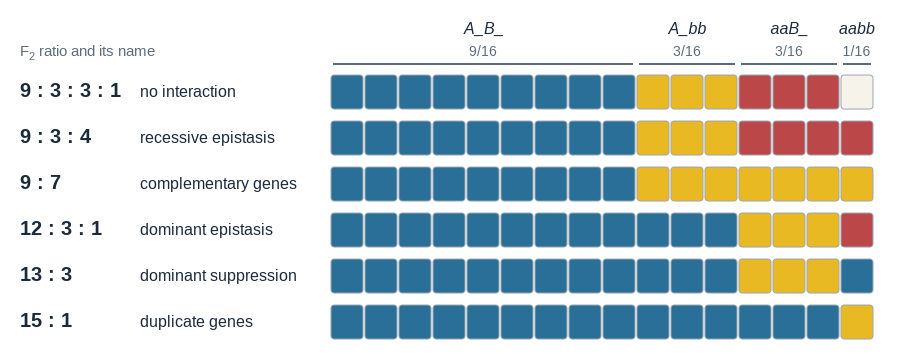
One picture: the same 16 squares, recoloured
Read each row: the 16 squares are always 9 A_B_, 3 A_bb, 3 aaB_, 1 aabb. Each ratio only colours some of them the same.
One table: ratio → pathway
F₂ ratio
Name
Pathway logic
Example
Test cross AaBb × aabb
9 : 3 : 3 : 1
no interaction
separate pathways
pea seed shape and colour
1 : 1 : 1 : 1
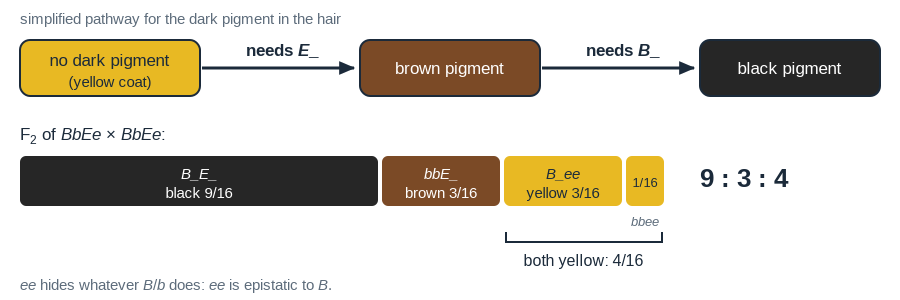
9 : 3 : 4
recessive epistasis
aa blocks an early step; B acts later
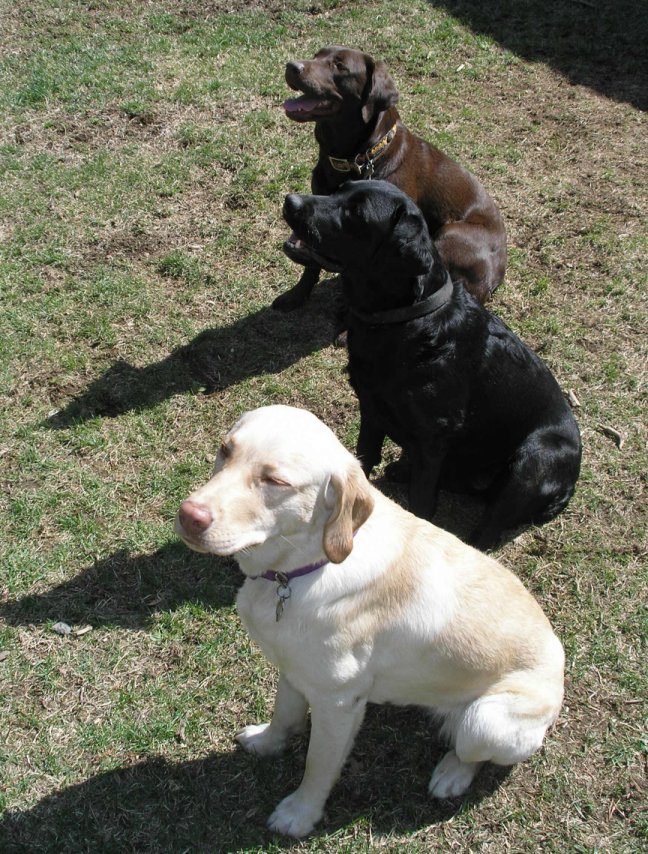
Labrador coat
1 : 1 : 2
9 : 7
complementary genes
both steps needed
sweet pea flowers
1 : 3
12 : 3 : 1
dominant epistasis
A_ blocks an early step
summer squash colour
2 : 1 : 1
13 : 3
dominant suppression
A_ inhibits the other gene’s product
chicken feathers
3 : 1
15 : 1
duplicate genes
either enzyme is enough
shepherd’s purse
3 : 1
9 : 6 : 1
duplicate, additive
each gene adds to the effect
summer squash shape
1 : 2 : 1
A test cross has the four classes in 1 : 1 : 1 : 1, so merging the same classes gives the test-cross ratio.
Explore: pathways and the Punnett square
Strategy: collapse the F₂ into 16ths
How many phenotype classes? Two classes from a dihybrid cross points to 9 : 7, 13 : 3 or 15 : 1; three classes to 9 : 3 : 4, 12 : 3 : 1 or 9 : 6 : 1; four to 9 : 3 : 3 : 1.
Convert to 16ths: count ÷ total × 16.
Match to sums of 9, 3, 3, 1. For example 4 = 3 + 1, 6 = 3 + 3, 7 = 3 + 3 + 1, 12 = 9 + 3, 13 = 9 + 3 + 1, 15 = 9 + 3 + 3.
Test the candidates with χ², with df = number of classes − 1.
Explain it with a pathway, and check with a test cross if you can.
Worked example 1: two classes
Sweet pea F₂ from two white lines: 382 purple, 290 white (672 plants; illustrative counts).
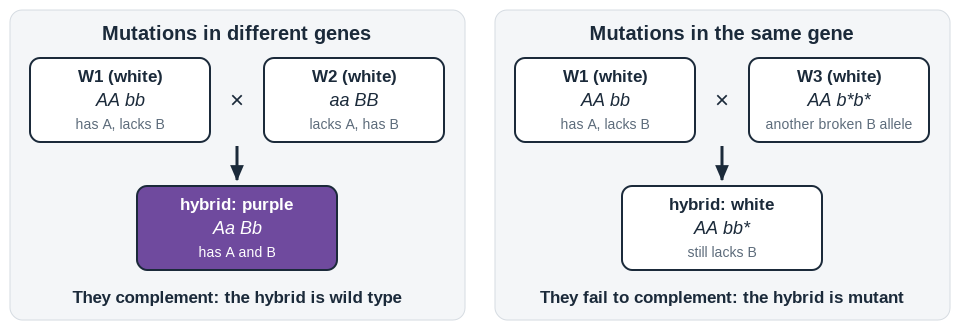
recessive mutants with a wild-type hybrid are in different genes
Strategy
counts → 16ths → candidate ratios → χ² → pathway; explain every class
Where this leads
Pedigree analysis (next unit): incomplete penetrance, variable expressivity and new mutations make human pedigrees harder to read.
Mutation and complementation: the 9 : 7 cross is a complementation test. Two recessive mutants that give a wild-type hybrid have mutations in different genes.
Linkage: when two genes are close on a chromosome, the dihybrid classes are no longer 9 : 3 : 3 : 1, for a quite different reason.
Complex traits: many genes and the environment together give continuous variation.
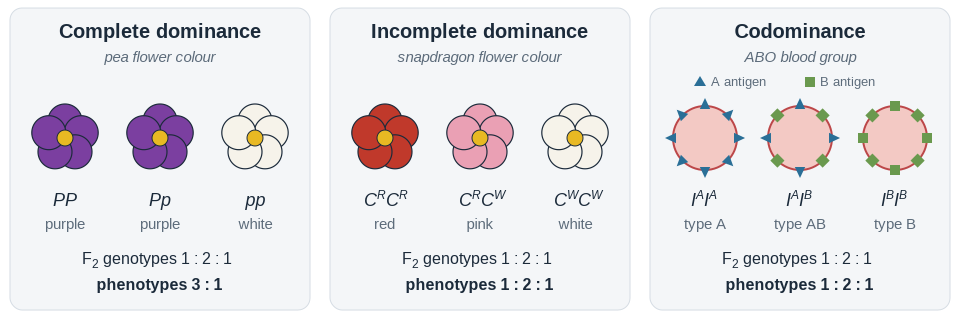
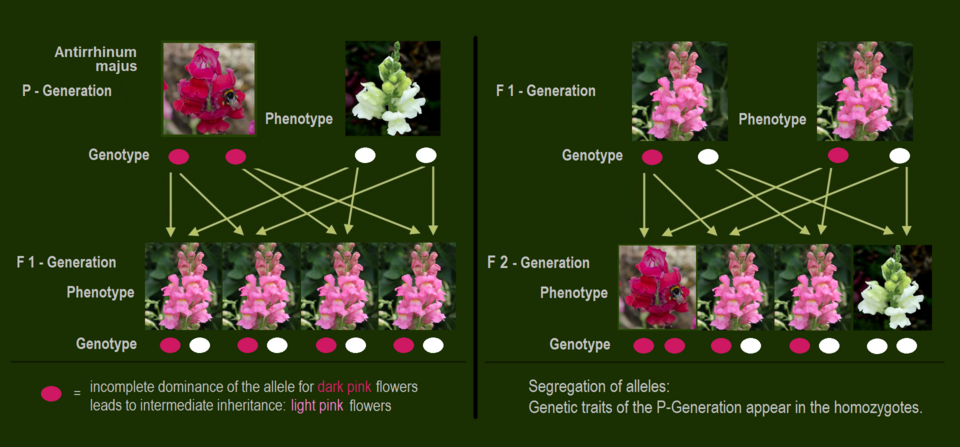 Image: Jacek Halicki, I am Jim, Crochet.david and Sciencia58, CC BY-SA 4.0, via Wikimedia Commons
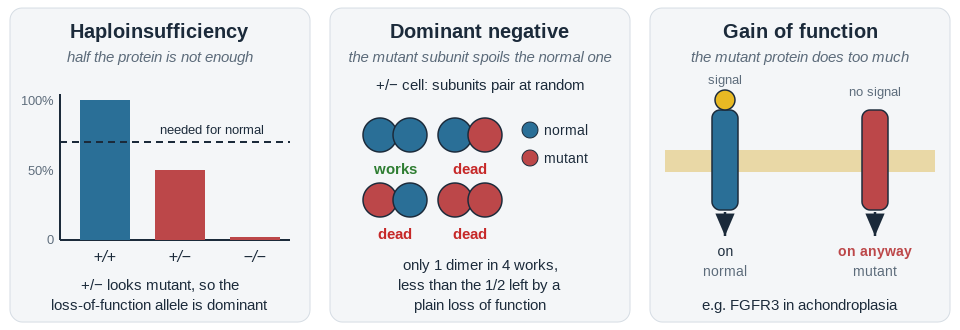
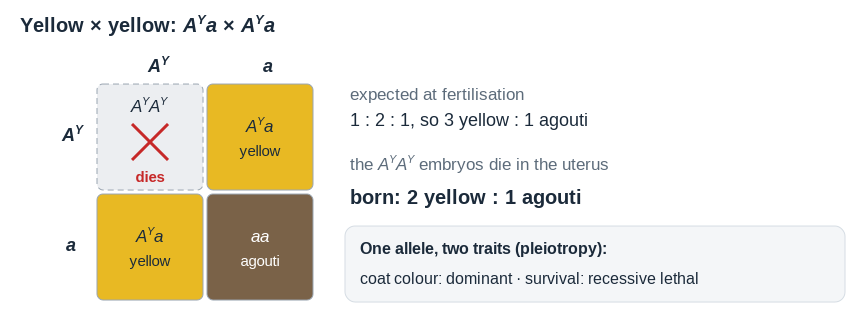
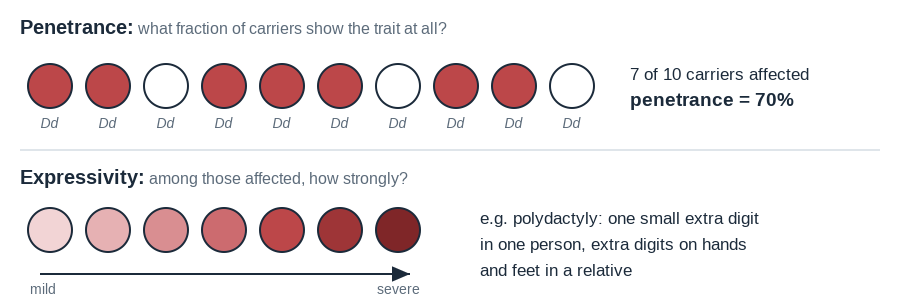
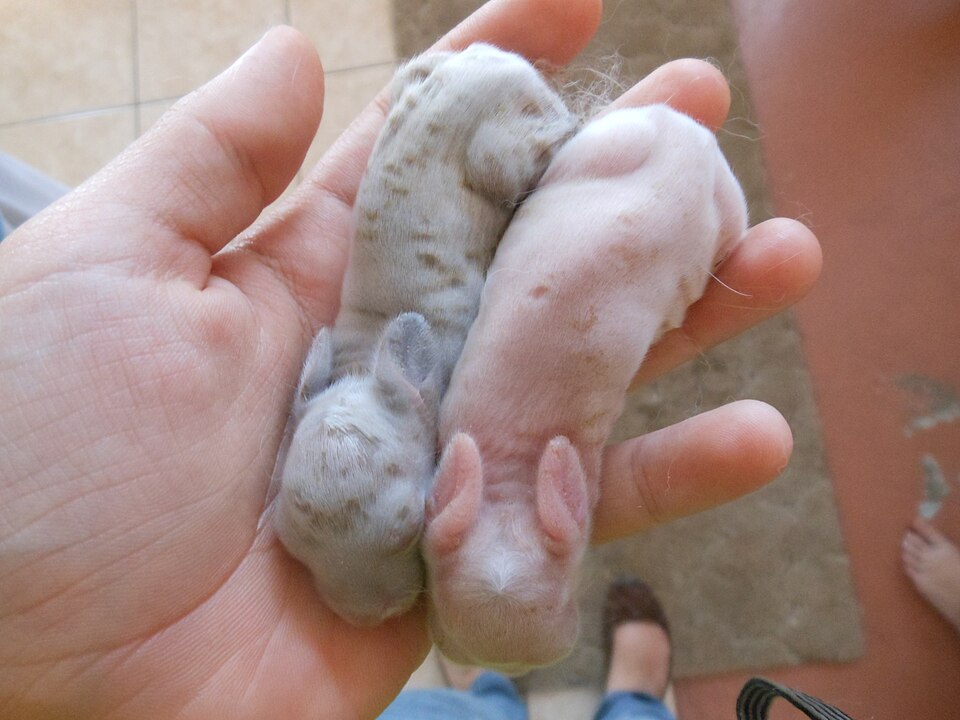 Photo: SableSteel, CC BY-SA 3.0, via Wikimedia Commons