RNA-mediated regulation
Part 6: Gene regulation & development. RNAi, microRNAs and long non-coding RNAs
About this lecture
Transcription is not the last word. Small RNAs, about 22 nucleotides long, pair with mRNAs and turn them down. They were found twice: once by geneticists studying worm larvae that developed at the wrong pace, and once by researchers trying to switch genes off with antisense RNA.
- lin-4 and let-7: how a genetic screen found the first microRNAs, and how to read its genetics.
- RNA interference (RNAi): double-stranded RNA silences genes.
- miRNA biogenesis: Drosha, Dicer, RISC.
- Seed matching: from a miRNA to its target site, step by step; site types; how often sites occur by chance.
- siRNA vs miRNA; designing an siRNA; long non-coding RNAs such as XIST.
- RNAi as a lab tool for reverse genetics, and how to interpret it.
Book: Hartwell, Genetics: From Genes to Genomes, the chapter on RNA-based regulation (non-coding RNAs).
A post-transcriptional layer
| RNA | Size | Made from | Acts on | Effect |
|---|---|---|---|---|
| miRNA | ~22 nt | its own gene (hairpin) | many mRNAs, partial pairing via the seed | less translation, mRNA decay |
| siRNA | ~21 nt | long double-stranded RNA (virus, transposon, or the experimenter) | mRNAs with perfect complementarity | cleavage of the target |
| piRNA | 24–31 nt | piRNA clusters, germ line | transposon RNAs | silences transposons in the germ line |
| lncRNA | > 200 nt | its own gene | chromatin, other RNAs, proteins | many; e.g. XIST silences an X |
Humans have about two thousand miRNA genes in miRBase; a typical miRNA has hundreds of predicted targets, and most human mRNAs carry at least one conserved miRNA site.
A genetic screen in a worm
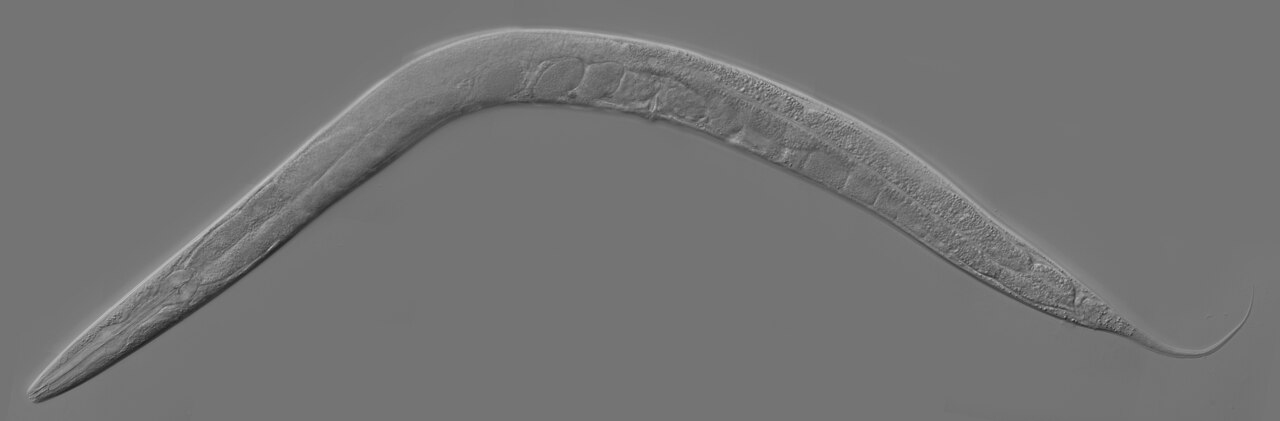
Photo: Zeynep F. Altun (WormAtlas), CC BY-SA 2.5, via Wikimedia Commons
C. elegans is about 1 mm long and transparent, so every cell can be followed under the microscope. Each cell division in the larva happens at a fixed stage (L1 to L4, then adult). Heterochronic mutants do the right things at the wrong time:
- lin-4(lf): cells repeat L1-type divisions in later stages (retarded). Recessive.
- lin-14(lf): cells skip L1 fates and jump ahead (precocious): the opposite phenotype.
- lin-14(gf): dominant alleles that look like lin-4(lf). They delete part of the lin-14 3′UTR; the protein is normal.
Reading the heterochronic genetics
| Genotype | LIN-14 protein after L1 | Phenotype |
|---|---|---|
| wild type | low (turned down when lin-4 RNA appears) | normal timing |
| lin-4(lf) | stays high | retarded: repeats L1 fates |
| lin-14(lf) | none, even in L1 | precocious: skips L1 fates |
| lin-14(gf), 3′UTR deleted | stays high | retarded |
| lin-4(lf); lin-14(lf) | none | precocious, like lin-14(lf) |
- Epistasis: opposite single-mutant phenotypes, and the double looks like lin-14. So lin-14 acts downstream, and lin-4 is a negative regulator of lin-14: lin-4 ⊣ lin-14 → L1 fates.
- Dominance: lin-14(gf) escapes regulation on its own mRNA, whatever the other allele does: dominant and cis-acting, like Oc. One copy of lin-4 makes enough RNA to act on both lin-14 alleles in trans.
lin-4 is a small RNA
In 1993 the Ambros and Ruvkun labs cloned lin-4 and found that it makes no protein: only a ~22-nt RNA.
- The lin-4 RNA is partly complementary to repeated sites in the lin-14 3′UTR: exactly the region deleted in the dominant lin-14(gf) alleles.
- LIN-14 protein falls in late L1, while lin-14 mRNA stays much the same: regulation after transcription.
- For seven years this looked like a worm curiosity. Nobel Prize 2024.




lin-4 turns down lin-14
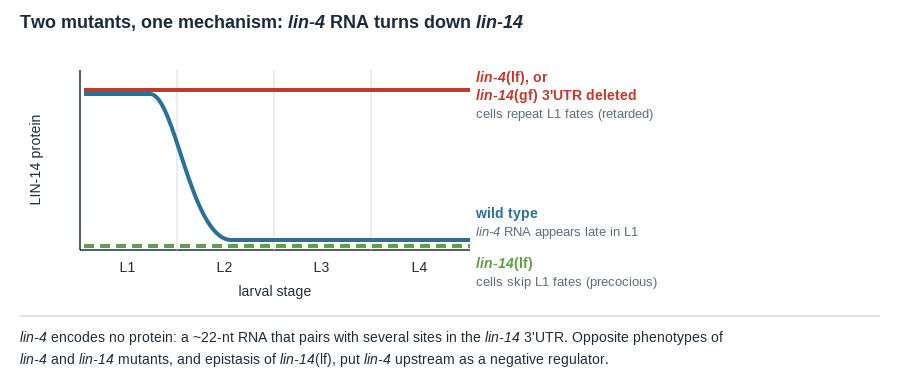
The lin-14 3′UTR is a cis-acting element, like lacO: deleting it makes the gene escape regulation, dominantly. The lin-4 RNA is the trans-acting factor.
let-7: the first conserved microRNA
In 2000, let-7 was found by the same kind of screen: another heterochronic gene, again a ~22-nt RNA, acting on the 3′UTRs of later-stage regulators (lin-41, hbl-1).
- let-7 turned out to be conserved: the mature let-7 of worms, flies and humans is identical over its first 22 nucleotides, and it is expressed at the same transition, from larval/embryonic to adult fates.
- Suddenly small regulatory RNAs were not a worm oddity. Cloning projects found hundreds in animals and plants: they were named microRNAs.
- Human let-7 targets include HMGA2, LIN28B and RAS genes; let-7 is often low in tumours, and HMGA2 is a growth-promoting oncogene.
RNA interference
Fire, Mello and colleagues (1998) injected RNA into worms to silence the unc-22 gene (loss of unc-22 makes worms twitch):
| Injected RNA | Silencing |
|---|---|
| sense strand | weak |
| antisense strand | weak |
| double-stranded RNA | strong, with only a few molecules per cell, spreading through the body and into the progeny |
Double-stranded RNA is cut by Dicer into ~21-nt siRNAs; one strand guides Argonaute (in RISC) to cut any mRNA that matches perfectly. Natural roles: defence against viruses and transposons. (Nobel Prize 2006.)
How a microRNA is made
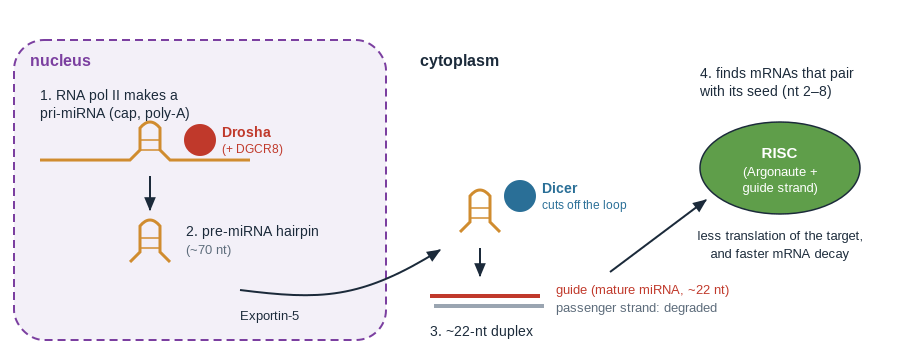
Drosha cuts the hairpin out in the nucleus; Dicer cuts off the loop in the cytoplasm; the guide strand goes into Argonaute (RISC). siRNAs use the same Dicer and Argonaute, but start from long double-stranded RNA.
Seed matching
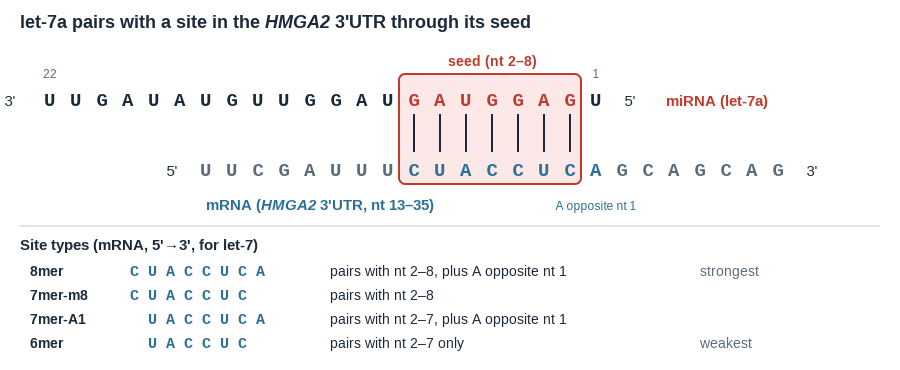
Animal miRNAs find targets mainly through the seed, nucleotides 2–8 from the 5′ end. A target site in the mRNA (usually the 3′UTR) is the reverse complement of the seed, sometimes with an A opposite nucleotide 1.
From seed to site, step by step
Worked example: human let-7a-5p, written 5′→3′.
miRNA      5'-U GAGGUAG UAGGUUGUAUAGUUU-3'
position      1 2345678
seed          GAGGUAG            (nt 2-8)
complement    CUCCAUC            (A<->U, G<->C, same order)
reverse       CUACCUC            (read backwards: now 5'->3')
site in mRNA  5'-...CUACCUC...-3'   7mer-m8
5'-...CUACCUCA...-3' 8mer (plus an A opposite nt 1)- Count from 1 at the 5′ end; the seed starts at 2.
- Complement each base (in RNA: A↔︎U, G↔︎C).
- Reverse it, so that the site is written 5′→3′ like the mRNA.
Four kinds of site
| Site | mRNA pairs with | Example for let-7 (seed GAGGUAG) | Strength |
|---|---|---|---|
| 8mer | nt 2–8, plus an A opposite nt 1 | CUACCUCA | strongest |
| 7mer-m8 | nt 2–8 | CUACCUC | strong |
| 7mer-A1 | nt 2–7, plus an A opposite nt 1 | UACCUCA | weaker |
| 6mer | nt 2–7 only | UACCUC | marginal |
- All four share the 6-nt core that pairs with nt 2–7 (here UACCUC).
- To classify a match, look at the base before the core (a C pairs with nt 8) and the base after it (an A sits opposite nt 1).
- The A opposite nt 1 does not base-pair; Argonaute has a pocket that prefers an A there.
How often does a site turn up by chance?
A site is a fixed word of k nucleotides. In random sequence with equal base frequencies, a given word occurs about once every 4k nucleotides.
| Site length | Chance of a match at one position | Expected per 1000 nt of 3′UTR |
|---|---|---|
| 6 nt | 1/46 = 1/4096 | ≈ 0.24 |
| 7 nt | 1/47 = 1/16 384 | ≈ 0.06 |
| 8 nt | 1/48 = 1/65 536 | ≈ 0.015 |
- An mRNA is single-stranded: count one strand only (for a transcription-factor motif in DNA you count both).
- Over thousands of genes, chance alone gives many matches per miRNA. A single 7-nt match means little.
- More convincing: a conserved site, several sites in one UTR, a stronger site type, and miRNA and mRNA made in the same cells.
Check yourself: seeds and sites
Answers in the notes.
- A miRNA starts 5′-UAAGGCACGCGG…-3′. What is its seed, and what is its 7mer-m8 site?
- A student writes the let-7 site as CUCCAUC. What went wrong?
- In a 3′UTR you find 5′-…GUACCUCA…-3′. Which kind of let-7 site is this?
- Why is one 7-nt match in a long 3′UTR weak evidence that the gene is a target?
siRNA vs miRNA
| siRNA | miRNA | |
|---|---|---|
| Source | long dsRNA (virus, transposon, experiment) | genome-encoded hairpin |
| Processing | Dicer | Drosha, then Dicer |
| Pairing with target | full length, perfect | mostly the seed (nt 2–8) |
| Typical outcome | target mRNA cut by Argonaute | translation down, mRNA decay |
| Targets per small RNA | one (the matching gene) | hundreds |
| Natural role | defence (viruses, transposons) | gene regulation, development |
| As a lab tool | knock down a chosen gene | — (but siRNAs can act like miRNAs: off-target effects via their seed) |
Designing an siRNA
The guide (antisense) strand must pair perfectly with the target mRNA, so it is the target’s reverse complement. Worked example with a made-up 19-nt target stretch:
target mRNA   5'-GAUCCAGUUCGAAGCAUCU-3'
complement       CUAGGUCAAGCUUCGUAGA      (3'->5')
guide strand  5'-AGAUGCUUCGAACUGGAUC-3'   (reversed)
guide seed        GAUGCUU                 (nt 2-8)
off-target site AAGCAUC (any mRNA with this 7-mer)- The guide cuts the intended mRNA, which matches all 19 nt.
- Its seed can also pair, miRNA-style, with any 3′UTR that has the seed’s site: off-target knockdown of many genes, each a little.
Regulatory RNA in genetics and disease
- Target-site mutations act in cis. Chromosomal rearrangements in benign tumours (e.g. lipomas) cut HMGA2 off from its 3′UTR. The truncated mRNA loses its seven let-7 sites, escapes repression, and makes too much protein: a dominant gain of function, like lin-14(gf).
- miRNA mutations act in trans. A point mutation in the seed of MIR96 causes dominant progressive hearing loss in humans (and in the diminuendo mouse). The mutant miRNA loses its normal targets and gains new ones.
- The miRNA pathway is a drug target. Patisiran, an siRNA drug approved in 2018, silences the TTR gene in hereditary transthyretin amyloidosis.
miRNA genes: dominance and redundancy
- Loss of one copy of a miRNA gene is usually recessive: the other copy makes enough RNA to act on all targets in trans.
- A seed mutation can be dominant: the mutant miRNA from one allele stops repressing its old targets and represses new ones (MIR96).
- Many miRNAs come in families that share a seed (the let-7 family: let-7a to let-7i and miR-98 in humans). Members target the same sites, so they can cover for each other.
- So deleting one miRNA gene often gives no visible phenotype: in C. elegans, most miRNA genes deleted one at a time showed no obvious defect (Miska et al., 2007). Removing the whole family does.
This is genetic redundancy, as with the duplicate genes behind a 15 : 1 ratio (Extensions to Mendel).
Long non-coding RNAs
lncRNAs are transcripts longer than 200 nt that do not encode a protein. Some work in cis, on the chromosome they are made from; others in trans.
- XIST (from the last unit): made from the X that will be silenced; coats that X in cis and recruits silencing complexes. Deleting XIST on one X means that X cannot be inactivated.
- Many lncRNAs act as scaffolds for chromatin complexes, or as decoys that soak up miRNAs or proteins.
- Many more are transcribed but of unknown function. Genetics is the test: does deleting it, or its promoter, change a phenotype?
RNAi as a tool for reverse genetics
Forward genetics goes from a phenotype to the gene. Reverse genetics starts from a gene and asks: what happens if I remove it? RNAi made this easy.
- Worms: feed them E. coli that make dsRNA against a gene. A library covering about 86 % of predicted C. elegans genes allowed genome-wide RNAi screens (2003).
- Flies: transgenic hairpin RNAs (often combined with tissue-specific GAL4 drivers, next unit).
- Mammalian cells: transfect siRNAs or express shRNAs.
Today CRISPR–Cas9 knockouts are often preferred, but RNAi remains useful for genes whose knockout is lethal, and for tuning dosage.
Interpreting an RNAi phenotype
| RNAi knockdown | Mutant allele (e.g. CRISPR null) | |
|---|---|---|
| What it changes | the mRNA, in trans, all copies at once | the gene, one allele at a time |
| Strength | partial: a hypomorph; varies between cells and experiments | can be a clean null |
| Lethal genes | can still study later roles | null may die early |
| Complementation test | not possible: there is no allele to put in trans | possible |
| Main pitfall | off-target effects through the seed | linked background mutations |
Controls for an RNAi result: two or more independent siRNAs against the same gene; show that the target mRNA or protein went down; rescue with a version of the gene that the siRNA cannot match (silent changes in the target site).
Common mistakes
- Counting the seed from 0, or from nt 1. The seed is nt 2–8; nt 1 is not part of it.
- Complementing without reversing. A site written 5′→3′ is the reverse complement of the seed.
- Mixing DNA and RNA letters. A UTR from a FASTA file has T; a miRNA in miRBase has U.
- Counting both strands for a miRNA site. The mRNA is single-stranded.
- “An siRNA hits only its target.” Its seed can act on hundreds of mRNAs.
- “A miRNA mutation must be recessive.” Seed mutations can be dominant (MIR96); site deletions in the target are dominant and cis (lin-14(gf), HMGA2).
- “No knockout phenotype means no function.” Family members with the same seed may cover for it.
Summary
| Concept | Key fact |
|---|---|
| lin-4 / lin-14 | first miRNA (1993); lin-14(gf) = 3′UTR deletions, dominant, cis; lin-4 acts in trans; lin-14 epistatic |
| let-7 | first conserved miRNA (2000); identical in worm and human |
| RNAi | dsRNA → Dicer → siRNA → Argonaute cuts the perfectly matching mRNA |
| Biogenesis | pri-miRNA → Drosha → pre-miRNA → Exportin-5 → Dicer → RISC (Argonaute) |
| Seed and site | nt 2–8; site = reverse complement; 8mer > 7mer-m8 > 7mer-A1 > 6mer |
| Chance | a k-nt site every 4k nt, one strand; 7mer ≈ every 16 kb |
| siRNA vs miRNA | perfect pairing, one target, cleavage vs seed pairing, many targets, repression |
| siRNA design | guide = reverse complement of the target; its seed gives off-targets |
| Disease | HMGA2 3′UTR loss (cis, oncogenic); MIR96 seed mutation (trans, deafness) |
| Redundancy | miRNA families share seeds; single knockouts often have no phenotype |
| lncRNA | > 200 nt, no protein; XIST acts in cis |
| RNAi as a tool | knockdown = hypomorph; no complementation; controls: several siRNAs, rescue |
Where this leads
- Next: Development & model organisms. Forward screens like the heterochronic screen, reverse genetics with RNAi and CRISPR, and the transcription-factor cascades that build the fly embryo. Redundancy returns with the four mammalian Hox clusters.
- Part 7: Cancer genetics. let-7 and HMGA2 are one example of how loss of regulation makes an oncogene.