Waste materials and leachate chemistry
Week 4 — Soils, waste, and contaminants
About this lecture
Copper was mined at Falun in central Sweden for roughly a thousand years, until 1992. The mine is now a UNESCO World Heritage Site. Its waste heaps are still chemically active: water draining them carries acid, sulfate and metals toward the lakes downstream.
Why does old rock keep making acid long after mining stops?
Today you will learn to:
- balance pyrite oxidation: 4 H⁺ per FeS₂;
- separate present pH from future acid-generating inventory;
- close a neutralisation budget with a stated endpoint;
- tell concentration from load.
Last lecture, soils consumed acid from finite stocks. Today a solid produces it.
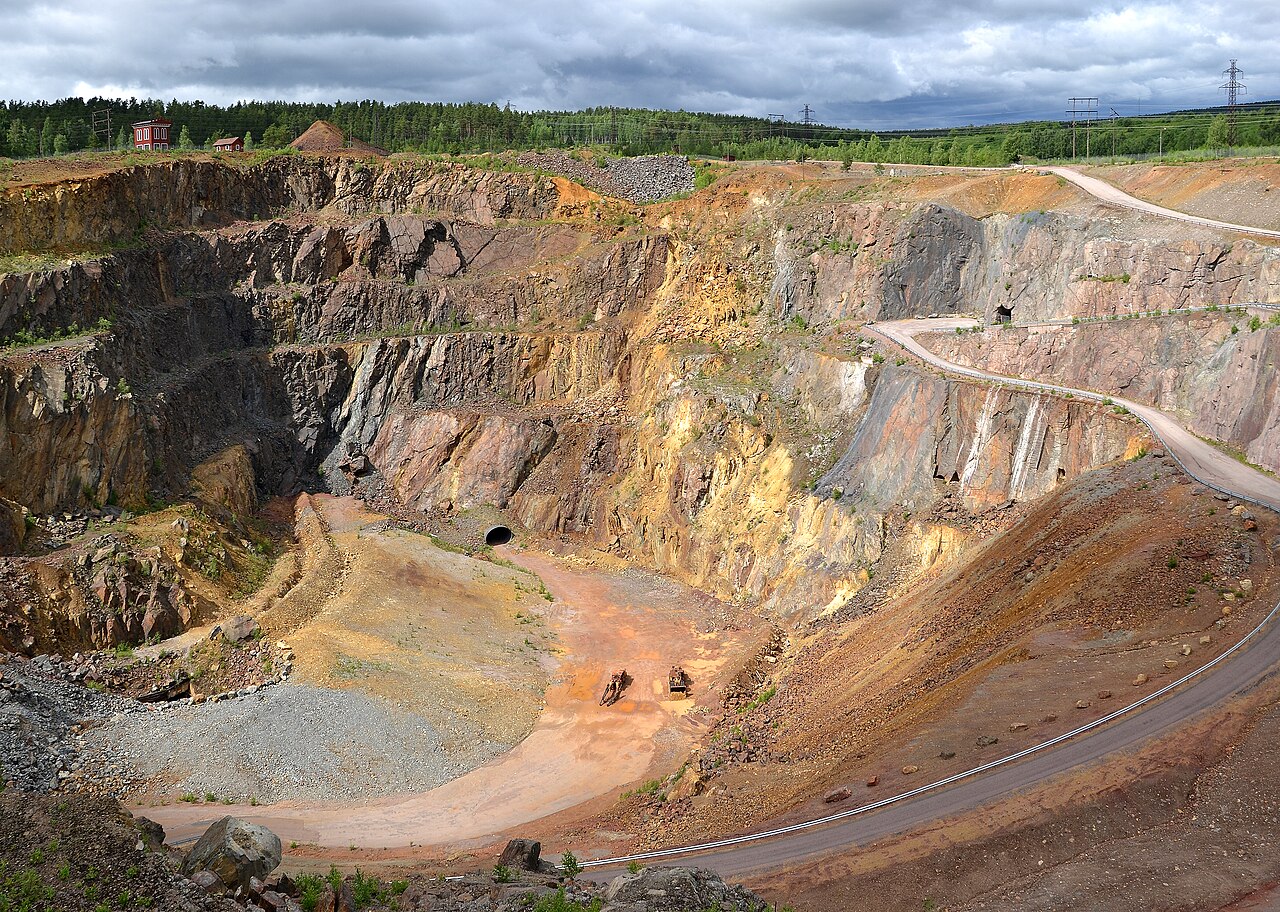 The Great Pit at Falun copper mine, Sweden. Photo: Pudelek, CC BY-SA 4.0, Wikimedia Commons.
The colour of Swedish houses is mine chemistry
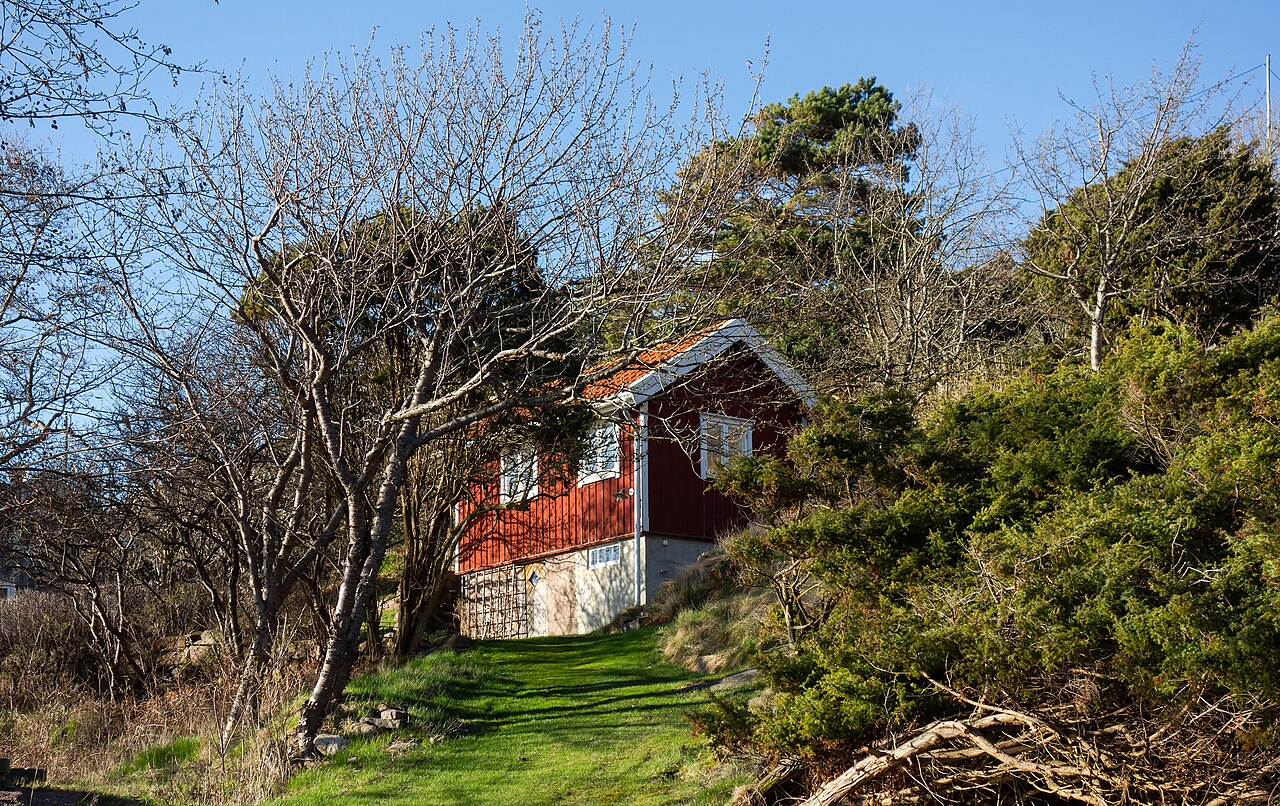 A Falu red cottage, Lysekil, Sweden. Photo: W.carter, CC0, Wikimedia Commons.
The classic red paint, Falu rödfärg, is made from pigment recovered from the Falun mine’s weathered waste.
The pigment is mainly iron oxides. They formed when iron sulfide in the waste reacted with oxygen and water over centuries.
So the reactions that gave Swedish cottages their colour are the same ones that produce acid in the mine drainage.
Today’s question: what exactly happens when pyrite meets air and water, and how much acid does it make?
Pyrite: stable underground, reactive in air
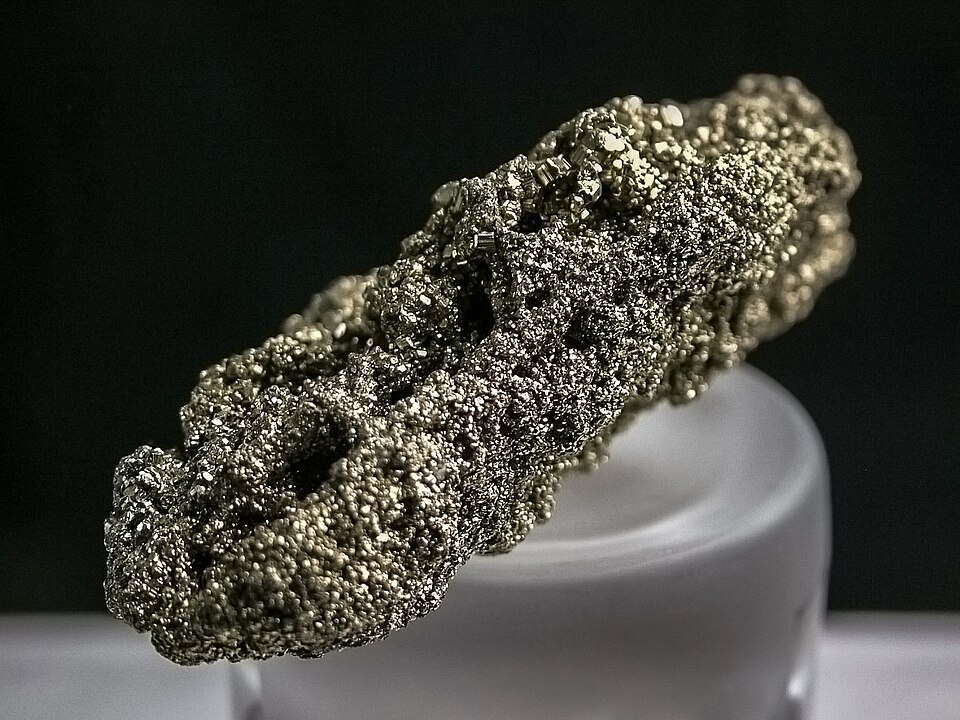 Pyrite (FeS₂) crystals on a glass, photographed in Visby, Gotland. Photo: W.carter, CC BY-SA 4.0, Wikimedia Commons.
Pyrite, FeS₂, “fool’s gold”, is the most common sulfide mineral. Sulfur sits as the disulfide ion S₂²⁻, oxidation state −1 per S.
Deep in bedrock or under water, there is almost no oxygen, so pyrite can persist for millions of years.
Mining, road cuts and drained wetlands crush the rock and expose it to air and water. Crushing also creates vast new surface area.
Pyrite is common in ore waste, in some black shales, and in drained coastal acid sulfate soils around the Baltic.
Inside a waste heap
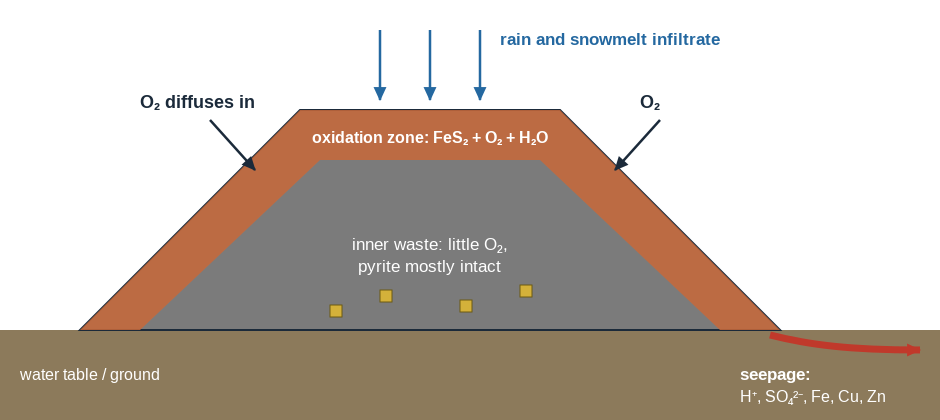
Pyrite oxidation needs oxygen and water together. Both enter from the surface, so most reaction happens in an outer oxidation zone. The products leave the heap as seepage.
Two oxidations, four hydrogen ions
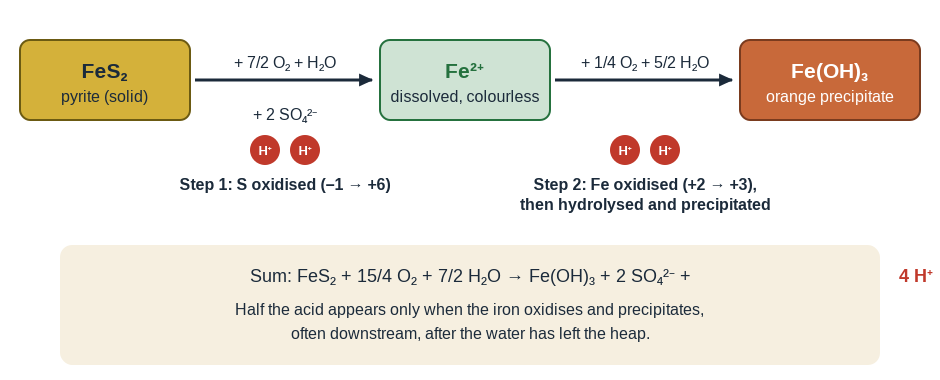
Each step is a redox reaction that also releases H⁺. Step 1 makes 2 H⁺ and dissolved Fe²⁺. Step 2 oxidises the iron and precipitates it, releasing 2 more.
Iron(III) speeds it up
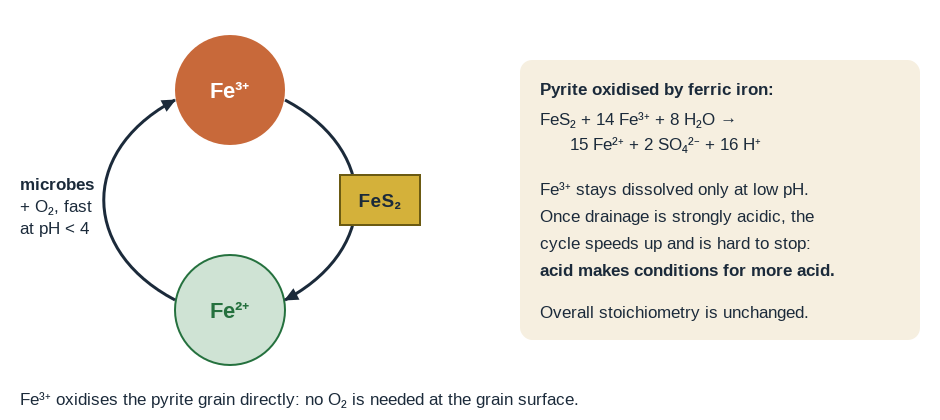
Once drainage is acidic, dissolved Fe³⁺ itself oxidises pyrite, and iron-oxidising microbes regenerate Fe³⁺ from Fe²⁺. Acid drainage can accelerate itself.
What the end point looks like
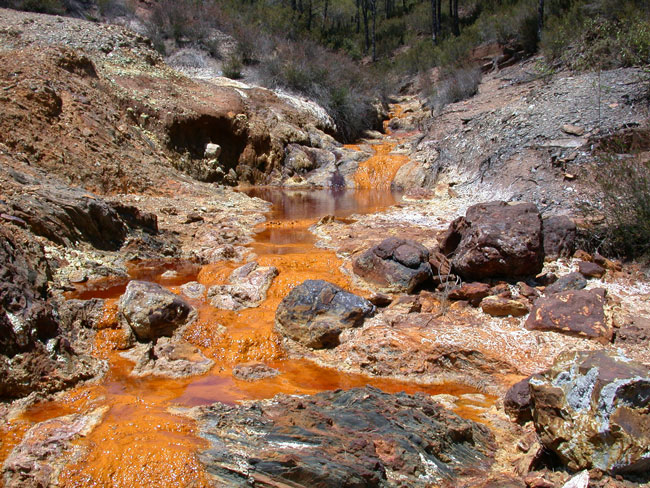 Iron-stained stream bed of the Río Tinto, Spain. Photo: Carol Stoker, NASA, public domain, Wikimedia Commons.
The Río Tinto in southwest Spain drains a sulfide belt that has been mined for thousands of years.
Its water is strongly acidic, often around pH 2, and rich in dissolved iron(III), which colours it red.
Few organisms beyond specialised microbes live there. The river is studied as an analogue for life in extreme environments.
This is the iron cycle of the previous slide running at full speed.
Orange streams: iron precipitates downstream
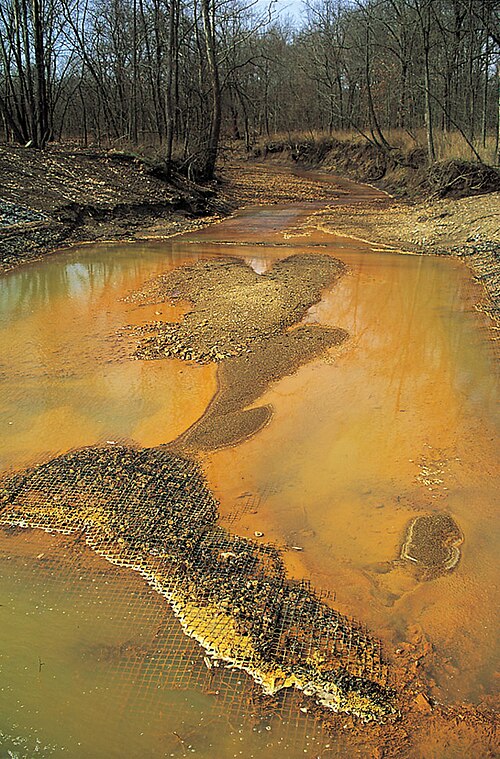 Iron hydroxide precipitate in a stream receiving acid drainage, Missouri. Photo: D. Hardesty, USGS, public domain, Wikimedia Commons.
Where acid drainage mixes with less acidic stream water, pH rises and Fe³⁺ precipitates as orange iron hydroxide (“yellow boy”).
Two consequences:
- Step 2 releases its acid here, in the stream, not in the heap. A seep can leave the heap at moderate pH and still acidify the stream.
- The orange coating smothers the stream bed, and the fresh precipitate binds metals such as Cu, Zn and As.
Removing the orange solid does not remove the acid already released.
Neutral today, acid tomorrow
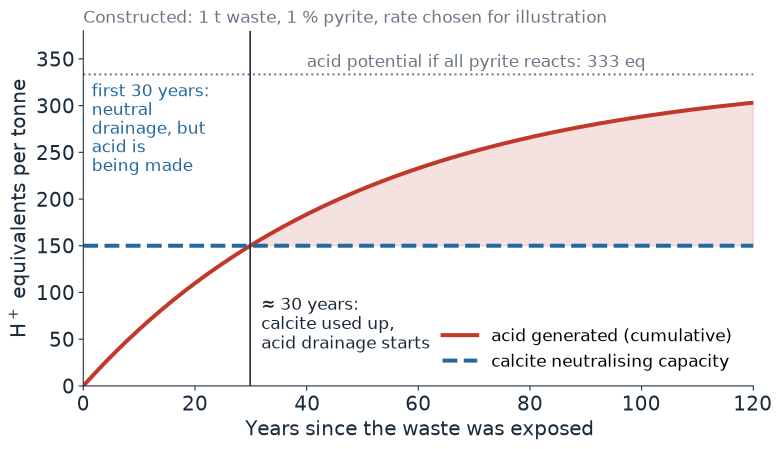
While calcite lasts, it neutralises the acid as fast as pyrite makes it, and drainage looks harmless. When calcite runs out, the acid potential that was there all along appears in the water.
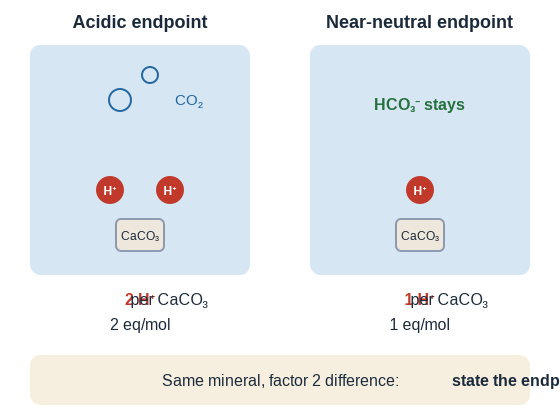
Neutralisation depends on the endpoint
For the CO₂* endpoint (acidic final water, carbon leaves as CO₂):
\mathrm{CaCO_3+2H^+\rightarrow Ca^{2+}+CO_2^*+H_2O}
For a near-neutral endpoint, bicarbonate stays in the water:
\mathrm{CaCO_3+H^+\rightarrow Ca^{2+}+HCO_3^-}
The same calcite can neutralise 2 or 1 equivalents per mole. Mine-waste schemes differ in which they assume, so always state the endpoint before you use a coefficient.
Calcite present is not calcite available
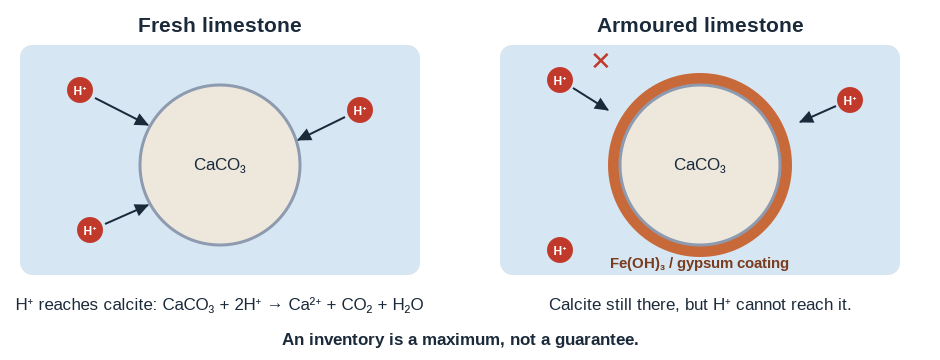
In acid, iron-rich water, limestone grains become coated with iron hydroxide or gypsum. The calcite is still there, but H⁺ cannot reach it. Calcite in a layer the water does not pass through is equally useless.
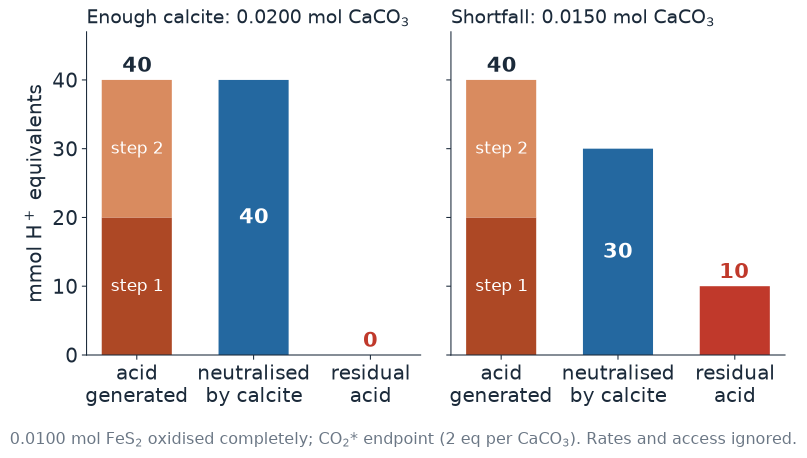
Worked example: closing the budget
0.0100 mol FeS₂ oxidises completely:
- acid: 4 × 0.0100 = 0.0400 mol H⁺ eq
- sulfate: 2 × 0.0100 = 0.0200 mol
- CaCO₃ needed (CO₂* endpoint): 0.0400 / 2 = 0.0200 mol = 2.00 g
Exercise 2: only 0.0150 mol CaCO₃ is accessible. It neutralises 0.0300 eq, leaving 0.0100 mol eq of acid.
Concentration is not load
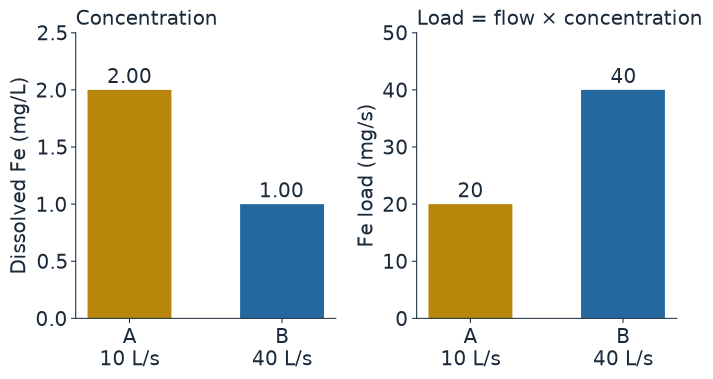
Load = flow × concentration.
- Discharge A: 10.0 L/s × 2.00 mg/L = 20.0 mg/s Fe
- Discharge B: 40.0 L/s × 1.00 mg/L = 40.0 mg/s Fe
B looks cleaner but exports twice as much iron, about 1.3 tonnes a year.
During snowmelt, concentrations often fall while loads rise. Judge a waste by its load to the receiving lake.
Immobilised is not destroyed
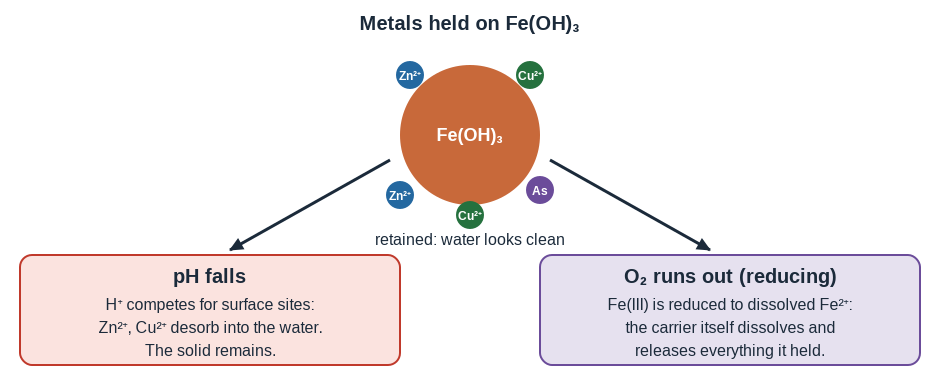
Treatment often moves metals from water onto solids. The solid then needs conditions that keep it stable: enough alkalinity to keep pH up, and enough oxygen to keep iron oxidised.
Back to Falun: a worked estimate
Constructed: one tonne of waste rock with 1 % pyrite by mass.
- FeS₂: 10 kg / 120 g/mol ≈ 83 mol
- acid potential: 4 × 83 ≈ 333 mol H⁺ eq
- sulfate: 2 × 83 ≈ 167 mol
- CaCO₃ to neutralise: ≈ 17 kg (CO₂* endpoint) or ≈ 33 kg (near-neutral endpoint)
Multiply by the millions of tonnes of waste at an old mining district, and the century-long drainage makes sense.
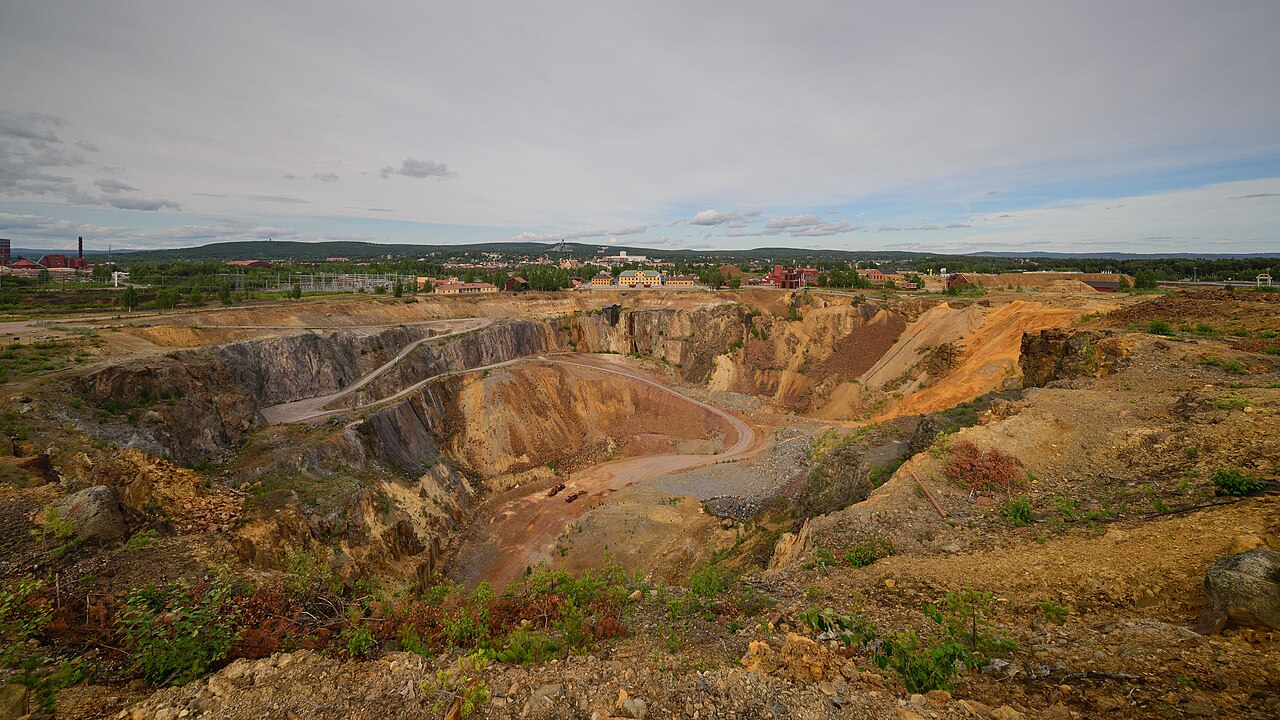 The Great Pit at Falun with its weathered, iron-stained rock and the town beyond. Photo: Arild Vågen, CC BY-SA 4.0, Wikimedia Commons.
Summary
| Concept | Key fact |
|---|---|
| Pyrite | FeS₂, S at −1; stable without O₂, reacts when exposed to air and water |
| Step 1 | FeS₂ + 7/2 O₂ + H₂O → Fe²⁺ + 2SO₄²⁻ + 2H⁺ |
| Step 2 | Fe²⁺ + 1/4 O₂ + 5/2 H₂O → Fe(OH)₃ + 2H⁺, often downstream |
| Total | 4 H⁺ and 2 SO₄²⁻ per FeS₂ |
| Fe³⁺ cycle | at low pH Fe³⁺ oxidises pyrite; microbes regenerate Fe³⁺ |
| Inventories | acid potential vs neutralisation potential; pH is a snapshot |
| Lag | drainage can stay neutral for decades, then acidify |
| Endpoint | CaCO₃ neutralises 2 eq (CO₂*) or 1 eq (HCO₃⁻) |
| Load | flow × concentration; dilution can hide a large export |
| Immobilisation | sorbed metals return if pH falls or Fe(III) is reduced |
Next: Organic contaminants and environmental fate. Where does a molecule go, and is “gone from the water” the same as “destroyed”? Then the exercises and the notes.
 Sailors in firefighting foam (AFFF) during a sprinkler test, 2006. Photo: US Navy, public domain, Wikimedia Commons.