ATAC-seq processing and peak calling
From raw reads to Tn5 insertion sites, peaks, replicate agreement and a consensus peak set
The ATAC-seq pipeline, end to end
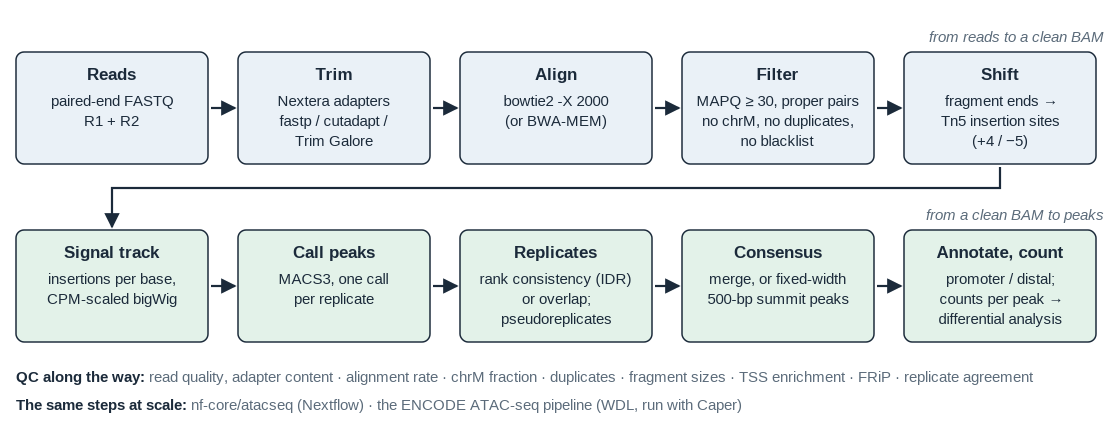
- Ten steps; each one answers a specific problem with the raw data. We go through them in order.
- Production pipelines do exactly this: nf-core/atacseq (Nextflow) and the ENCODE ATAC-seq pipeline (WDL). Learn the steps on one sample by hand, then run the pipeline on all of them.
Trim the adapters first
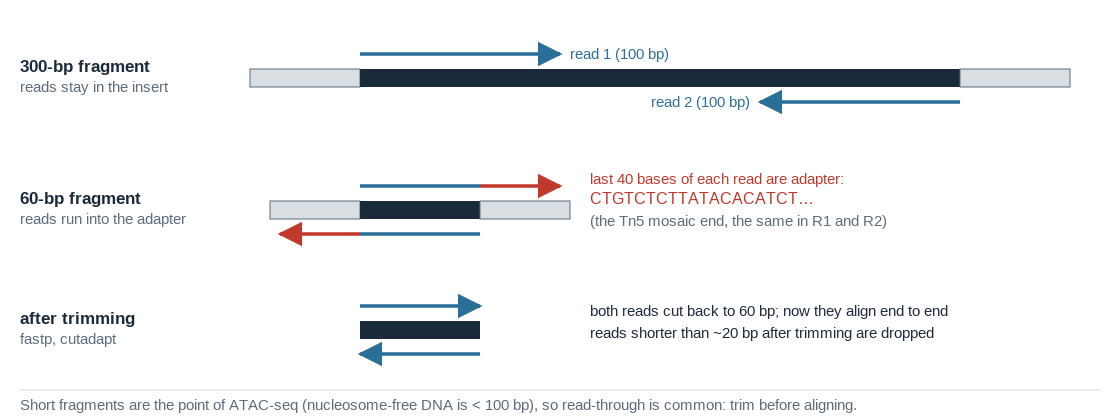
- Tn5 loads the Nextera adapters. Both reads of a short fragment run into the adapter:
CTGTCTCTTATACACATCT…. - ATAC-seq is made of short fragments: in our data fastp trimmed adapter bases from 38% of the reads.
- Untrimmed, these reads fail to align end to end or align with mismatches at the ends; trim with fastp, cutadapt or Trim Galore.
Five filters, five reasons
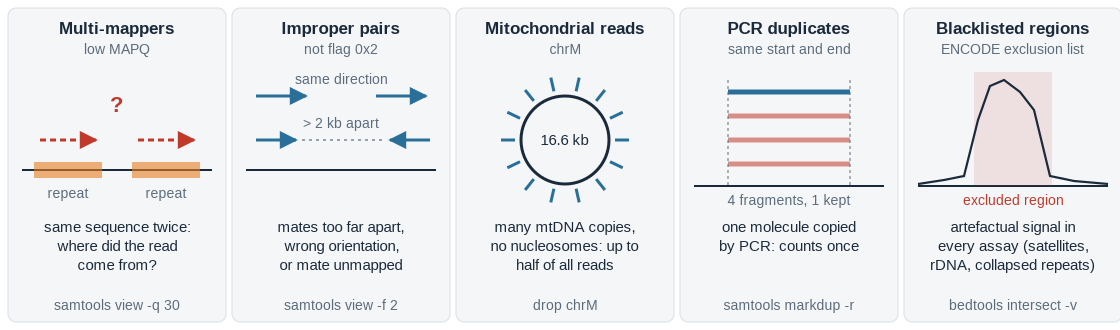
- Keep a pair only if both mates pass: unique (MAPQ ≥ 30), properly paired, not chrM, not a duplicate.
- Blacklisted regions (Amemiya et al. 2019) are removed from the insertion sites and from the peaks.
Real data: reads through the pipeline
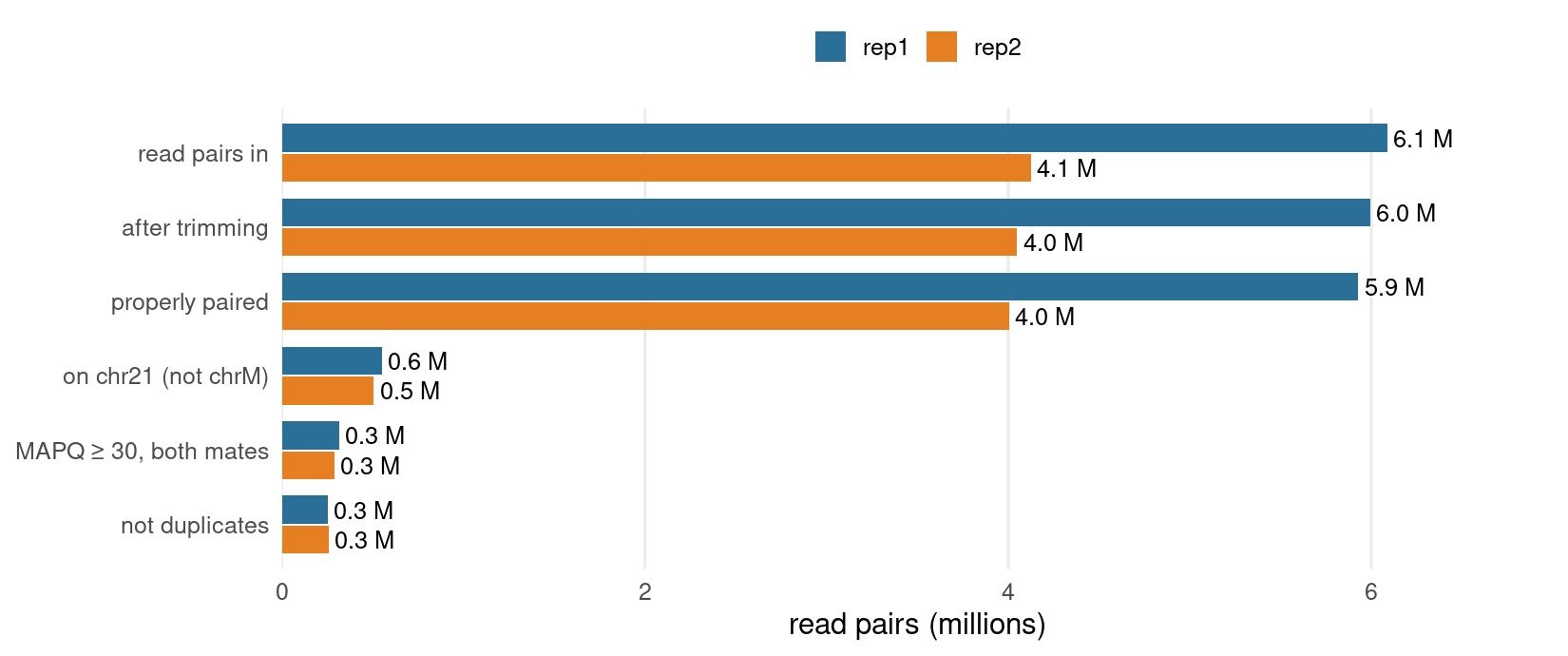
- GM12878 replicate 1: 6.1 M read pairs in, 0.25 M usable fragments on chr21 out.
- Biggest losses: chrM (91% of our pairs; 14% of the whole library), MAPQ (43% of the chr21 pairs) and duplicates (20%).
Tn5 cuts the two strands 9 bp apart
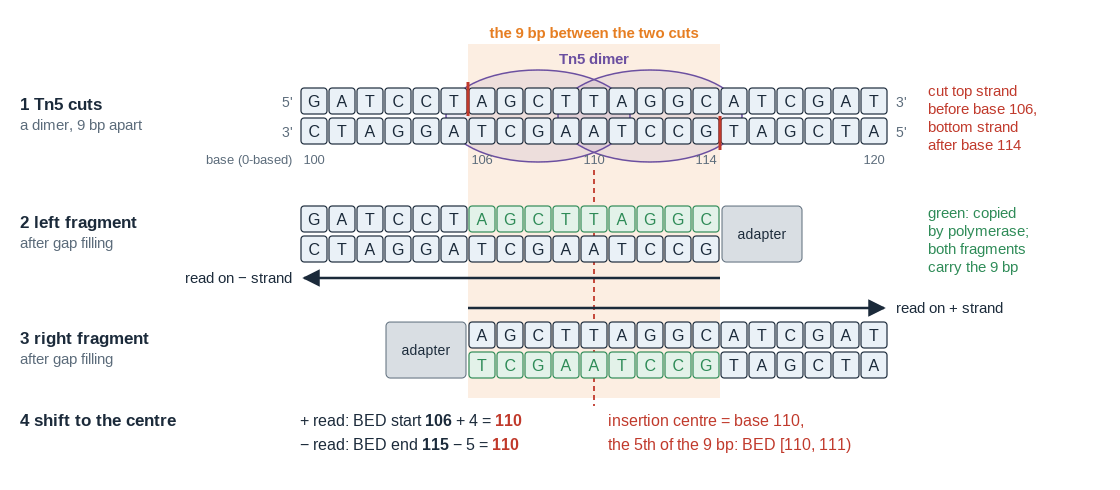
- The Tn5 dimer joins adapters to the two strands 9 bp apart. Gap filling copies those 9 bp, so both fragments carry them.
- The insertion “point” is the centre of the 9-bp duplication: +4 from a + read’s start, −5 from a − read’s end (BED coordinates).
From a read pair to two insertion sites
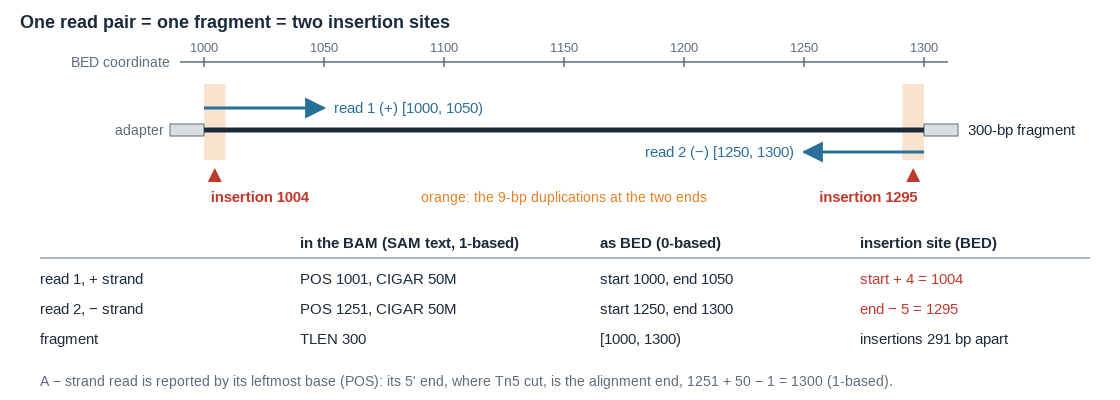
- Every properly paired fragment gives two insertion sites, one at each end.
- In BED: + read
start + 4, − readend − 5. Tools:awkon a BEDPE file, oralignmentSieve --ATACshift(deepTools).
Fragments or insertion sites?
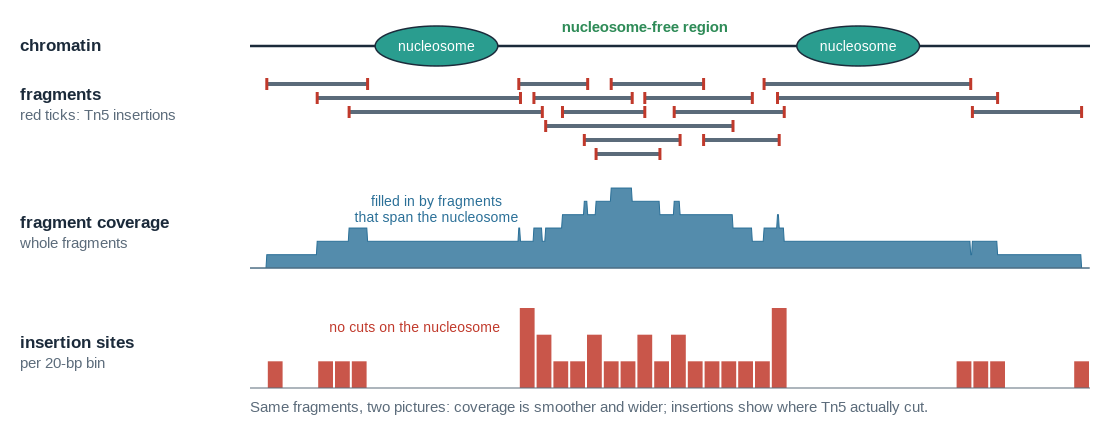
- Fragment coverage counts the DNA between two cuts: smooth, but fragments that span a nucleosome fill it in.
- Insertion sites count only where Tn5 cut: sharper, closer to “accessibility” in the strict sense.
- Peaks, signal tracks and counts can use either. Be explicit about which.
Real data: insertions vs fragment coverage
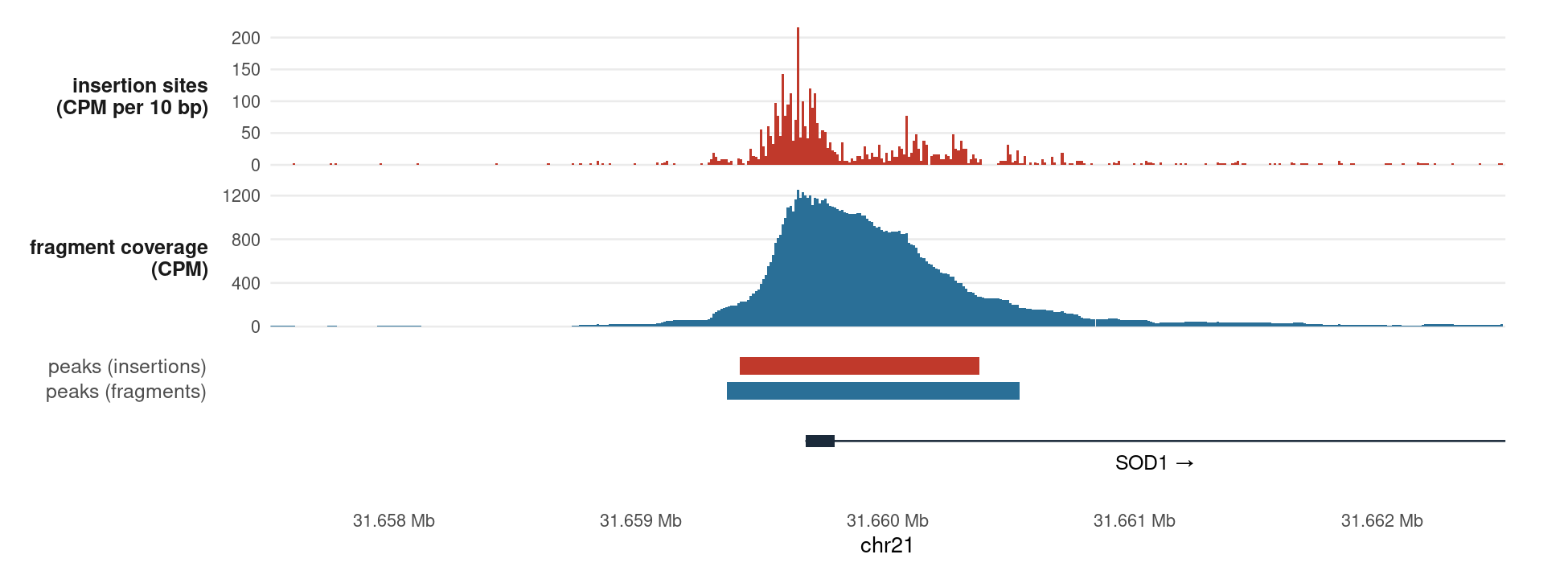
- GM12878 replicate 1 at the SOD1 promoter (chr21). Same reads, two tracks, both CPM.
- Insertions concentrate at the open sites; fragment coverage is broader and also covers the flanking nucleosomes.
What a peak caller does
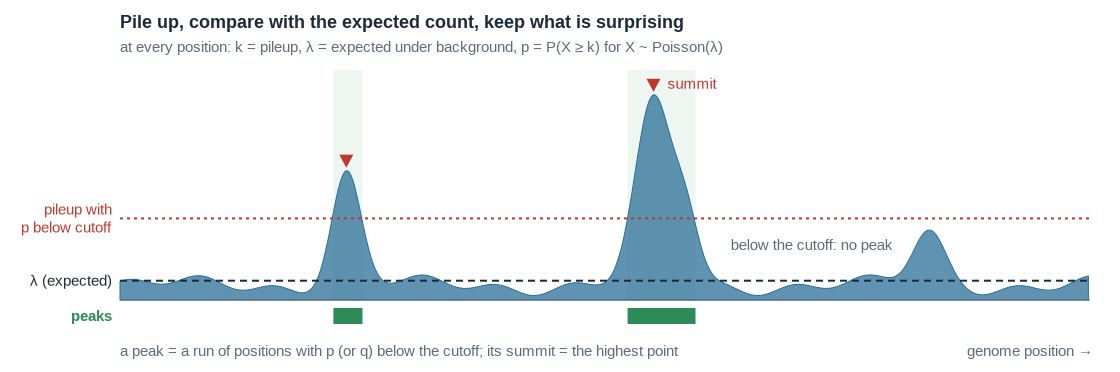
- Pile up the reads (or insertion windows) along the genome.
- At each position compare the pileup k with the expected count \lambda under background: p = P(X \ge k), X \sim \text{Poisson}(\lambda).
- A peak is a run of positions below the cutoff; its summit is the highest point.
The local λ: background is not uniform
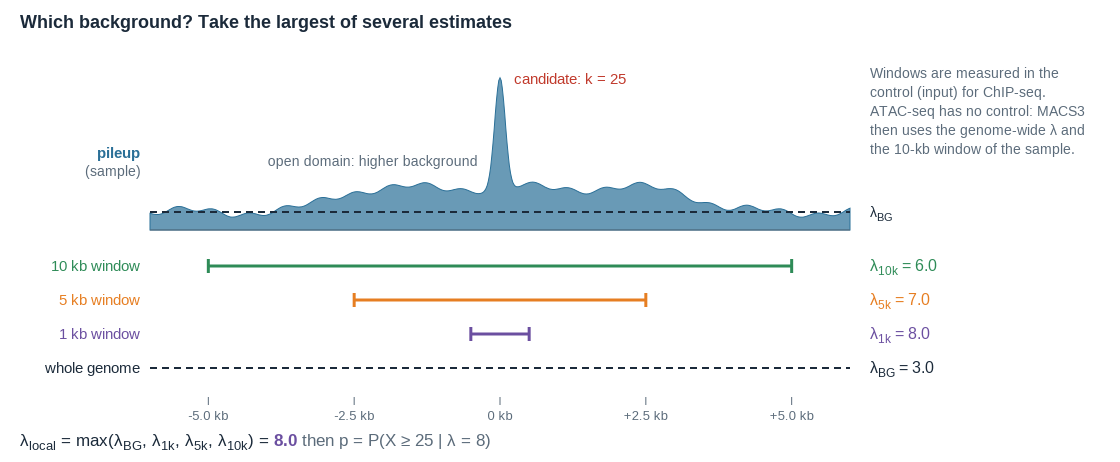
- \lambda_\text{BG} = total reads × window / genome size. But open domains, copy-number gains and mappability make background vary.
- With a control, MACS2/3 use \lambda_\text{local} = \max(\lambda_\text{BG}, \lambda_d, \lambda_\text{1k}, \lambda_\text{10k}), the windows measured in the control: the largest estimate, the conservative choice. (The 2008 paper used 1, 5 and 10 kb.)
- Without a control (ATAC-seq), MACS3 uses \lambda_\text{BG} and the sample’s own 10-kb window.
From counts to p-values and q-values
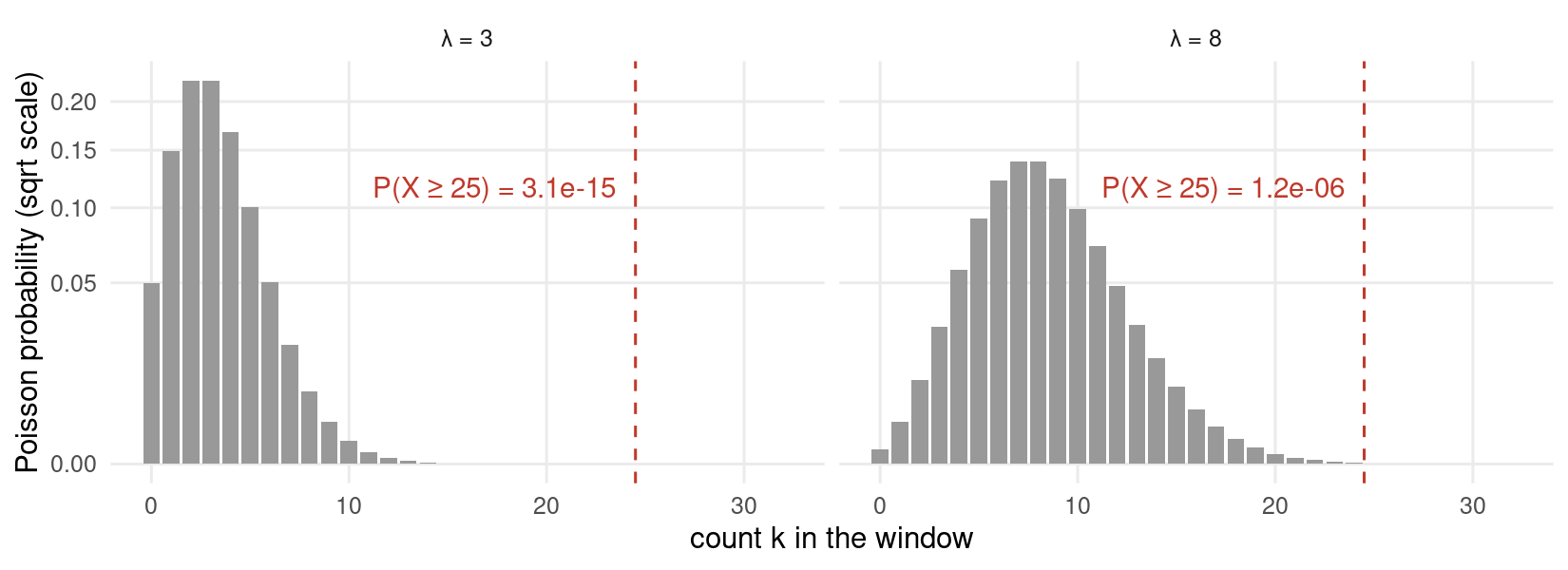
- The same 25 reads are extremely surprising against \lambda = 3 and much less so against \lambda = 8.
- Millions of positions are tested, so MACS converts p to q-values (Benjamini–Hochberg FDR).
-q 0.01: expect about 1% of called peaks to be false.
Two ways to run MACS3 on ATAC-seq
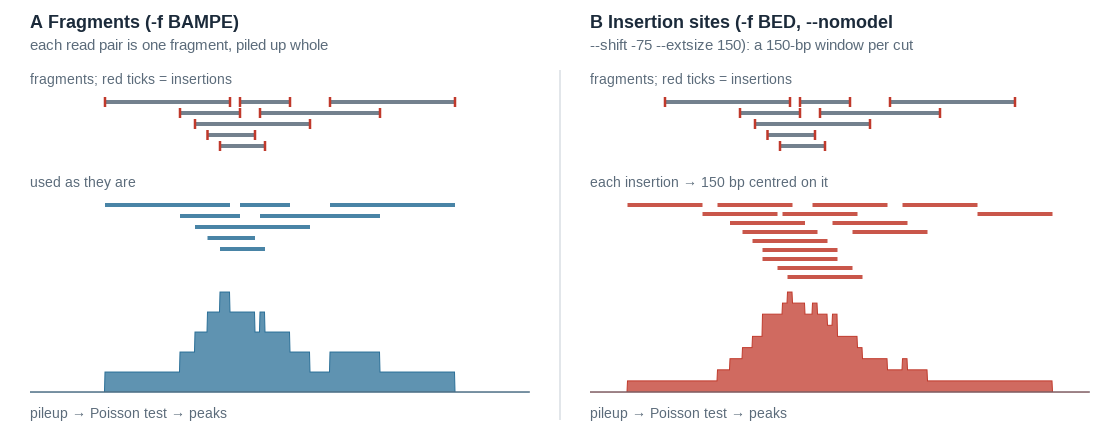
- A.
-f BAMPE: the pileup is the real fragments, no model, no shift. Simple; nucleosome-spanning fragments widen the peaks. - B. Insertion sites as BED,
--nomodel --shift -75 --extsize 150: every cut becomes a 150-bp window centred on it. Used by ENCODE and Corces et al. 2018.
Real data: how many peaks?
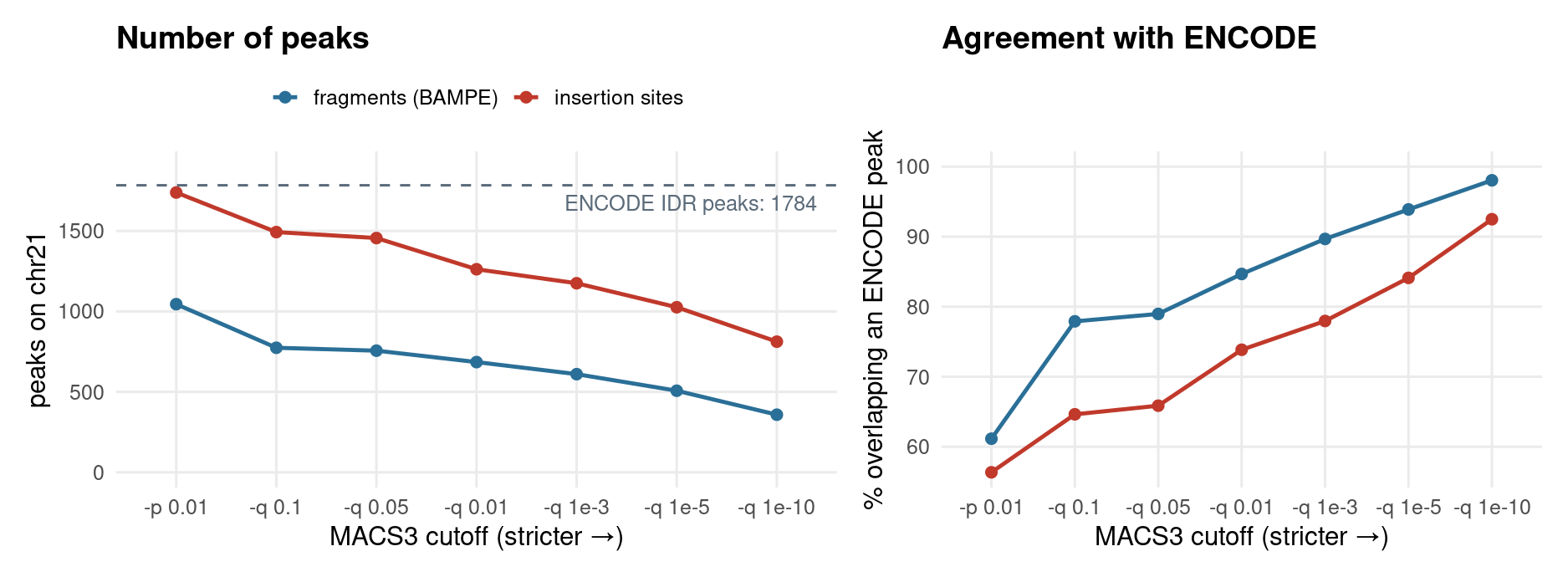
- Replicate 1, chr21, q < 0.01: 685 peaks with fragments (
BAMPE), 1262 with insertion sites. ENCODE’s IDR set has 1784. - The number of peaks depends smoothly on the cutoff: there is no natural threshold. Weak peaks are a continuum, not a separate class.
Replicates: overlap vs rank consistency
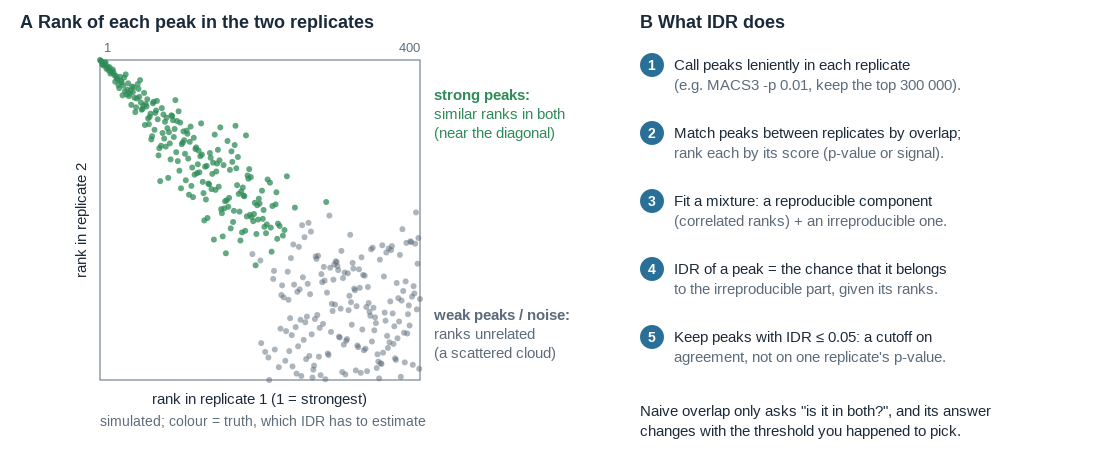
- Naive: call peaks in each replicate, keep those found in both. The answer depends on the cutoff, and a lax cutoff lets noise in.
- IDR (Li et al. 2011) uses the ranks: real peaks rank similarly in both replicates, noise does not. It finds where the agreement breaks down.
Pseudoreplicates and ENCODE’s peak sets
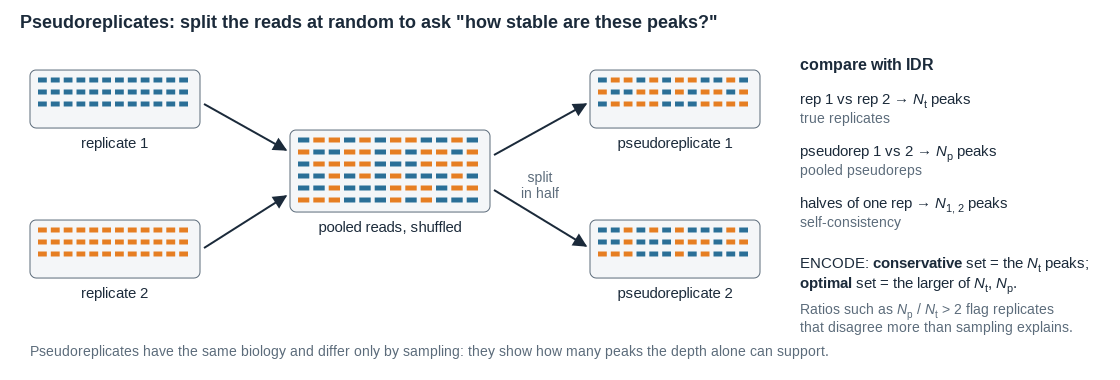
- Pool the replicates, shuffle the reads, split in two: pseudoreplicates differ only by sampling.
- If true replicates agree much less than pseudoreplicates (ratio > 2), the replicates differ in biology or quality, not just depth.
Real data: do the replicates agree?
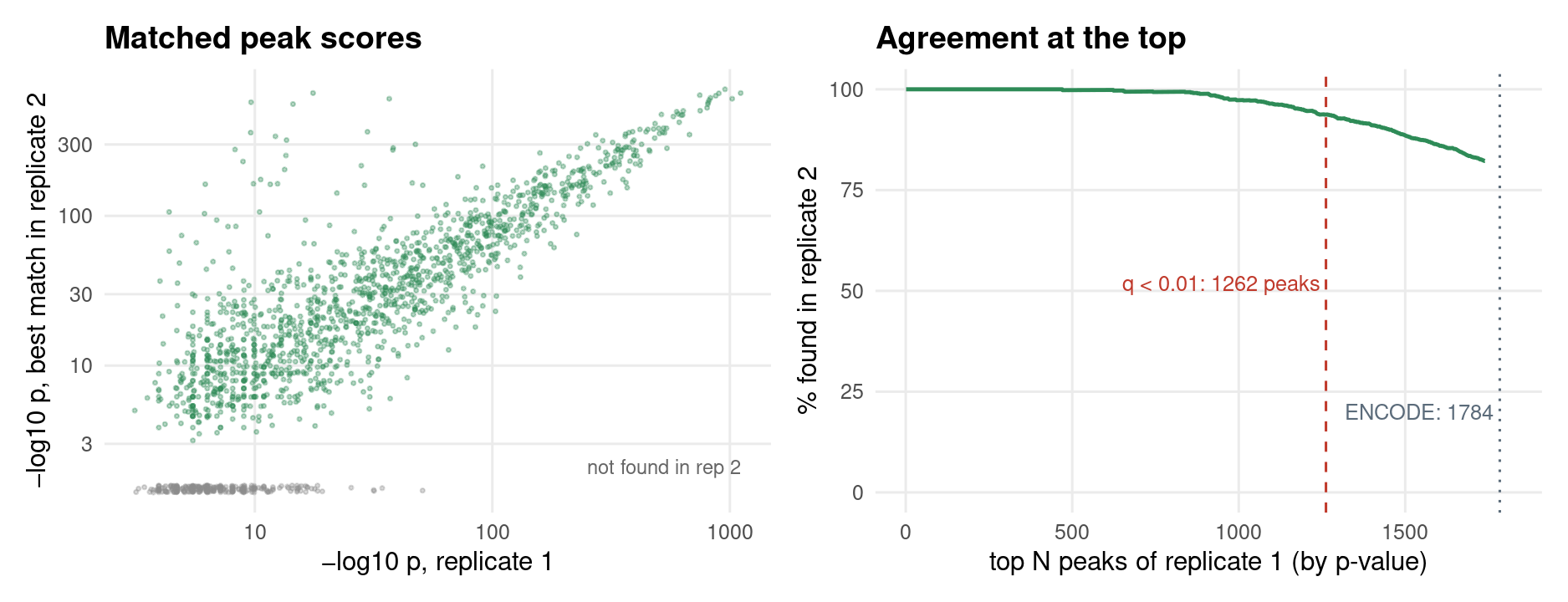
- Left: −log10 p of matched peaks in replicate 1 vs 2. Right: of the top N peaks of replicate 1, the fraction also found in replicate 2.
- The top 750 peaks: 99% found in replicate 2. Agreement stays ≥ 90% up to about 1450 peaks, then falls (82% for all 1739).
Real data: our peaks and ENCODE’s
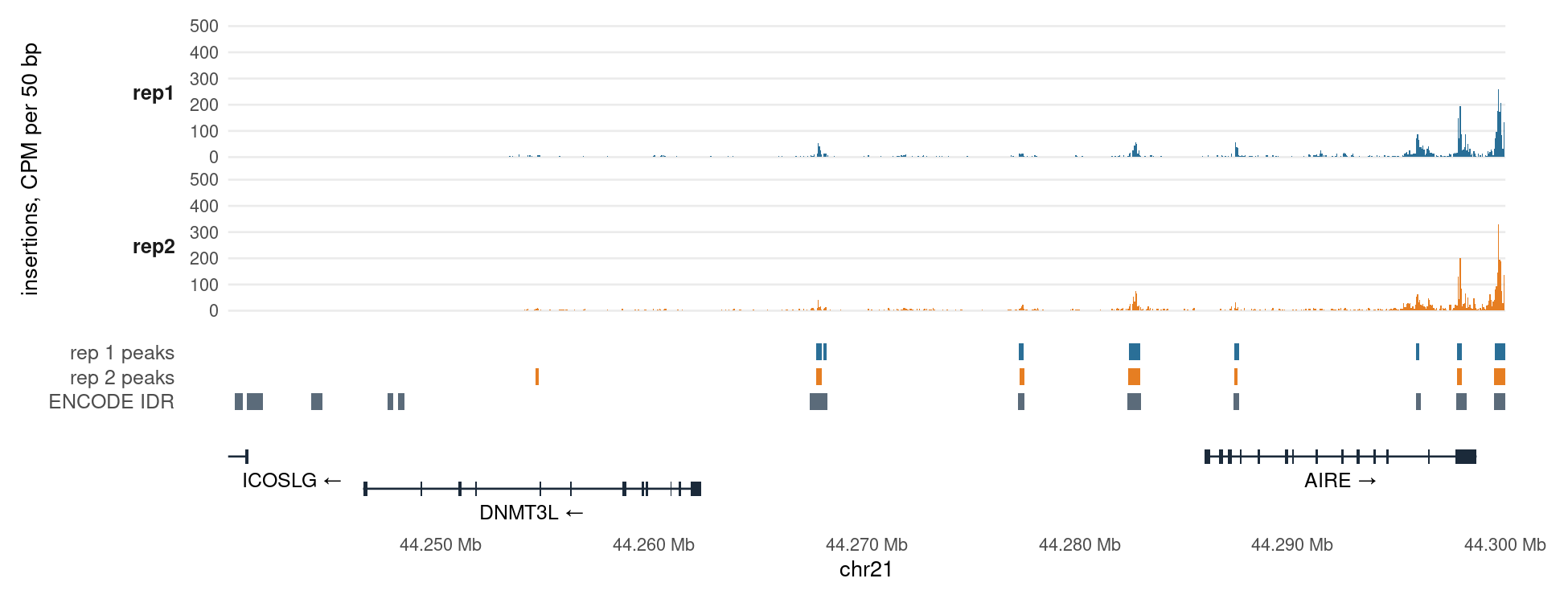
- 74% of our 1262 replicate-1 peaks are in ENCODE’s set; 89% of ENCODE’s 1784 chr21 peaks are in ours.
- Left: 1680 read pairs but only 7 with MAPQ ≥ 30 (sequence present twice). We drop them; ENCODE keeps multi-mappers.
A consensus peak set across samples
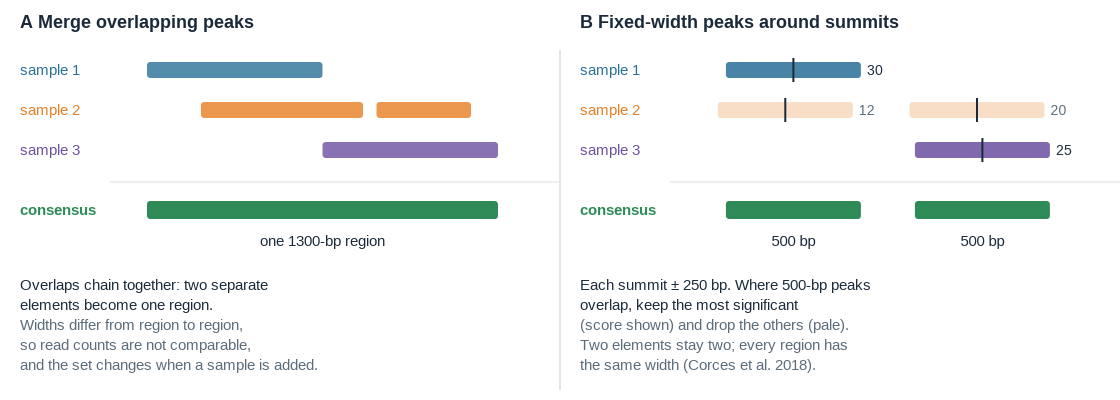
- To count reads per peak in many samples (Differential accessibility), every sample needs the same regions.
- Merge (
bedtools merge): simple, but overlaps chain into wide regions of very different widths. - Fixed width: summit ± 250 bp, overlaps resolved by significance. Every region is 500 bp, centred on a summit.
Iterative overlap removal
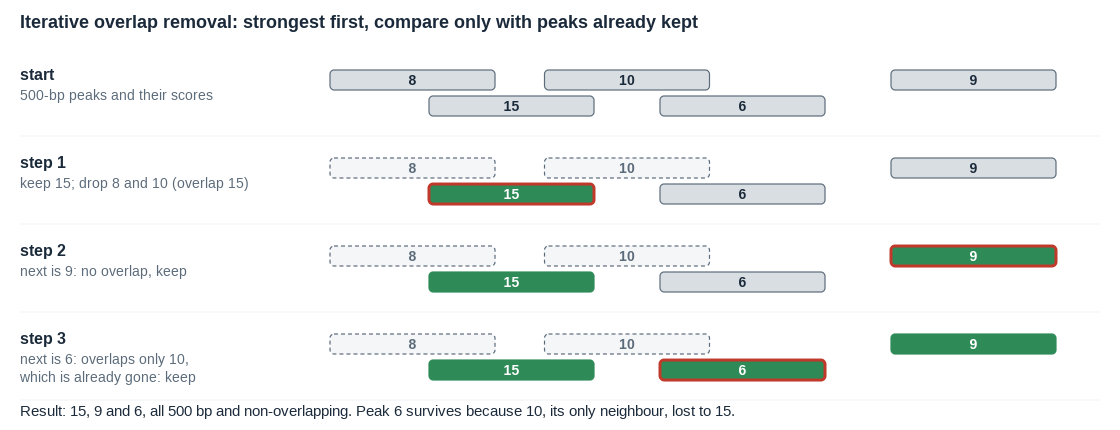
- Sort the 500-bp peaks by significance; keep the best; drop the peaks that overlap it; repeat with the next best that is left.
- Across samples, first make the scores comparable (e.g. −log10 p divided by the sample’s total, “score per million”), then run the same procedure on all peaks together.
FRiP: fraction of reads in peaks
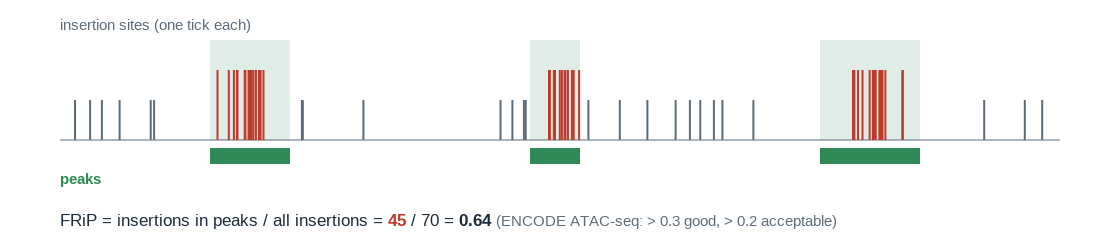
- FRiP = insertions (or reads) in peaks / all. A signal-to-noise measure: how much of the library is in accessible sites?
- Ours: 0.57 (replicate 1) and 0.48 (replicate 2), insertions in own q < 0.01 peaks. ENCODE standard for ATAC-seq: > 0.3, > 0.2 acceptable.
Where are the peaks?
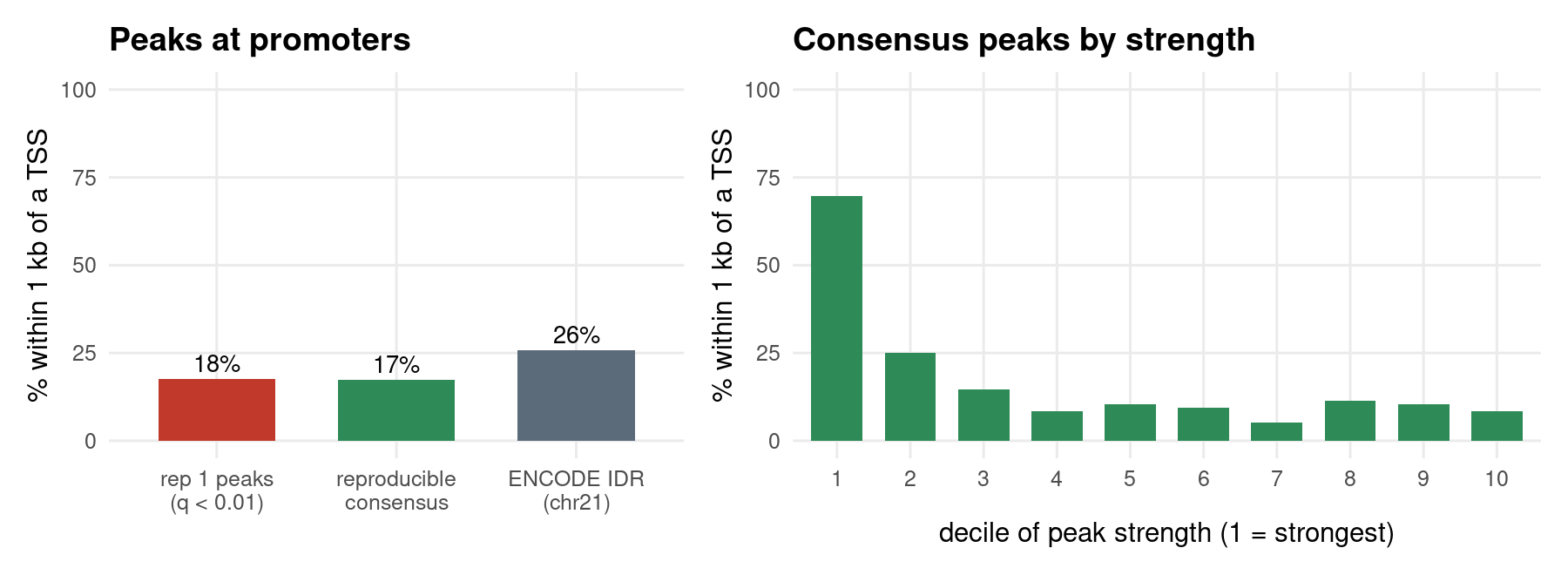
- Fraction of peaks within 1 kb of a protein-coding TSS, by peak strength (Genomic intervals).
- Strongest 10% of consensus peaks: 70% at a promoter; the other deciles: 5–25%. Overall 17% (ours) and 26% (ENCODE).
- Most peaks are distal: candidate enhancers and insulators.