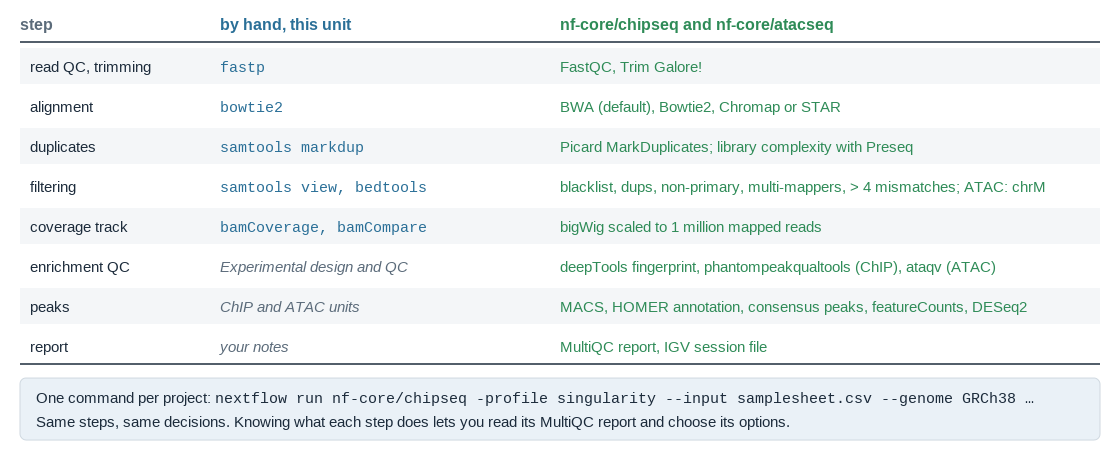
From reads to coverage
Trimming, alignment, filtering and normalised signal tracks for ChIP, ATAC and CUT&Tag
About this lecture
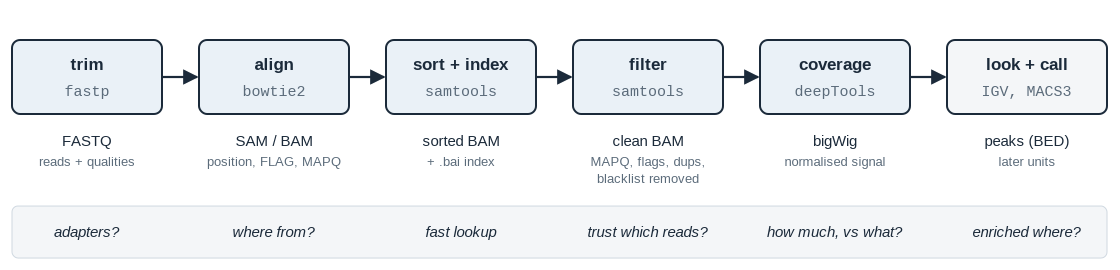
ChIP-seq, ATAC-seq and CUT&Tag measure different things, but they all hand you the same raw material: DNA fragments from enriched regions, read by a sequencer. This lecture is the shared processing that turns those reads into a signal track you can trust.
- Reads: FASTQ, base qualities, adapters, trimming.
- Alignment: bowtie2, SAM/BAM, FLAGs, MAPQ and multi-mapping reads.
- Filtering: duplicates, the blacklist, chrM, the order of the steps.
- Coverage: read extension, CPM and RPGC, fold change over input, with deepTools.
- Real data throughout: GM12878 CTCF ChIP-seq and its input, chr21.
Three assays, one kind of data
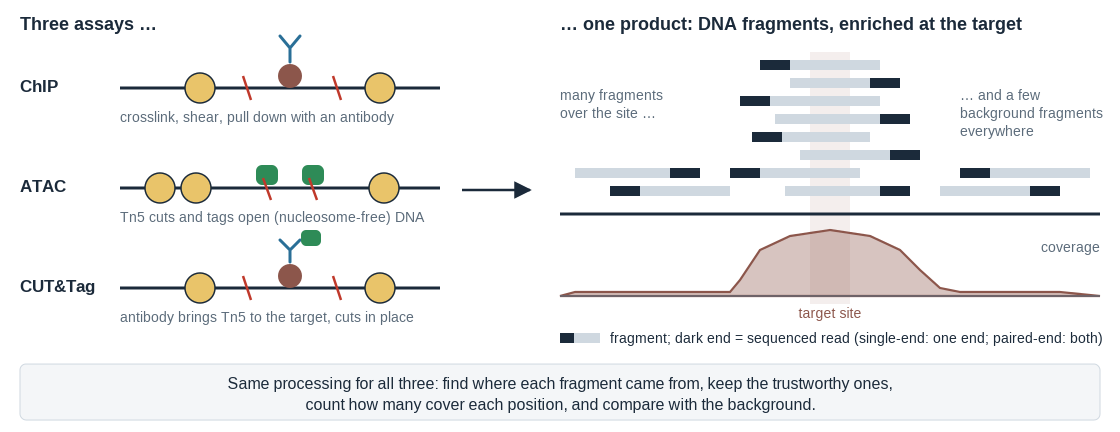
- ChIP: crosslink, shear, pull down with an antibody. ATAC: Tn5 cuts open DNA. CUT&Tag: an antibody tethers Tn5 to the target.
- Each gives fragments, more of them at the target than elsewhere. We sequence one end (single-end) or both ends (paired-end) of each fragment.
- Processing: find where each fragment came from, keep the trustworthy ones, count how many cover each position, compare with the background.
FASTQ and base quality
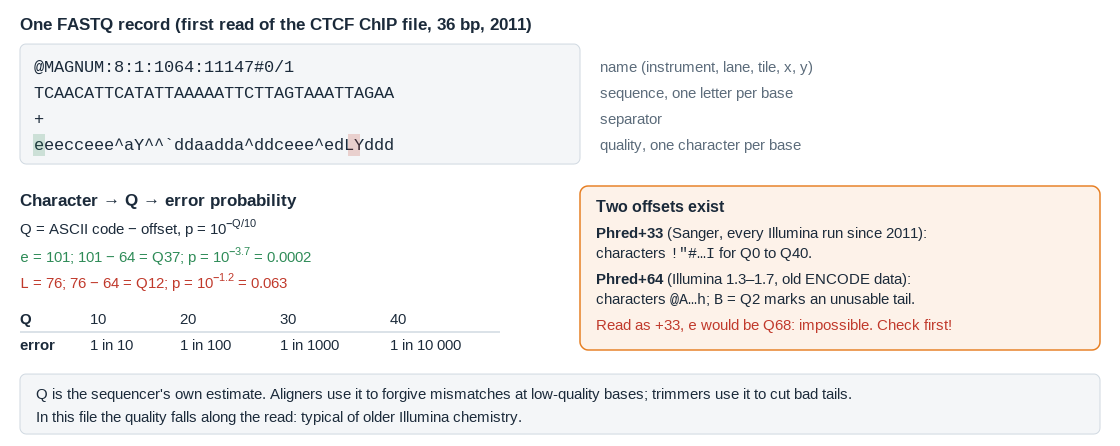
- Four lines per read: name, sequence,
+, quality. Each quality character encodes Q = −10 log10(perror). - Q20 = 1 error in 100, Q30 = 1 in 1000. To decode: ASCII code − offset (33 today, 64 in old Illumina files like this one).
Real data: quality along the read
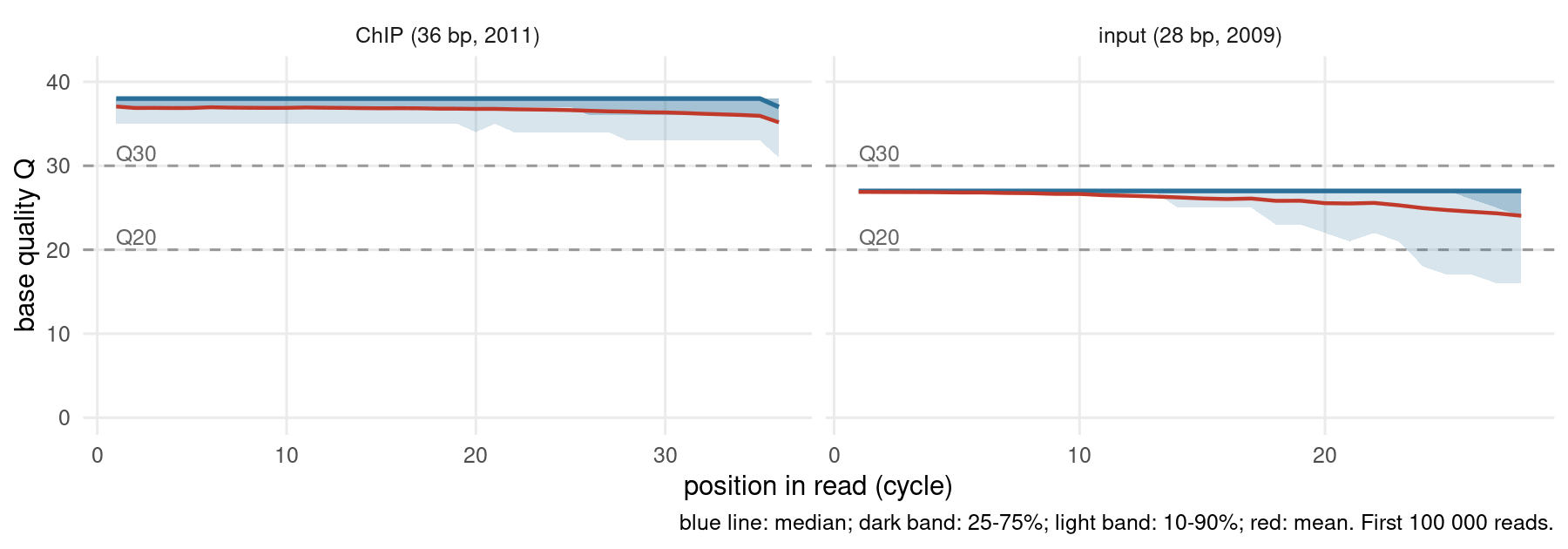
- CTCF ChIP (36 bp, 2011): median Q38, mean Q37 at the start, Q35 at the last base. Input (28 bp, 2009): mean Q27 falling to Q24; at the last base 16% of bases are below Q20.
- Quality falls along the read: the sequencing chemistry loses phase cycle by cycle. A few bad bases are tolerated by the aligner; bad tails are trimmed.
Adapters and read-through
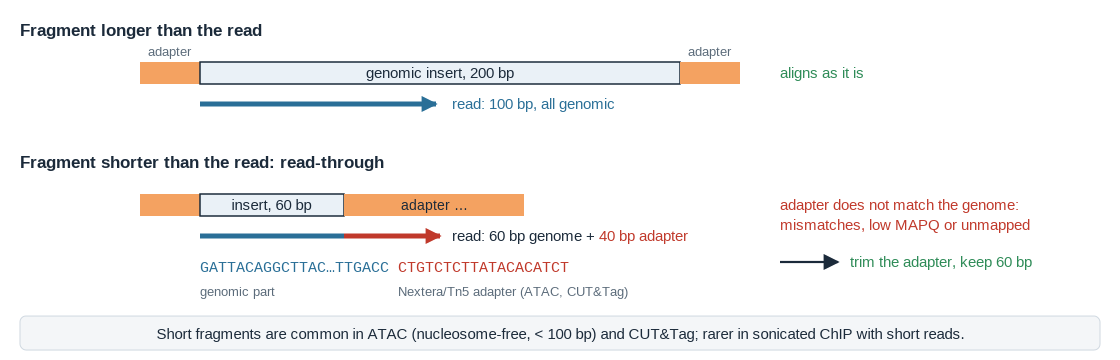
- If the fragment is shorter than the read, the sequencer reads on into the adapter. The adapter part matches nothing in the genome.
- Common in ATAC and CUT&Tag (fragments under 100 bp), rare in sonicated ChIP with short reads: fastp found no adapter in our 36 bp CTCF reads.
fastpdetects adapters (from the data, or from the overlap of paired reads) and trims them, removes low-quality and too-short reads (tail trimming on request:--cut_right), and writes an HTML report.
fastp -w 8 -i chip.fastq.gz -o chip.trim.fastq.gz -h chip.fastp.html -j chip.fastp.jsonAligning DNA is simpler than aligning RNA
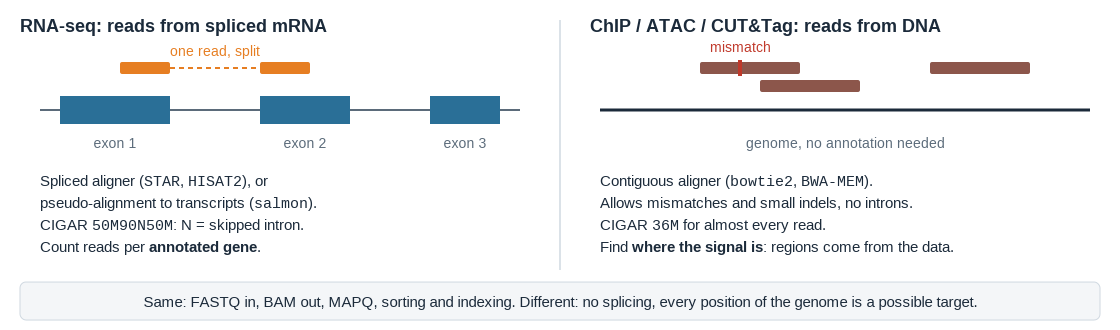
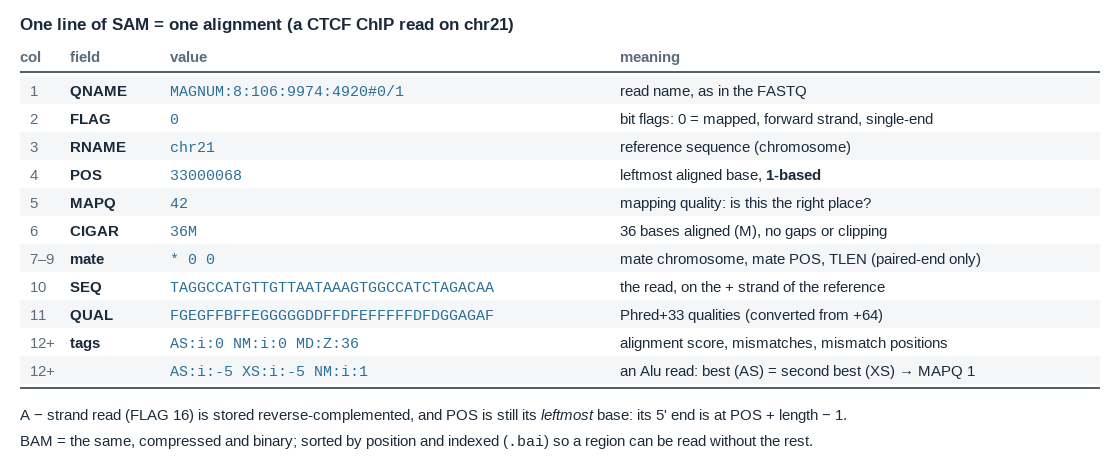
- No splicing: a read from genomic DNA aligns contiguously, with at most a few mismatches and small indels. bowtie2 or BWA-MEM, not STAR.
- No annotation: every position of the genome is a possible target. The regions come from the data (peaks), not from a GTF.
How bowtie2 finds a position: seed and extend
The SAM record
Decoding the FLAG by hand
MAPQ and reads in repeats
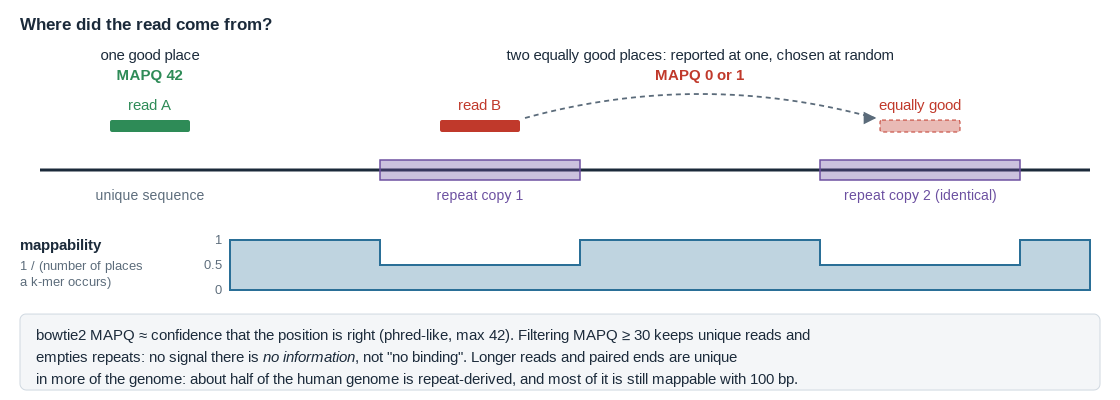
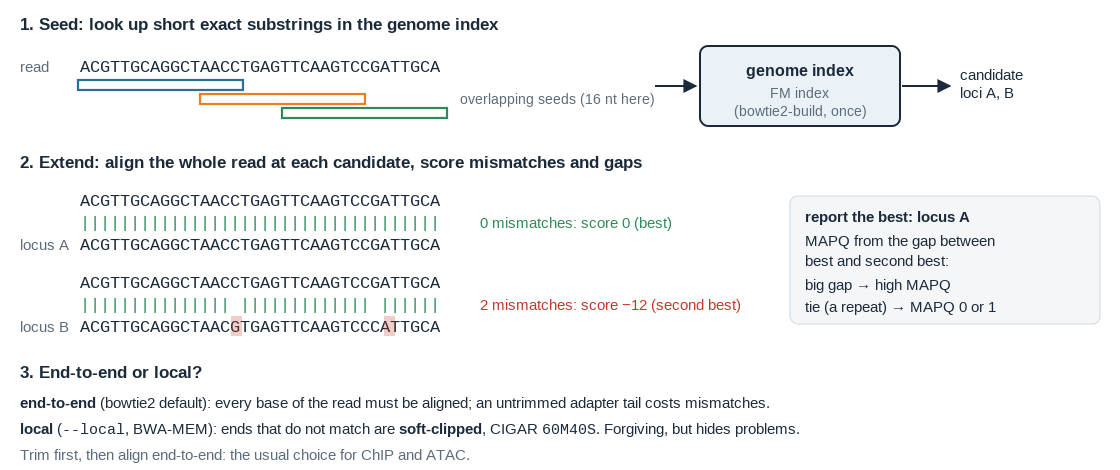
- About half of the human genome is repeat-derived (transposons, segmental duplications, satellites). A short read there fits several places equally well.
- bowtie2 reports one of them at random, with MAPQ 0 or 1. Keep only MAPQ ≥ 30 (or ≥ 10–20 in some pipelines) for coverage tracks.
Real data: MAPQ on chr21
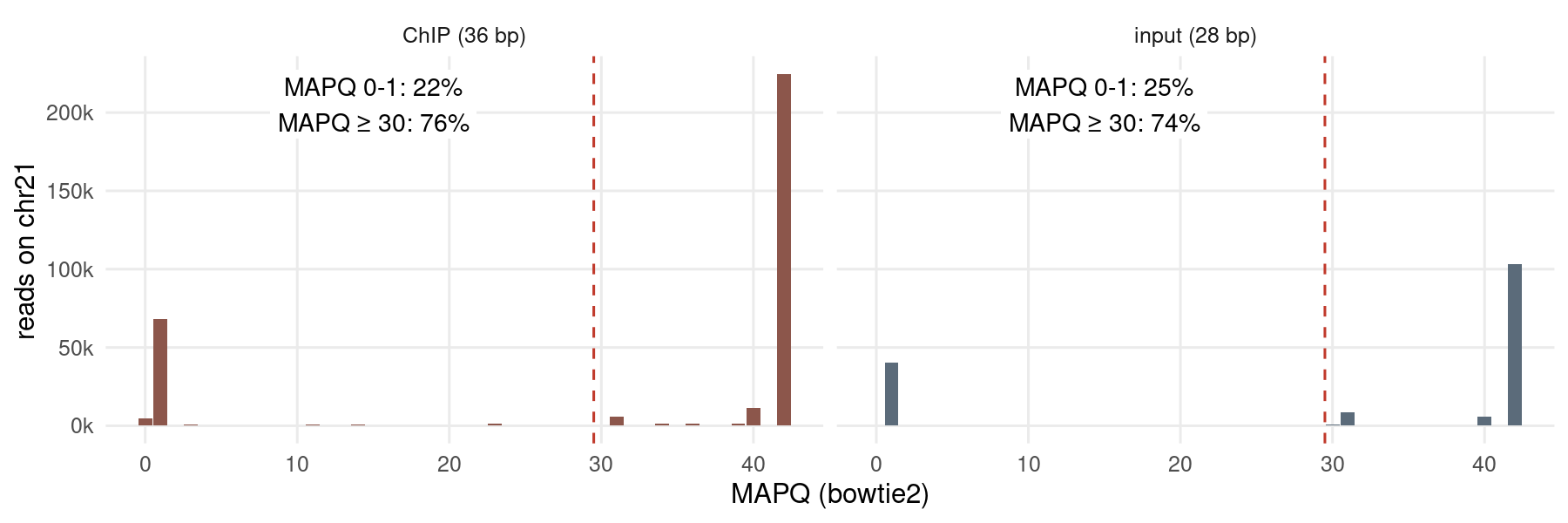
- Two peaks: MAPQ 0–1 (22% of ChIP reads, 25% of input reads) and MAPQ 42. Little in between.
- Filtering at MAPQ ≥ 30 keeps 76% (ChIP, 36 bp) and 74% (input, 28 bp) of the reads on chr21. Shorter reads are unique less often.
Paired-end reads and the fragment
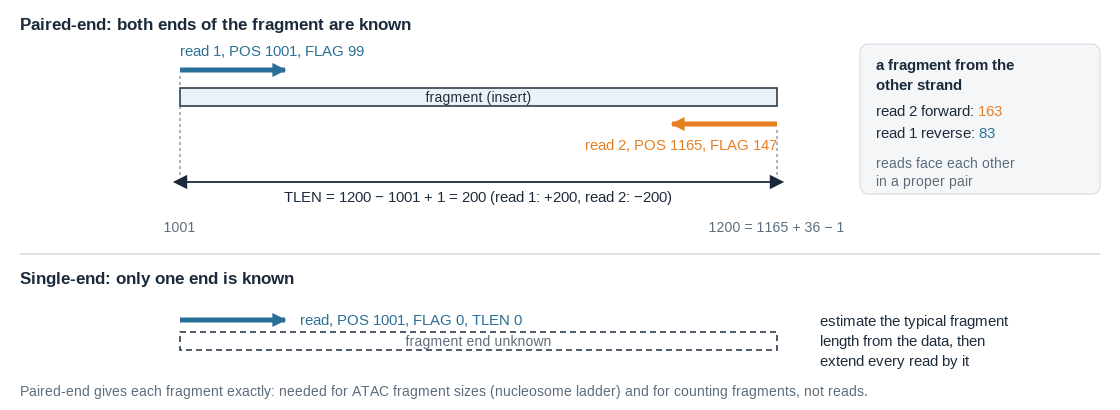
- A proper pair: the two reads face each other on opposite strands, at a plausible distance. TLEN = rightmost end − leftmost start + 1 = the fragment length.
- Single-end data know only one end: the fragment length must be estimated and the reads extended.
PCR and optical duplicates
Real data: the blacklist and chrM
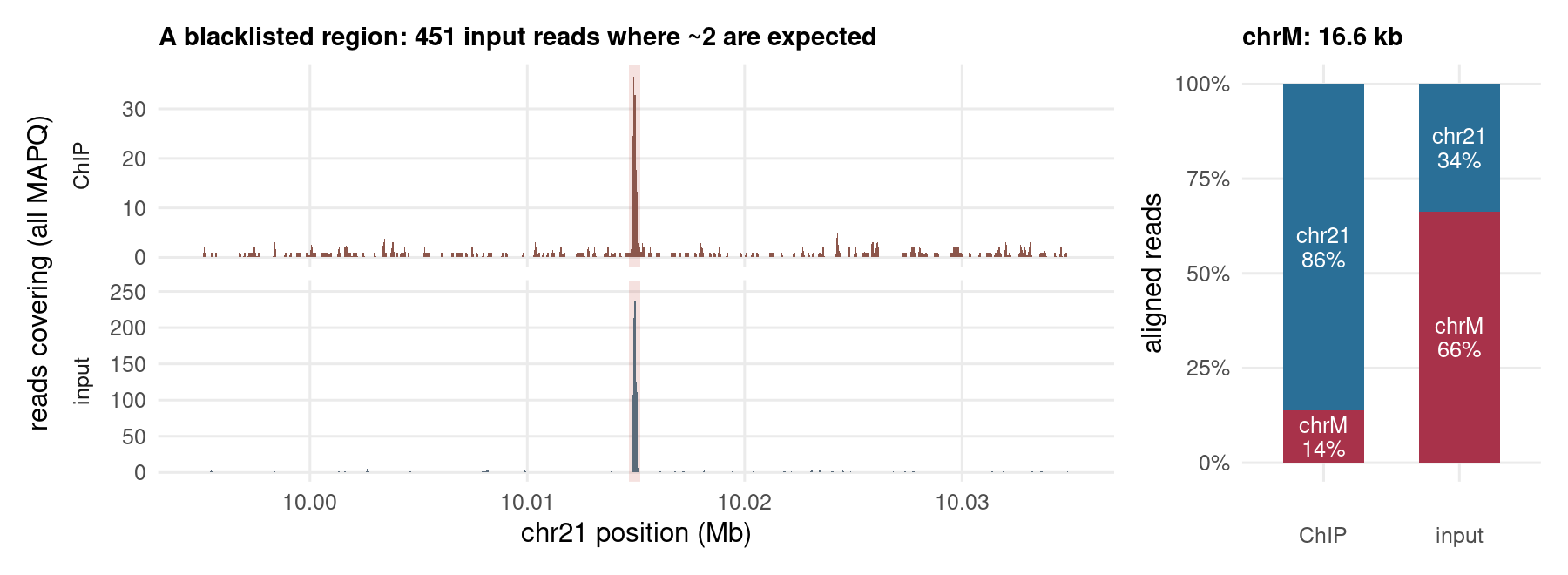
- Blacklist (ENCODE exclusion list): regions with extreme signal in every experiment, input included: satellite repeats, rDNA, centromeres. 910 regions in GRCh38, 24 on chr21. Remove reads there.
- chrM: many copies per cell, no nucleosomes. 14% of ChIP reads but 66% of input reads here; in ATAC often 20–80%. Remove before normalising.
The filtering chain, step by step
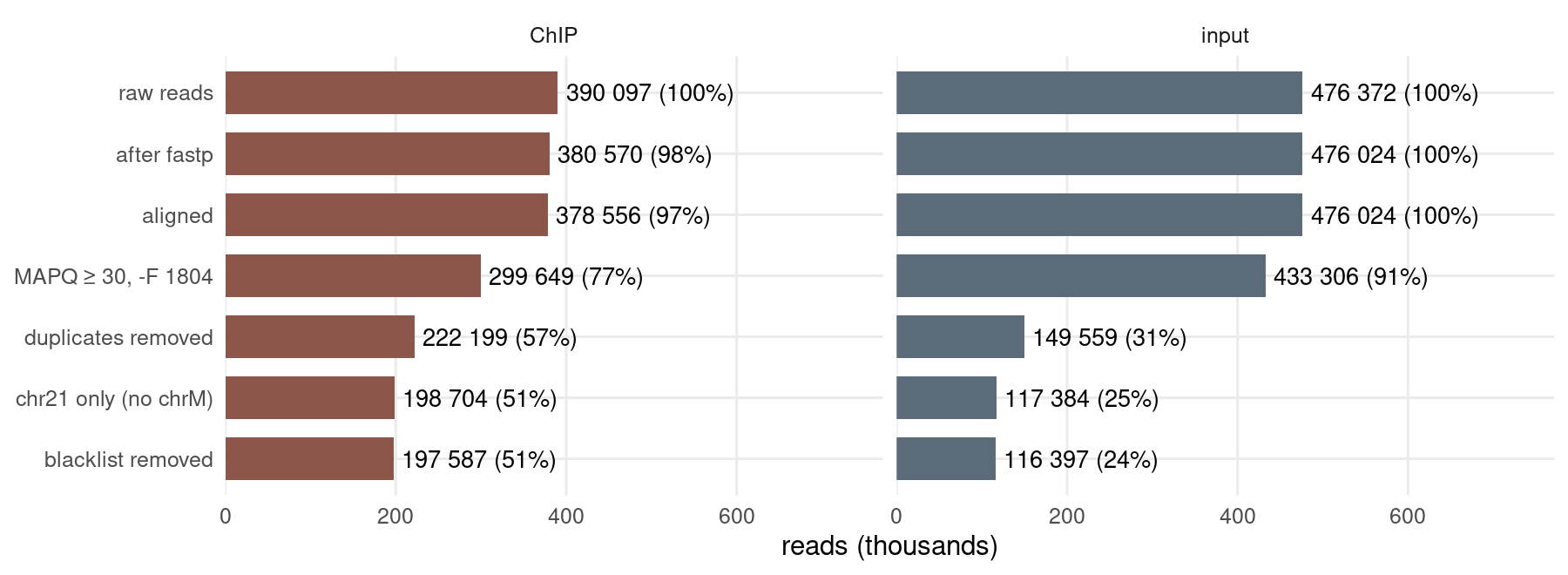
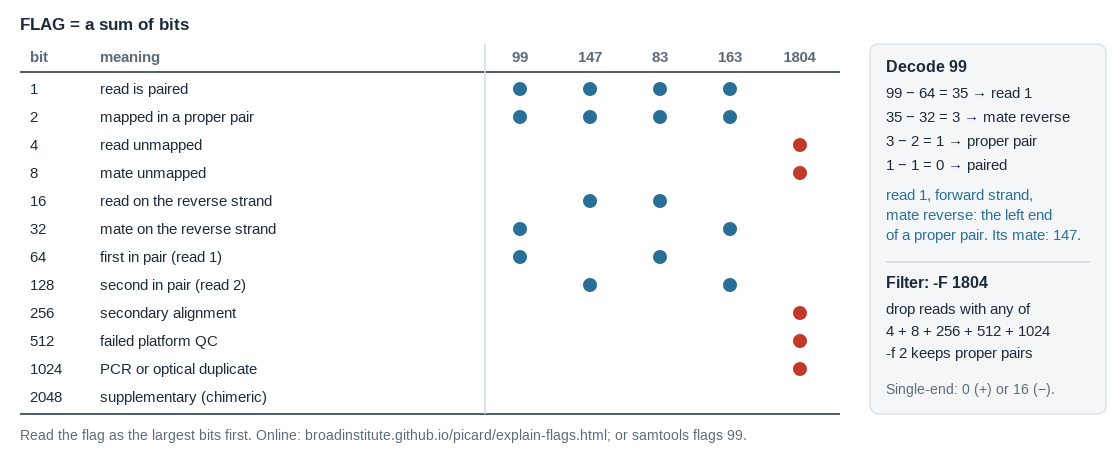
samtools view -b -q 30 -F 1804 -o chip.q30.bam chip.sorted.bam        # unique, mapped, primary
samtools markdup -s chip.q30.bam chip.markdup.bam                     # flag duplicates (1024)
samtools view -b -F 1024 -o chip.dedup.bam chip.markdup.bam chr21     # drop them, and chrM
bedtools intersect -v -abam chip.dedup.bam -b blacklist.bed > chip.final.bamSingle-end reads need extending
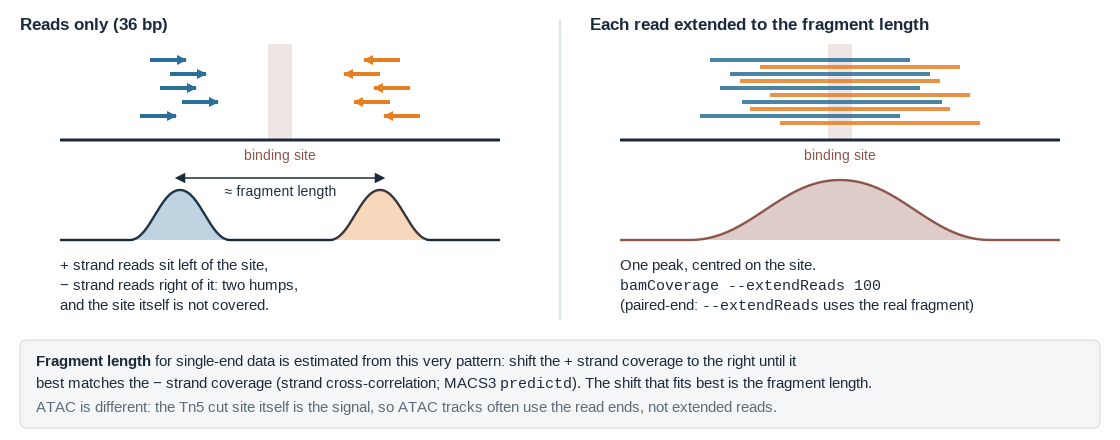
Real data: the two strands around CTCF sites
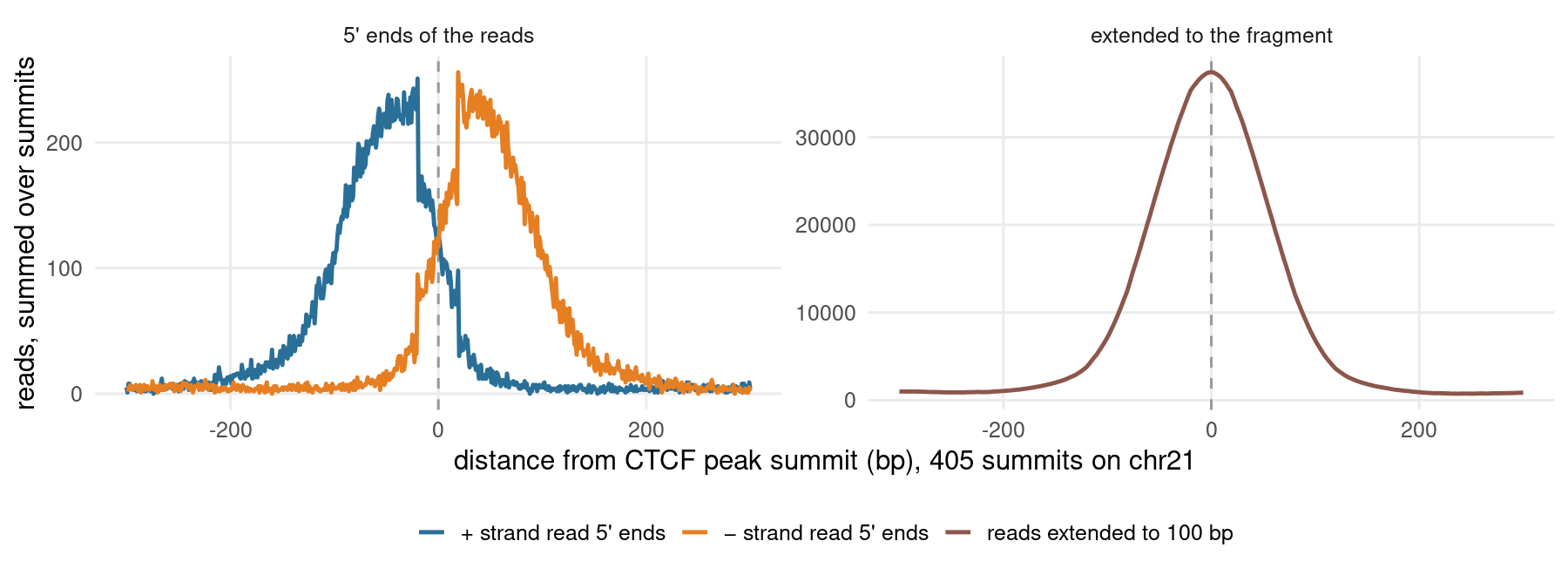
- Left: 5’ ends of + strand reads peak about 50 bp left of the CTCF summits, − strand reads about 50 bp right. Median distance between them: ≈ 100 bp = the typical fragment.
macs3 predictdestimates the same: 100 bp. Right: reads extended to 100 bp give one peak, centred on the summits.
Coverage and normalisation: CPM and RPGC
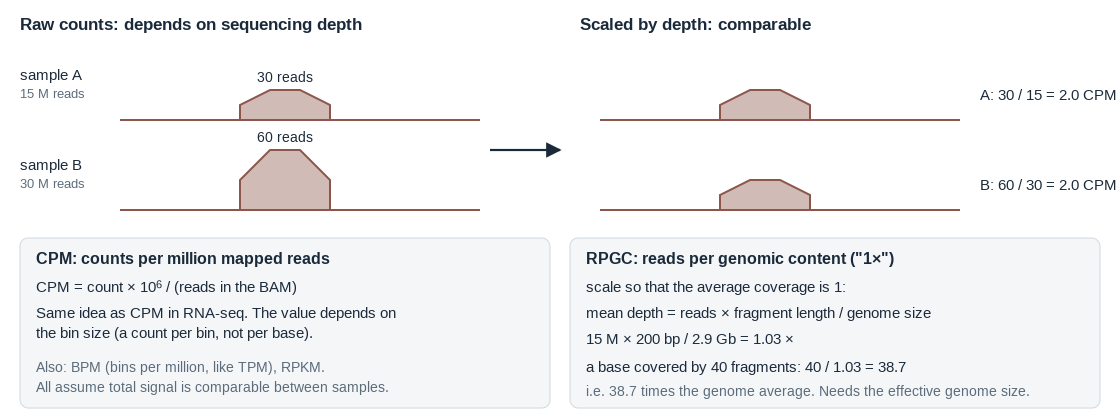
- Raw counts scale with sequencing depth. CPM divides by the number of reads (in millions): the same as CPM in RNA-seq.
- RPGC (1× normalisation) scales so the genome average is 1: a value of 38.7 means 38.7 times the average coverage.
- Both assume the total amount of signal is comparable between samples. A global change (a drug that removes a mark everywhere) breaks them: spike-ins, in Experimental design and QC.
Fold change over the input
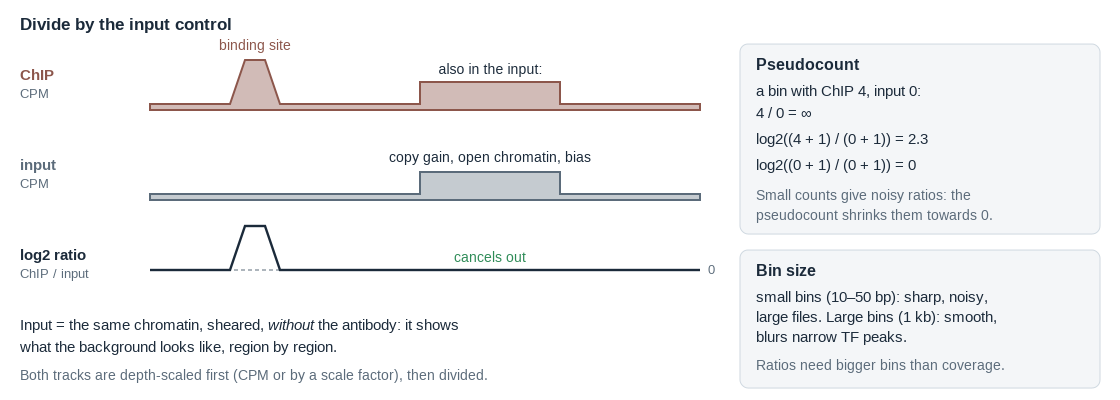
- The input (same chromatin, no antibody) shows local background: copy number, open chromatin, mappability, GC bias. Dividing by it removes what ChIP and input share.
bamComparescales both to the same depth, then reports ratio or log2 ratio per bin, with a pseudocount to avoid dividing by zero.
Real data: our tracks at a locus
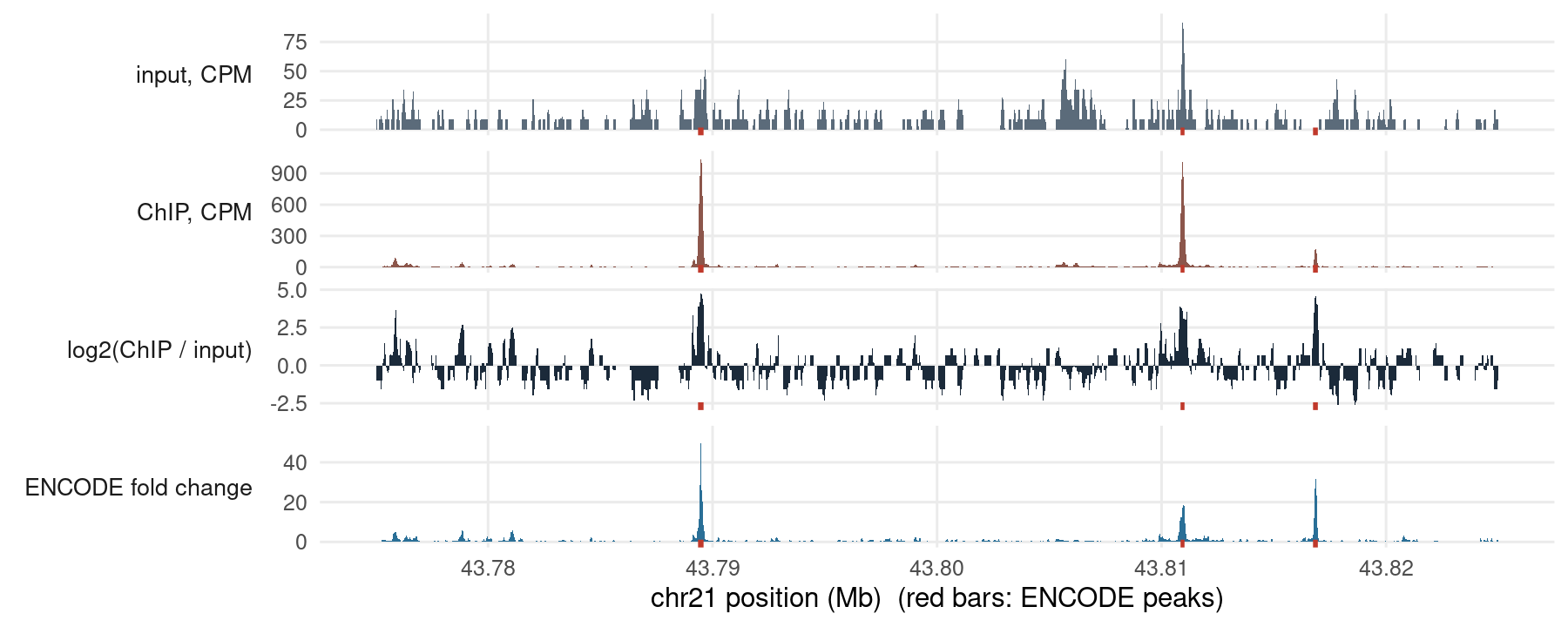
- Three CTCF sites at chr21:43.78–43.82 Mb. Our ChIP CPM track and ENCODE’s fold change agree on where the peaks are.
- Our log2 ratio is noisy away from peaks: the input has only 116 000 reads on chr21, about 3 per kb. ENCODE’s track smooths the input over kilobases (MACS2 local λ).
Real data: our track against ENCODE’s
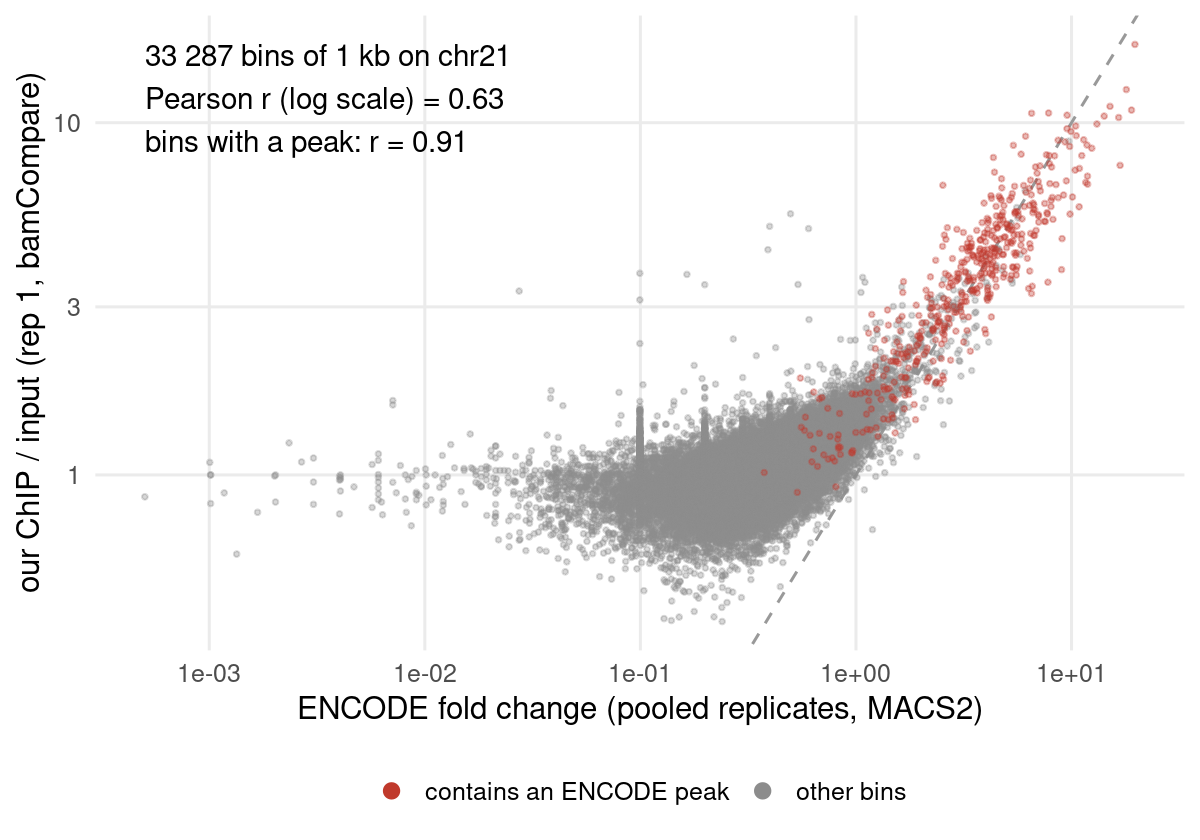
- Mean signal in 33 287 one-kb bins on chr21 (blacklist and empty bins removed). Bins with an ENCODE peak agree well (r = 0.91); background bins much less (overall r = 0.63).
- Same data, different tools and choices: the peaks are robust, the background depends on how you treat the input.
The shortcut used in this course
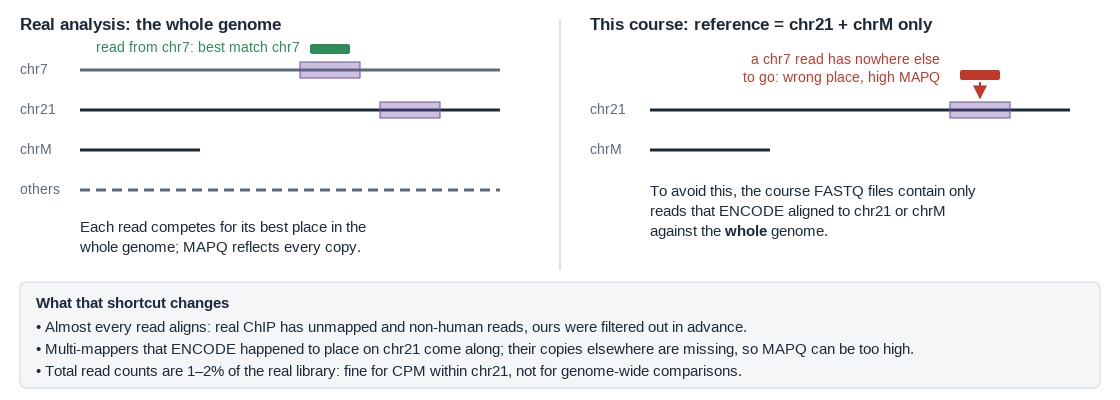
What the production pipelines do