Modified bases on single native molecules: nanopore and PacBio, modkit, haplotypes, imprinting, X inactivation and Fiber-seq
Epigenetics
About this lecture
Bisulfite and enzymatic sequencing reads methylation from converted, short DNA fragments. Long-read sequencers read the native molecule, so the modification itself is part of the signal, on reads of 10 to 100 kb.
How a nanopore and a PacBio instrument see 5mC, 5hmC and 6mA without conversion.
The modBAM: MM and ML tags, call probabilities, and modkit pileup to a bedMethyl table.
Agreement with WGBS on the same cell line.
Haplotype-resolved methylation: phasing reads, imprinted loci, X inactivation.
Chromatin accessibility on single molecules: Fiber-seq and its nanopore relatives.
Running example: HG001 = GM12878 (nanopore, ~80×) and an EcoGII-treated nanopore run of HG002.
Short converted reads vs long native molecules
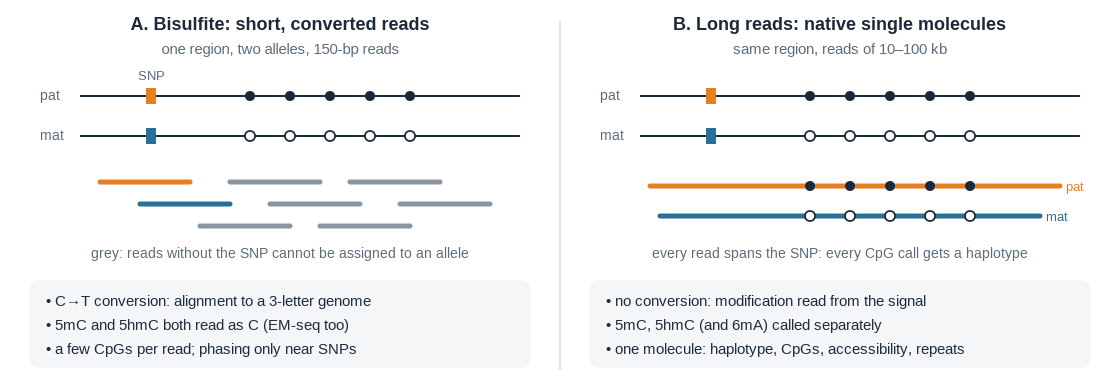
WGBS and EM-seq: reads of 150 bp, converted, aligned to a three-letter genome; 5mC and 5hmC both read as C.
Long reads: tens of kilobases of native DNA; every CpG on the molecule, its SNP alleles and other modifications in one record.
Two ways to see a modification without conversion
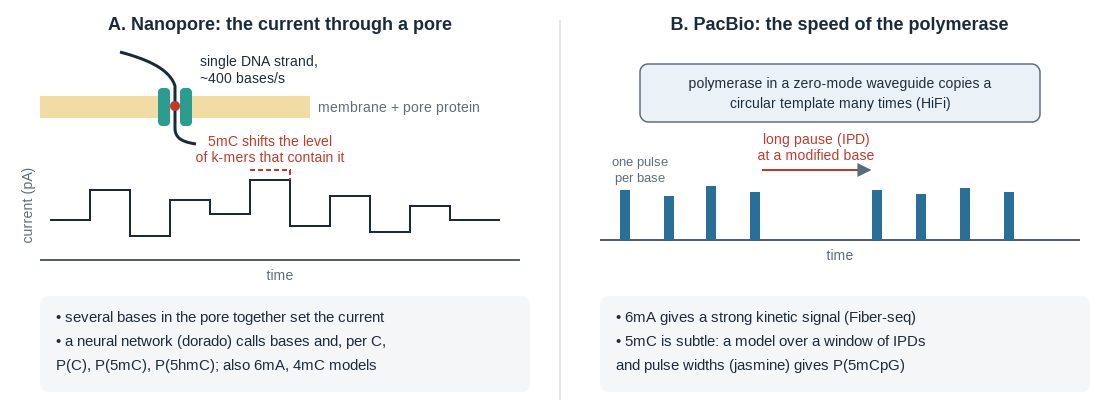
Nanopore: the ionic current through the pore depends on the few bases inside it; a methyl group changes it slightly. A neural network (dorado) turns the signal into bases and, for each candidate base, modification probabilities.
PacBio HiFi: the polymerase pauses longer at a modified template base (inter-pulse duration). 6mA gives a strong signal; 5mC at CpG is learned from the kinetics around it.
What can be called today
modification
context
nanopore (R10.4.1, dorado)
PacBio HiFi
5mC
CpG
yes, routine
yes, routine (jasmine)
5hmC
CpG
yes, together with 5mC
not routinely
5mC
all contexts (CHG, CHH: plants)
yes (all-context model)
limited
6mA
all contexts
yes
yes (strong kinetic signal)
4mC
bacteria
yes
yes
Every call is a probability per base per read, from a model trained on control DNA (unmethylated PCR products, fully methylated by M.SssI, synthetic oligos).
Model and basecaller versions matter: always report them, and compare samples called with the same model.
nanopore, nuclei treated with EcoGII (6mA), and untreated
chr21 33–34 Mb
ONT open data, chrom_acc_2025.06
10 462 reads, median length 4.6 kb (mean 11 kb) in the slices; about 80× coverage. The reads were cut out of the genome-wide CRAMs by indexed remote access (samtools view -M -L regions.bed https://...cram).
The modBAM: MM and ML tags
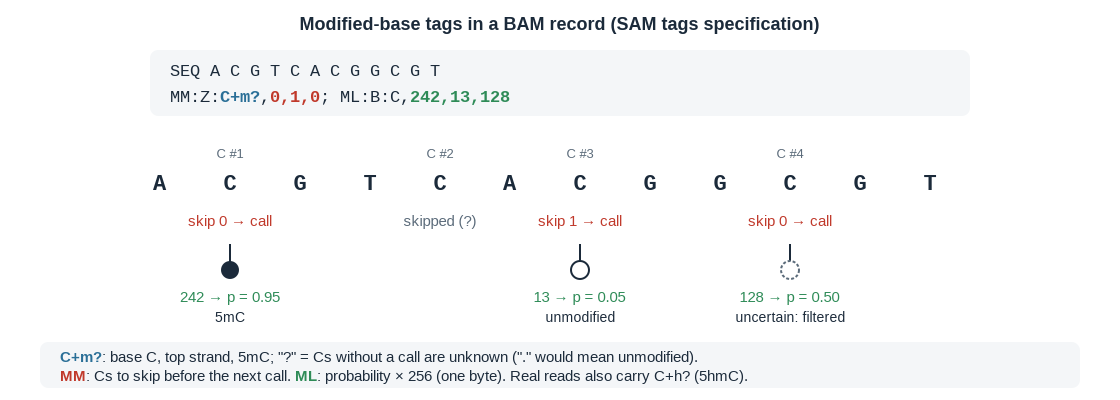
MM lists which bases carry calls (as skip counts); ML gives one probability per call, scaled to 0–255.
Calls refer to the read sequence as sequenced (SEQ is reverse-complemented for reverse-strand alignments: tools handle this).
Probabilities, and the threshold
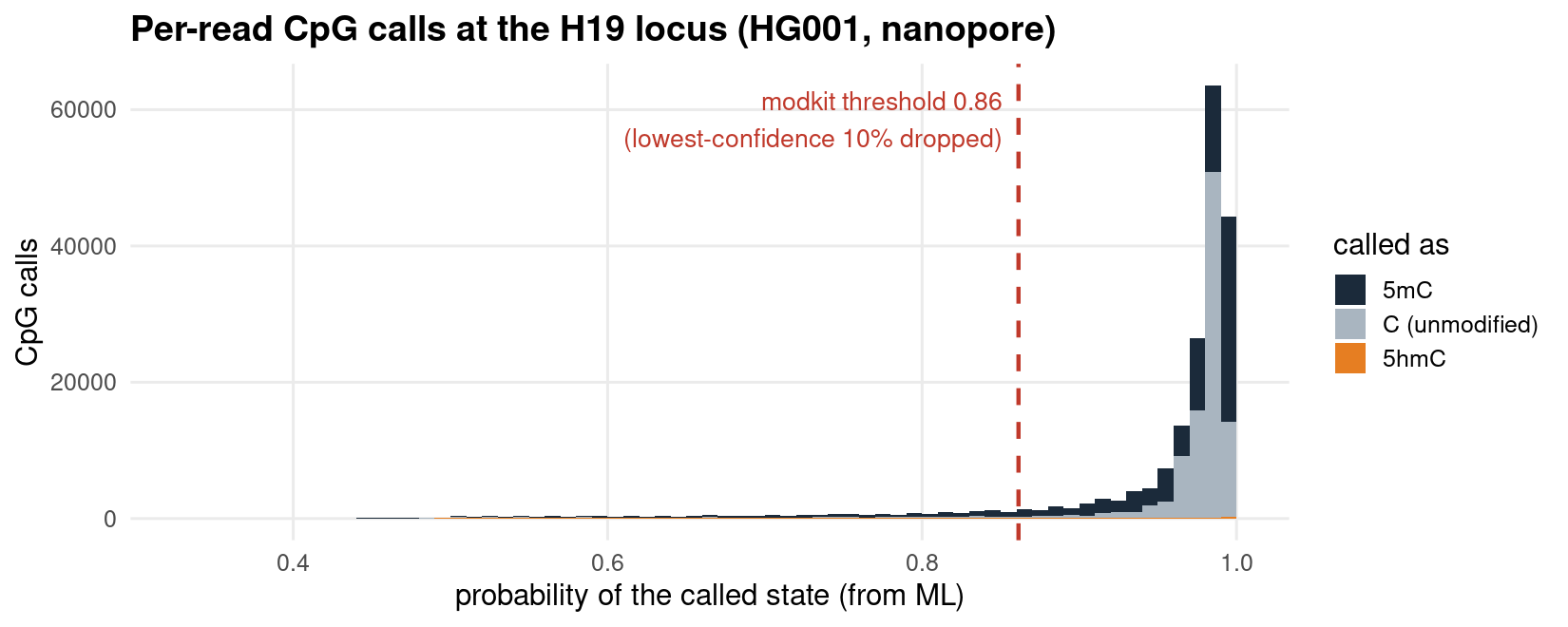
Most calls are confident (probability > 0.95). modkit estimates a threshold so that the least confident 10% of calls are discarded: 0.865 for these reads.
A methylation level is then a count: methylated calls / valid calls, exactly like C/(C+T) in WGBS.
N other modification (here: 5hmC calls, for the m row)
16
N fail: calls below the confidence threshold
Nanopore and WGBS agree
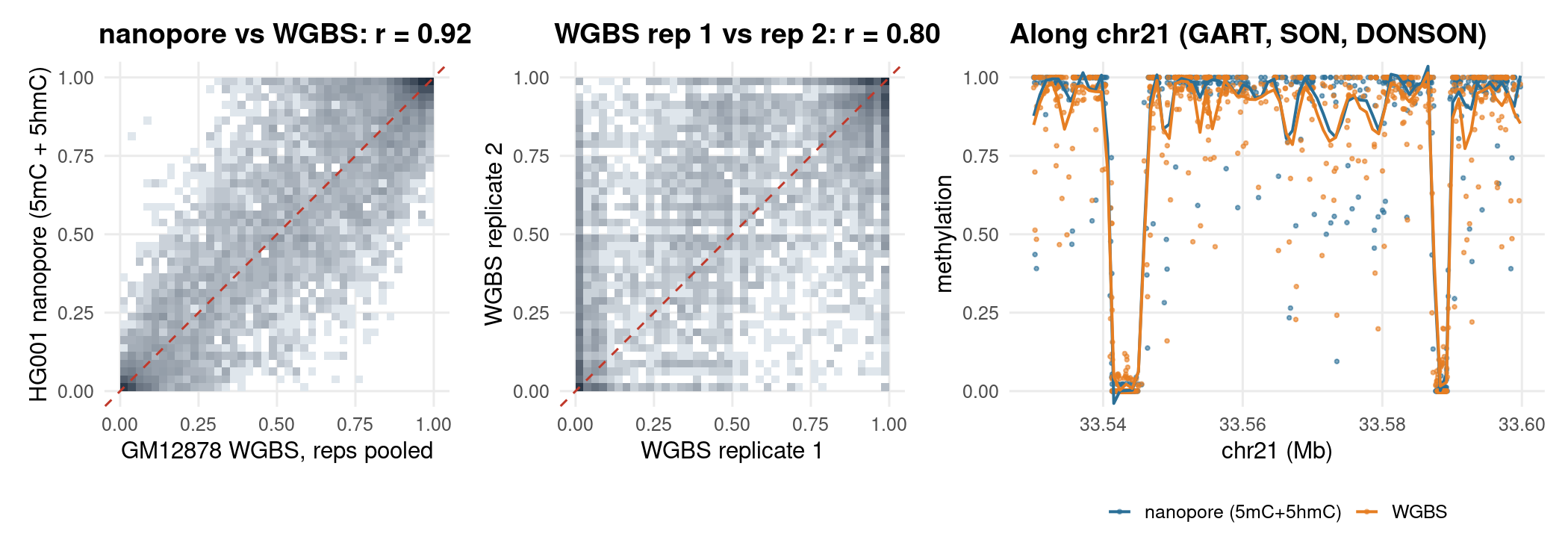
9 779 CpGs with ≥ 10 calls in nanopore and in each of two ENCODE WGBS replicates: nanopore vs pooled WGBS r = 0.92 (median absolute difference 0.05).
The two WGBS replicates agree less with each other (r = 0.80) than nanopore agrees with them. Along the chromosome the profiles are almost identical.
5mC and 5hmC: what bisulfite cannot separate
In our HG001 slices: mean 5mC 55%, mean 5hmC 0.8% of CpG calls. Blood cells and cell lines have little 5hmC; brain has 10–20 times more.
Bisulfite (and EM-seq) report 5mC + 5hmC as “methylated”. TAB-seq, oxBS or 5hmC-specific enzymatic methods are needed to split them; the nanopore model does it in the same run.
Caution: at 1% the 5hmC calls are close to the false-positive rate of the model. Small 5hmC differences between samples need validation.
Haplotypes: which copy is methylated?
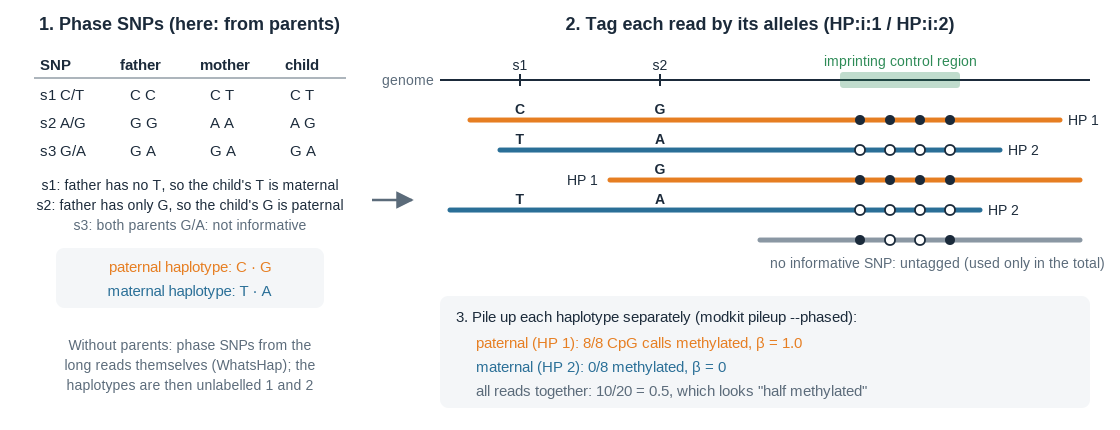
A level of 0.5 can mean half of the cells, or one of the two alleles in every cell. Only reads assigned to haplotypes tell them apart.
With the parents’ genotypes (a trio) the haplotypes get parental labels; without them they are just 1 and 2.
Phasing in practice
# child heterozygous, phase by transmission -> VCF with GT = paternal|maternal (awk in the exercise)bcftools query -f'%CHROM\t%POS\t%REF\t%ALT[\t%GT]\n'$D/hg001_trio_regions.vcf.gz |awk'...'> trio_phased.vcfbgzip trio_phased.vcf &&tabix-p vcf trio_phased.vcf.gzwhatshap haplotag --ignore-read-groups--reference hg38_lr.fa \--output-haplotag-list haplotags.tsv -o hg001_tagged.bam trio_phased.vcf.gz $D/hg001_ont_regions.bamsamtools index hg001_tagged.bammodkit pileup hg001_tagged.bam phased/ --phased--ref hg38_lr.fa \--cpg--modified-bases 5mC 5hmC --combine-strands--sampling-frac 1 -t 4
562 heterozygous SNPs informative in the trio; 5 575 of 10 462 reads (53%) carry at least one and get a tag: 2 880 paternal, 2 695 maternal.
phased/hp1.bedmethyl and phased/hp2.bedmethyl: one bedMethyl per haplotype.
Single molecules at the H19 imprinting control region
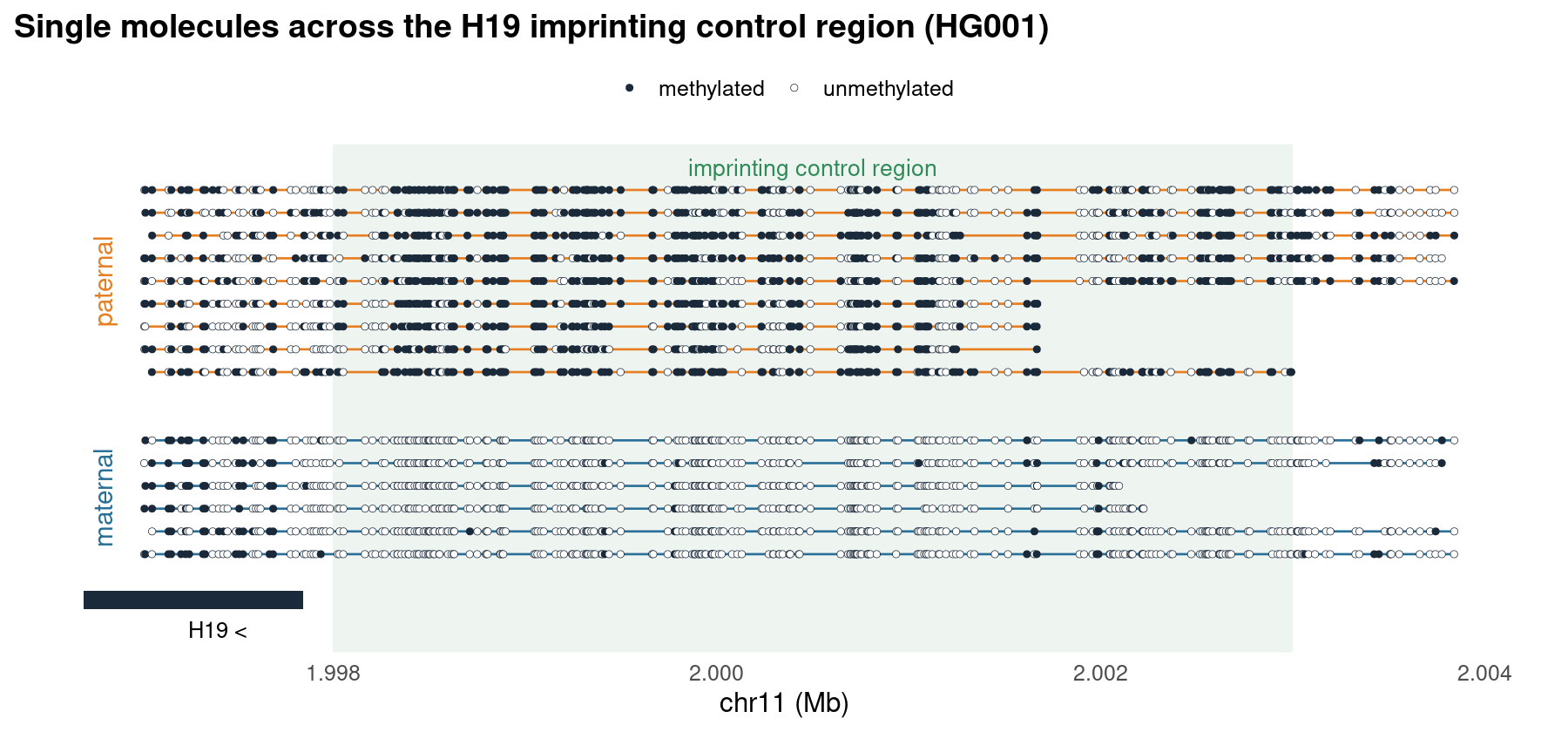
Paternal reads: 67% of CpG calls methylated; maternal reads: 8%, and across the 5-kb ICR 0.72 vs 0.01. The methylated copy is the paternal one, as the textbook says.
Outside the ICR (left, over the H19 gene) both alleles are partly methylated.
Three imprinted loci, both directions
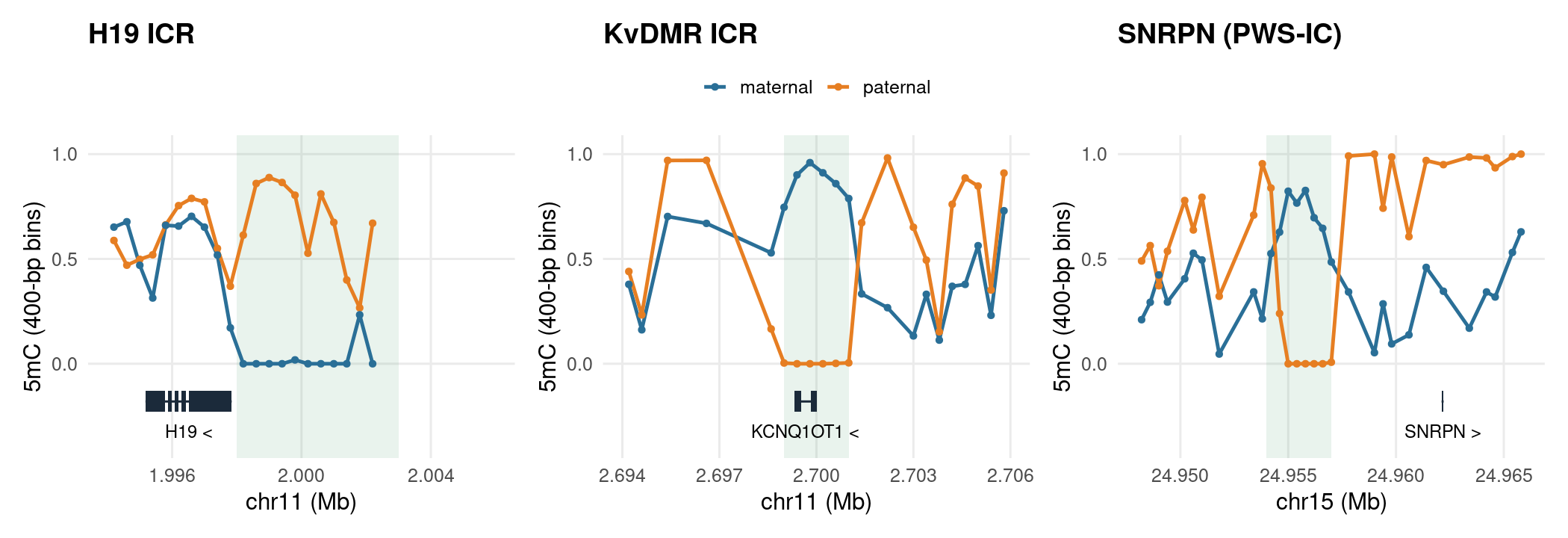
ICR (shaded)
methylated allele, expected
paternal
maternal
H19 ICR (chr11)
paternal
0.72
0.01
KvDMR, KCNQ1OT1 promoter (chr11)
maternal
0.00
0.90
PWS-IC, SNURF/SNRPN promoter (chr15)
maternal
0.04
0.75
Three reasons for allele-specific methylation
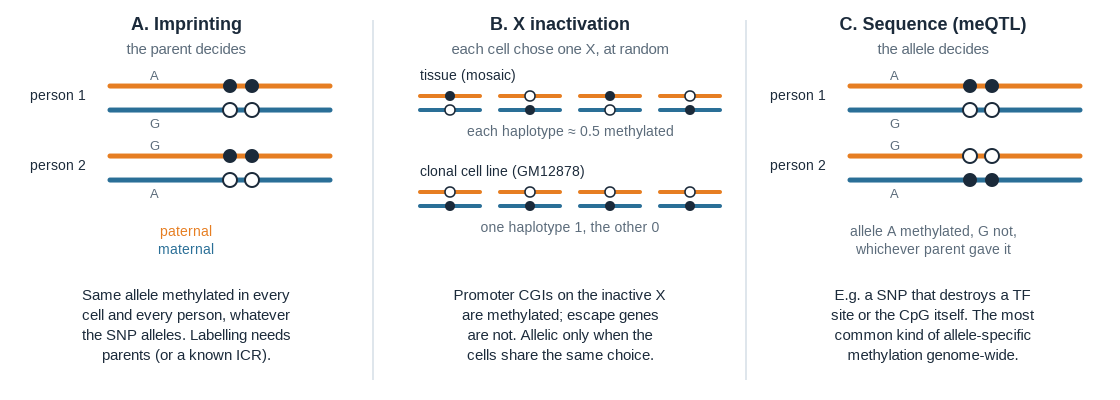
Phasing finds allele-specific methylation (ASM); the cause must be inferred: parent of origin, random X choice, or the DNA sequence.
Test: does the methylated allele follow the parent (imprinting) or the SNP allele across people (meQTL)?
X inactivation, on one cell line’s two X chromosomes
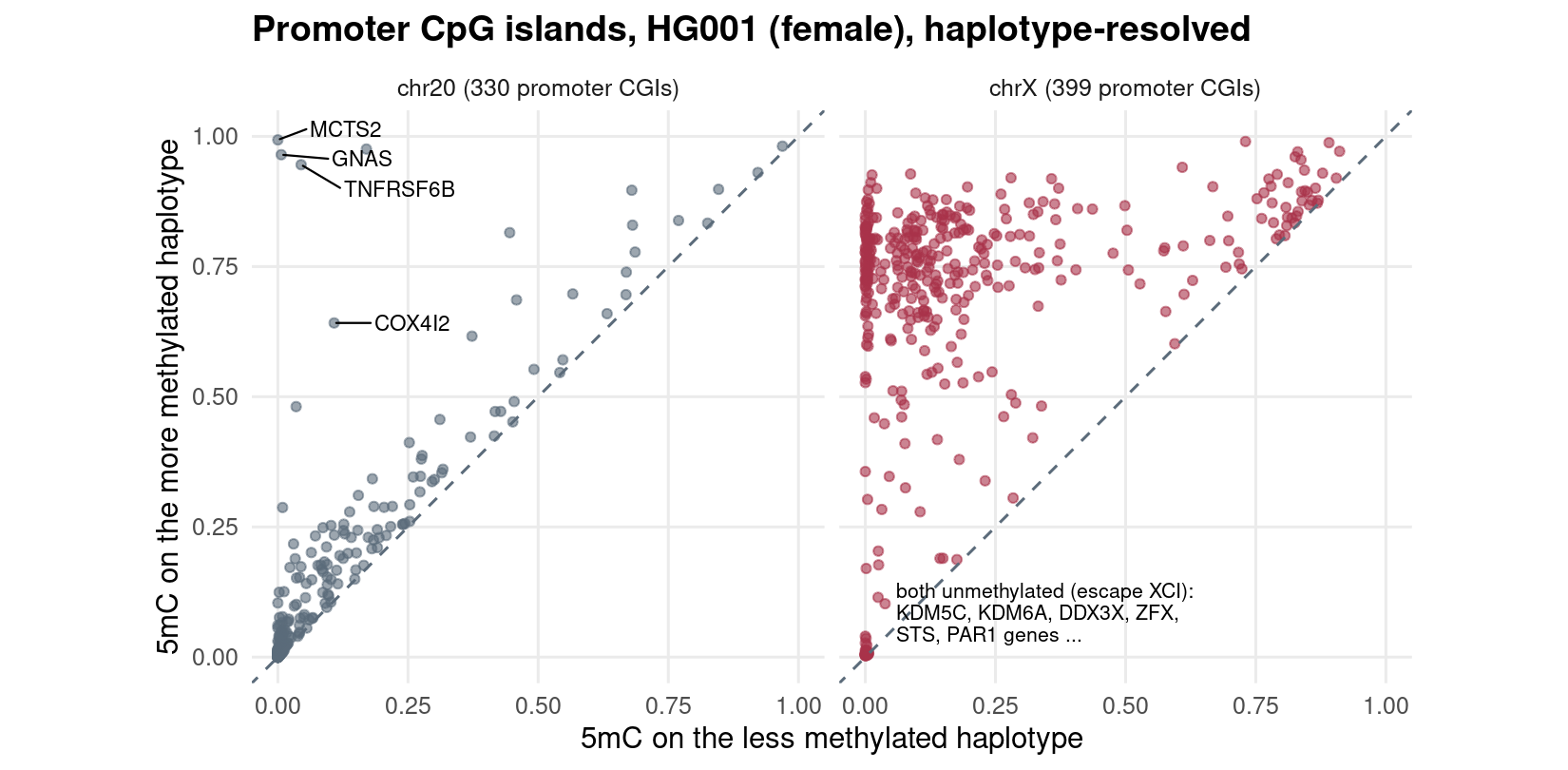
62% of 399 chrX promoter CpG islands are methylated on one haplotype only (difference > 0.5), against 1.5% of 330 on chr20; the chr20 exceptions include the imprinted GNAS and MCTS2.
37 chrX islands are unmethylated on both: KDM5C, KDM6A, DDX3X, EIF2S3, ZFX, USP9X, STS, the PAR1 genes, all known to escape X inactivation.
Accessibility on the same molecules: Fiber-seq
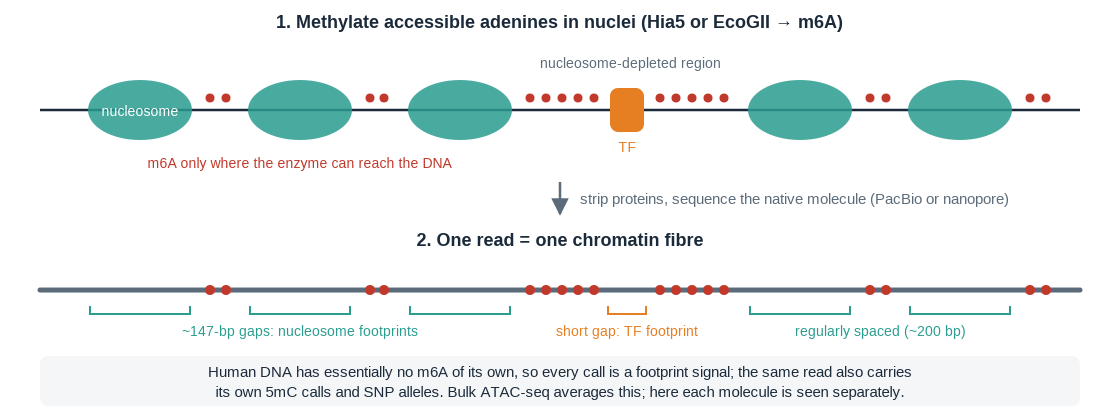
Treat nuclei with a non-specific adenine methyltransferase (Hia5, EcoGII): it methylates A wherever the DNA is reachable. Then sequence the native DNA.
One read = one chromatin fibre: nucleosome footprints (~147 bp without m6A), linkers, and nucleosome-free regulatory elements, plus the read’s own 5mC and SNP alleles.
Real fibres at a promoter
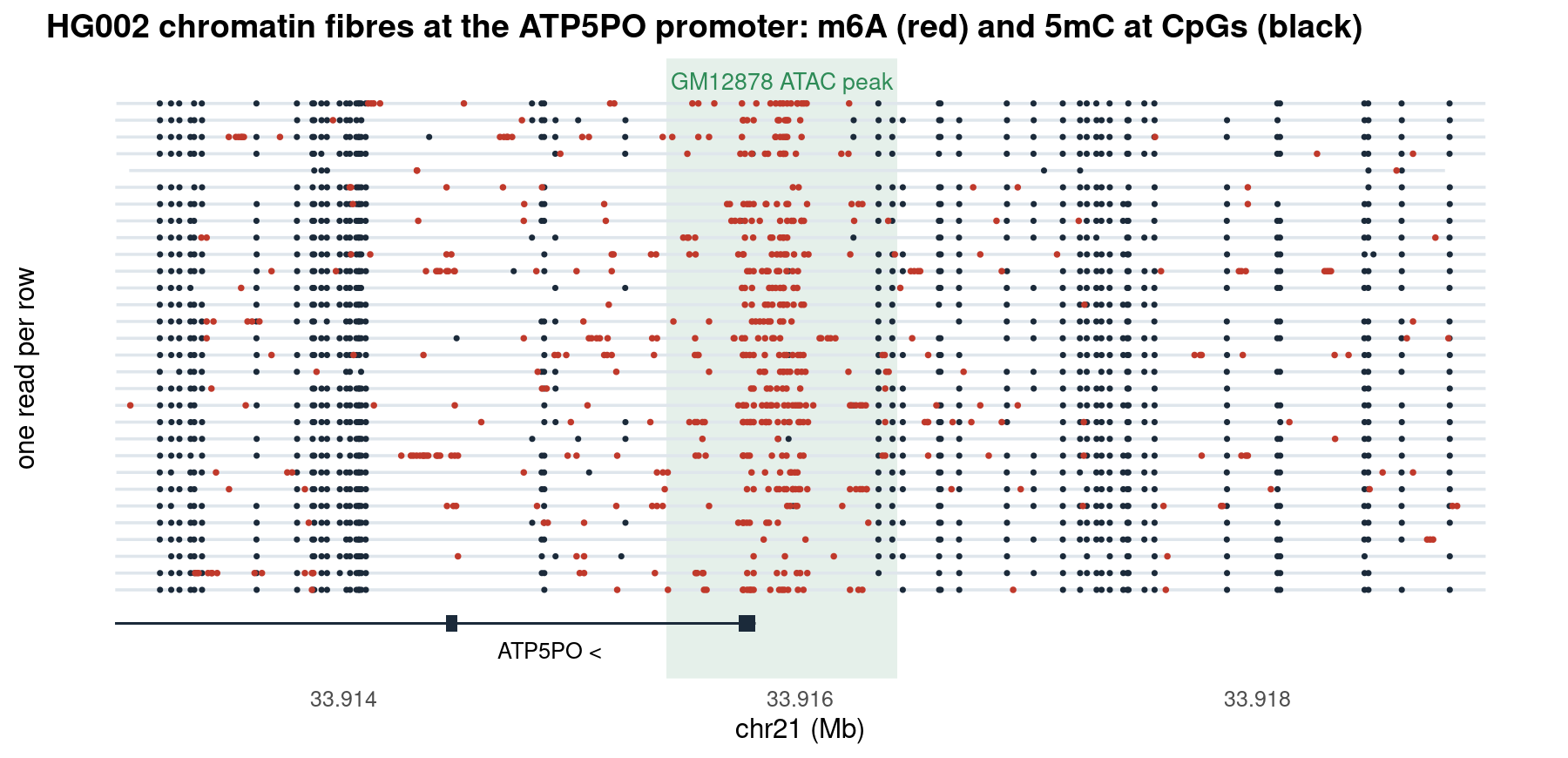
At the ATP5PO promoter (an LCL ATAC peak), 12.9% of adenines are m6A in the nucleosome-free region, against 0.5% in the flanks; the CpG island on the same reads is unmethylated (9.5% vs 82%).
Fibres differ: some are open over the whole element, some only partly, a few not at all.
The signal in aggregate
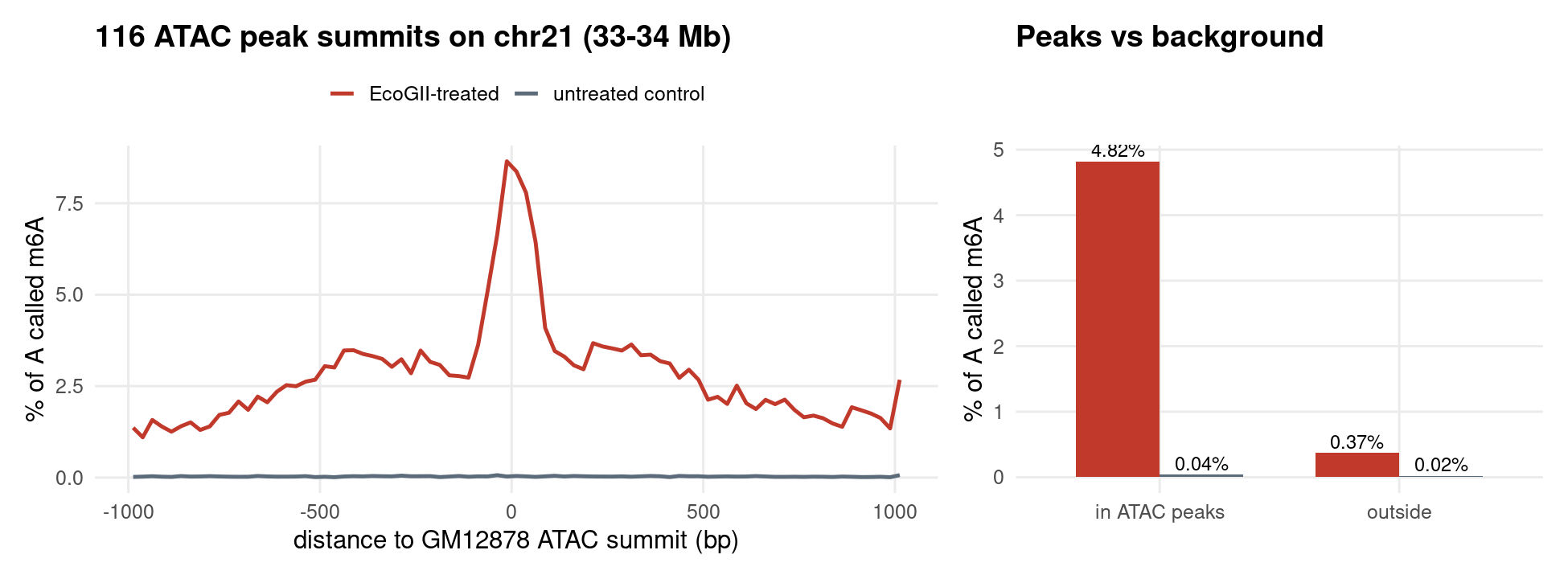
Over 116 ATAC summits on chr21 (33–34 Mb): m6A peaks at the summit (~8.5% of A), on a plateau of ~3% that extends ±400 bp.
Treated: 4.8% in peaks vs 0.37% outside (13-fold). Untreated control: 0.04% and 0.02%, the false-positive background of the 6mA model.
From m6A marks to footprints and elements
Nucleosomes: stretches of ~100–200 bp without m6A between marked linkers. Methyltransferase-sensitive patches (MSPs): longer marked stretches, i.e. nucleosome-free regions.
Accessible regulatory elements per fibre (e.g. FIREs in the fibertools pipeline), then aggregated into peaks, like ATAC peaks but with a per-molecule fraction: “this element is open on 62% of fibres”.
TF footprints: short protected stretches inside an open element (CTCF, ~40 bp).
Tools: fibertools (PacBio and nanopore), modkit open-chromatin predict (nanopore EcoGII), NanoNOMe/nanopolish for GpC data.
Caveats and pitfalls
Models: accuracy depends on context and on the training data; compare samples called with the same basecaller and model version.
Thresholds: modkit drops the least confident 10% of calls; low-confidence regions (homopolymers, read ends) lose more coverage.
Strand and context: CpG models do not call CpH methylation; --combine-strands assumes symmetric CpG methylation (not true for hemimethylated DNA).
Mapping: long reads map into repeats short reads cannot, but MAPQ still matters; supplementary and secondary alignments are skipped by default.
Phasing: only reads with informative SNPs get a haplotype; switch errors between phase blocks mix haplotypes; parental labels need a trio or a known ICR.
Coverage: 30× genome ≈ 15× per haplotype: allele-specific calls are noisy at single CpGs, average over regions.
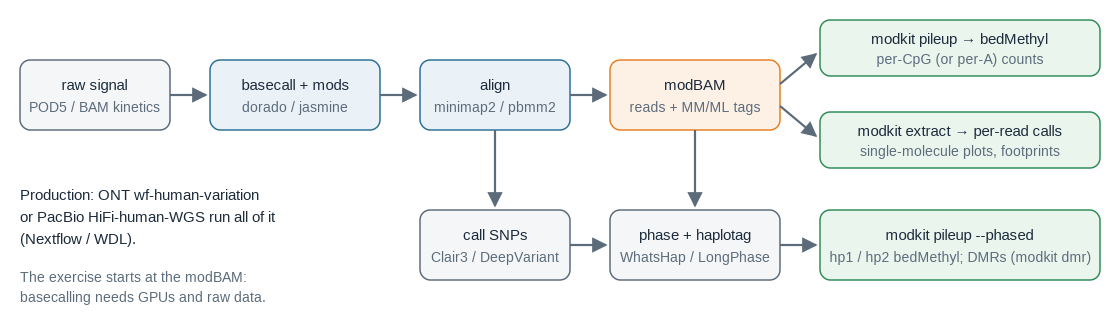
The workflow, end to end
Basecalling with modification models needs the raw signal and a GPU; most users start from the modBAM.
Repeats and centromeres: the first complete human genome (T2T-CHM13) came with a complete methylome, including centromeric satellites invisible to short reads (Gershman et al. 2022).
Imprinting disorders: parent-of-origin methylation and the variant in one test.
X inactivation, escape and erosion in female cells and cell lines.
Allele-specific methylation and meQTLs without population arrays.
Single-molecule co-occurrence: is the open enhancer on the unmethylated copy? Are two elements open together?
Cancer: haplotype-specific methylation at amplified or deleted alleles; structural variants and their methylation from the same reads.
Summary
idea
key fact
detection
nanopore: current through a pore; PacBio: polymerase kinetics; no conversion
what is called
5mC and 5hmC at CpG, 6mA, 4mC; probabilities per base per read from a model
modBAM
MM: which bases (skip counts); ML: probability × 256; ? vs . for skipped bases
pileup
modkit drops the least confident 10%; level = modified / valid calls (bedMethyl)
vs WGBS
r = 0.92 per CpG (WGBS rep vs rep: 0.80); compare 5mC + 5hmC with bisulfite
phasing
het SNPs on reads → HP tags (WhatsHap); trio gives parental labels