Bisulfite and enzymatic sequencing (WGBS, RRBS, EM-seq)
From converted DNA to per-CpG methylation calls
5mC is invisible to sequencing
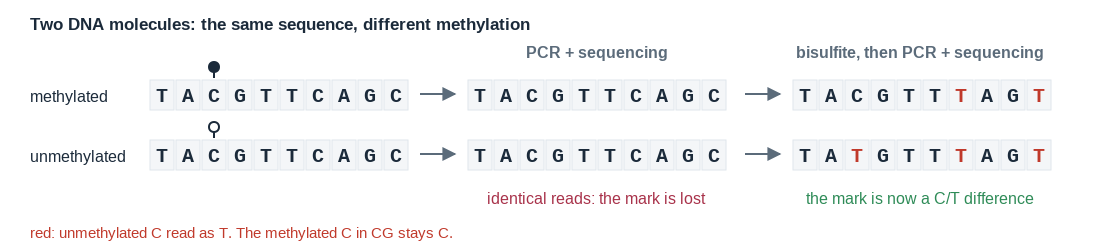
- Polymerases copy 5mC as C, and sequencers read it as C: the methylation of a molecule is lost in PCR and in sequencing.
- Either turn methylation into a sequence difference first (bisulfite, enzymes), or read the native molecule (nanopore, PacBio: Methylation and chromatin from long reads).
- Older methods used methylation-sensitive restriction enzymes or antibodies against 5mC (MeDIP); they give regional, not single-base, information.
Bisulfite chemistry
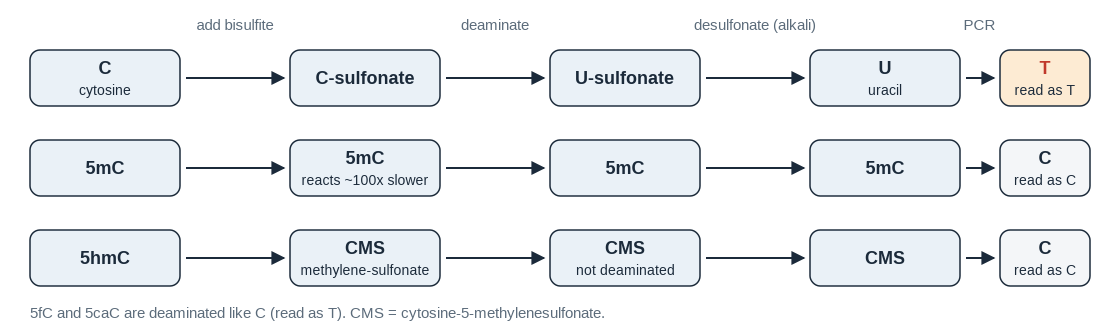
- Bisulfite adds to C; the adduct deaminates to uracil-sulfonate; alkali removes the sulfonate; PCR copies U as T.
- 5mC reacts about 100 times more slowly and stays C. 5hmC forms a stable adduct (CMS) and also reads as C.
- Harsh conditions (low pH, heat, hours): most of the DNA is fragmented and lost, and conversion must be > 99% to be useful.
One molecule, four strands
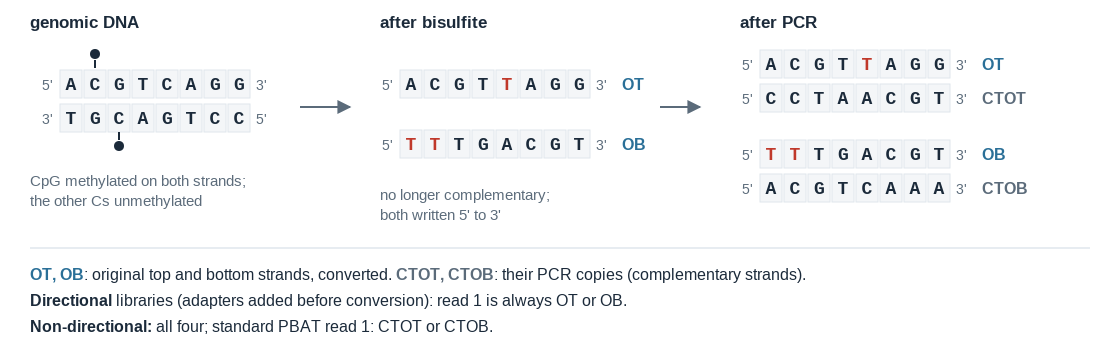
- After conversion the two strands are no longer complementary: each is its own template.
- PCR makes a complementary copy of each: four possible strands in the library.
- Standard WGBS kits are directional: read 1 always comes from OT or OB, which halves the alignment work.
Reading a converted read
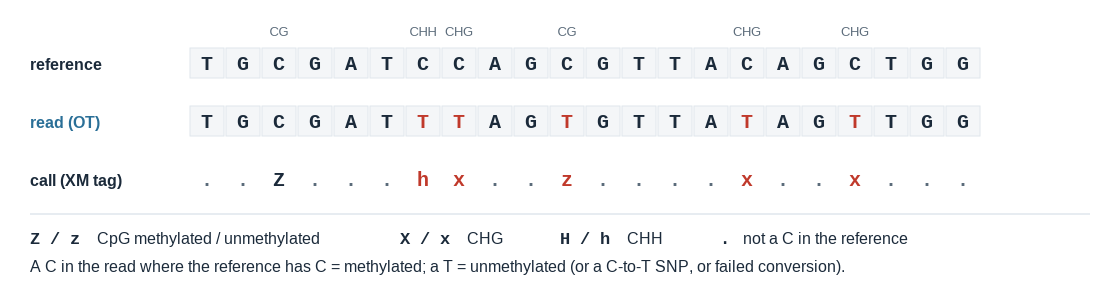
- Compare each read with the reference: where the reference has a C, a C in the read means methylated, a T means unmethylated.
- Bismark writes one symbol per base in the XM tag of the BAM file; upper case = methylated.
- The level of a CpG is the fraction of reads with C: \beta = M / (M + U).
Bisulfite reads look strange
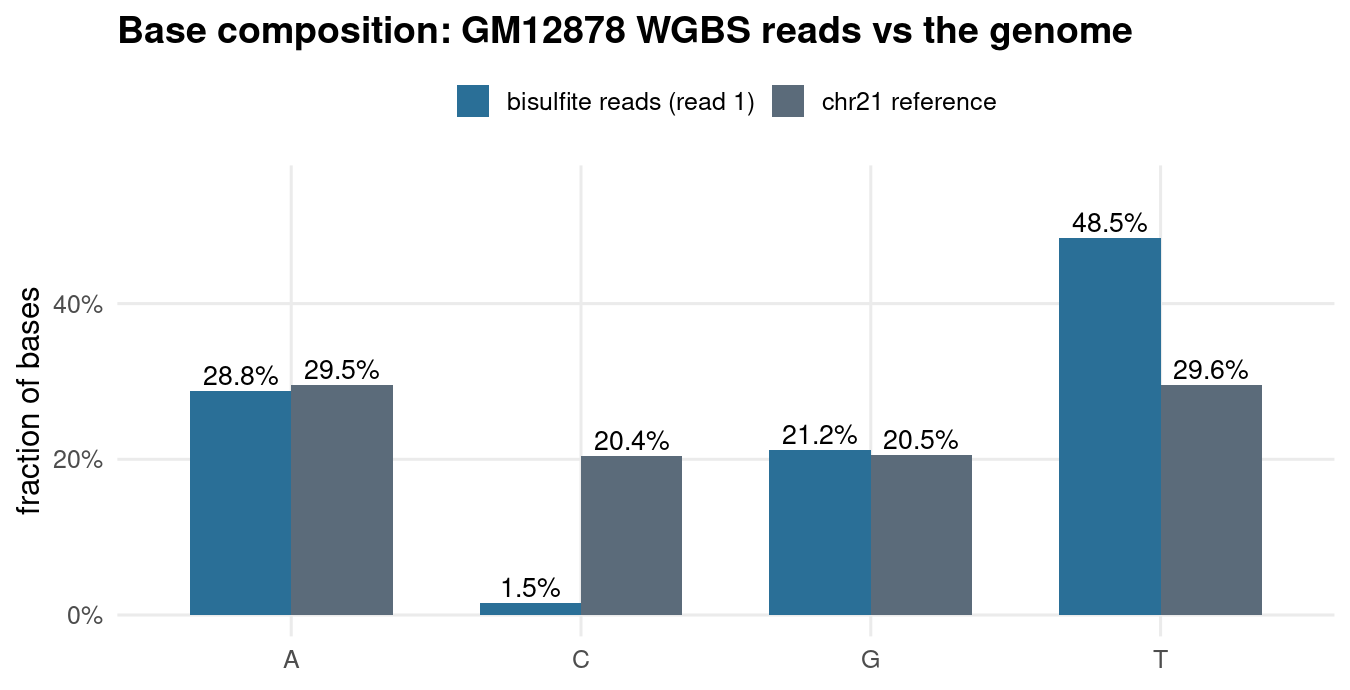
- Our 360 142 reads (GM12878, read 1): 1.5% C and 48.5% T, against 20.4% C and 29.6% T in the genome.
- Almost all remaining Cs are in CpG context: the methylated ones.
- Low complexity breaks normal tools: quality metrics complain, and a normal aligner sees many mismatches.
Alignment in three letters
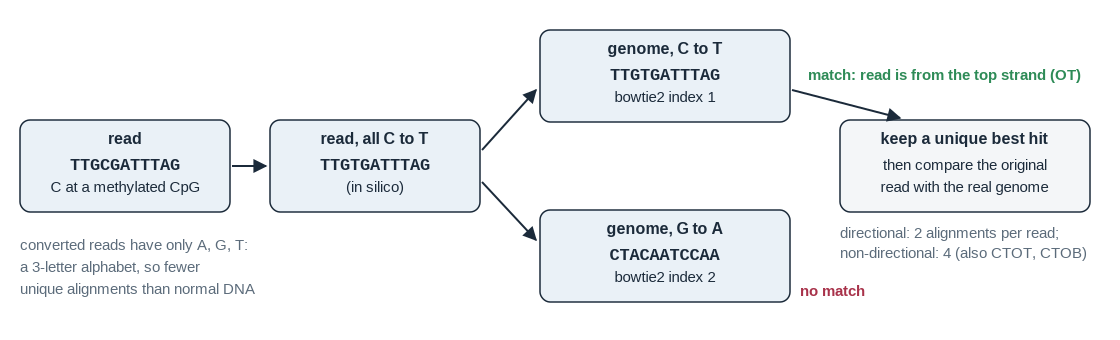
- Convert all C to T in the read, and make two converted copies of the genome (C→T and G→A).
- Align with a normal aligner (bowtie2) to both; keep the read only if it has a unique best alignment.
- Then compare the original read with the original genome to call methylation.
Bismark: from FASTQ to per-CpG calls
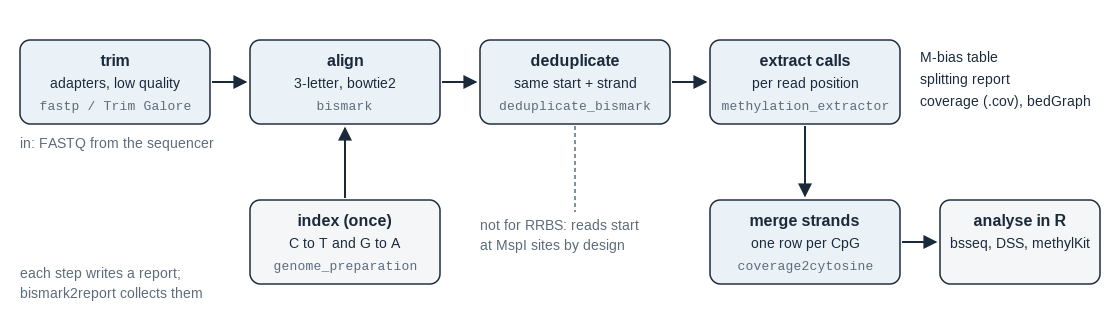
bismark_genome_preparation genome                  # once per genome
bismark --genome genome trimmed.fastq.gz
deduplicate_bismark --bam trimmed_bismark_bt2.bam
bismark_methylation_extractor --gzip --bedGraph trimmed_bismark_bt2.deduplicated.bam
coverage2cytosine --merge_CpG --genome_folder genome -o gm_cpg *.bismark.cov.gzWhat happened to our reads
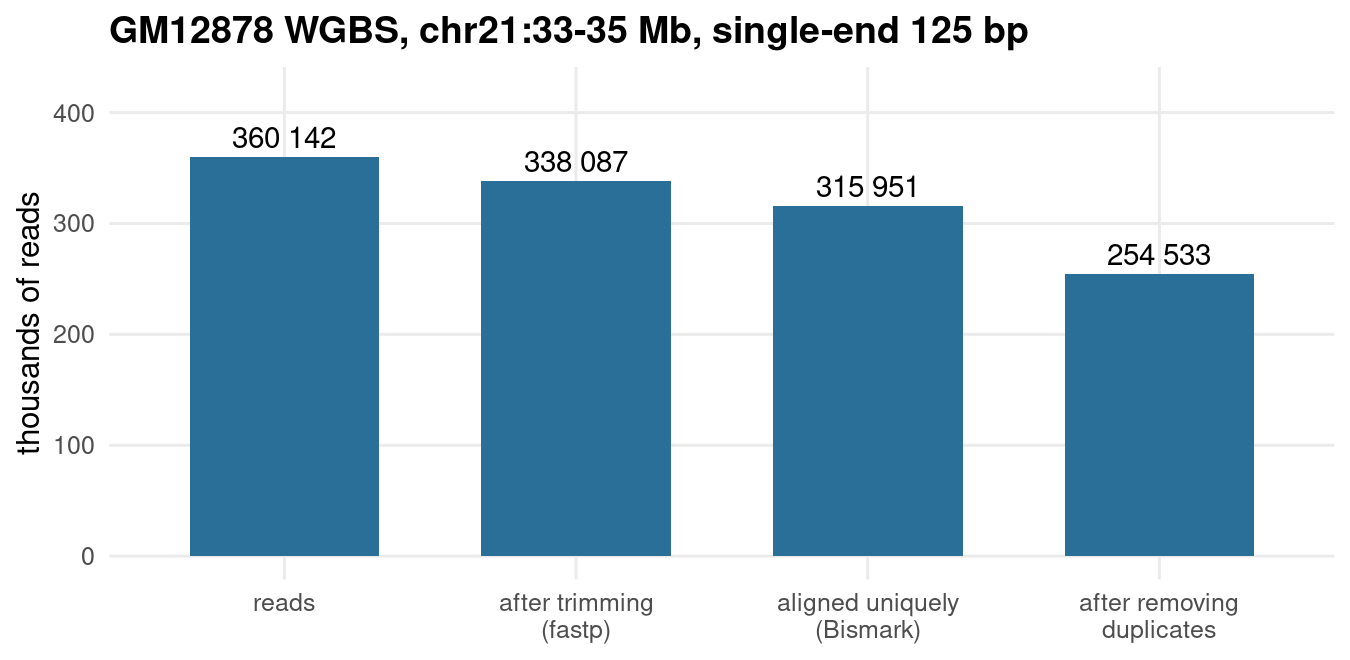
- fastp removed 6% (low quality), and trimmed adapters from 36 808 reads.
- Bismark aligned 93.5% uniquely; only 379 reads were ambiguous.
- 19.4% were duplicates (same start and strand); 254 533 reads remain.
Duplicates
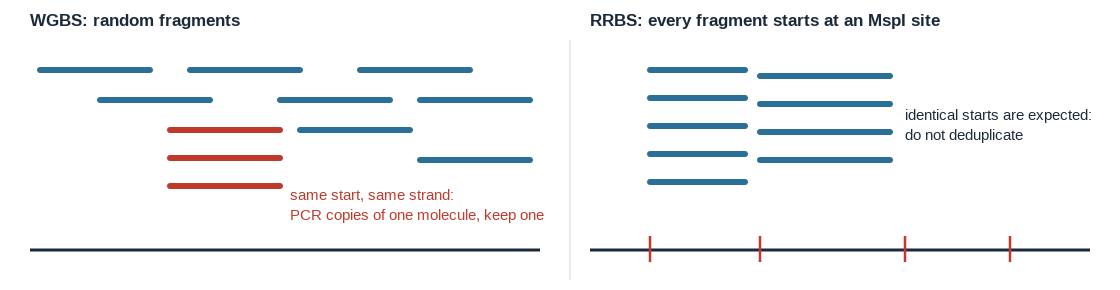
- In WGBS, reads with the same start and strand are probably PCR copies of one molecule: keep one (
deduplicate_bismark). - In RRBS (and amplicon methods), fragments start at the same restriction site by design: do not deduplicate.
- Duplicates inflate coverage without adding information: a CpG seen 20 times in one molecule’s copies has really one observation.
Where M-bias comes from
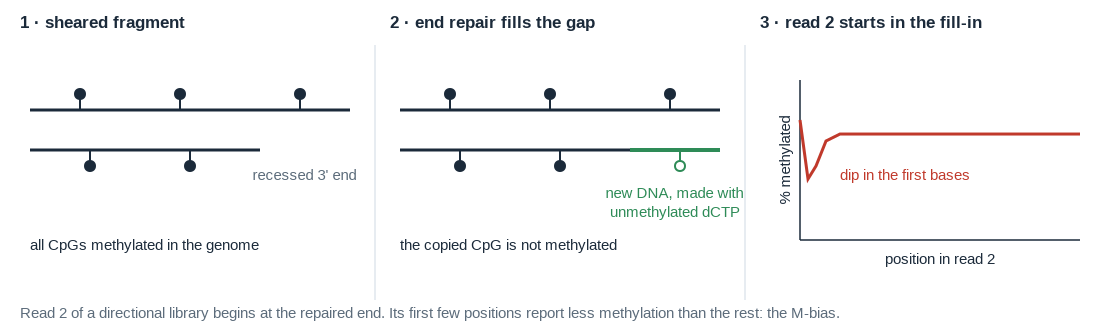
- Sheared fragments are end-repaired before adapter ligation; the polymerase fills gaps with unmethylated dCTP.
- The filled-in bases are read at the start of read 2: their CpGs look unmethylated.
- Other read-end artefacts: adapter remnants, random-primer bias (PBAT), low quality at 3’ ends.
Reading an M-bias plot
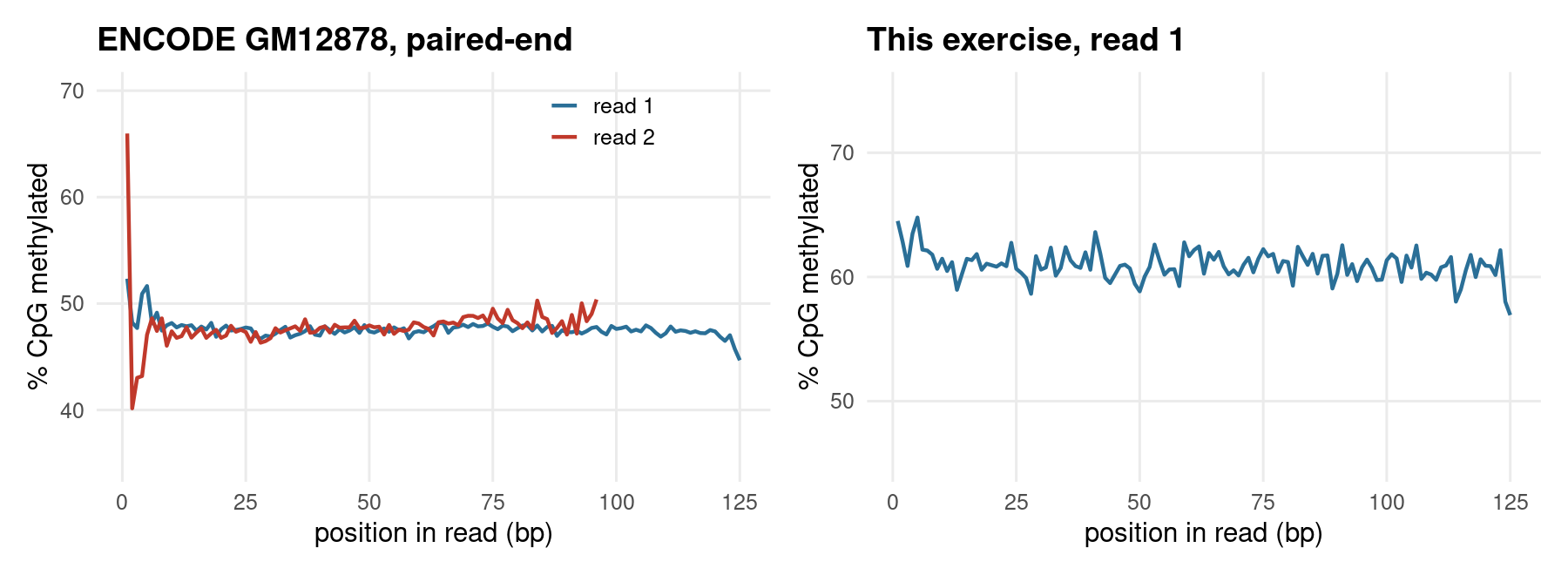
- ENCODE paired-end data (left): read 2 positions 2–4 are at 40–43% vs a plateau of 48%; position 1 jumps to 66%. Read 1 is nearly flat.
- Our single-end read 1 (right): flat at about 61% (this region is more methylated than the genome average).
- Fix: ignore the biased positions at extraction, e.g.
--ignore_r2 4, and check the plot again.
Conversion efficiency
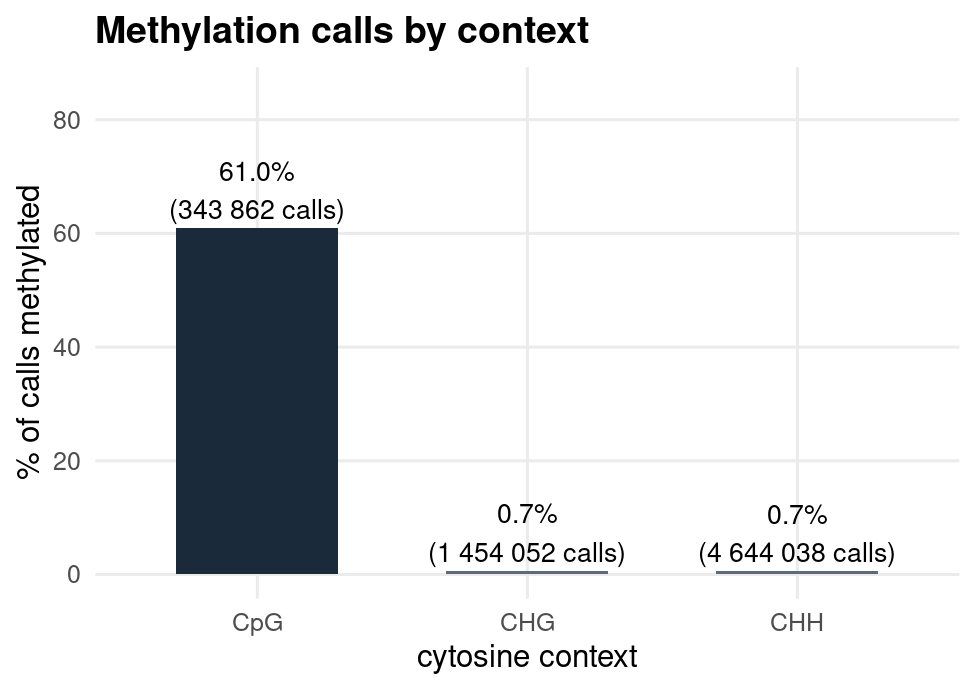
- In most mammalian cells non-CpG methylation is near 0. So methylated CHH calls measure failed conversion: here 0.66%, a conversion rate of 99.34%.
- A spike-in of unmethylated lambda phage DNA measures it directly, also where CpH methylation is real (neurons, ES cells, plants).
- Effect: an unmethylated CpG appears 0.7% methylated; β = 0.5 appears 0.503. ENCODE requires conversion ≥ 98%.
Coverage and precision
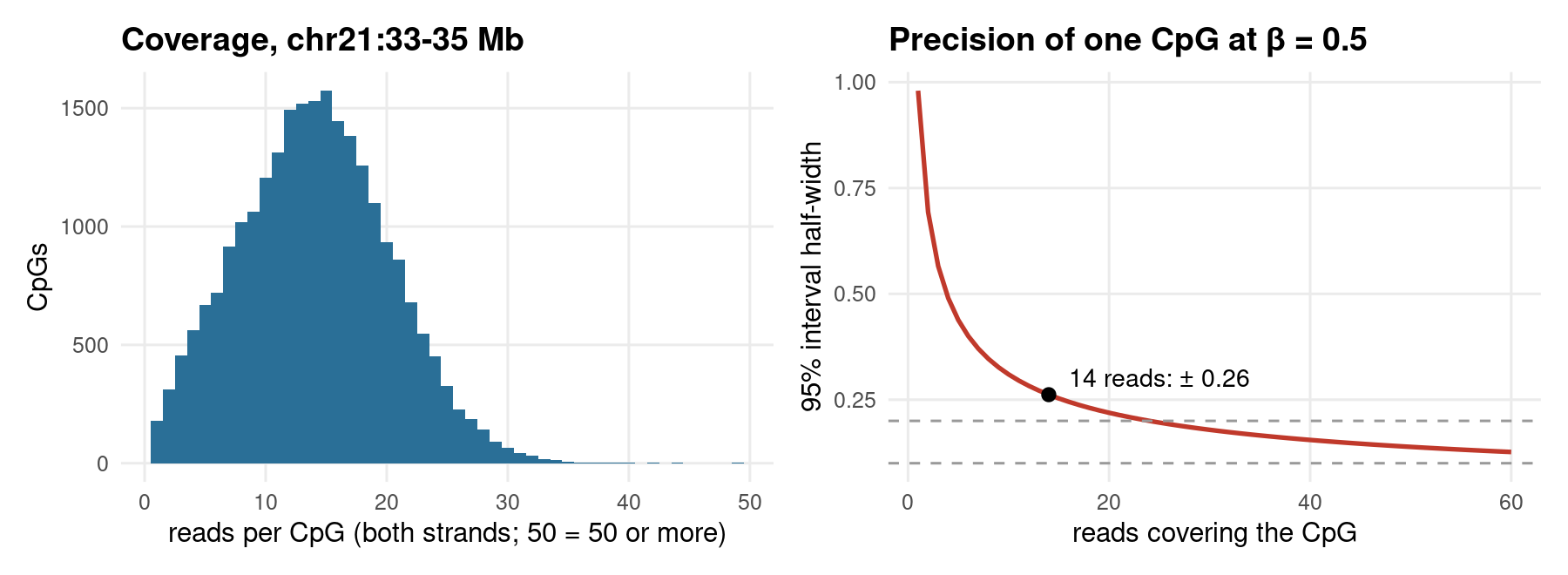
- After merging strands, 24 675 CpGs; median 14 reads, 75% with at least 10.
- With 14 reads a CpG at β = 0.5 has a 95% interval of about ± 0.26: single CpGs are imprecise.
- Remedies: more depth, more replicates, or averaging neighbouring CpGs (Differential methylation).
Do our calls agree with ENCODE’s?
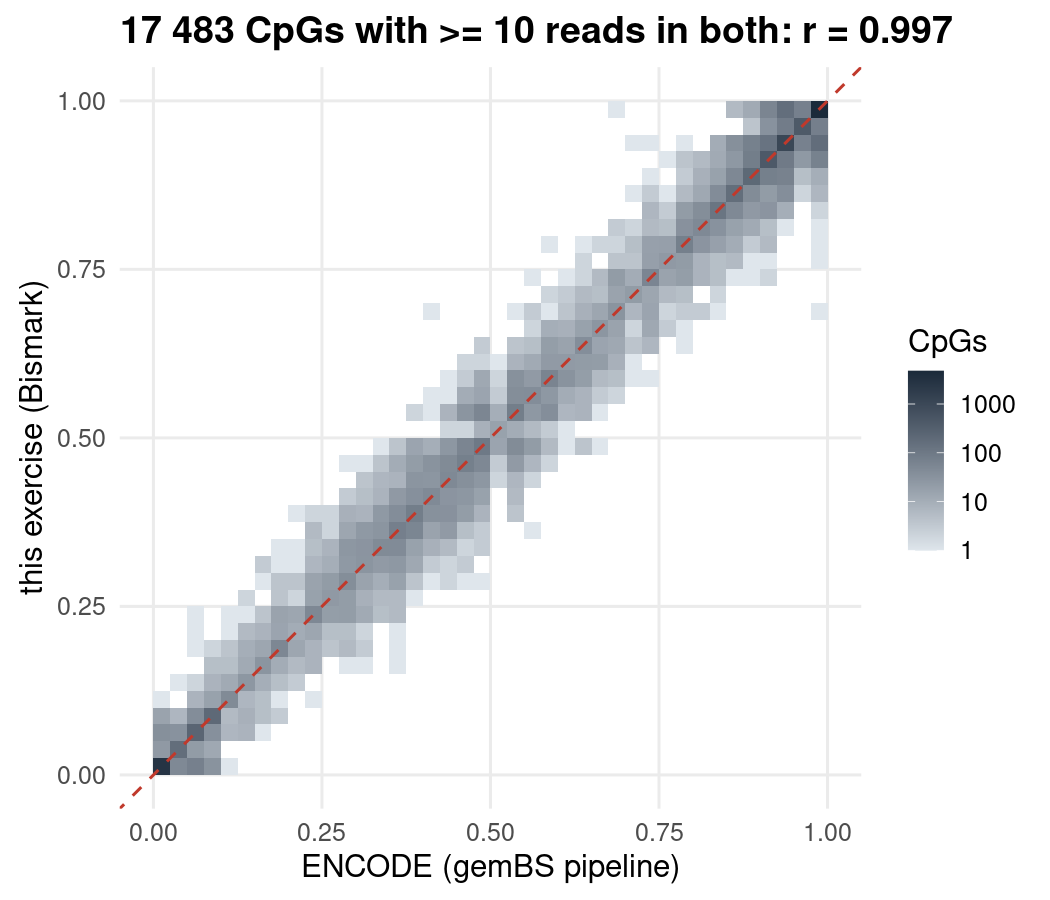
- Same reads, different pipelines: ENCODE used gemBS (GEM3 aligner, its own caller), we used fastp + Bismark.
- 23 567 CpGs in both; 17 483 with ≥ 10 reads in both: r = 0.997, mean |Δβ| = 0.016.
- Only 28% of CpGs have identical counts: trimming, duplicate removal and alignment filters differ slightly.
SNPs at CpGs look like unmethylated Cs
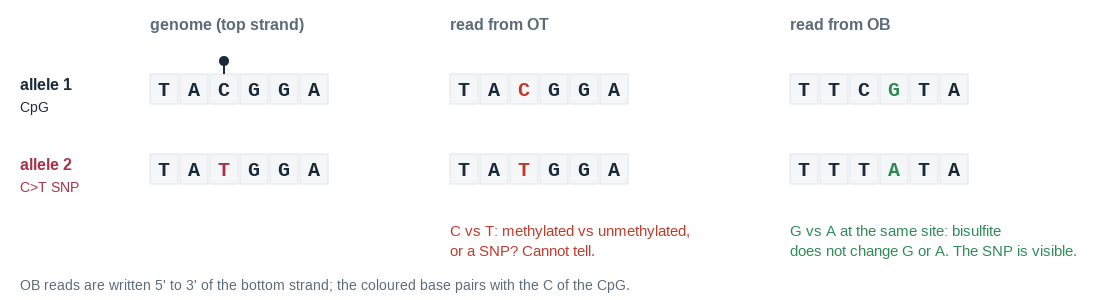
- On the strand with the C, a C→T SNP gives exactly the same read as an unmethylated C.
- On the other strand the same site is G vs A, which bisulfite does not change: the genotype is visible there.
- Tools that use both strands can call SNPs and methylation together (Bis-SNP, gemBS, BISCUIT).
SNPs in real data
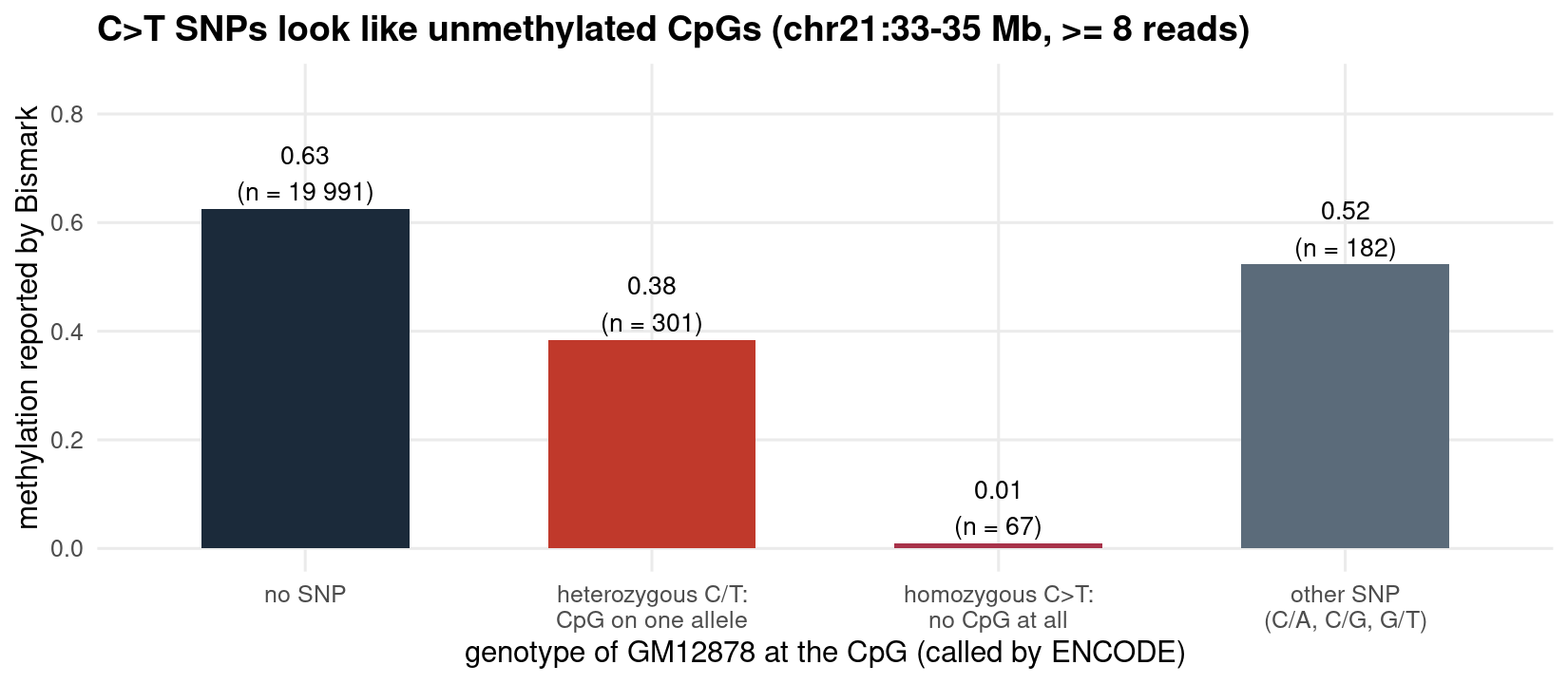
- ENCODE called the genotype of GM12878 at every CpG. In our Bismark calls, CpGs with a heterozygous C/T SNP average 0.38 (vs 0.63), and homozygous C>T sites 0.01.
- Other SNPs (C/A, C/G, G/T) change the base to one bisulfite cannot produce, so they are seen as mismatches, not as unmethylated.
Reduced representation bisulfite sequencing (RRBS)
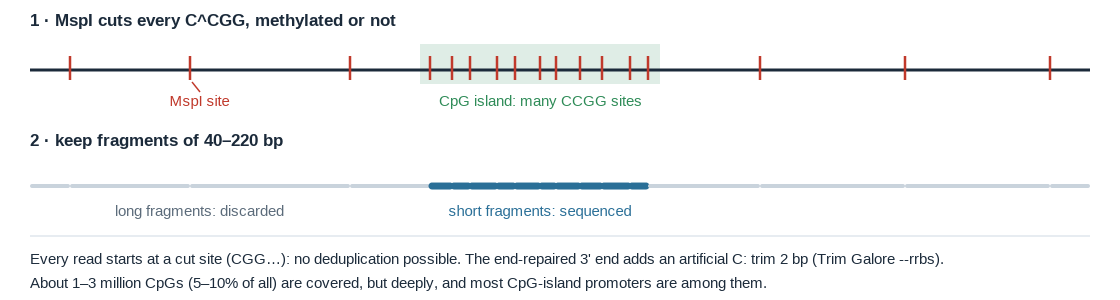
- MspI (C^CGG) cuts regardless of methylation; short fragments come from CpG-dense DNA: islands and promoters.
- Cheap and deep for 1–3 million CpGs, ideal for many samples; blind to most enhancers, gene bodies and PMDs.
- Analysis differences: Trim Galore
--rrbs, no deduplication, and only regions covered in all samples can be compared.
EM-seq and TAPS: without bisulfite
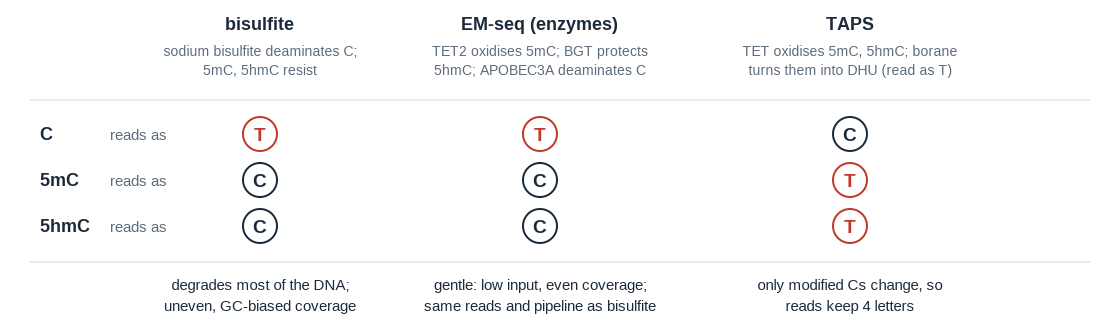
- EM-seq: TET2 and T4-BGT protect 5mC and 5hmC; APOBEC3A deaminates the unprotected C. Same readout as bisulfite, so the same pipeline (Bismark works unchanged).
- TAPS: only modified Cs change (to T). Reads keep four letters: better alignment, less sequencing wasted.
- Both damage DNA much less: lower input, more uniform coverage, fewer duplicates.