Erosion and dilation
Where we start
- From the thresholding day: a threshold turns a grey image into a mask, 1 = foreground (object), 0 = background.
- Typical defects: isolated specks (noise above the threshold), holes inside objects, gaps that split one object, thin bridges that join two.
- A linear filter (a blur, from the kernels unit) would smear the mask into grey values, and we would have to threshold again.
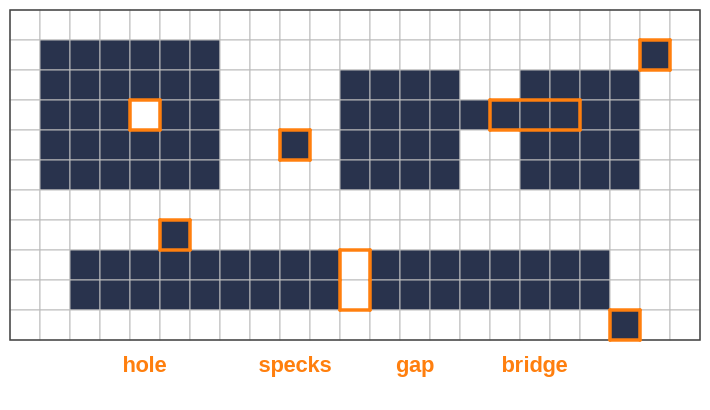
Wanted: operations that take a mask and return a mask, and that act on shape: “remove what is thinner than 3 pixels”, “fill what is narrower than 3 pixels”.
A binary image is a set
Write the mask as the set A of its foreground pixels: A = \{(x, y) : \text{pixel } (x, y) \text{ is } 1\}.
- Union A \cup C, intersection A \cap C, complement A^c (the background) are pixel-wise OR, AND, NOT.
- Translate A_z: the set shifted by the vector z.
- Reflect \check B: the set mirrored through the origin, every b replaced by -b.
A structuring element B is a small set with a marked origin: a 5-pixel cross, a 3 \times 3 square, a digital disc, a line, an L-shape. It plays the role of the kernel in a convolution.
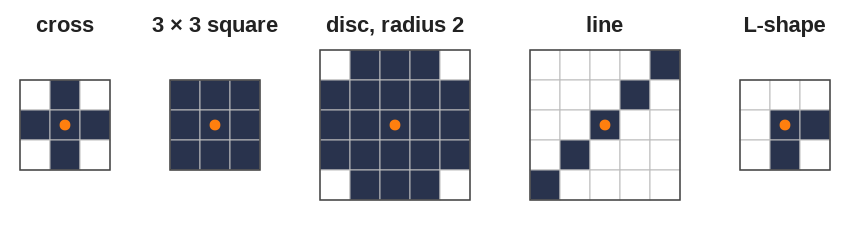
Five structuring elements; the orange dot marks the origin.
Erosion: where does the SE fit?
Place the SE with its origin on pixel x. Keep x if every SE pixel lands on the object:
A \ominus B = \{x : B_x \subseteq A\}.
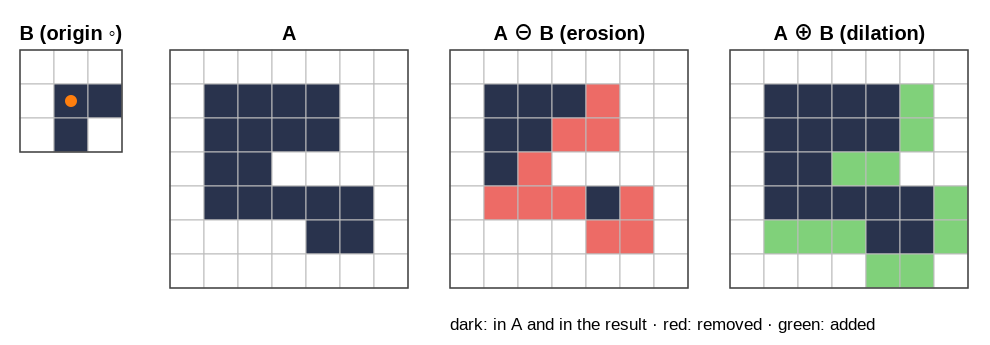
A 7 \times 7 image A, an L-shaped SE (origin in the corner, orange dot), the erosion and the dilation. Dark: kept, red: removed, green: added.
- 17 pixels in, 7 out. Everything gets thinner; parts thinner than the SE vanish.
- With the origin inside B, erosion only ever removes pixels.
Dilation: where does the reflected SE hit?
Keep x if the reflected SE placed at x hits at least one object pixel:
A \oplus B = \{x : \check B_x \cap A \ne \emptyset\} = \{a + b : a \in A,\ b \in B\}.
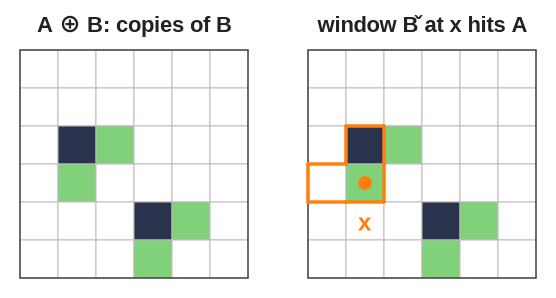
- The second form: put a copy of B on every object pixel and take the union. A single pixel dilates to a copy of B itself.
- In the 7 \times 7 example of the last slide: 17 pixels become 28. Objects grow, holes and gaps narrower than the SE close.
- Why the reflection? For an asymmetric SE like the L, “paste B on every pixel” and “look through B at each pixel” differ by a mirror image, exactly as convolution and correlation differ by a flip of the kernel.
Same window as a convolution, min/max instead of a sum
Write the mask as 0/1 values. Then (from the kernels unit: slide a window, combine the values under it)
(A \ominus B)(x) = \min_{b \in B} A(x + b), \qquad (A \oplus B)(x) = \max_{b \in B} A(x - b).
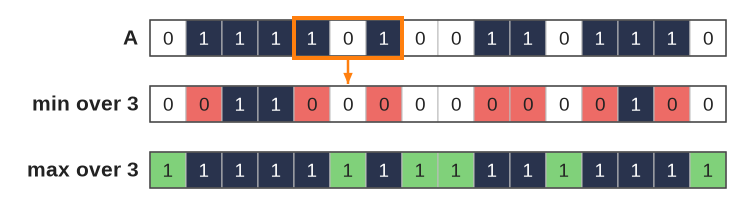
One row of a mask with a 3-wide window (orange: the window at one pixel, 1\,1\,0 gives min 0 and max 1). Red: removed by the min, green: added by the max.
- A flat SE is a window with no weights: erosion is a min filter, dilation a max filter.
- Shift-invariant like a convolution: shift the image, the result shifts the same way.
- Not linear: \max(f + g) \ne \max f + \max g in general, so no superposition, no frequency response.
- The same formulas work on grey images (the grey-level unit of this day).
Duality: eroding the object = dilating the background
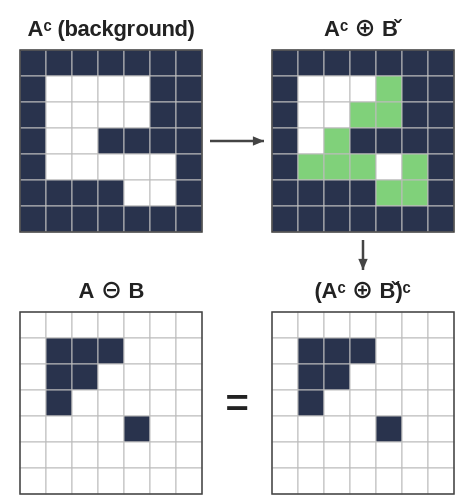
(A \ominus B)^c = A^c \oplus \check B .
- In words: a pixel is not in the erosion if the SE placed there hits the background somewhere. That is a dilation of the background.
- So a filter on objects is also a filter on the background: erosion shrinks the objects and grows the background, and the reflection \check B is needed when B is asymmetric.
- Check with the L: the complement of A^c \oplus \check B is exactly the 7 pixels of A \ominus B (right; the exercise does it by hand).
Two lines make a square
Dilation is associative: A \oplus (B_1 \oplus B_2) = (A \oplus B_1) \oplus B_2.
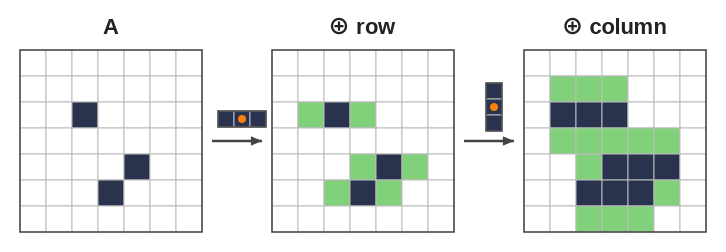
Three pixels dilated by a row of 3, then by a column of 3 (green: added at each step): 3 → 9 → 22 pixels, the same set as the dilation by the 3 \times 3 square.
- A 3 \times 3 square is a row of 3 dilated by a column of 3, so dilating by the square = dilating by the row, then by the column. A 15 \times 15 square: 30 comparisons per pixel instead of 225. The separable-kernel trick of the kernels unit, again.
- A disc is approximated by lines in a few directions (an octagon from 4 lines).
- A line of any length costs about 3 comparisons per pixel with the van Herk / Gil–Werman algorithm (running min/max over blocks): the cost no longer depends on the SE size.
- Erosion decomposes the same way: A \ominus (B_1 \oplus B_2) = (A \ominus B_1) \ominus B_2.
Boundaries
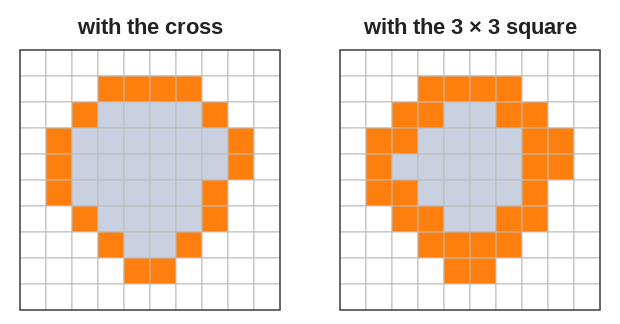
The inner boundary of an object: the pixels that erosion removes,
\partial A = A \setminus (A \ominus B).
- With the cross, a pixel is interior if its 4 neighbours are in A; the boundary is a thin contour that is 8-connected (it may step diagonally).
- With the square, a pixel is interior only if all 8 neighbours are in A; the boundary is thicker and 4-connected.
- Course convention (the labelling and watershed days use it too): objects 8-connected, background 4-connected.
At the image border
Erosion near the edge asks about pixels outside the image. A convention decides:
- outside = 0: the image is surrounded by background; erosion eats into every object that touches the edge.
- outside = 1 (or “ignored”): the outside never removes anything; an object cut by the edge is not eroded from that side.
- Example (the demo’s “border convention”): 36 pixels, eroded by the 3 \times 3 square: 10 with outside = 0, 16 with outside = 1.
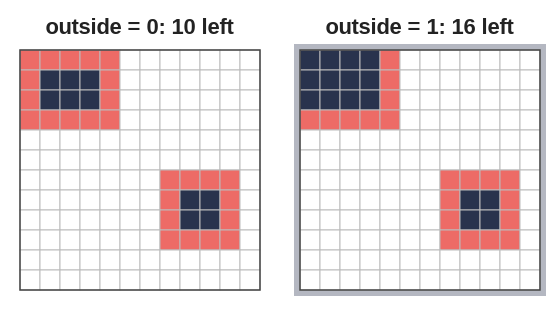
Neither is right in general: an object cut by the image edge continues outside, or it does not. The same question as zero vs replicate padding for convolutions.