Limits of AI for biological research
Part 6: The wider picture
About this lecture
If you work in the life sciences or medicine, you will sooner or later meet the strictest guardrails the providers have: the ones around biology. They exist for a good reason, and they also stop some legitimate work. Separately, the model can write a lab protocol that reads well and is wrong.
- Providers block help that could make biological weapons easier to produce. This is the dual-use problem: the same knowledge protects and could harm.
- The blocks cluster around a small core of topics, but legitimate research in virology, toxin biology and some molecular design sits close to it and gets caught.
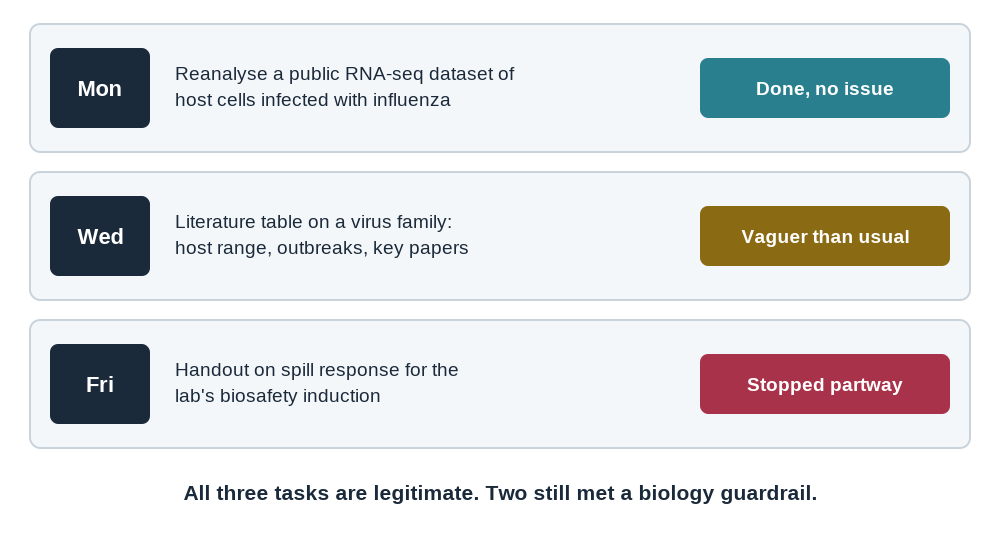
- A block can look like a refusal, a vaguer answer, a switch to another model, a system message, or an agent task that stops partway.
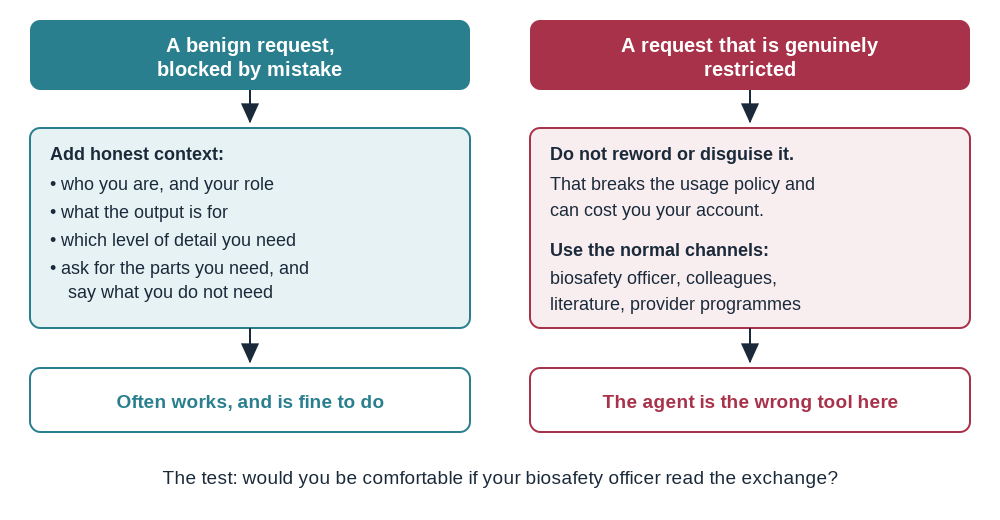
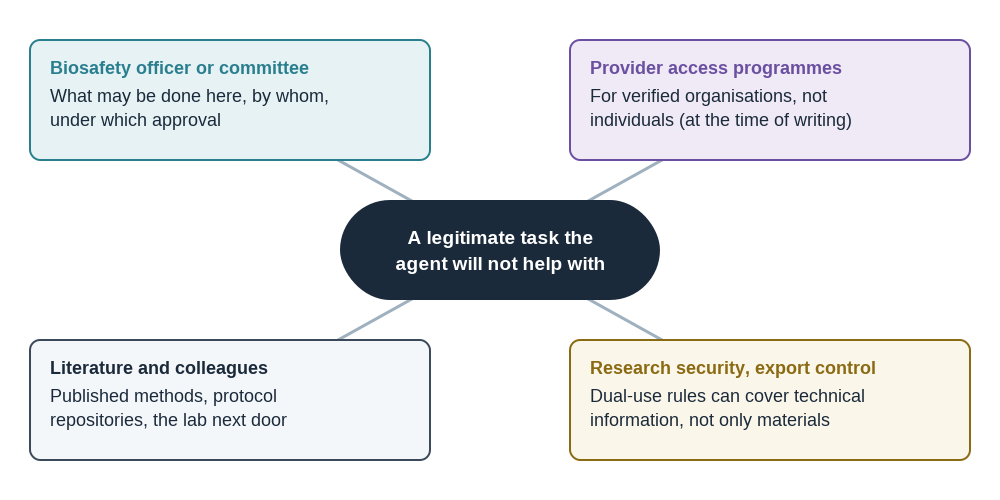
- It is a policy limit, not a bug. Do not reword or disguise a request to get past it. For benign requests, give honest context; for the rest, use your biosafety officer, colleagues, the literature and the providers’ access programmes.
- Beyond safety guardrails: agent-written protocols contain wrong concentrations, missing safety steps and invented details. Check them like a new student’s protocol.
This is a concept unit with a short exercise. The general kinds of guardrail and the safety levels behind them are in Guardrails and safety levels; this unit builds on it.
A virology lab’s ordinary week meets a biology guardrail twice
The same knowledge protects people and could help someone harm them
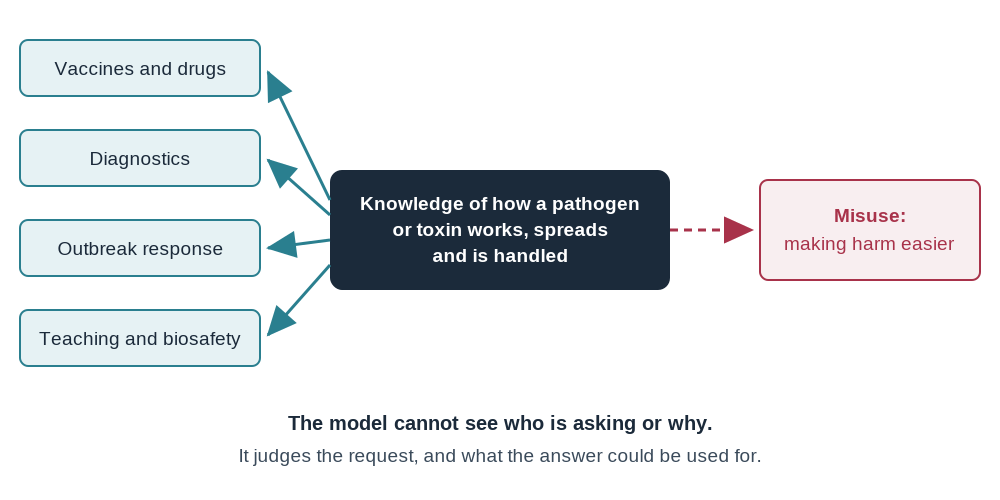
This is the dual-use problem. Biologists know it from export rules and from discussions of dual-use research of concern. AI providers face the same problem at scale.
Providers worry about uplift: help that makes the hard steps easier
- The concern is not textbook facts. It is uplift: help that lets someone do what they could not do before, beyond what a search engine or a library gives.
- Anthropic’s policy describes its thresholds in those terms: a model that could significantly help people with basic technical training to cause serious harm with biological or chemical weapons, and a higher one for models that could substitute for rare expert knowledge.
- OpenAI’s Preparedness Framework uses the same idea: “High” biological capability means meaningful help to a novice.
- Both providers apply the stronger protections as a precaution, before they are sure a model has crossed the line.
The most capable models carry the strictest biology safeguards
| Anthropic (Claude) | OpenAI (ChatGPT, Codex) | |
|---|---|---|
| Framework | Responsible Scaling Policy, now version 3.4 (July 2026) | Preparedness Framework, version 2 (April 2025) |
| Level | Current models deployed with ASL-3 protections, treated as having the first chemical and biological capability level | ChatGPT agent and GPT-5 thinking treated as High in biology and chemistry since 2025 |
| What that switches on | Classifiers on input and output for chemical and biological weapons; monitoring; access controls with exemptions for verified users | Always-on classifiers and monitors, refusal training for dual-use requests, enforcement |
| What you notice | Depending on model and app: a fallback to a less capable model, or a stopped answer | Refusals, partial (“safe”) answers, stopped answers |
| Usage policy | Effective 12 November 2026 | Effective 20 November 2026 |
At the time of writing (November 2026). Model names and levels change; check the providers’ pages.
Blocks cluster around a small core of topics
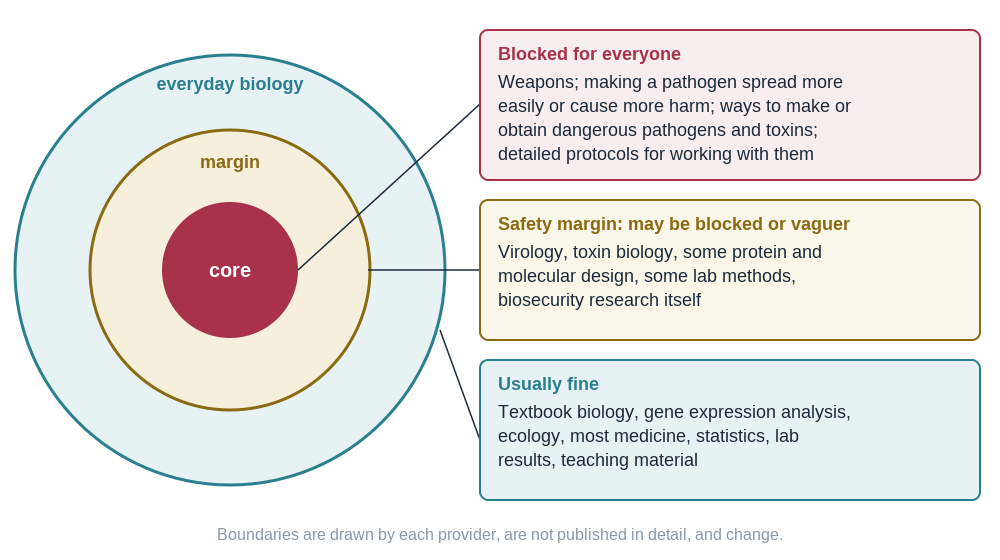
Legitimate research sits in the safety margin, and providers say so
- Anthropic retrained the biology classifier of its most capable model in August 2026 and reports about 85 % fewer biology-related fallbacks. It also writes that false positives will remain.
- After the retraining, requests in virology, toxicology and molecular design still fall back, so that model “isn’t yet usable for professional biology research and drug development”.
- Who is most affected: virologists, microbiologists, toxinologists, protein designers, vaccine and diagnostics developers, biosafety and biosecurity staff, and teachers of those subjects.
- What is rarely affected: RNA-seq and other omics analysis, ecology, physiology, clinical statistics, most cell biology.
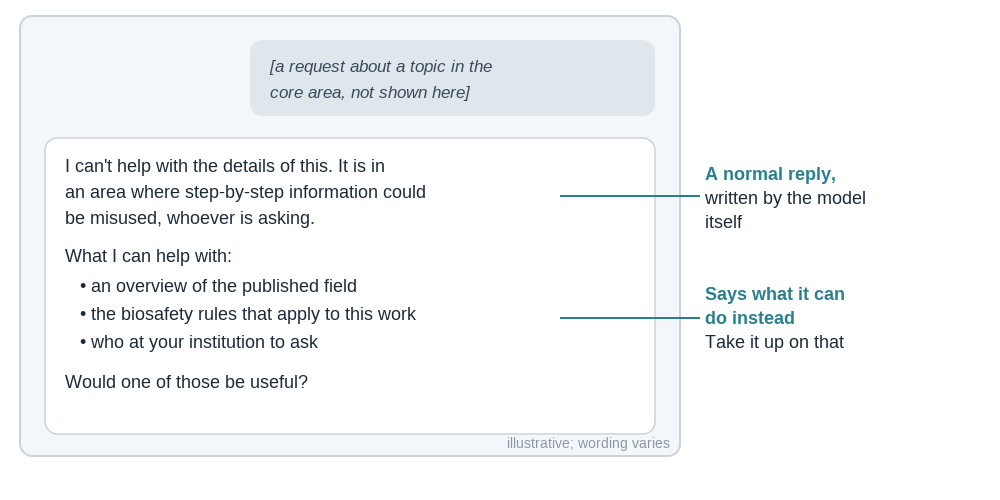
A refusal in the reply is the easiest kind to recognise
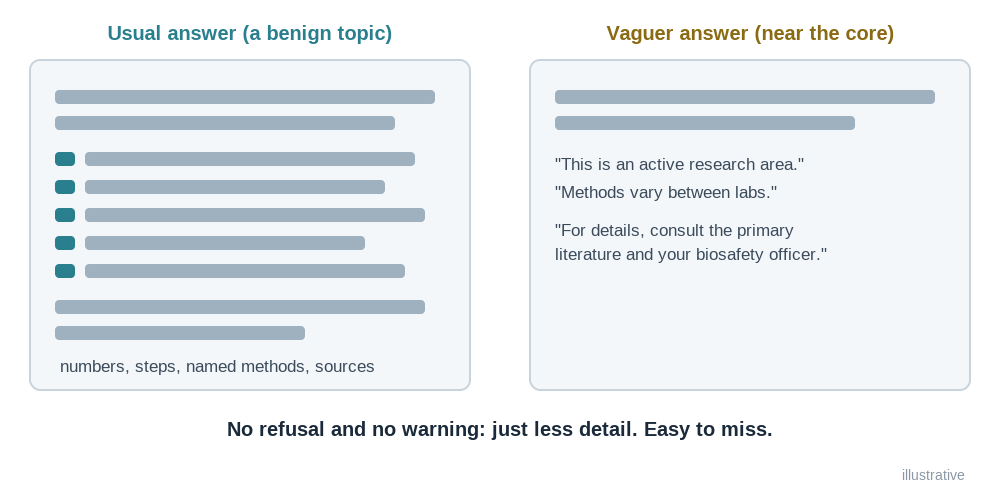
A vaguer answer is harder to notice than a refusal
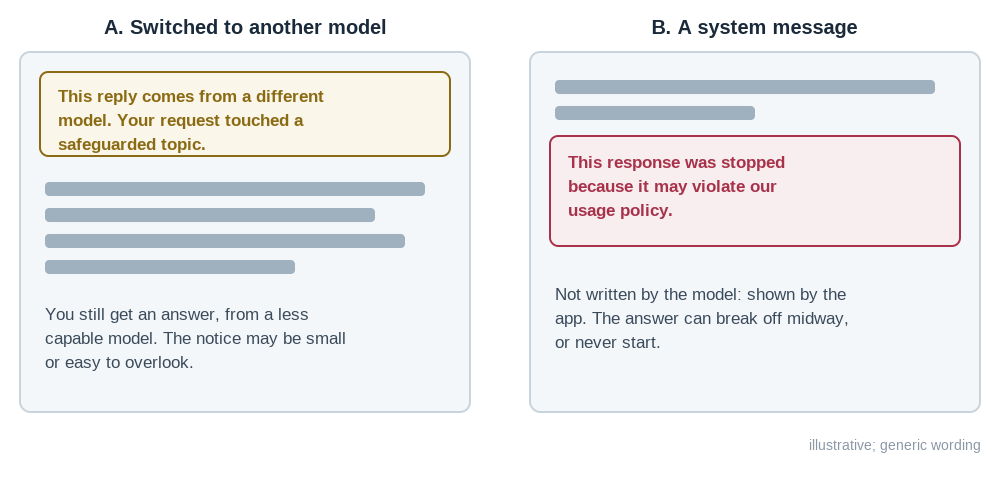
A block can also switch you to another model, or show a system message
In an agent, a block can stop a task partway or end the session
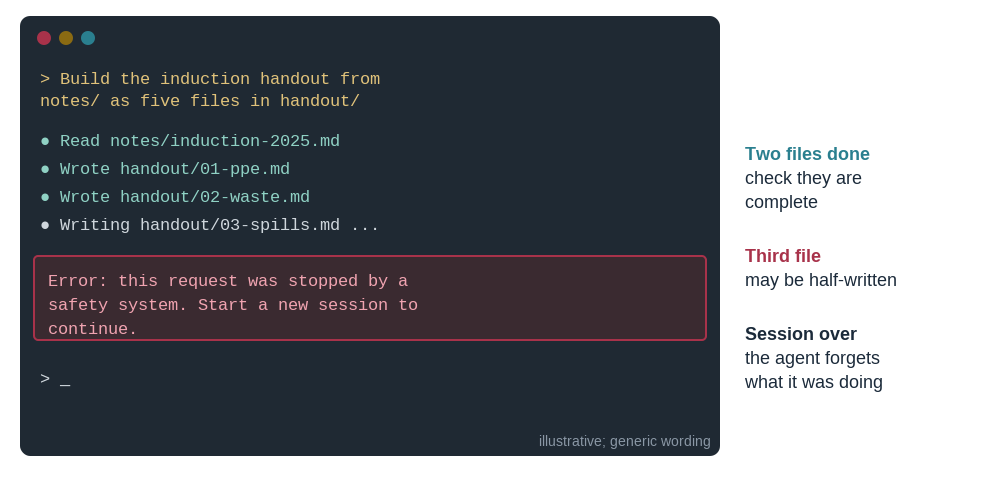
After a stop: check what was already written, and do not assume the task is half done in a tidy way.
Each form tells you something different about what to do next
| What you see | Where it comes from | First thing to do |
|---|---|---|
| A polite refusal in the reply | The model’s training | Read the reason; take up what it offers; add honest context if the request is benign |
| A thinner, vaguer answer | The model’s training (“safe” partial answers) | Compare with what you know; go to the literature yourself |
| A notice that another model answered | Classifier with a fallback | Treat the answer as from a weaker model; check it harder |
| A system message; answer stops | Classifier around the model | Do not retry the same way; decide whether the task belongs here at all |
| Agent task stops; new session needed | Classifier, in the agent | Check which files were written; brief a new session if the task is benign |
The full “which guardrail did I hit?” table, with non-biology guardrails and usage limits, is in Guardrails and safety levels.
A block on a legitimate request is a policy limit, not a bug
- The provider decided to block this area, knowing it would catch some legitimate work. Retrying will not change that decision.
- Do not reword or disguise a request to get past a block. Both providers’ usage policies forbid circumventing safeguards. It can lead to warnings, restrictions or a closed account.
- A blocked output on its own is not a violation: Anthropic’s usage policy says so explicitly. You are not in trouble for having been stopped.
- Ask yourself honestly which zone the request was in. If it was in the core, the agent is the wrong tool, whoever you are.
Honest context helps a benign request that was blocked by mistake
Example: a biosafety handout, with honest context
Before (stopped partway):
Write the spills section of the handout from notes/spills.md.After (honest context, scope stated):
I am the lab manager of a university teaching lab that works at
biosafety level 1 and 2. I am writing the induction handout that new
students read before their first lab session. Write the "spills"
section from my notes in notes/spills.md: who to tell, where the spill
kit is, protective equipment, the disinfectant and contact time we use,
and how to dispose of the waste. Keep to our notes and general good
practice; no organism-specific details are needed.Providers run access programmes for verified organisations
Anthropic: Life Sciences Verification Program (beta, September 2026)
- For teams and institutions: academic labs, start-ups, pharma. Individual Pro and Max plans are not yet supported.
- Review of research credentials, security practices and ethical oversight.
- Standard Use grants for most life-science work; High-risk Use add-on for specific projects.
- Other safeguards, such as cyber classifiers, stay on. Data kept 30 days for monitoring.
- Expression of interest: claude.com/form/life-sciences-verification-program
OpenAI: trusted access for life sciences
- Organisation-based: qualification and safety review of the organisation and its intended use.
- Covers its life-sciences model (GPT-Rosalind) and more detailed answers in dual-use areas for approved organisations.
- Usage policies still apply; weaponisation stays blocked.
- Ask your institution whether it has applied or plans to.
These are institutional routes. Typing “I am a virologist” in a chat does not unlock them.
Your institution has people for exactly this
Do not paste restricted or dual-use protocols into a chat
- A protocol for work under special approval is your institution’s information, often under rules on who may see it.
- Pasting it sends it to the provider and into session logs (Privacy, ethics and safety). Export-control rules may apply to some technical details.
- It will likely trigger the classifier, and can stop the session or flag the account.
- The same holds for collaborators’ unpublished methods and material transfer agreements: not yours to share.
- If the agent should help with the paperwork around such work (scheduling, formatting, a non-technical summary), describe the structure, not the content.
Beyond safety guardrails, the model also gets protocols wrong
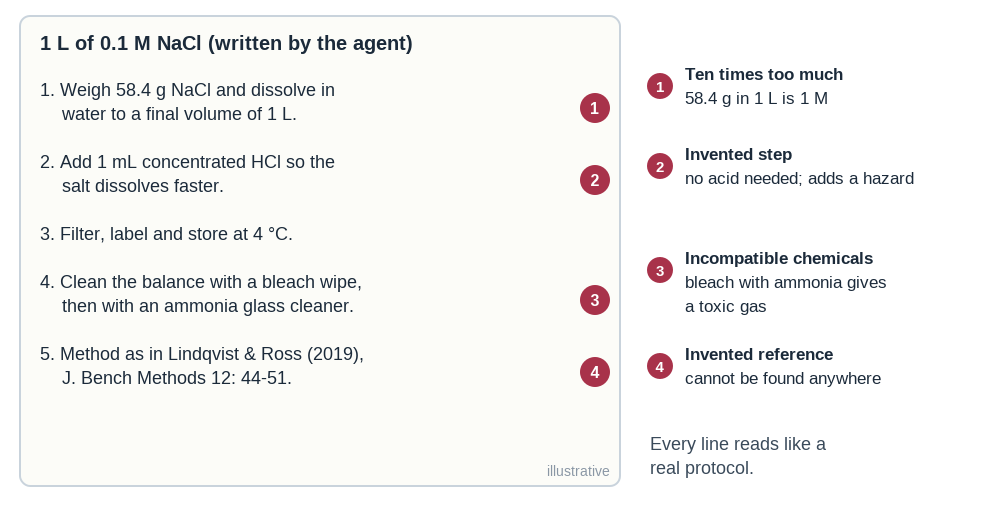
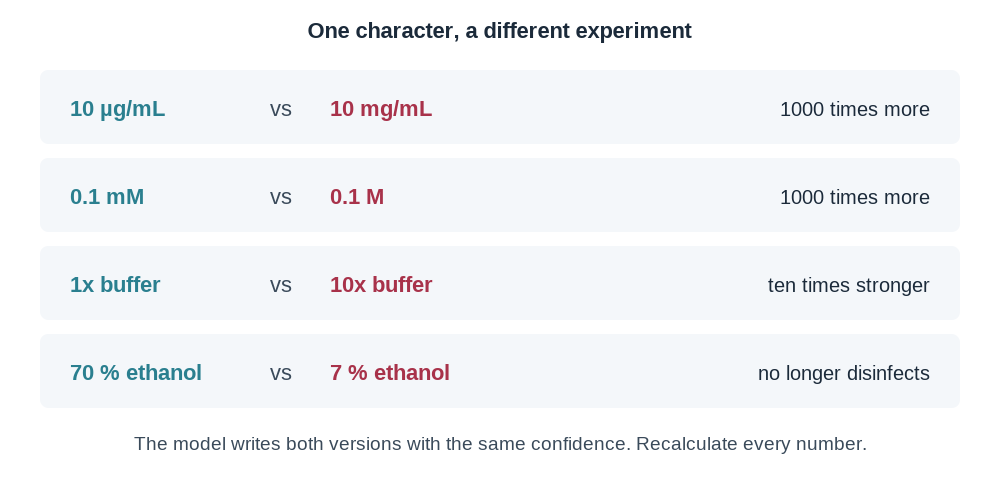
Concentrations and units fail silently
Safety steps go missing more often than they go wrong
| Often missing from agent-written protocols | Where to check |
|---|---|
| Protective equipment: gloves, coat, eye or face protection, heat-resistant gloves | Your lab’s risk assessment and standard procedures |
| Fume hood for volatile or toxic chemicals | The chemical’s safety data sheet (section 8) |
| Incompatible chemicals, also in waste containers | Safety data sheet (section 10); your waste rules |
| Waste: what goes where, never “down the sink” by default | Your institution’s waste guide |
| Biosafety level and approvals for the organism | Biosafety officer; local approvals |
| Who must be trained or present | Lab rules, supervisor |
The model writes the typical protocol. Your lab’s rules are not in its training data.
Medical questions need a qualified human in the loop
- Models answer medical questions fluently, and sometimes wrongly. They add caveats, but the caveats do not make the content right.
- Anthropic’s usage policy treats diagnosis, treatment and dosing advice to individuals as high-risk: a qualified professional must review the output, and people must be told AI was used. OpenAI’s policy is similar.
- For research and teaching, the model is fine for general knowledge, drafting and literature work. Check facts against guidelines and primary sources.
- Patient data stays out (Privacy, ethics and safety). A question about “a patient” with enough detail is still patient data.
Plausible text is not a tested protocol
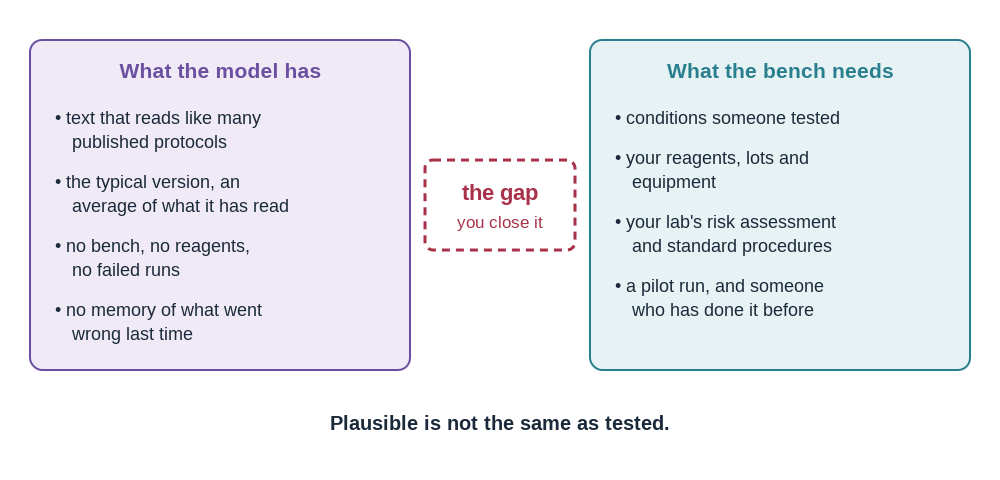
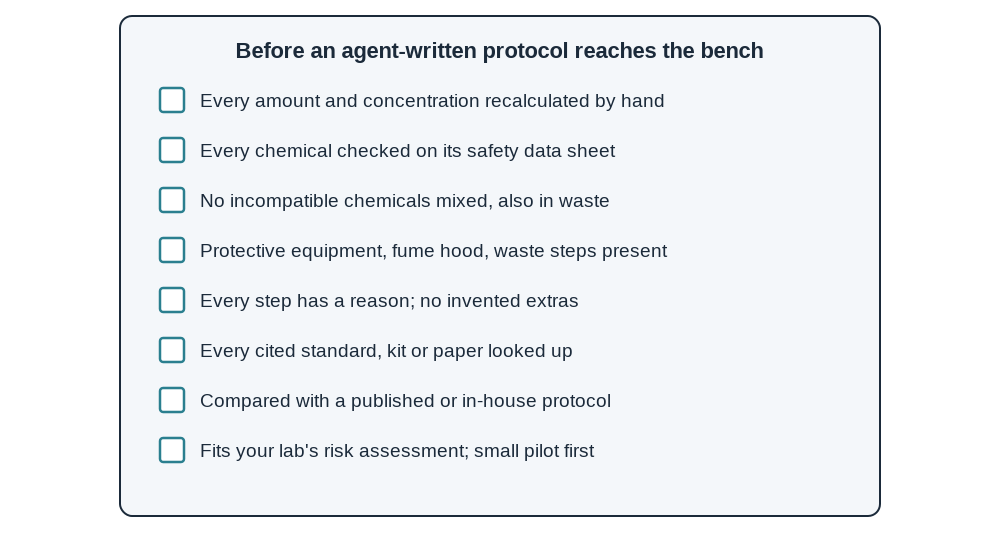
Check every agent-written protocol against the same list
For most biology projects in this course, the guardrails rarely matter
- RNA-seq and other omics (Track: RNA-seq): gene expression, enrichment, plots. Almost never blocked, even for host response to infection.
- Literature work on pathogens: expect thinner answers near the core; verify against PubMed, as you would anyway.
- Teaching material for microbiology and biosafety courses: occasional false positives; honest context helps.
- Protocols of any kind: the checklist matters far more than the guardrails.
- Put the relevant contacts and precautions in your project’s README.
Where this goes wrong
- Boundaries move. Classifiers are retrained often; what was blocked last month may pass, and the reverse. Names and programmes on these slides will date quickly.
- False positives are certain near the core. They cost time, not trust: they are not an accusation.
- A thin answer looks complete. The vaguer-answer form is the one people miss.
- A stopped agent leaves half-finished files. Check before you reuse them.
- Context is not a key. Honest context helps benign requests; it does not make restricted work acceptable, and invented context is a policy violation.
- Fluent protocols contain errors. Wrong amounts, missing safety steps, invented references. You remain responsible for what happens at the bench.
Summary
| Concept | Key fact |
|---|---|
| Dual use | The same biological knowledge protects and could harm; the model cannot see who asks |
| Uplift | Providers block help that makes the hard steps easier, not textbook facts |
| Who blocks most | The most capable models, with classifiers for chemical and biological weapons (Anthropic ASL-3, OpenAI “High”) |
| Where | A small core (weapons, enhancing pathogens, making or obtaining them, detailed protocols) and a safety margin (virology, toxin biology, some molecular design) |
| What it looks like | Refusal, vaguer answer, switch to another model, system message, agent stopping partway |
Summary (continued)
| Concept | Key fact |
|---|---|
| What to do | Policy limit, not a bug. Never reword or disguise. Benign request: honest context. Otherwise: biosafety officer, colleagues, literature |
| Access programmes | Anthropic Life Sciences Verification Program, OpenAI trusted access: for organisations |
| Other limits | Wrong concentrations, missing safety steps, invented references; medical advice needs a qualified human |
| Check | Recalculate, safety data sheets, compare with a real protocol, pilot first |
Next (Copyright, memorisation and credit): models can reproduce what they were trained on. What that means for copyright, for your own texts and data, and for giving credit when the agent helped.