Labelling AI-generated content: the EU rules, watermarks and detection
Part 6: The wider picture
About this lecture
You now publish things made with AI: course pages, figures, slides, perhaps a news text for your department. Since 2 August 2026, EU law has rules on telling people when content is AI-generated. At the same time, AI providers have started to hide marks in what their models produce, and teachers are offered “AI detectors” for student work.
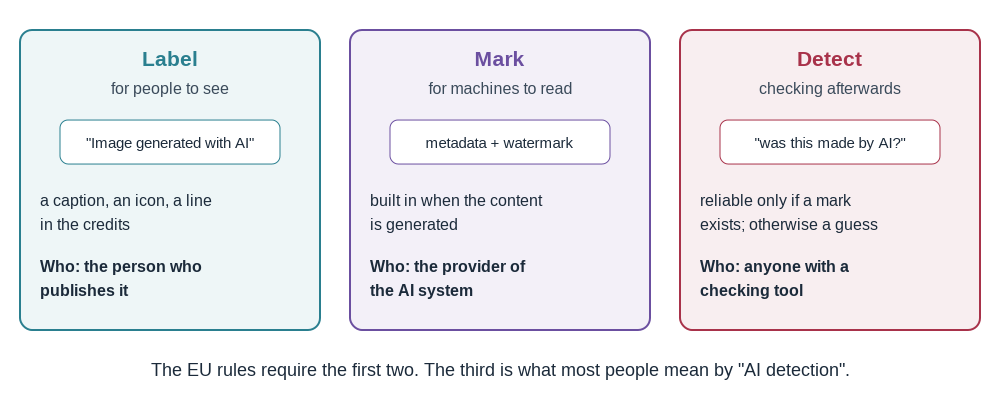
- Label, mark, detect are three different things. The EU AI Act (Article 50) requires the first two.
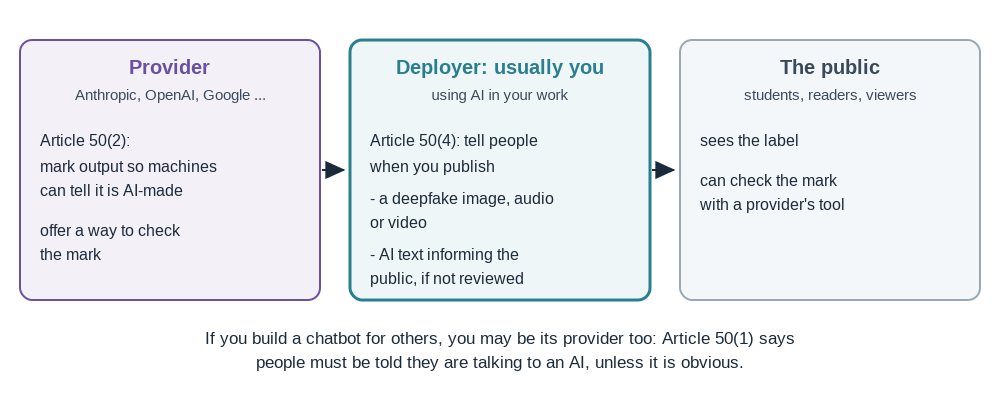
- As a deployer, you must disclose deepfakes and AI-written text that informs the public, unless a person reviewed it and takes editorial responsibility.
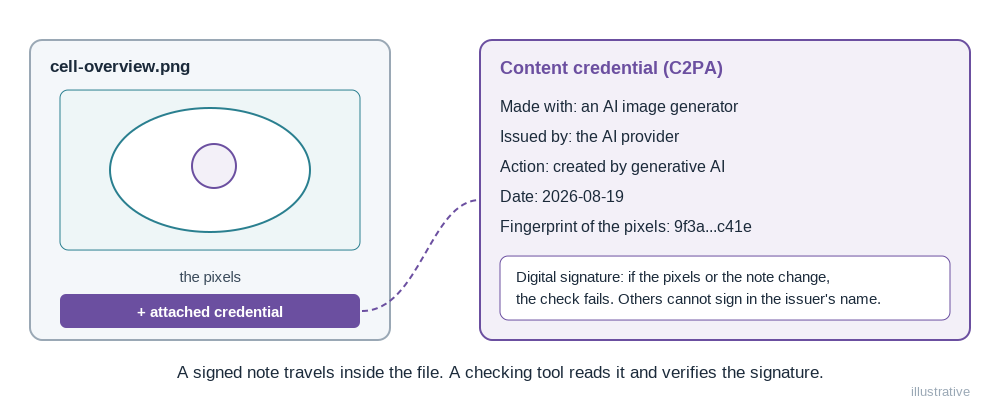
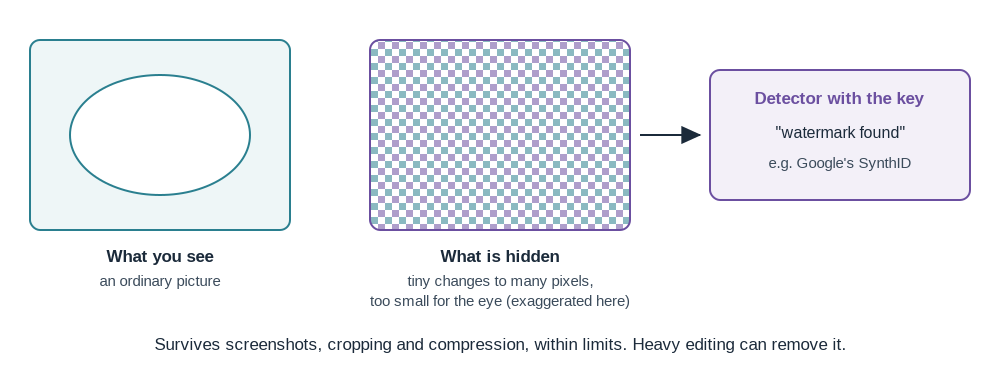
- Marks come as signed metadata (content credentials) and invisible watermarks in pixels, sound and text.
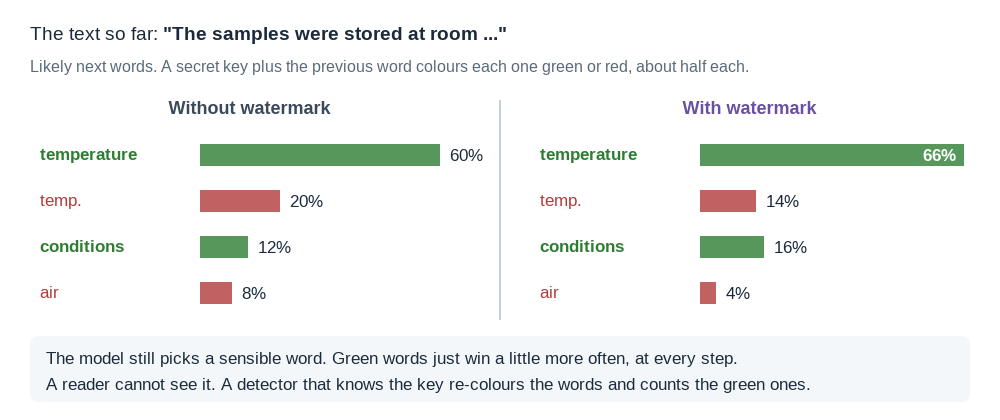
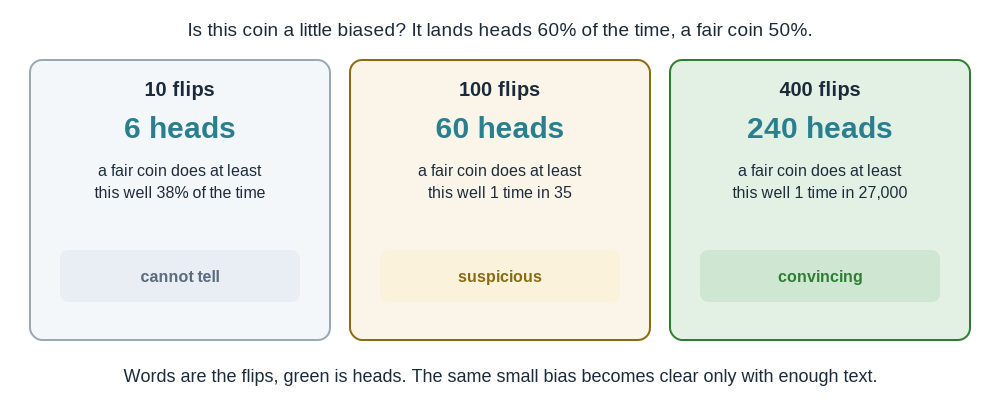
- A text watermark works like a slightly biased coin: invisible in a sentence, clear over a page.
- “AI detectors” without a watermark guess, and wrongly accuse non-native writers. A score is not evidence.
This is a concept unit with a hands-on demo, no maths. It builds on disclosure in Privacy, ethics and safety. Guardrails come in Guardrails and safety levels; copyright in Copyright, memorisation and credit.
A teacher publishes a course page; another gets an “87% AI” score
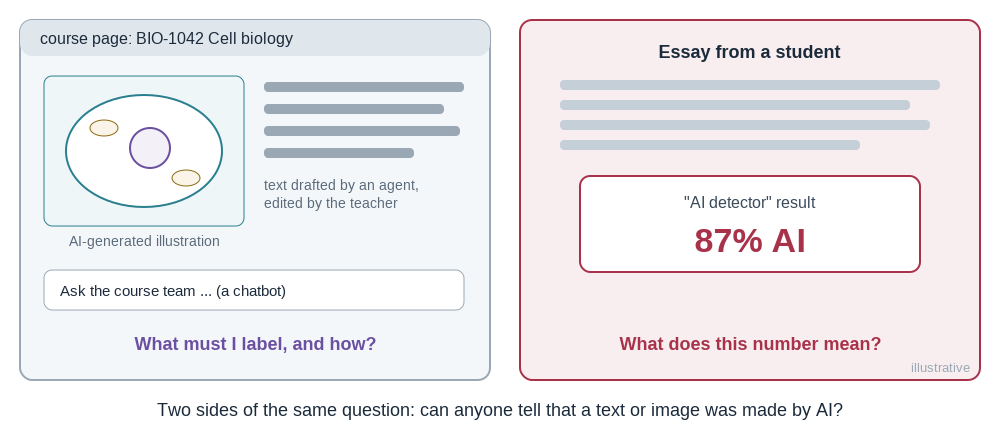
Labelling, marking and detecting are three different things
EU AI Act Article 50 has four transparency duties
| Duty | Who | What |
|---|---|---|
| 50(1) Chatbots | Provider of a system that talks with people | Tell people they are interacting with an AI, unless it is obvious |
| 50(2) Marking | Provider of a system that generates text, images, audio or video | Mark the output in a machine-readable way, so it can be detected as AI-generated. Not for tools that only assist standard editing |
| 50(3) Emotion recognition, biometric categorisation | Deployer | Inform the people exposed to it |
| 50(4) Deepfakes and public-interest text | Deployer | Disclose that a deepfake is AI-generated or manipulated. Disclose AI-generated or manipulated text published to inform the public on matters of public interest, unless it had human review or editorial control and someone holds editorial responsibility |
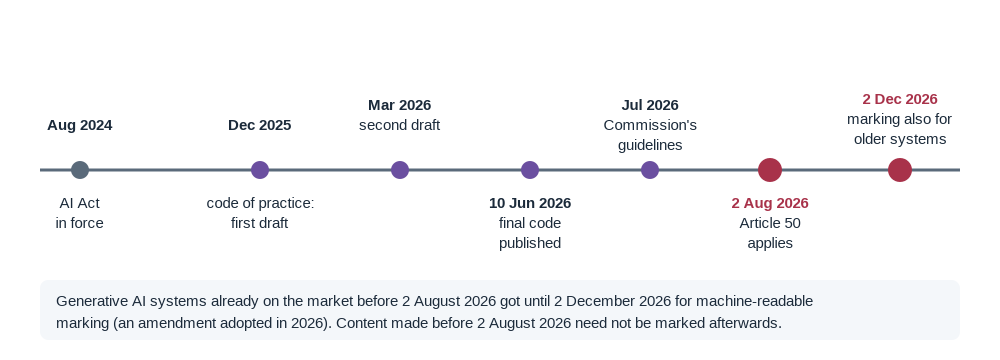
Information must be clear and given at the latest at the first interaction or exposure. Rules apply from 2 August 2026.
The rules started in August 2026, with a code of practice to show how
Providers mark; you, as the deployer, label what you publish
A deepfake is realistic content that could pass as real
- The Act’s definition: AI-generated or manipulated image, audio or video that resembles existing persons, objects, places, entities or events and would falsely appear authentic.
- Examples close to your work:
- a photo from the lab opening with people added or removed by generative fill,
- a lecture video with an AI copy of your voice, or of a colleague’s,
- a realistic “photo” of a field site, an instrument or a patient that never existed.
- Not deepfakes: a cartoon or schematic of a cell, a clearly stylised illustration, a data plot drawn by your script.
- Obviously artistic, satirical or fictional work: the disclosure can be light, so long as it does not spoil the work.
AI-written text must be disclosed only in one case, but your university may ask for more
- Article 50(4) covers AI-generated or manipulated text published to inform the public on matters of public interest: think news items, press releases, public information.
- Not covered when a person reviewed or edited it and someone takes editorial responsibility. A department news item checked and published by the communications office is in that position; an unreviewed bot posting news is not.
- A course page, a lab manual or a paper is usually not “informing the public on matters of public interest”. The AI Act then asks nothing.
- But journals, funders, your university and your own course rules may still ask for disclosure (Privacy, ethics and safety). Those rules apply whatever the AI Act says.
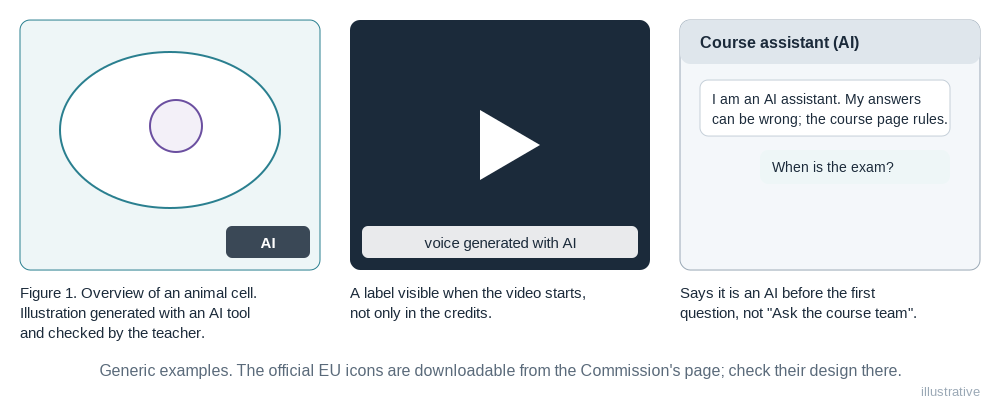
The code of practice shows how to comply, with layers and common icons
For providers (marking, 50(2))
- No single technique is enough. Signatories use at least two layers of machine-readable marking where needed, for example signed metadata and an invisible watermark.
- Offer a detection tool, such as a website or an API, so that others can check.
- Voluntary: providers who sign it can use it to show they comply. Others must show their own measures are adequate.
For deployers (labelling, 50(4))
- How and where to show a label: visible at first exposure, clear, accessible (alt text for screen readers).
- EU icons that anyone may use freely: a basic icon, one for fully AI-generated and one for partially AI-modified content.
- Using the icon is optional; the duty to label is not. Using it does not by itself prove compliance.
The icons and their guidance: Commission page “EU icons for labelling AI-generated content”.
What this means for what you publish
| You publish | AI Act duty for you? | What to do anyway |
|---|---|---|
| Course page text drafted by an agent, edited by you | No (reviewed, not news) | Your university’s rules; a line in the page footer is good practice |
| AI-generated schematic illustration | No (not realistic) | Caption: “Illustration generated with an AI tool” |
| Team photo with people added or removed by AI | Yes: deepfake | Label it, or better, do not publish it |
| Video with an AI voice (yours or anyone’s) | Yes: deepfake | Label it when the video starts |
| Department news item drafted by AI | Only if published without human review and editorial responsibility | Have it reviewed; follow the communications office’s rules |
| Chatbot on your course page | Users must be told it is an AI | Say so in the chat window, before the first question |
| Figure drawn by your script (written by an agent) | No | Method disclosure in the paper, as the journal asks |
A good label is short, visible and says what the AI did
Marking, method 1: content credentials are a signed note inside the file
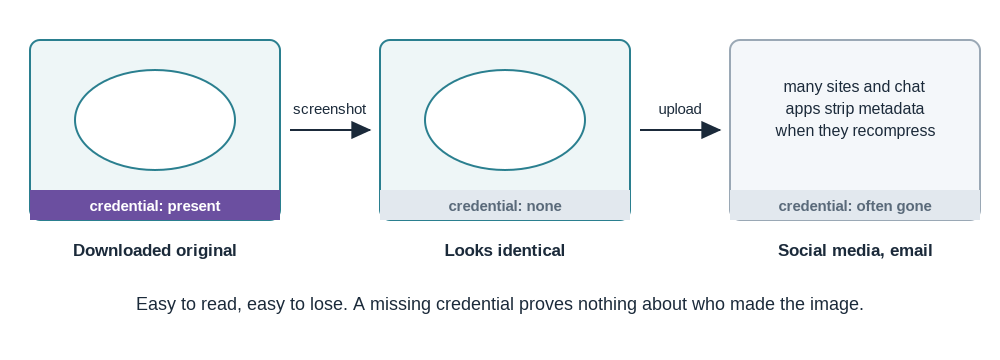
Content credentials are easy to read and easy to lose
The big providers now mark by default and offer checking tools
| Anthropic (Claude) | OpenAI (ChatGPT, API) | |
|---|---|---|
| Text | Invisible watermark in text from supported Claude models, on all surfaces including Claude Code | Text watermark (“textGrain”) in ChatGPT in the EU; API customers can switch it on |
| Files | C2PA content credentials on files Claude generates in the Claude apps and the API | C2PA and SynthID watermarks on images; SynthID on audio; C2PA on PDFs |
| Public checker | claude.com/check-content (files; runs in your browser) | openai.com/verify (images, audio, PDFs) |
| Text checker | Private preview for regulators, researchers, media and similar | By application, for research and public-interest projects |
| Their own caveat | A mark is a signal, not proof; no mark does not mean human-written | Same; heavy edits, translation and short texts weaken the signal |
From the providers’ help pages, November 2026. Coverage varies by model and product, and changes.
Marking, method 2: invisible watermarks hide a pattern in the content itself
Marking, method 3: a text watermark nudges the choice of words
Detecting it is like spotting a slightly biased coin
Try it: a toy watermark and a detector that counts green words
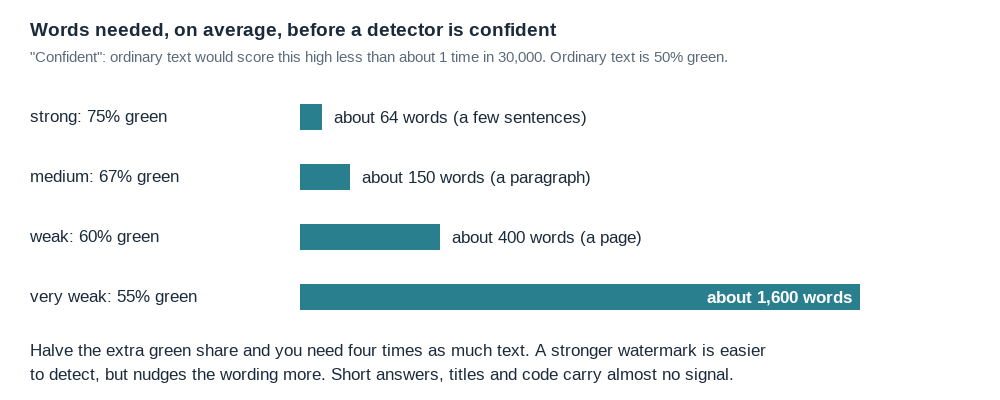
A detector needs enough text, and the weaker the bias, the more text
Paraphrasing and translating dilute the watermark
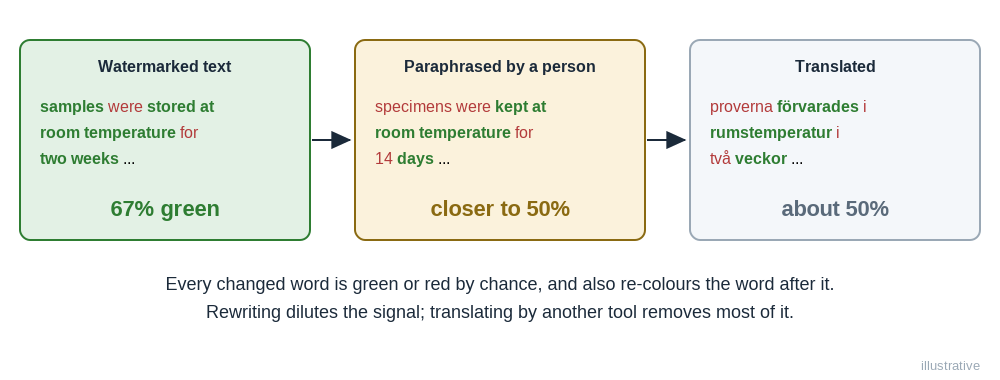
- Google’s SynthID documentation: detection confidence drops sharply when a text is thoroughly rewritten or translated.
- The signal also depends on the language: OpenAI reports that, at a 1% false-alarm rate, its detector found the watermark in 69% of Spanish and 42% of Romanian test texts, and then strengthened it for weaker languages.
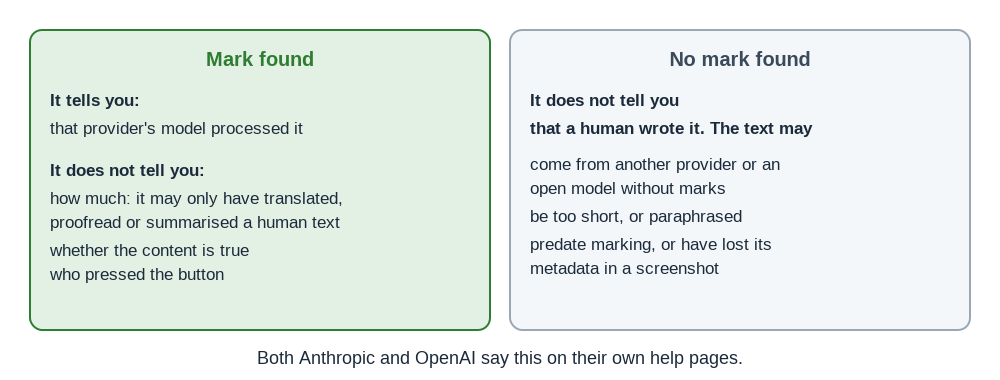
A mark tells you less than it seems, and no mark tells you almost nothing
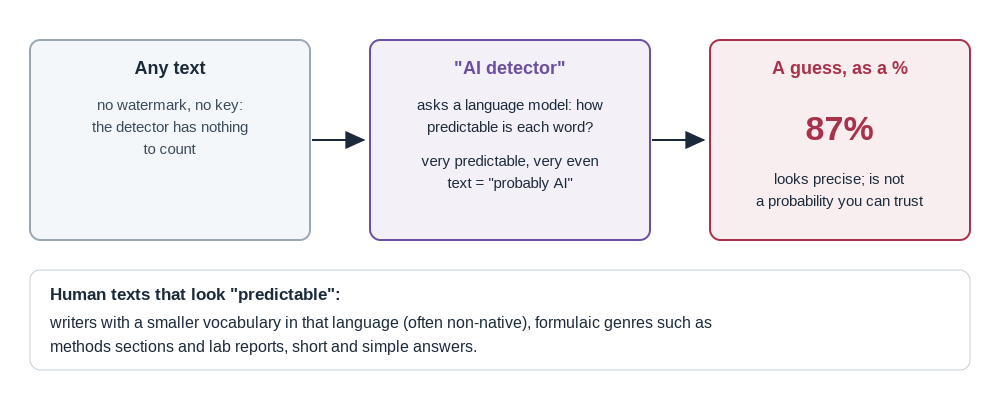
“AI detectors” without a watermark can only guess from style
Detectors wrongly flagged most essays by non-native writers
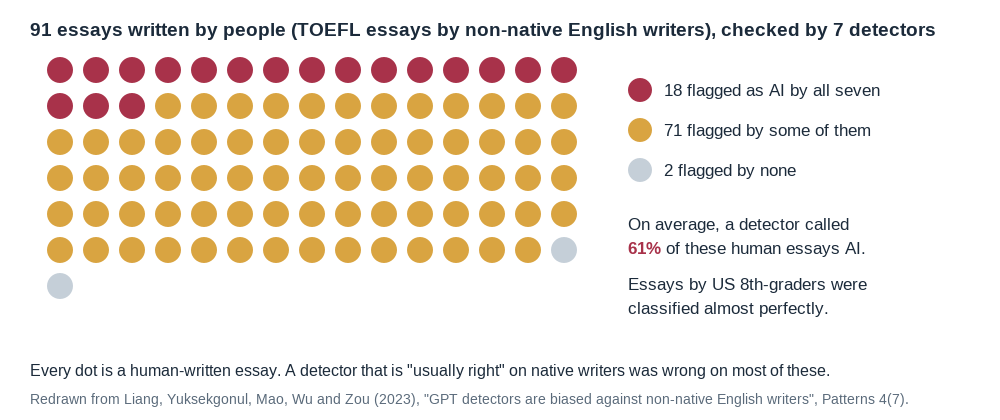
The evidence on detectors points the same way
- OpenAI withdrew its own AI text classifier in July 2023, six months after launch, citing its low accuracy.
- Weber-Wulff and colleagues (2023) tested 14 detection tools on human and AI texts, including paraphrased and machine-translated ones, and concluded that they are neither accurate nor reliable, with a bias towards calling texts human.
- Liang and colleagues (2023): false accusations concentrated on non-native writers (previous slide).
- The providers’ own text checkers are not open to teachers checking students: Anthropic’s is in private preview for selected organisations; OpenAI’s application programme says academic integrity checks are outside its scope.
- No detector can see text made by an open-weights model run locally, or text that was rewritten afterwards.
For teachers: a detector score is not evidence
- A score is a guess from style, not a finding. On its own it must not be the basis for a misconduct case.
- False accusations fall hardest on non-native writers and students who write plainly.
- Uploading student work to a third-party detector is processing personal data. Check your university’s approved tools first (Privacy, ethics and safety).
- What works better:
- clear rules per assignment on what AI use is allowed and how to declare it,
- assignments that show the process: drafts, notes, version history, an oral follow-up,
- talking with the student about the work.
- Follow your university’s procedure. Many universities now advise against relying on detectors.
Where this goes wrong
- “It is only a schematic”, when the image is photorealistic. If it could pass as real, label it.
- Labels in the wrong place: in the credits at the end, in alt text only, or after the first exposure.
- A chatbot that sounds human, with a heading like “Ask the course team”.
- Trusting a missing mark: no credential or watermark proves nothing about who made something.
- Over-reading a found mark: it says the model processed the content, not that the person did no work.
- Using a detector score as proof against a student or a colleague.
- Assuming the AI Act is the only rule: journals, funders and your university ask for their own disclosures.
- Facts age: dates, the code of practice, providers’ tools and coverage change. Check the sources before you rely on them.
Summary
| Concept | Key fact |
|---|---|
| Label, mark, detect | Labels are for people, marks for machines; detection is checking afterwards |
| Article 50 | Applies from 2 August 2026: chatbots disclose, providers mark, deployers label deepfakes and public-interest text |
| Your duty | Label deepfakes (realistic manipulated images, audio, video) and unreviewed public-interest text; tell chatbot users it is an AI |
| Code of practice | Final 10 June 2026; voluntary; at least two marking layers; free EU icons |
| Content credentials (C2PA) | A signed note in the file; easy to check, lost by a screenshot |
Summary (continued)
| Concept | Key fact |
|---|---|
| Invisible watermarks | A keyed pattern in pixels, sound or word choice; survives some editing |
| Text watermark | Green words slightly preferred; detectable over enough text, like a biased coin; paraphrase and translation weaken it |
| What a mark means | Found: the model processed it. Not found: almost nothing |
| AI detectors | Guess from style; falsely flag non-native writers; a score is not evidence |
Next (Guardrails and safety levels): the different kinds of guardrail you may hit when an agent refuses or stops, how to tell them apart, and the safety levels behind the strictest ones.