Copyright, memorisation and credit
Part 6: The wider picture
About this lecture
You are about to publish something the agent helped make: a course page, a script, a figure, a paper. Whose material is it, could it contain someone else’s work without you knowing, and who should get credit? Courts, researchers and the AI companies themselves are still arguing about all three.
- Training on copyrighted material is being decided in court, case by case and country by country. Four cases show the range.
- Models memorise. They can reproduce training text, code and images almost word for word, especially material that appears many times online.
- You publish it, so you check it. A short checklist before you publish catches most problems.
- Credit still goes to people. The OpenAI Navier–Stokes controversy shows why: who did the work, who checked it, and what happened to unpublished drafts.
This is a discussion unit with one hands-on check. It is not legal advice: for a real case, ask your university’s legal office or library.
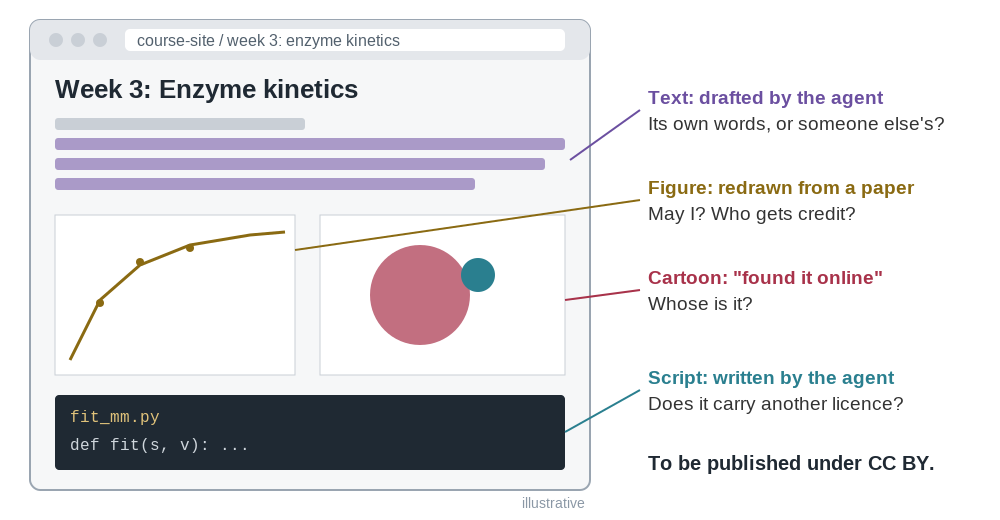
A course page is ready to publish, and nobody knows where every part came from
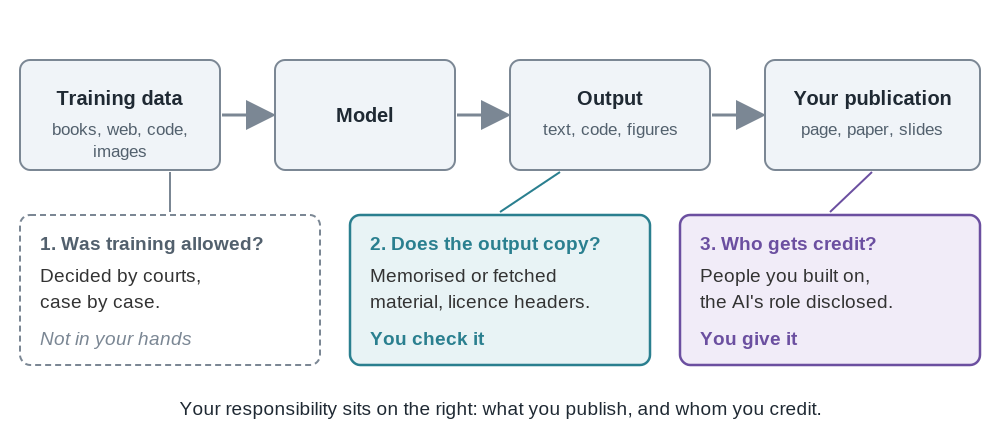
Copyright questions arise at three points: training, output and credit
Copyright protects the expression, not the idea
| What it means for you | |
|---|---|
| Expression, not ideas | The Michaelis–Menten equation is free to use. A textbook’s paragraph explaining it is not. |
| Automatic | Text, code, figures and photos are protected from the moment they are made, with no © needed. “Found online” means “someone owns it”. |
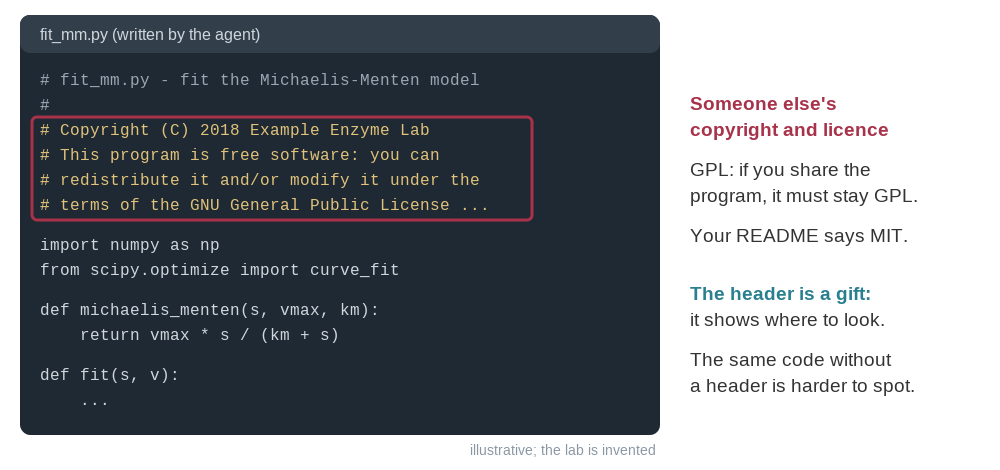
| Licences grant permissions | CC BY: reuse with credit. CC BY-SA: credit, and share your version under the same licence. GPL code: your program must also be GPL if you distribute it. MIT: almost anything, keep the notice. |
| Exceptions | Quotation with credit, teaching, research. They differ between countries. The EU has exceptions for text and data mining; the US has fair use, decided case by case. |
| Data and facts | Facts and measurements are not protected by copyright; databases can have other protection in the EU. |
Courts in Germany, the US and the UK are deciding it case by case
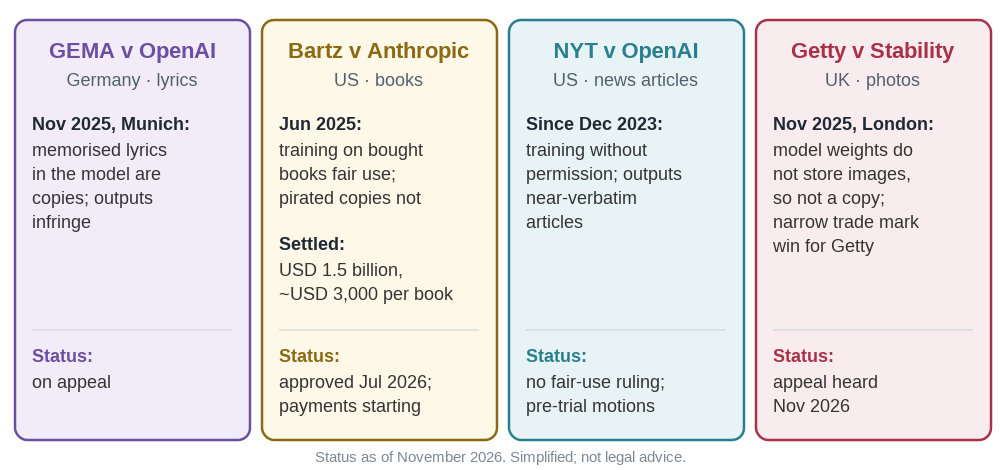
Status as of November 2026. Each case can still change on appeal.
GEMA v OpenAI: a German court treated memorised lyrics as copies
- Who: GEMA, the German music rights society, against OpenAI, about the lyrics of nine German songs.
- Ruling (Regional Court Munich I, 11 November 2025): the lyrics were memorised in the model, which the court treated as a reproduction; ChatGPT’s outputs of the lyrics also infringed. The EU text and data mining exception did not cover this.
- Status: OpenAI has appealed to the Higher Regional Court in Munich. The ruling is not final.
- Why it matters: the first major EU ruling. It links the legal question directly to memorisation, the topic of the middle part of this lecture.
Bartz v Anthropic: training was fair use, pirated books were not
- Who: a class of authors against Anthropic, in the US.
- Ruling (June 2025, before trial): training on lawfully bought and scanned books was fair use. Keeping a library of books downloaded from pirate sites was not.
- Settlement: USD 1.5 billion for roughly half a million books, about USD 3,000 per book, split between authors and publishers. Final approval in July 2026; some objectors have appealed; first payments are planned for late 2026.
- Why it matters: it separates how the material was obtained from what training does with it.
The New York Times v OpenAI and Microsoft is still heading for trial
- Who: The New York Times against OpenAI and Microsoft, filed December 2023 in New York, now joined with similar suits by news publishers and authors.
- Claims: training on millions of articles without permission, and outputs that reproduce articles nearly word for word or summarise paywalled content.
- Status: no ruling yet on fair use. In autumn 2026 the parties filed motions asking the judge to decide parts of the case without a trial.
- A side effect for users: in 2025 a court order required OpenAI to keep ChatGPT conversations it would otherwise have deleted, as possible evidence. Your chats can end up in someone else’s lawsuit.
Getty Images v Stability AI: the UK court found the model is not a copy
- Who: Getty Images against Stability AI, maker of the Stable Diffusion image model, in the High Court in London.
- Ruling (November 2025): Getty dropped its main training claim, because the training happened outside the UK. On the remaining claim, the court held that the model’s weights do not store the training images, so the model is not an infringing copy. Getty won a narrow point on Getty watermarks appearing in some generated images.
- Status: Getty appealed. The Court of Appeal heard the case on 11 and 12 November 2026; the judgment is pending.
- Why it matters: the opposite reasoning to Munich, on the same question: is a trained model a copy of what it learned from?
What the four cases add up to, for now
| Question | Where things stand (November 2026) |
|---|---|
| Is training on copyrighted material legal? | It depends. US: fair use possible (Bartz). EU: text and data mining exception, with opt-outs, but not for memorised copies (GEMA, under appeal). |
| Does it matter how the material was obtained? | Yes. Pirated sources were the expensive part of Bartz. |
| Is a trained model a copy of its training data? | Courts disagree. Munich: memorised lyrics, yes. London: image model, no. Both under appeal. |
| Can outputs infringe? | Yes, if they reproduce protected material. This is the part that concerns you. |
| Who is liable for an infringing output you publish? | Unsettled for the provider. You are responsible for what you publish. |
Not legal advice. For a real question, ask your university’s legal office or library.
The EU AI Act puts copyright duties on the model providers, not on you
- Since 2 August 2025, providers of general-purpose models in the EU must:
- have a copyright policy and respect machine-readable opt-outs from text and data mining,
- publish a summary of the content used for training, on a template from the EU’s AI Office.
- A voluntary code of practice (July 2025) spells this out; most large providers signed it. The Commission can enforce the rules from August 2026.
- For you as a user, these duties change little. Your own duties come from ordinary copyright law and your university’s rules.
Models can reproduce some training text word for word
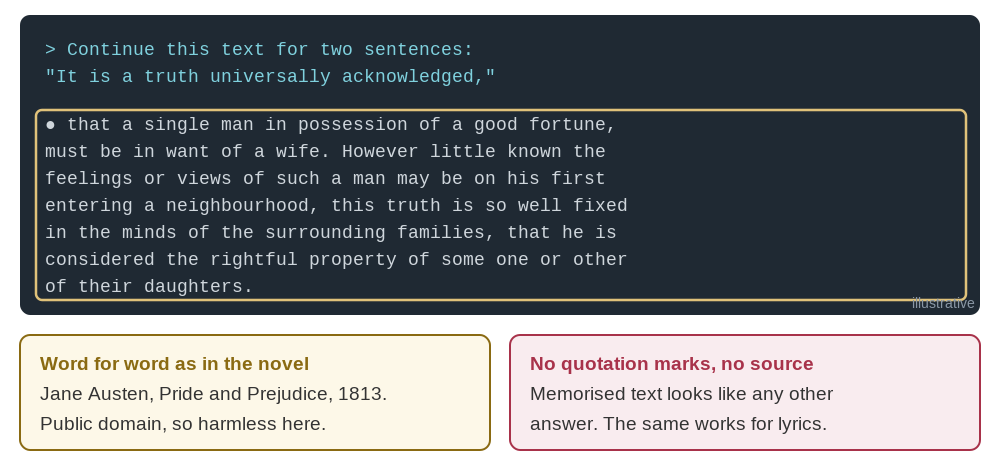
Researchers have extracted memorised training data on purpose
| Study | What they showed |
|---|---|
| Carlini et al. 2021, Extracting Training Data from Large Language Models (USENIX Security) | Hundreds of verbatim sequences from GPT-2’s training data, including names, phone numbers and code. |
| Carlini et al. 2023, Quantifying Memorization Across Neural Language Models (ICLR) | Memorisation grows with model size, with how often a text was repeated, and with how much of it you give as a prompt. |
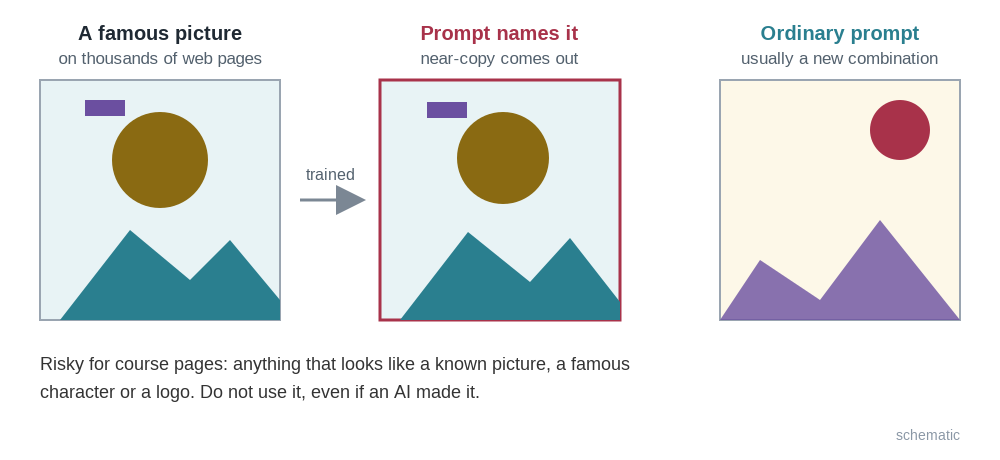
| Carlini et al. 2023, Extracting Training Data from Diffusion Models (USENIX Security) | Image models (Stable Diffusion, Imagen) regenerated over a thousand training images almost exactly, from portraits of real people to company logos. |
| Nasr et al. 2023, Scalable Extraction of Training Data from (Production) Language Models (arXiv:2311.17035) | A simple trick made ChatGPT emit memorised training text at scale. |
| Cooper et al. 2025, Extracting memorized pieces of (copyrighted) books from open-weight language models (arXiv:2505.12546) | Most books are not memorised, but some are: one open model held almost all of the first Harry Potter book. |
| Ahmed et al. 2026, Extracting books from production language models (arXiv:2601.02671) | Near-complete books extracted from some commercial models despite their safeguards; other models refused. |
What gets memorised is what appears many times
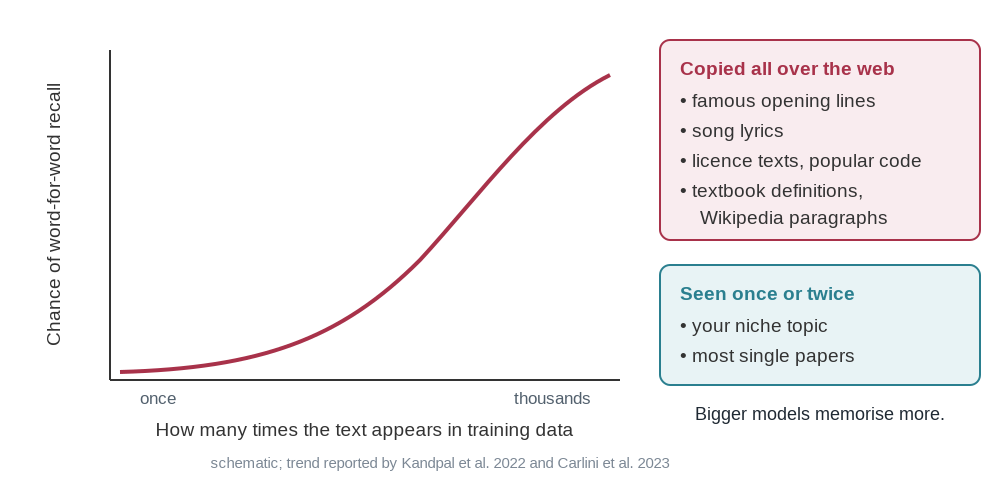
Image models can make near-copies, especially of famous images
Agent-written code can carry someone else’s licence
Guardrails reduce verbatim copying, but do not remove it
- Providers add filters: refusing to print song lyrics or long book passages, or stopping when the output matches known text.
- These filters are incomplete: the 2026 book study got past some of them; paraphrased copies pass any word-for-word filter.
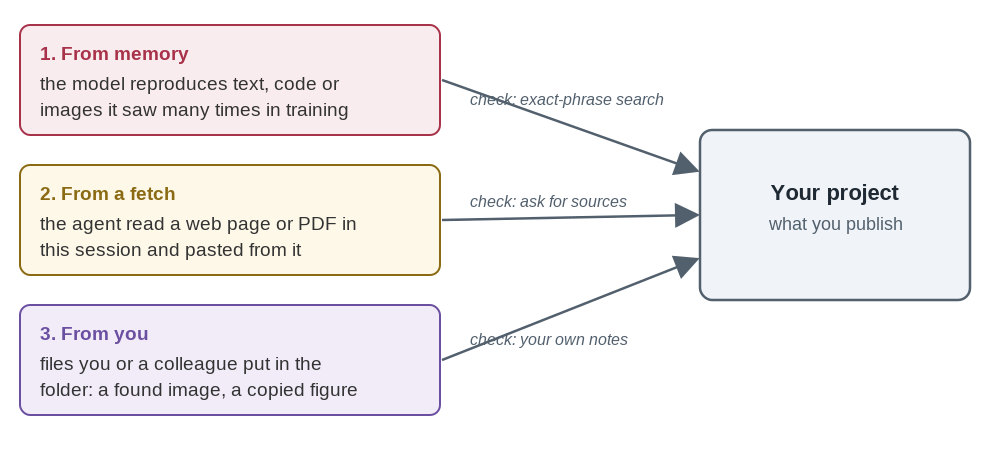
- Agents also fetch pages from the web and may paste from them. That is copying too, even if no memorisation is involved.
- So the responsibility stays with the person who publishes. Ask the agent: “Did any of this come from a specific source? Name it.” Then check yourself.
Three ways someone else’s material ends up in your work
Who owns what the agent writes is partly unsettled
| Question | Short answer |
|---|---|
| Do the provider’s terms give you the output? | Yes. Anthropic’s and OpenAI’s terms assign to you whatever rights they have in the output. |
| Is the output protected by copyright at all? | Only where a human made the creative choices. The US Copyright Office says purely AI-generated material is not protected; EU law requires the author’s “own intellectual creation”. Your edits, selection and structure count. |
| Does that stop someone else’s rights? | No. If the output copies a protected work, the terms do not give you that work. |
| Will the provider defend you? | Some offer copyright protection to business and API customers; personal plans usually do not. Read your plan’s terms. |
| Can you put a licence on it? | Yes, and you should: it tells others what they may do with your work. |
Put a licence on what you publish, and make it match your sources
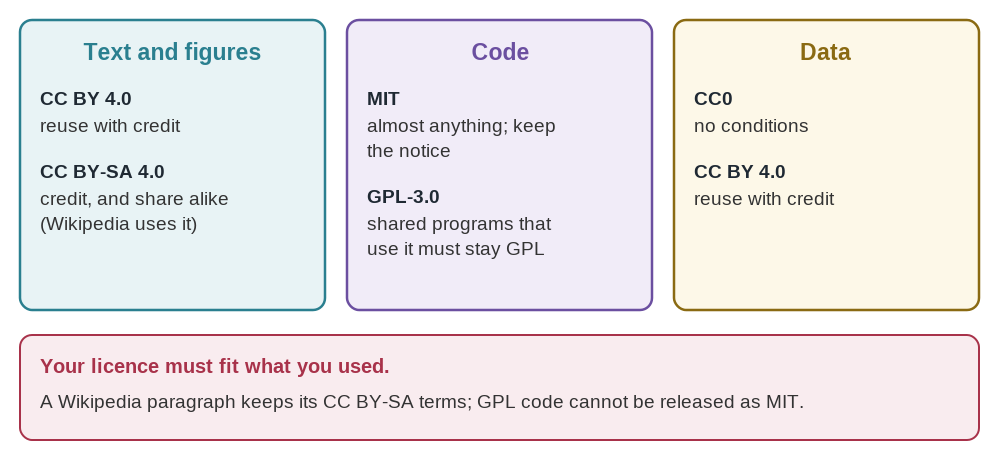
Your inputs have licences too
- What you feed the agent is also a use: paywalled PDFs, textbooks, a colleague’s code (Privacy, ethics and safety).
- Redrawing a published figure from its numbers is usually fine with a citation. Copying its design or the image itself needs permission or an open licence.
- Open-access papers under CC BY may be reused with credit; check the licence on the paper, not the journal.
- Your library knows which publisher licences allow text and data mining, and which forbid uploading to AI tools.
Before you publish, run a five-minute check
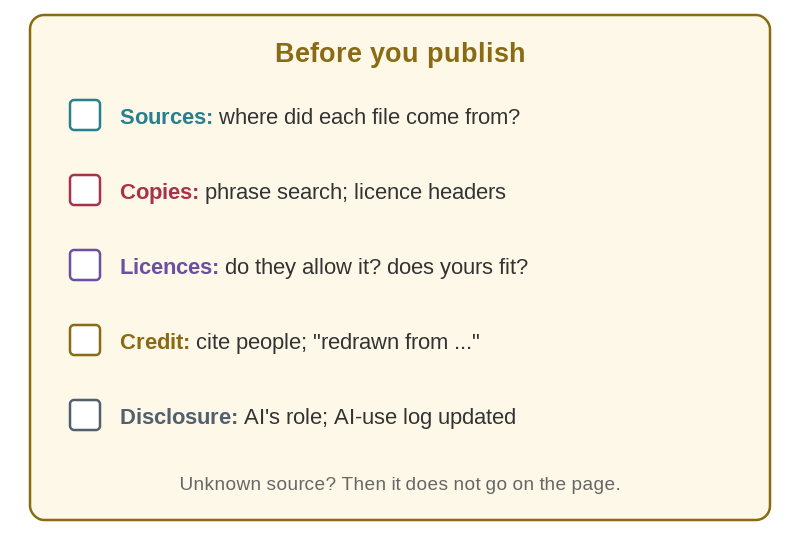
The agent can do the legwork of the check, but cannot sign it off
Before I publish this folder, do a copyright and credit check.
For every file (text, code, figures, images), make a table in
PUBLISHING-CHECK.md with: file, what it is, where it came from as far
as you can tell (my notes, the AI-use log, your own session), any
licence or copyright notice inside it, and what I should do.
Search the web for exact matches of distinctive sentences in the text.
Look for copyright and licence headers in code.
Flag anything whose source is unknown. Do not change any files.
My planned licences are in README.md.
The agent can search for matches and read licence headers. It cannot know where your cartoon came from, or certify that nothing was copied.
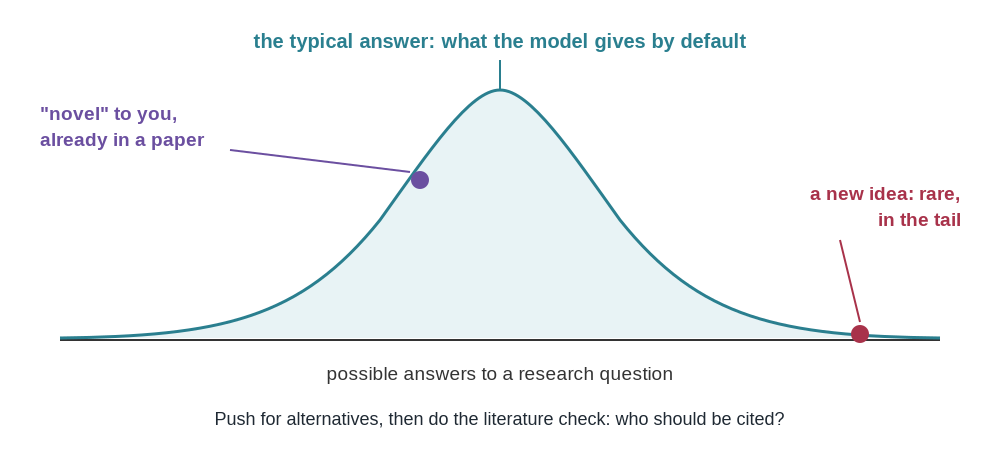
The model gives the likely answer, so “new” ideas may not be new
In September 2026, OpenAI claimed its agents had solved a Millennium Prize problem
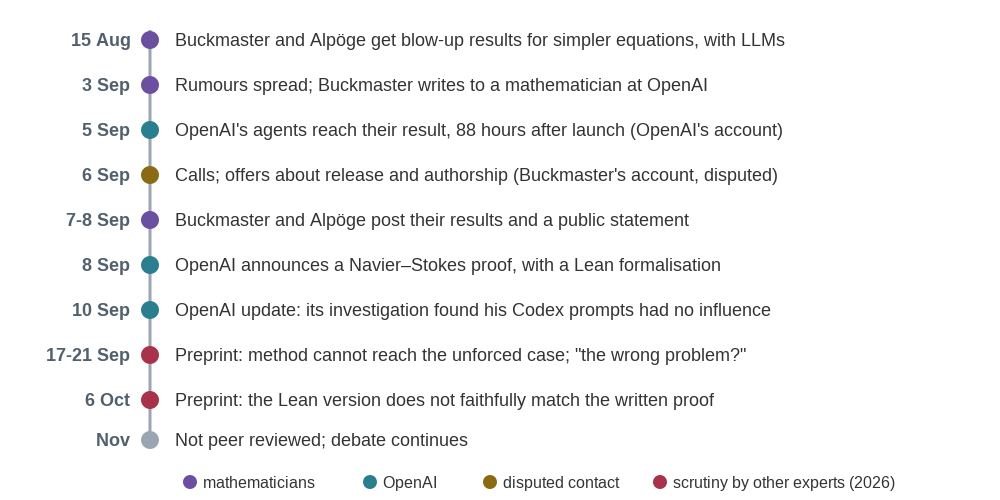
Mathematicians asked whether it solved the problem they actually care about
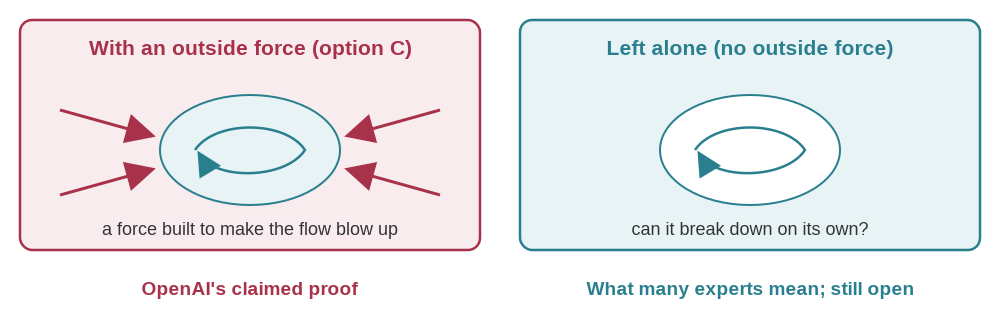
- The official problem statement (Fefferman, 2000) allows a smooth external force. OpenAI’s proof uses one, built for the purpose.
- Many experts mean the problem without an outside force: can the fluid break down on its own? That question remains open.
- Within weeks, a preprint argued the method cannot be extended to the unforced case, and another that the Lean version did not match the written proof.
The credit dispute: who built on whose work?
| What was said | |
|---|---|
| Earlier human work | The approach builds on a programme by Diego Córdoba and Luis Martínez-Zoroa, developed over several years. Buckmaster credits them explicitly. |
| Buckmaster and Alpöge | Worked on the problem for about a year with AI tools. Buckmaster’s public statement says OpenAI offered two options: a coordinated release, or a paper by him alone presenting OpenAI’s result, without Alpöge, who works at Anthropic. He declined both. |
| OpenAI | Says its work started independently, that neither its researchers nor its agents saw the pair’s work before it was public, and that it recognises their priority on a related result. It disputes Buckmaster’s account of the conversations. |
| Commentators | Asked whether ten thousand agents and millions of dollars of compute crowd out the human work that a field learns from, and called for full transparency about how such results are made. |
The allegation about drafts in Codex, and OpenAI’s denial
What Buckmaster wrote
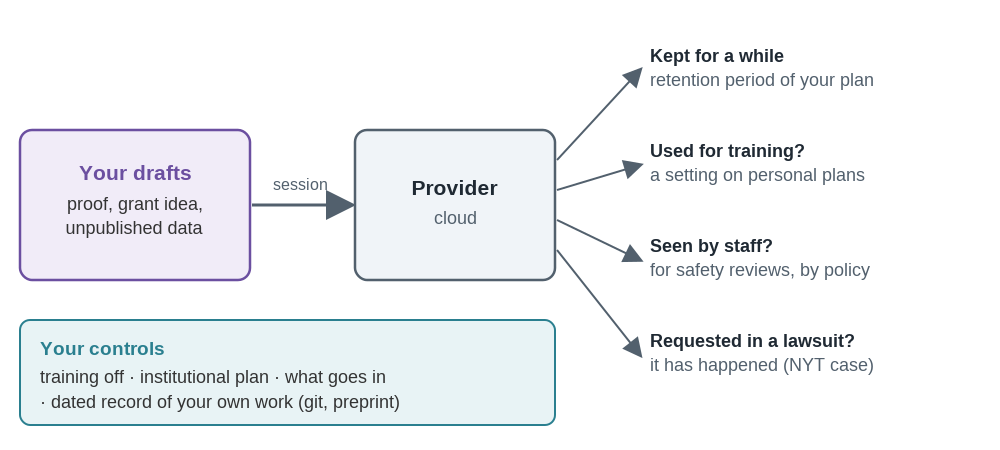
- He and Alpöge had put all their drafts for the project into Codex sessions.
- He asked whether OpenAI’s model had access to those sessions or had been trained on them. He was told the model did not look up user data; on training, he says he got no answer.
- He states that he does not know whether their data was used and is not accusing anyone.
What OpenAI said
- Its researchers and agents did not see the pair’s work before it was published, and no specific user data was accessed.
- At first it said it could not rule out that de-identified usage data had helped improve its models in general.
- After an internal investigation (update of 10 September 2026), it said his Codex prompts could not have influenced the system in any way, including through training.
Your unpublished ideas go wherever your agent’s data goes
Credit when AI is involved: five habits
| Habit | Why |
|---|---|
| Cite the people whose ideas you used, even if an agent did the last step | The model does not track its sources; you have to. |
| Disclose the AI’s role the way your venue asks | Readers judge the work differently, and journals require it (Privacy, ethics and safety). |
| Have experts check the result, not only the agent or a formal tool | Navier–Stokes: a checked proof can still prove a different statement. |
| Date your own work as you go: git history, a lab notebook, a preprint | A dated record shows what you had and when. Your git log is one. |
| Decide what goes into a cloud agent before a project matters | Training off or an institutional plan; truly sensitive ideas stay local. |
Where this goes wrong
- Assuming agent output is free to use. The terms give you the provider’s rights, not other people’s.
- Publishing a standard explanation that is someone’s paragraph. Common definitions are the most memorised text.
- Keeping a licence header you did not read, or deleting one you should have kept.
- “Found online” images in course pages. Unknown source means do not publish.
- AI-generated images that look like a known picture, character or logo.
- Taking a confident “this is novel” at face value. Do the literature check.
- Trusting the agent’s own copyright check as a certificate. It is a list of questions.
- Putting a breakthrough idea in a cloud session without deciding first.
- Treating this lecture as legal advice. For real cases: your legal office or library.
Summary
| Concept | Key fact |
|---|---|
| Three questions | training (courts), output (you check), credit (you give it) |
| The four cases | GEMA: memorised lyrics infringe (appeal). Bartz: pirated books, USD 1.5 bn settlement. NYT: no ruling yet. Getty: model not a copy (appeal heard) |
| EU AI Act | copyright duties for model providers; little change for users |
| Memorisation | verbatim recall of text seen many times; also images and code |
| Where it bites | standard definitions, lyrics, famous images, popular code with licence headers |
| Ownership | terms give you the output; copyright needs human choices; others’ rights stay |
| Licences | put one on what you publish; it must match what you used |
| Before publishing | sources, copies, licences, credit, disclosure |
| Credit | cite people; experts verify; date your work |
| Unpublished ideas | go wherever your agent’s data goes; decide first |
Next (Tracks): apply the course’s skills to one field: RNA-seq, simulation, image analysis, survey data or teaching materials.