Sooner or later the agent says no, stops halfway, or shows a message you have not seen before. There are several kinds of guardrail, set by different parties for different reasons, and each one needs a different response. Most people cannot tell them apart, so they either give up on a legitimate task or try to trick their way past a block that is there on purpose.
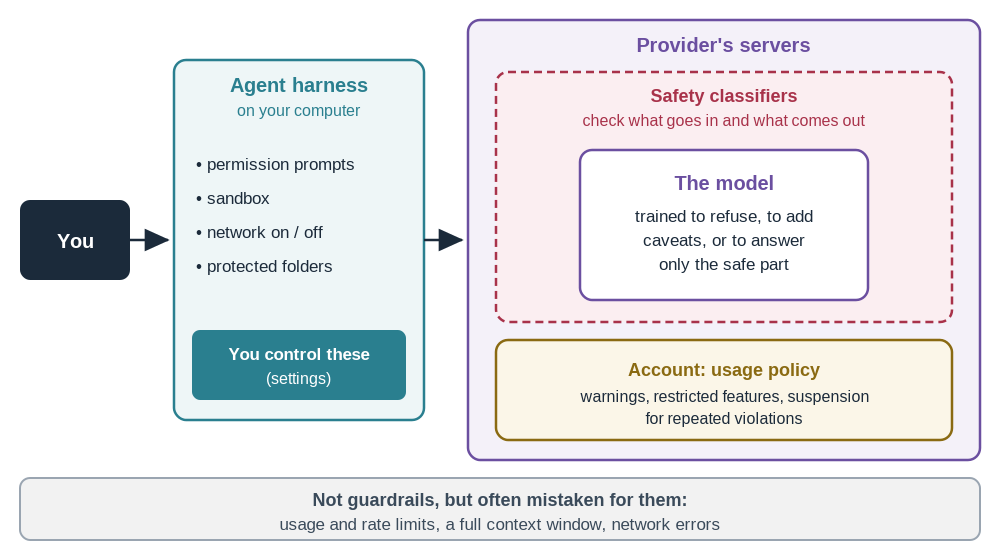
A guardrail can sit in four places: in the model, in classifiers around it, in the agent harness on your computer, and on your account.
Each looks different: a refusal in the reply, a system message or a cut-off answer, a permission prompt, an e-mail about your account.
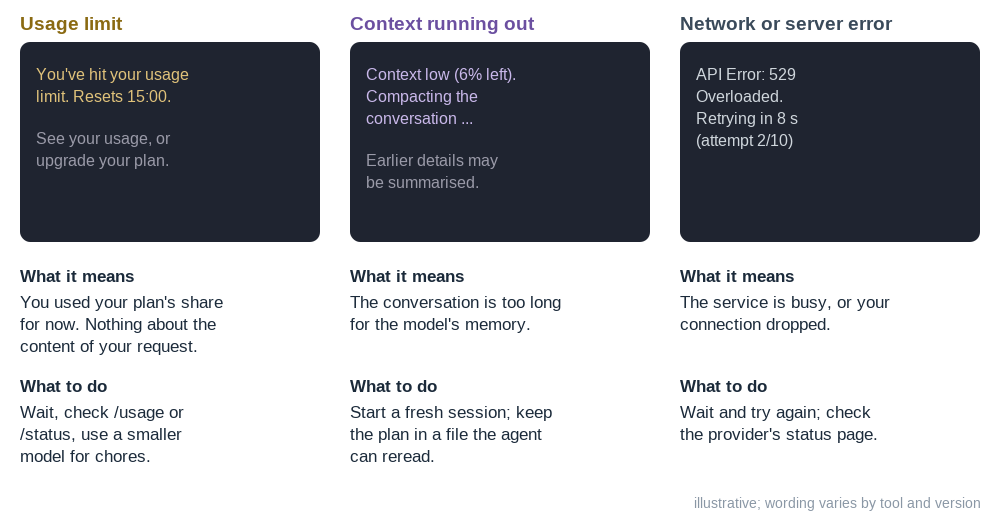
Usage limits, a full context window and network errors are not guardrails, but are often mistaken for them.
If your request is legitimate: give honest context, take the safe part, use normal channels for the rest. Never try to trick the model.
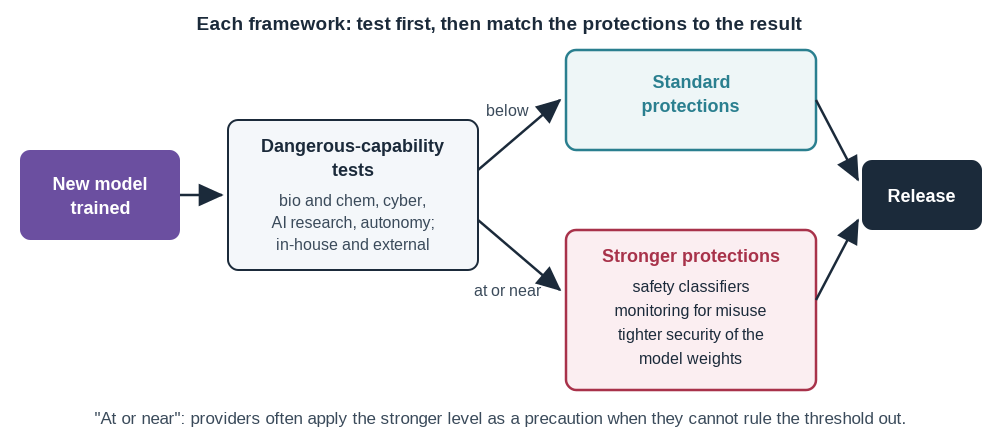
The strictest guardrails follow from safety levels: providers test each model for dangerous capabilities and add protections above a threshold, much like biosafety levels in a lab.
This is a concept unit with a short exercise. The deep dive for life sciences comes in Limits of AI for biological research.
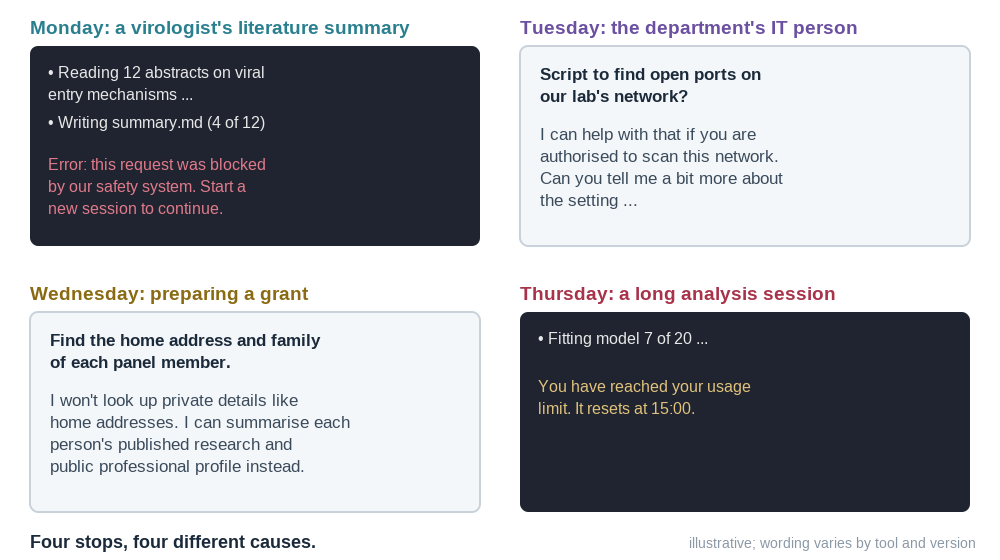
Four stops in one week, and each had a different cause
A guardrail can sit in the model, around it, on your computer, or on your account
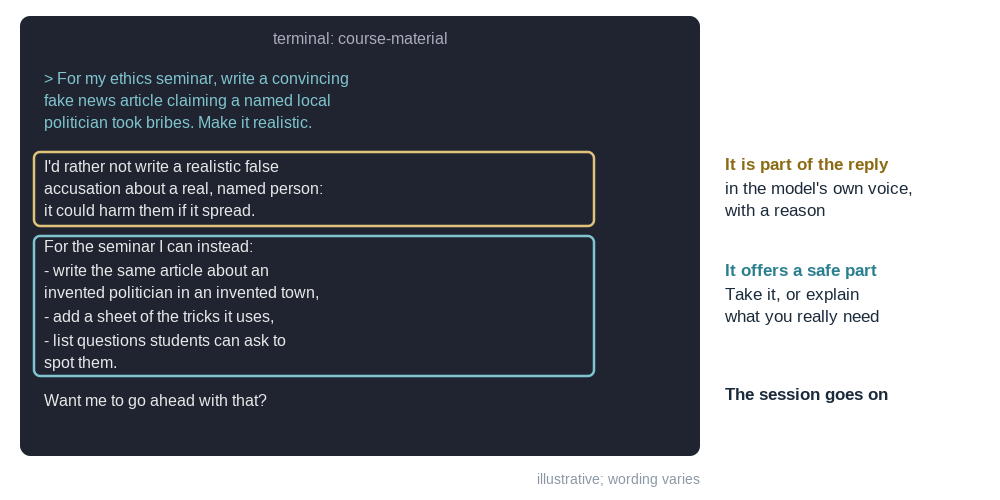
A refusal by the model is part of the reply, usually with a reason
Models also say “partly yes”: a safe part, a vaguer answer, or extra caveats
What you see
What is happening
Typical areas
A full refusal with a reason
The request as a whole is outside policy
weapons, sexual content involving minors, hateful content
A partial answer: the general part, not the specifics
The model answers the safe part of a dual-use request
chemistry, biology, security, some medicine
A normal answer with extra warnings, or “see a professional”
The model is being cautious
medical, legal, financial questions
A vaguer, shorter answer than usual
Hard to tell from the outside: caution, or a classifier switching models
dual-use science
OpenAI calls the second row safe-completions (introduced with GPT-5 in 2025): answer as much as is safe instead of refusing outright.
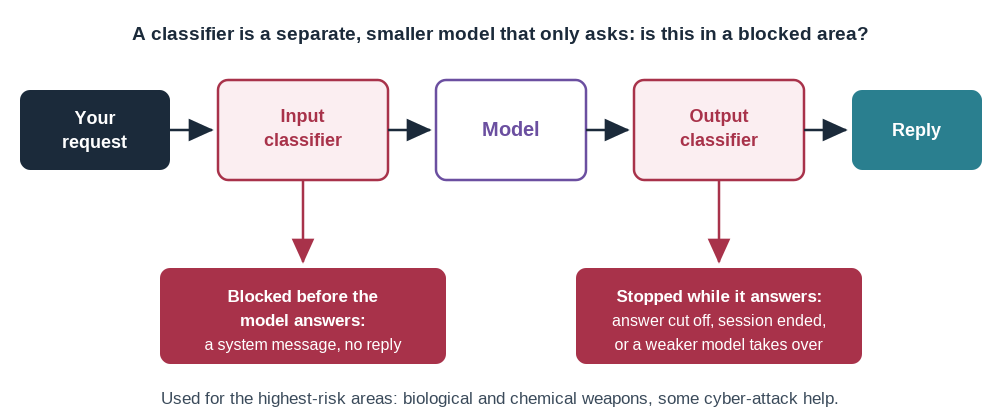
Safety classifiers are separate models that watch what goes in and out
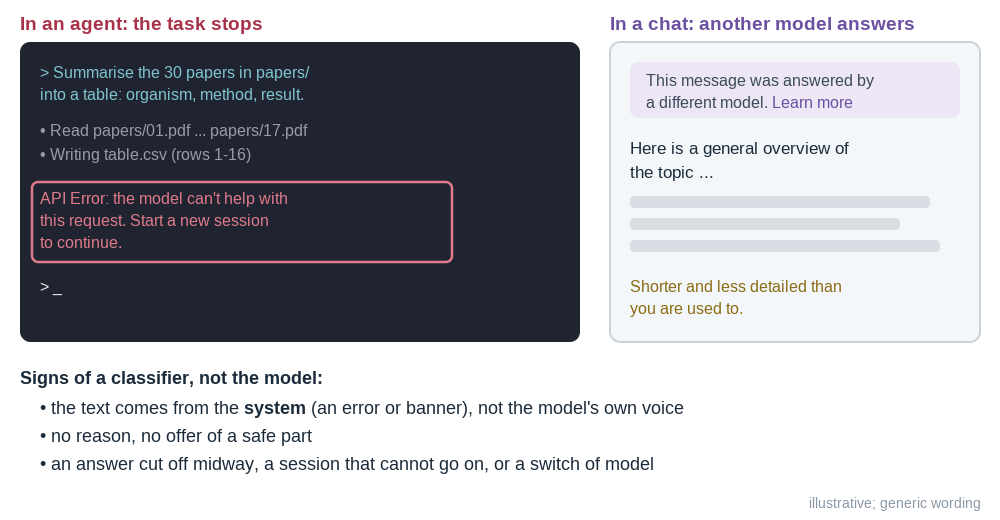
A classifier block looks like a system message, not like the model talking
Classifiers also stop legitimate research, and providers say so openly
Classifiers are tuned to err on the side of blocking. They see words and context, not your intentions or your institution.
Typical false alarms: virology, toxin biology, some protein design, biosecurity research itself, and lab safety material that names dangerous agents.
Providers publish this. In August 2026 Anthropic retrained its biology classifier and reported about 85 % fewer biology-related blocks, while saying that false positives will remain, and that virology, toxicology and molecular design still fall back to a less capable model.
Providers run verification programmes for vetted research teams that loosen some blocks (details in Limits of AI for biological research).
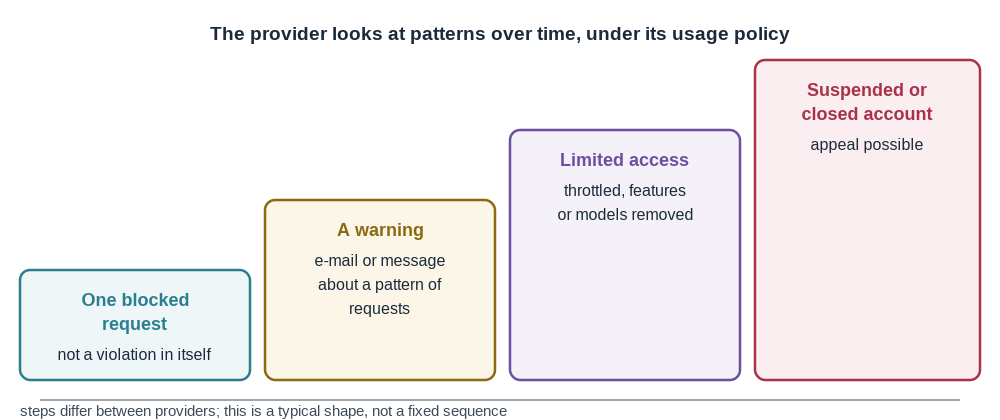
A false alarm is a policy limit, not a bug and not an accusation. One blocked request is not a violation.
Security and computing requests can look like hacking, even when they are your job
Requests that may be refused or questioned
scanning a network for open ports
testing passwords against a list
analysing a suspicious e-mail attachment or malware sample
writing a script that logs in to a website and scrapes it
getting around a licence check or a paywall
What helps
Say whose system it is and that you are authorised to test it (“our lab’s network, I am the IT contact”).
Ask for defensive framing: how to check, detect, harden.
Respect the site’s terms; Part 4 covers scraping politely.
Some requests (getting around paywalls or licence checks) are refused because they are the problem.
Personal data, copyright and professional advice have their own limits
Area
What the model tends to do
What to do instead
People
Declines to compile profiles of private individuals, find home addresses, or identify people in photos
Stay with public professional information (publications, institutional pages); this matters in Likely reviewers for an upcoming grant
Copyright
Will not reproduce long passages of books, song lyrics or paywalled articles
Ask for a summary, a short quote, or the reference; more in Copyright, memorisation and credit
Medical
Adds caveats, suggests a professional, avoids dosing advice for an individual
Use it for background and drafting; decisions about patients stay with qualified people
Legal and financial
Answers in general terms, adds “this is not advice”
Use it to prepare questions for the expert, not to replace them
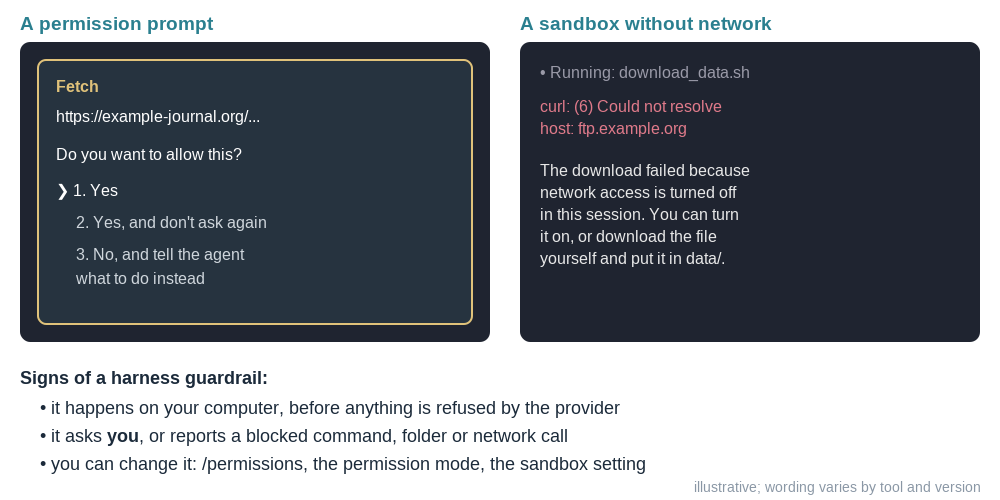
Harness guardrails run on your computer, and you control them
Account-level enforcement looks at patterns, not at one blocked request
Both providers’ usage policies allow warnings, limits and suspension for violations, and both forbid intentionally getting around safeguards. Anthropic: “a blocked output alone does not count as a violation.”
Usage limits, a full context and network errors stop you too, but they are not guardrails
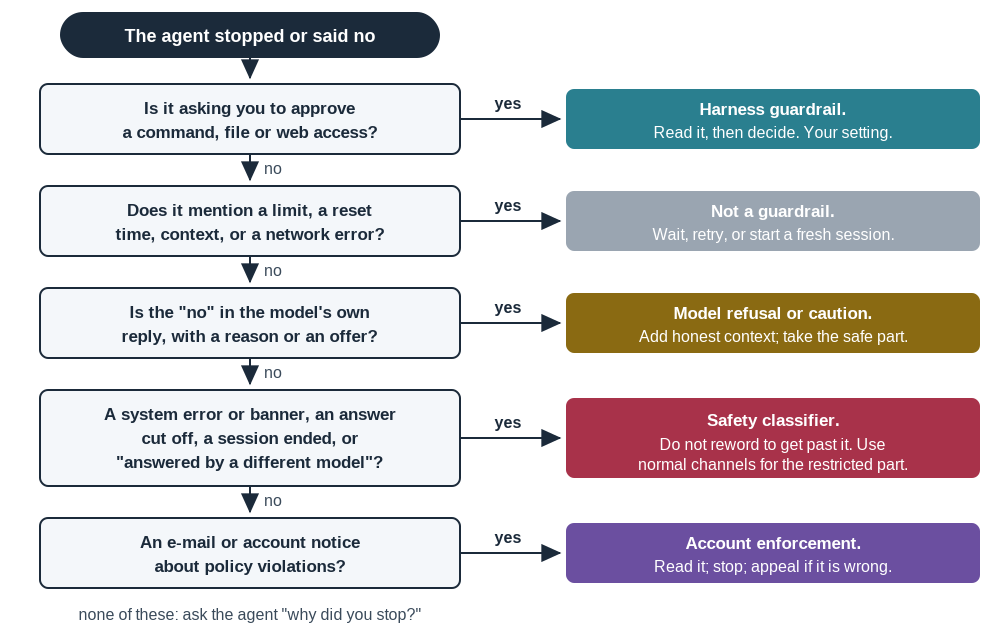
Which guardrail did I hit? Ask four questions in order
The same question in a table
What you see
Where it comes from
Who can change it
What to do
“Do you want to allow this?”
Harness
You
Read, then yes once, or no and say what instead
A blocked command or network call
Harness (sandbox)
You
Allow it for this task, or do that step yourself
“I won’t …, but I can …”
Model
Nobody, but context helps
Give honest context; take the safe part
Extra caveats, “see a professional”
Model (caution)
Nobody
Fine for background; decisions stay with experts
System error, cut-off answer, ended session, “answered by a different model”
Classifier
Provider (verification programmes)
Do not reword to get past it; use normal channels
Warning e-mail, restricted account
Account
Provider
Stop; read the policy; appeal if wrong
“Usage limit”, “context low”, “overloaded”
Not a guardrail
You (plan, session)
Wait, start fresh, retry
If the request is legitimate, say who you are and what it is for
Without context
Write a script that tries every
password in passwords.txt against
the login page at 10.0.4.17.
With honest context
I am the IT contact for our research
group and responsible for our lab
server at 10.0.4.17. Our security
office asked me to check that no
account uses a password from the
leaked-password list they gave me.
How should I run that check safely
and with their approval? Prefer
existing audit tools over a new
script, and tell me what to
document.
Context works for the model’s own caution. It does not change what a classifier blocks, and it must be true.
Split the task: let the agent do the safe parts, handle the restricted part another way
Most tasks that hit a guardrail are mostly fine. One part triggers it.
Ask for the parts that are clearly fine: structure, background, analysis code, formatting, a reading list.
Handle the restricted part through normal channels: your colleagues, the published literature, your institution’s safety officers, the provider’s programme for vetted researchers.
Write down in your project notes what was blocked and how you handled it. It helps a colleague, and it helps you if anyone asks.
Do not try to trick the model past a guardrail
Both providers’ usage policies prohibit intentionally getting around safeguards. It can cost you your account.
If something is blocked on purpose, a trick that “works” means you are now doing the very thing the block was for, under your name.
A trick that works today breaks tomorrow, and leaves a pattern in the logs.
Your institution may have rules too: research security, export control, dual-use research policies.
Rewording honestly to explain a legitimate task is fine. Rewording to hide what you are asking is not.
The strictest guardrails come from testing each model before release
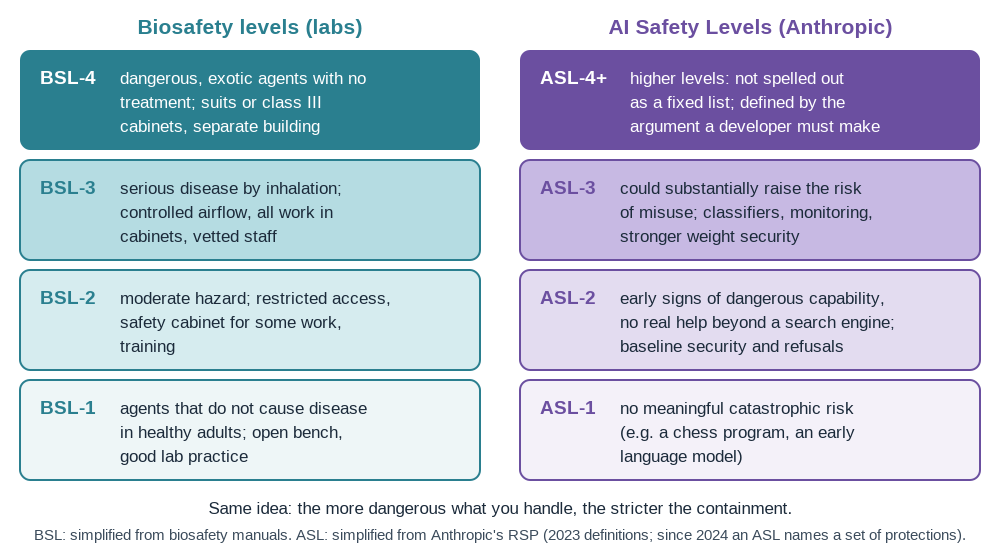
Anthropic’s AI Safety Levels were modelled on biosafety levels
Anthropic today: all current models run with ASL-3 protections
Responsible Scaling Policy, version 3.4 (effective 8 July 2026). Version 3.0 (February 2026) was a rewrite: it adds public Risk Reports every 3 to 6 months and a Frontier Safety Roadmap.
ASL-3 protections were first switched on in May 2025, with Claude Opus 4, as a precaution. They are aimed above all at chemical and biological weapons.
They include classifier guards, access controls with exemptions for trusted users, red-teaming and bug bounties, and security controls on the model weights.
At the time of writing (November 2026), Anthropic’s model report says its current models are deployed with ASL-3 protections, treating them as reaching its first chemical and biological threshold (“CB-1”).
The policy commits to keeping at least ASL-3 protections for models at that threshold, and to extending them at the next, higher one.
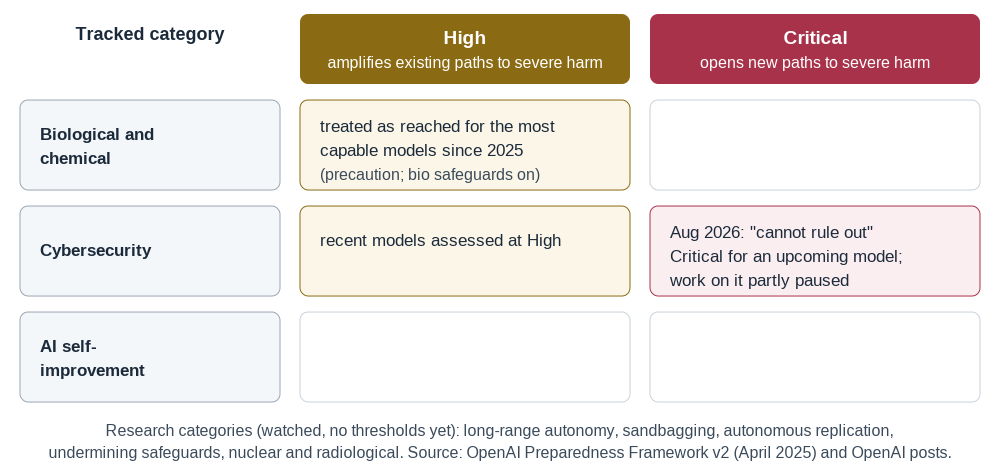
OpenAI’s Preparedness Framework tracks three categories with “High” and “Critical” thresholds
Google DeepMind’s Frontier Safety Framework uses “critical capability levels”
Frontier Safety Framework, version 3.0 (September 2025), updated to 3.1 (April 2026).
Critical Capability Levels (CCLs): thresholds at which a model could cause severe harm without extra protections. Domains: CBRN (chemical, biological, radiological, nuclear), cyber, harmful manipulation, machine-learning R&D, and misalignment (a model working against its operators).
Version 3.1 adds Tracked Capability Levels: lower thresholds that give an earlier warning.
At a CCL: a response plan, a safety case review before release, and stronger security and deployment protections.
The EU AI Act now requires this kind of testing for the largest models
The AI Act calls the largest models general-purpose AI models with systemic risk. A model trained with more than 1025 operations of compute is presumed to be one.
Their providers must: evaluate the model, including adversarial testing; assess and mitigate systemic risks (CBRN and loss of control among them); report serious incidents; and ensure cybersecurity of the model.
Obligations apply since 2 August 2025; the Commission’s enforcement powers started on 2 August 2026 (fines up to 3 % of global turnover, or withdrawal of a model).
A voluntary Code of Practice (July 2025) shows how to comply; most major providers have signed it.
For you as a user, the AI Act changes little directly. It is why the providers’ frameworks are now public and audited.
Three frameworks, one shape
Anthropic
OpenAI
Google DeepMind
Name
Responsible Scaling Policy
Preparedness Framework
Frontier Safety Framework
Current version
3.4 (July 2026)
2 (April 2025)
3.1 (April 2026)
Levels
AI Safety Levels (ASL-2, ASL-3, …) and capability thresholds
High, Critical
Critical and Tracked Capability Levels
Main risk areas
chemical and biological weapons, AI research and development
biological and chemical, cybersecurity, AI self-improvement
CBRN, cyber, harmful manipulation, ML R&D, misalignment
Where you notice it
classifiers, rerouting to another model
refusals, safe-completions, classifiers
refusals, filters
Versions as checked in November 2026. They change: check the provider’s page.
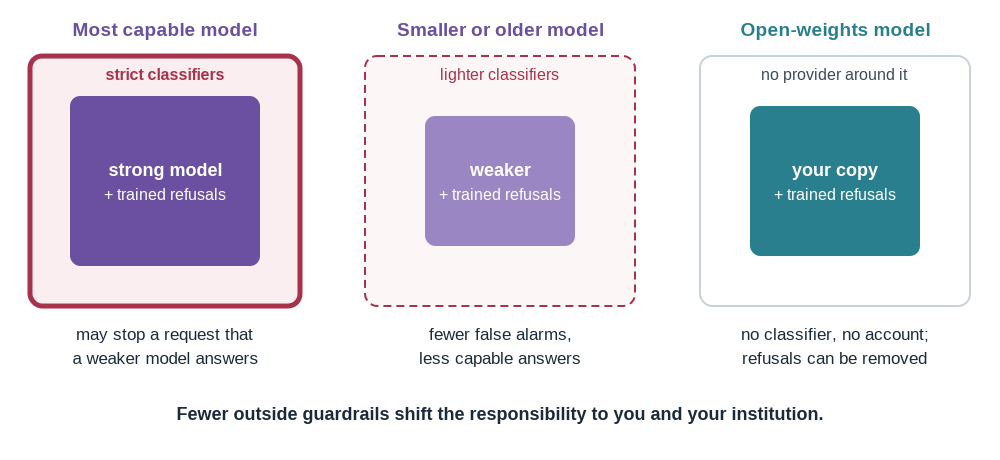
A stronger model may refuse what a weaker one does, and open weights shift the responsibility to you
Where this goes wrong
Misreading the type. Rewording a request that hit a usage limit; waiting out a classifier that will not change.
Taking a false alarm personally, or giving up on a legitimate task that only needed honest context or splitting.
Inventing context to get past a guardrail. That is circumvention, whatever the topic.
Treating the agent’s answer as permission. “The model helped, so it must be allowed” is wrong: the model does not know your institution’s rules, your ethics approval or export control.
Relying on guardrails for safety. They are coarse and they miss things; your judgement and your institution’s rules come first.
Old facts. Policies, levels and messages change several times a year.
Summary
Concept
Key fact
Model refusal
In the reply, with a reason and often a safe offer. Honest context helps
Partial answers
Safe part only, vaguer, or extra caveats; easy to mistake for “doesn’t know”
Safety classifier
Separate model; system error, cut-off answer, ended session or a switch of model. False alarms happen
Harness guardrail
Permission prompts, sandbox, network: your settings
Account enforcement
Usage policy; looks at patterns; one block is not a violation; getting around safeguards is
Summary (continued)
Concept
Key fact
Not guardrails
Usage limits, full context, network errors
What to do
Honest context; split the task; normal channels; never trick the model
Safety levels
Test before release; stronger protections above thresholds. ASL modelled on BSL
Frameworks
Anthropic RSP (ASL-3 on current models), OpenAI Preparedness (High, Critical), DeepMind FSF (CCLs), EU AI Act systemic risk
Consequence
Strongest models are strictest; open weights move responsibility to you
Next (Limits of AI for biological research): the deep dive for life sciences and medicine: which biology triggers the classifiers, what that looks like, the programmes for vetted researchers, and the limits that are not guardrails at all, such as protocols the model gets subtly wrong.