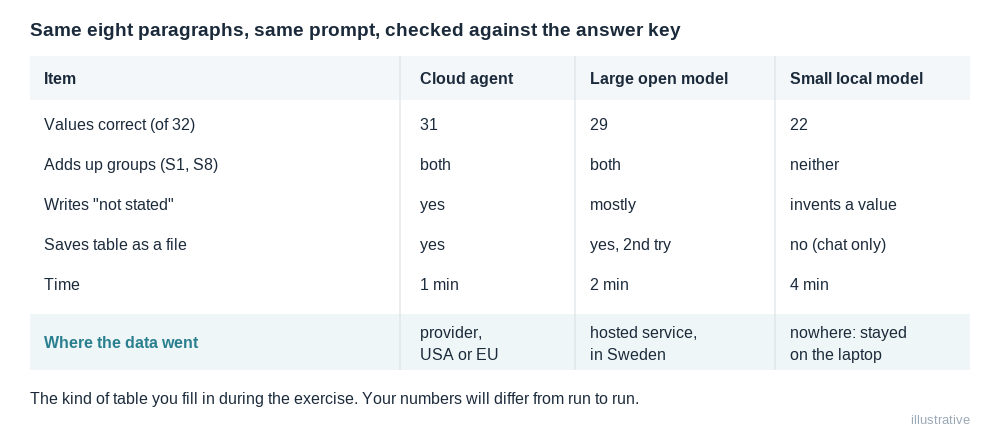
So far every prompt and every file the agent read went to Anthropic or OpenAI. For much of your work that is fine. For some it is not: patient data, interview transcripts, data under a contract. Open-weights models can run somewhere else: on a service your university or a national infrastructure runs, or on your own computer.
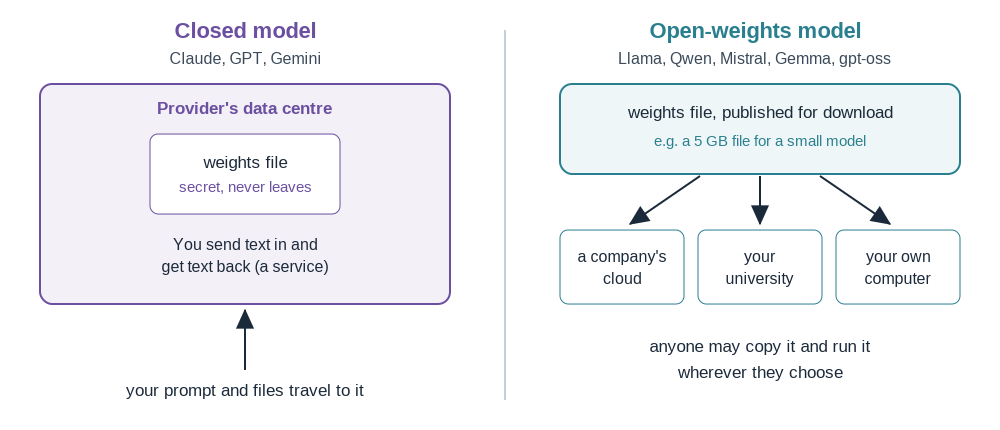
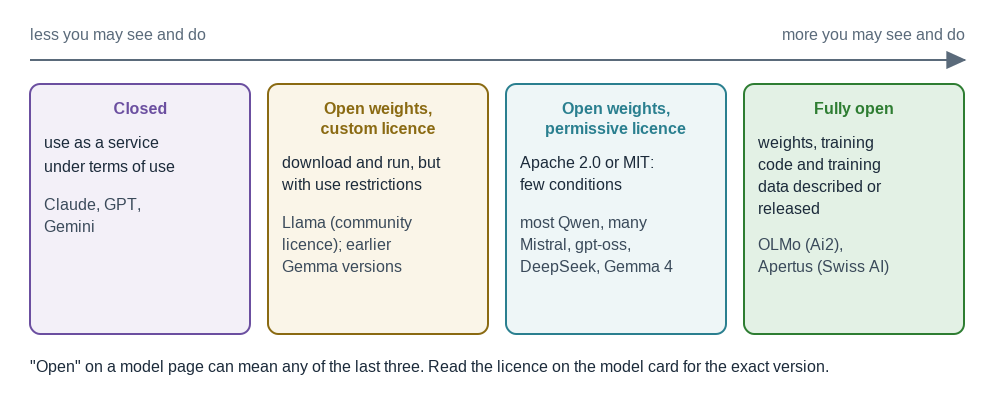
Closed models (Claude, GPT) run only on the provider’s servers. Open-weights models (Llama, Qwen, Mistral, Gemma, gpt-oss) are files anyone can download and run.
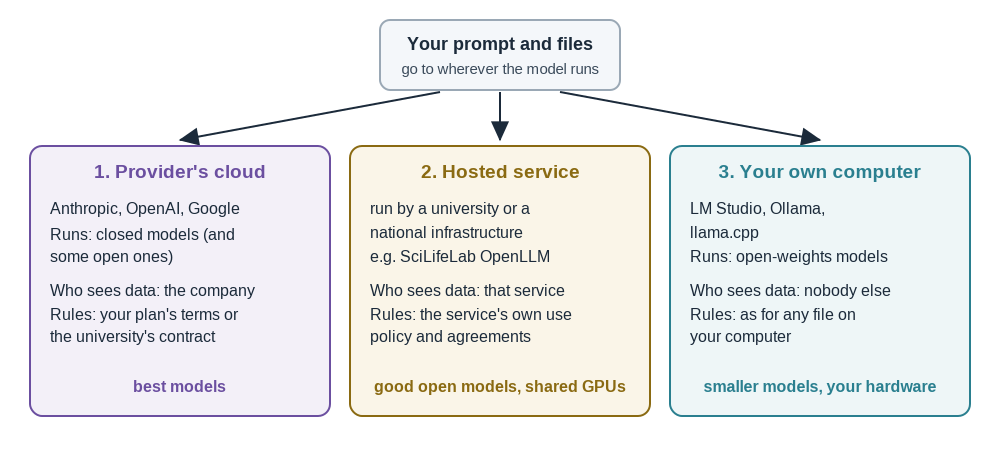
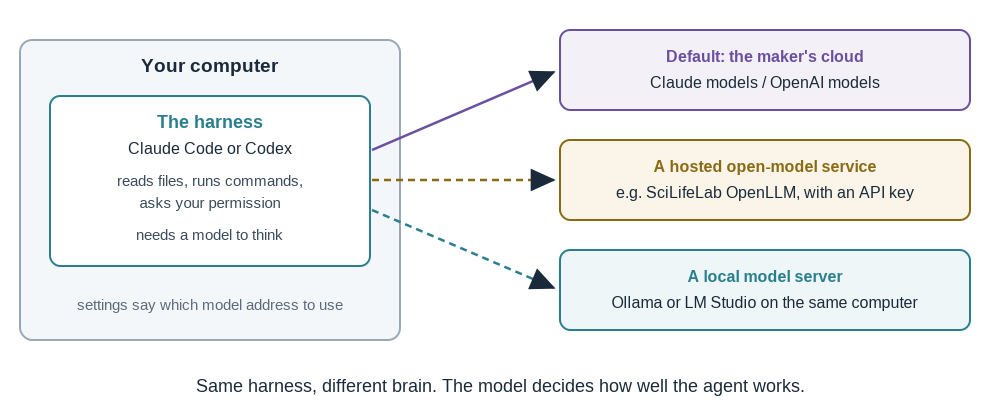
What matters for privacy is where the model runs: the provider’s cloud, a hosted service, or your own computer.
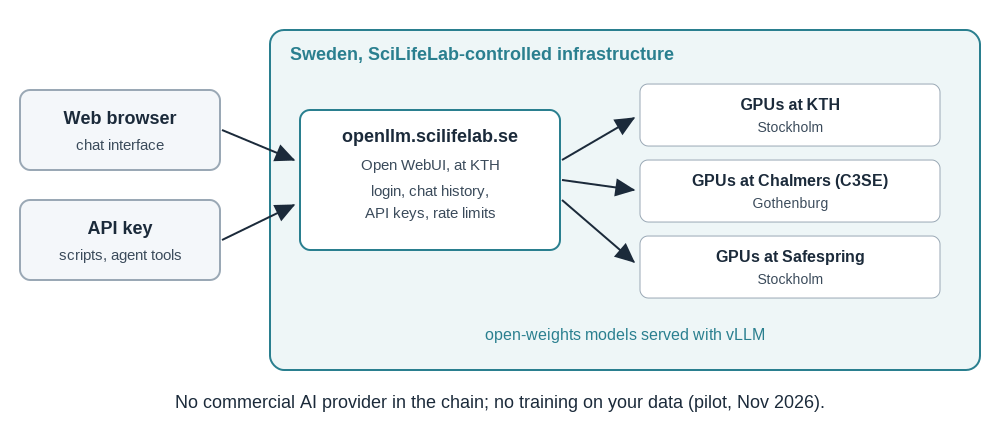
SciLifeLab OpenLLM is a Swedish example of a hosted service for research.
Open models cost you something: weaker results, especially as agents, hardware, and your time.
“Open” does not always mean open source: read the licence.
This is a concept and decision unit with a hands-on comparison. It builds on Privacy, ethics and safety and Choosing a model. Guardrails, which open models have fewer of, come in Guardrails and safety levels.
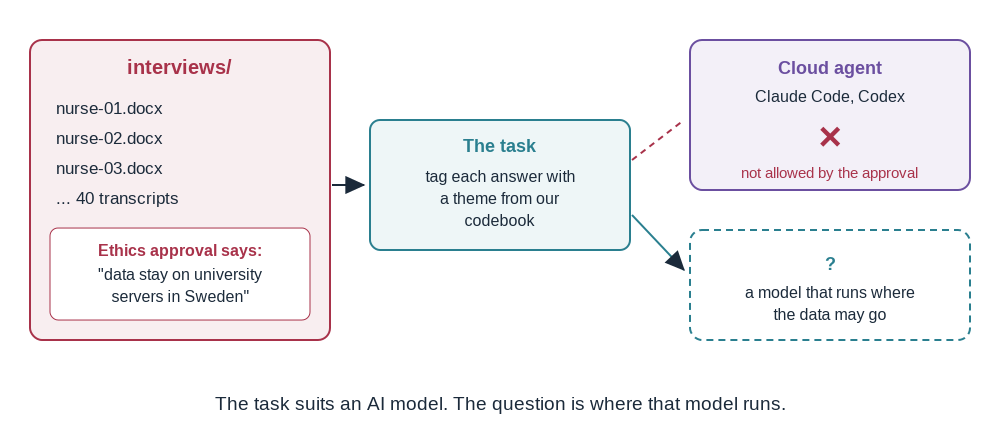
A researcher has 40 interview transcripts that may not leave the university
Tagging interview answers against a codebook is a good task for an AI model. The ethics approval says the transcripts stay on university servers. A cloud agent is out. Is there a model that runs where the data may go?
Closed models are a service; open-weights models are a file you can copy
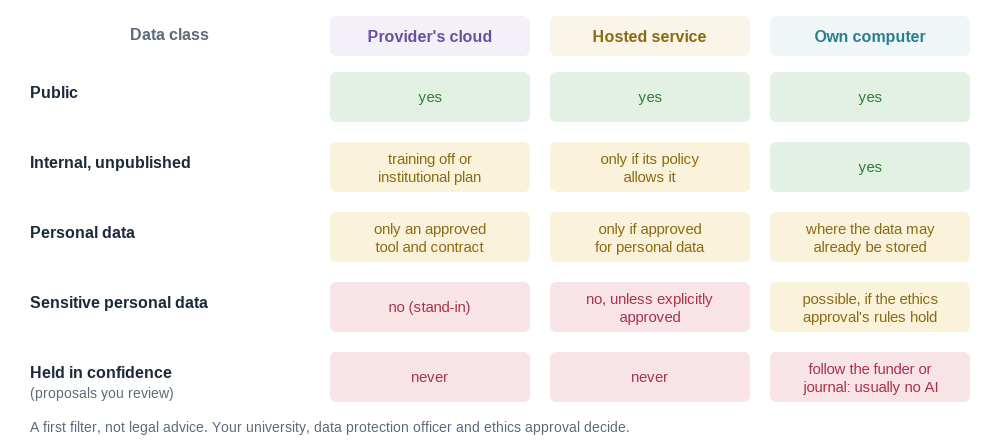
Where the model runs decides who sees your data
“Hosted in Sweden” is not the same as “approved for your data”
Question to ask
Why it matters
Who runs it, and under which agreement?
Decides whether your university can treat it as an approved tool
What is it approved for? Public, internal, personal, sensitive data?
A service can run locally and still ask you to send only public data
What is logged and kept? Chat history, files, prompts?
Logs are data too, and may hold your text for a long time
Is it a pilot or a production service?
Pilots can change rules, models and uptime, or close
Does your ethics approval or contract name it?
If not, ask before you use it with that data
SciLifeLab OpenLLM runs open models on Swedish infrastructure for research
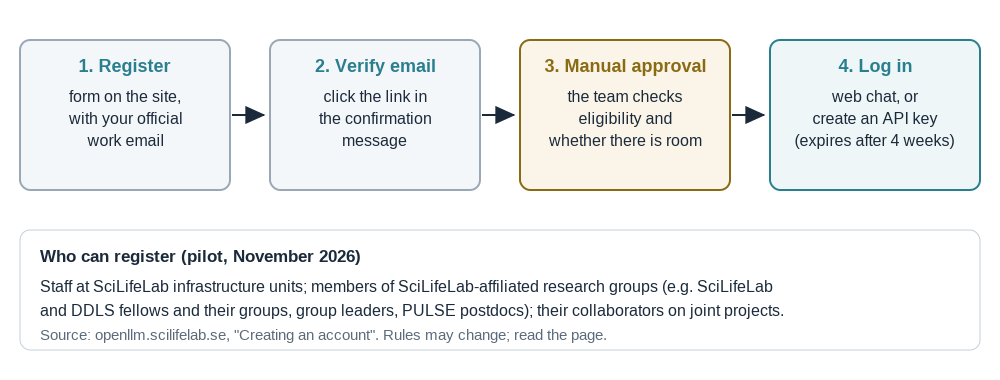
A pilot service from the SciLifeLab Data Centre (openllm.scilifelab.se). Main use: API access from scripts, pipelines and agent tools. A basic web chat also exists.
SciLifeLab OpenLLM is for the SciLifeLab community, with manual approval
Questions: openllm@scilifelab.se, or the #openllm_pilot_users channel on SciLifeLab Slack.
It offers large open models, and the list changes during the pilot
Model (as listed, Nov 2026)
Family
Service’s recommendation
Mistral-Large-3-675B-Instruct-2512-NVFP4
Mistral
advanced chat and long documents; can read images
Qwen3.8-27B
Qwen
AI-assisted coding
Qwen3-235B-A22B
Qwen
research and reasoning
gemma3-27b
Gemma (Google)
multilingual tasks
bge-m3
BAAI
embeddings for search (not for chat)
These are large models, beyond what a laptop runs. Several are in the hundreds of billions of parameters.
The web interface can open a web page from a link you give it, but it cannot search the web.
Check the Models page before you start: models are added and replaced as the pilot learns what users need.
Its own policy says: send only public information for now
“Do not send any text, data, or code that requires any level of confidentiality above publicly available information.” SciLifeLab OpenLLM, use policy page (pilot), November 2026
The pilot has not yet set its confidentiality, integrity and availability levels. A use policy will come before any production service.
The registration announcement adds: avoid sending any human sensitive data.
So today it is a place to learn and test open models, not a place for the transcripts from the start of this lecture.
The lesson for any service: read its policy, not its location.
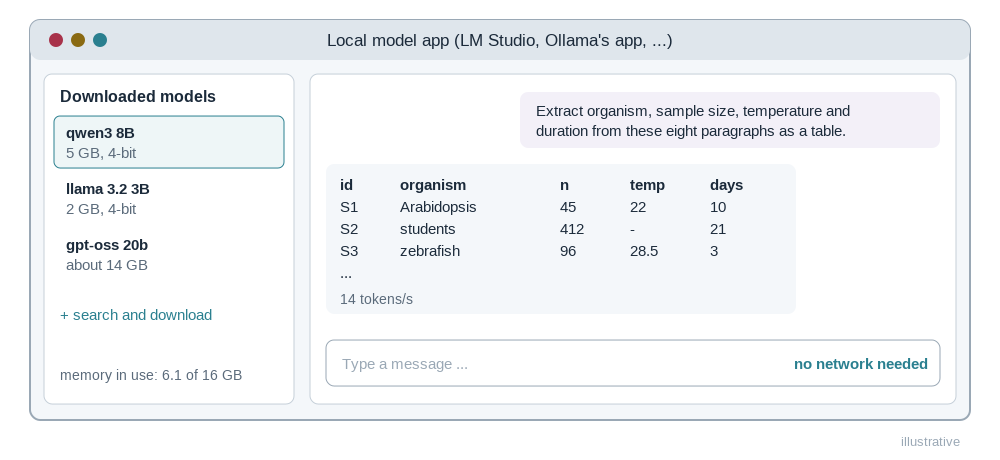
On your own computer, nothing leaves the machine once the model is downloaded
LM Studio: a desktop app with a model browser and a chat window. No command line. Free for home and work use.
Ollama: an app plus a command line; also a local server that agents can talk to.
llama.cpp: the open-source engine many of these build on.
You download a model once, often from Hugging Face. Then chat and processing run offline.
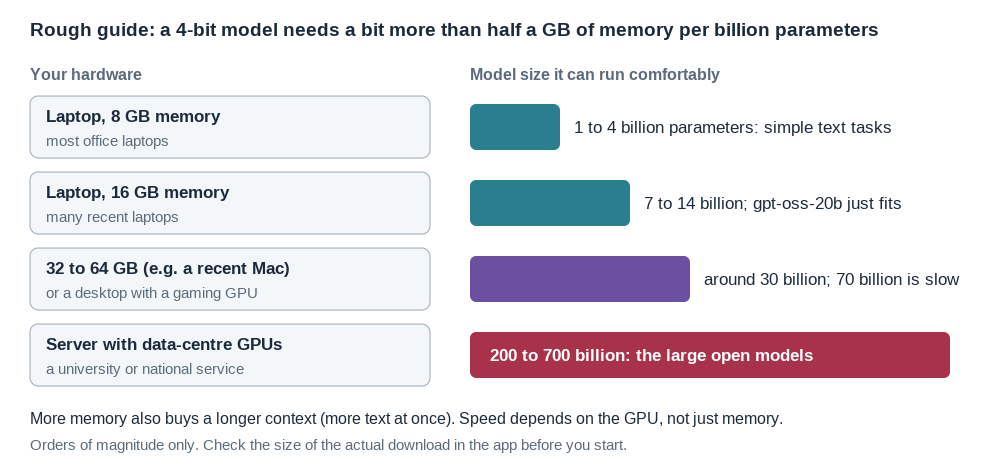
Your computer’s memory decides how large a model it can run
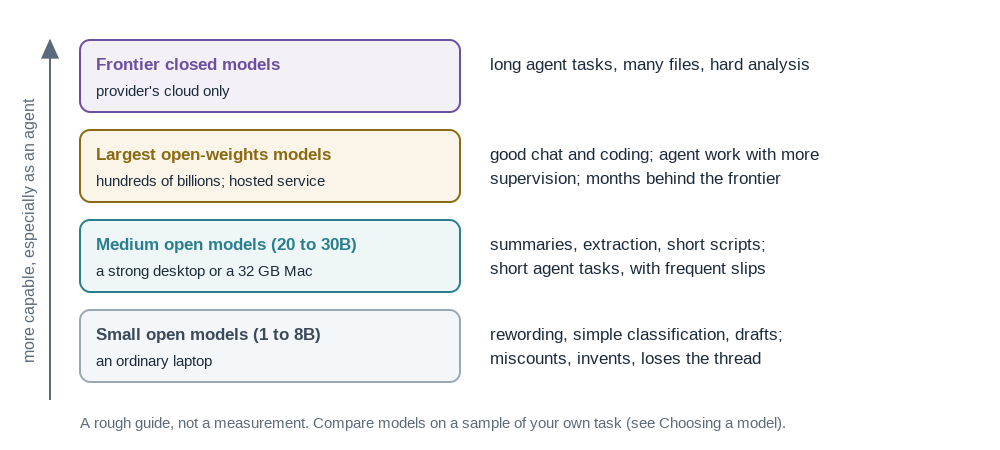
Open models trail the best closed models, and small ones trail by far
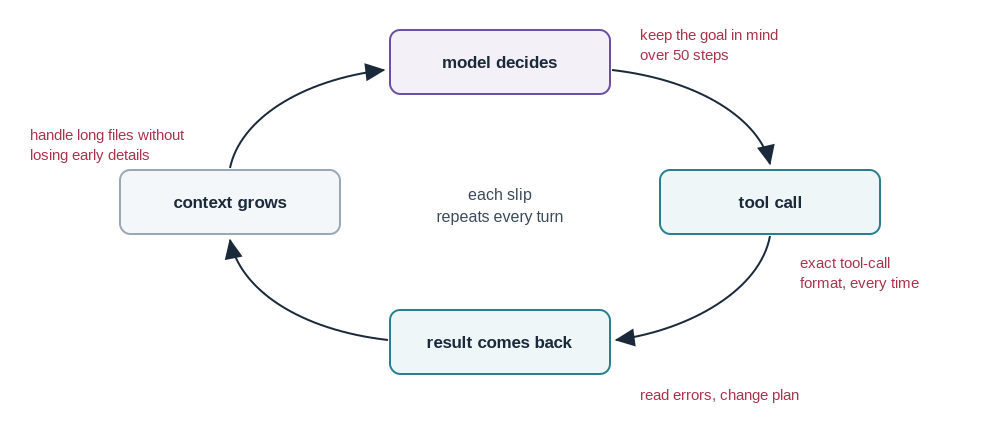
Agents need more from a model than chat does
A chat answer that is 90% right is useful. An agent that makes a small mistake at every step of a 50-step loop drifts off course. Small models struggle most with tool calls, long context and recovery from errors.
The harness and the model are separate, so you can point the harness at an open model
Codex supports local models; Claude Code can be pointed elsewhere, unsupported
Codex
Built-in option for local models: codex --oss.
Talks to Ollama or LM Studio on the same computer; it asks which, or you set --local-provider.
The app must be running with a model downloaded.
Hosted services can be added in Codex’s configuration file (advanced).
Claude Code
The setting ANTHROPIC_BASE_URL points it at another address that speaks Anthropic’s format.
Ollama offers this (ollama launch claude); SciLifeLab OpenLLM documents a set-up.
Anthropic does not support routing Claude Code to non-Claude models. It may work; if not, you are on your own.
It may still send some traffic to Anthropic unless switched off.
Both: the harness was tuned for its maker’s models. Expect slower, less reliable sessions, and check more.
Open-weights is not the same as open source: read the licence
Open models have fewer outside guardrails, so more responsibility falls on you
Cloud providers run safety classifiers and usage policies around their models. A downloaded model has only what was trained into it, and some published versions have had even that removed.
Nobody monitors what you do with a local model. That is the privacy benefit, and also the responsibility.
Open models can be wrong in the same ways as closed ones, often more: invented references, confident wrong numbers. Every check from How LLMs and agents work still applies.
Your university’s AI policy still applies to a local model: disclosure, authorship, how results are checked.
More on guardrails and the safety levels behind them in Guardrails and safety levels.
Match the route to the data class, then check with your university
Compare on your own task: same prompt, two models, one answer key
Running models yourself costs time, hardware and attention
Cost
What it means in practice
Quality
More errors, more checking, smaller tasks
Hardware
Enough memory; a fast GPU for anything beyond a small model
Speed
A laptop may produce a few words per second; long files take minutes
Set-up
Download, pick a version, keep it up to date; connecting an agent is extra work
Your judgement
You choose the model and version, and you own the result
A hosted service takes most of these off you, but keeps one: the quality of open models.
Where this goes wrong
Local is assumed to mean approved. A model on your laptop does not make the laptop an approved place for sensitive data.
Hosted is assumed to mean private. Read the service’s policy; a pilot may ask for public data only.
An open model in someone’s cloud is as private as that cloud, not more.
The harness phones home. An agent pointed at a local model may still send usage data to its maker unless that is switched off.
A weaker model, checked less. People trust a local model more because it feels private, and check it less. Check it more.
The licence is skipped. Some open-weights licences restrict use, users or regions.
Facts here age fast. Model lists, tool options and the pilot’s rules change; check the pages before you rely on them.
Summary
Concept
Key fact
Closed vs open weights
Closed models are a service; open-weights models are files anyone can download and run
Where data goes
Wherever the model runs: the provider’s cloud, a hosted service, or your own computer
Hosted services
Ask who runs it, what it is approved for, what it logs, and whether it is a pilot
SciLifeLab OpenLLM
Pilot for the SciLifeLab community; open models on Swedish infrastructure; for now, public information only
Running locally
LM Studio, Ollama, llama.cpp; memory decides model size (about half a GB per billion parameters at 4-bit)
Summary (continued)
Concept
Key fact
Quality
Large open models trail the frontier; small local models trail by far, most of all as agents
Connecting an agent
Codex: --oss with Ollama or LM Studio. Claude Code: ANTHROPIC_BASE_URL, not supported by Anthropic for non-Claude models
Licences
Open weights is not open source; read the licence on the model card
Decision
Match the route to the data class; your university and ethics approval decide
Next (Labelling AI-generated content: the EU rules, watermarks and detection): what you must label when you publish AI-generated text and images, how watermarks work, and why “AI detectors” are not evidence.