letmut count =0;for base in"ACGTACGT".chars() {if base =='G'|| base =='C'{ count +=1;}}println!("{}", count);
Same shape in all three. Rust adds let mut (variables are read-only by default) and ! after println (it’s a macro, not a function). Everything else reads the same.
Counting k-mers in three languages
Python
from collections import Counterdef count_kmers(seq, k):return Counter( seq[i:i+k]for i inrange(len(seq)-k+1) )
R
count_kmers <-function(seq, k) { n <-nchar(seq) - k +1table(substring(seq, 1:n, k:nchar(seq)))}
Rust
usestd::collections::HashMap;fn count_kmers(seq:&[u8], k:usize)-> HashMap<Vec<u8>,usize>{letmut counts =HashMap::new();for w in seq.windows(k) {*counts.entry(w.to_vec()).or_insert(0) +=1;} counts}
Same algorithm. Rust adds type signatures (&[u8], usize, HashMap<...>) — that information is also present in Python and R, just inferred at runtime instead of checked at compile time.
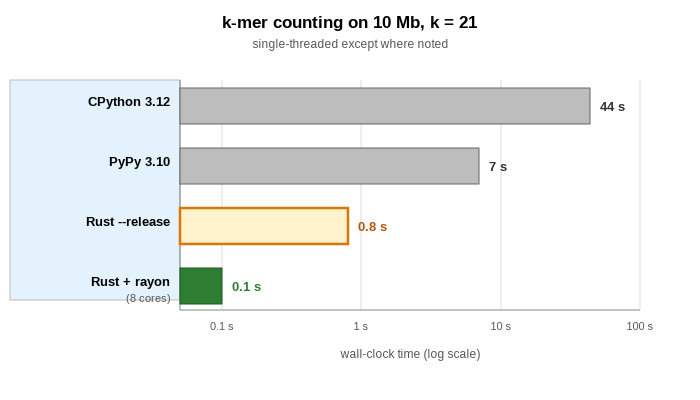
Rust is faster, with almost the same code
Figure 1: Wall-clock for k-mer counting at k=21 on a 10 Mb genome, across four implementations.
Why this matters in bioinformatics
Reads per sample: \(10^8\)
Samples per project: \(10^2\) to \(10^5\)
Genome / transcriptome / pangenome sizes are growing faster than CPU clock speeds
Cloud bill scales linearly with wall-clock
Iteration speed scales inversely with wall-clock
The deployment story — Python
$ ./run_analysis.shModuleNotFoundError: No module named 'pysam'$ pip install pysamERROR: Building wheel for pysam failed (htslib not found)$ apt install libhts-devE: Unable to locate package libhts-dev$# ...one hour later...
crates.io replaces a whole stack of tools
Python and R patch the dependency mess by layering container and environment managers on top:
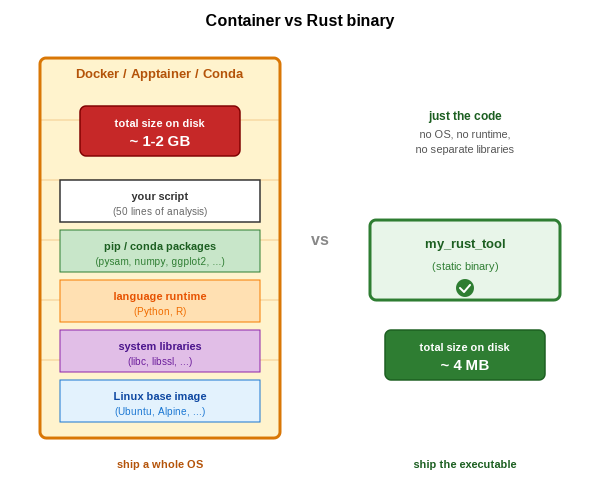
A container ships your script + every library + a whole Linux — often 1-2 GB to run a 50-line analysis.
Rust binaries pull in nothing at run time. cargo build --release produces a single static executable; cargo install some-tool fetches the source and builds it. crates.io is the index — one tool, one ecosystem.
The tool is the artifact. No container needed.
A container ships your code plus its libraries plus a whole Linux userspace — often 1-2 GB. A Rust binary is just the code, statically linked: a few megabytes.
Type safety — what Python and R skip
R — defend the function by hand
add <-function(a, b) {stopifnot(is.numeric(a), # ← Rustis.numeric(b)) # ← doesn't a + b # need} # theseadd(3, "seven")# Error: is.numeric(b) is not TRUE# (at runtime, not at write time)
Rust — the type signature is the check
fn add(a:i32, b:i32) ->i32{ a + b}add(3,"seven");// error[E0308]: mismatched types// expected `i32`, found `&str`// (caught at compile, never ships)
The stopifnot(...) block on the left is the same check the Rust signature does on the right — except R does it at every call, at runtime, after the type information has already been written.
Safety — and why it matters
A segfault (segmentation fault — what happens when a program touches memory it doesn’t own) is the classic crash mode of C and C++: the operating system spots a bad memory access and kills the process. Python and Rust are designed so you almost never see one — Python checks at runtime, Rust at compile time.
letmut seq =vec![0u8;100];let r =&seq[0];// borrow a reference into seqseq.push(b'A');// try to change seq while r still points inprintln!("{}", r);
error[E0502]: cannot borrow `seq` as mutable because it is also
              borrowed as immutable
  --> src/main.rs:3:5
   |
 2 | let r = &seq[0];
   |          ------ immutable borrow occurs here
 3 | seq.push(b'A');
   | ^^^^^^^^^^^^^^^ mutable borrow occurs here
 4 | println!("{}", r);
   |                - immutable borrow later used here
Parallelism is easy — and unavoidable
CPU clock speeds stopped climbing around 2005. The cores kept multiplying — every modern laptop, desktop, and HPC node has at least 8 of them; a server typically has 64 to 256. To use any of that you have to write code that spreads work across cores.
The compiler refuses to build any version that would race two threads against the same memory. No mutexes to acquire, no deadlocks to debug, no silently corrupted output. There is no equivalent in Python or R — Python’s GIL serialises threads, and R has no built-in story at all.
Rust in bioinformatics today
I/O and formats
noodles — pure-Rust HTSlib
rust-htslib — htslib FFI
needletail — FASTA/FASTQ
Variant calling
varlociraptor
longshot
Single-cell
alevin-fry
Long-read QC
chopper
nanoq
General
rust-bio
parts of mash, kraken2
Can easily integrate Rust code in Python if not ready to switch completely
usepyo3::prelude::*;#[pyfunction]fn count_kmers(seq:&[u8], k:usize)-> HashMap<Vec<u8>,usize>{// ...same body as the Rust version above...}
# In your Jupyter notebook:import my_fast_libcounts = my_fast_lib.count_kmers(seq, 21)