Structs, enums, iterators
Day 3
Rust for bioinformaticians
What this lecture is
The Rust types that you spend the most time with. Day 3 is where Rust starts to feel like Rust: types model the biology, the compiler keeps you honest
One concept per slide — what it is , why it works this way , a bioinformatics example
Concepts covered today:
struct and #[derive(...)]impl and methodsenum (with and without data)match and exhaustivenessOption<T>Result<T, E> and the ? operatoriterator chains
HashMapclosures
Yesterday you wrote functions over slices of bytes. Today the data gets shape. A genomic interval has a chromosome, a start, an end, and a strand — that wants to be one value, not four loose variables. A variant is either a SNP or an insertion or a deletion — that wants to be one type with three shapes, not a tagged tuple.
The two language features for this are struct and enum. They lead directly to Option, Result, exhaustive matching, iterators, and hash maps — every exercise today exercises some combination of them.
struct — a named bundle of fieldsstruct GenomicInterval { : String , : u64 , : u64 , } let iv = GenomicInterval { : "chr1" . to_string(), : 1000 , : 2000 , }; println! ("{}-{}" , iv. start, iv. end); Field-by-field construction. Access fields with iv.start. → Book: structs
A struct names a fixed set of fields and groups them into one value. The fields have types — here String and u64 — and the compiler lays them out in memory in the order you declared them.
Construction is field-by-field. You name every field; there’s no “positional” form for a struct with named fields. That sounds verbose, and it is, deliberately: a year from now when you read this code, you don’t have to remember which u64 was start.
Accessing fields is value.field — same dot syntax as Python or R’s $.
A struct in memory
What the programmer wrote
GenomicInterval {
    chrom: String  // name of
                   // the chromosome
    start: u64     // 0-based,
                   // inclusive
    end:   u64     // 0-based,
                   // exclusive
}
A named record, three fields, fixed shape.
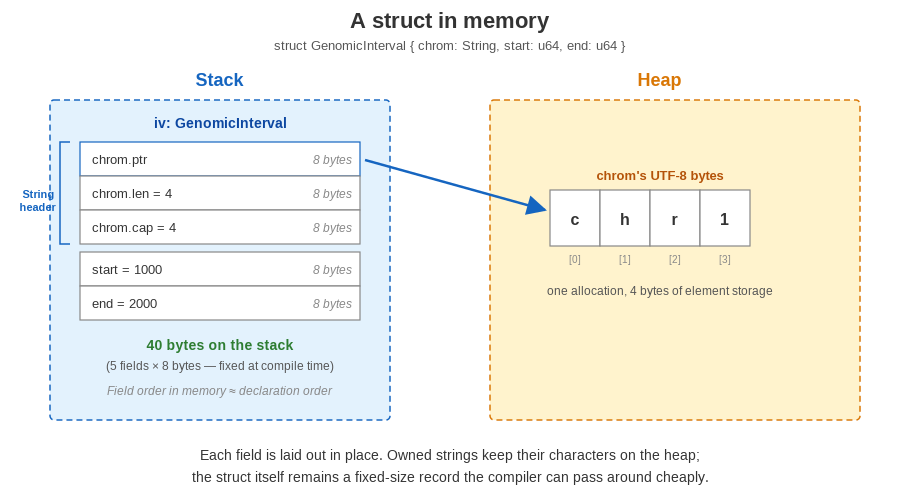
The same struct, two views. On the left, what the programmer wrote — a named record of three fields. On the right, what the machine sees — a fixed-size 40-byte record on the stack, with the chromosome name’s characters living separately on the heap and the String header on the stack pointing at them.
This is the same Vec layout from yesterday, applied to a field rather than a top-level variable. The compiler computes the struct’s size at build time by adding up the sizes of its fields. That fixed size is what lets you put a GenomicInterval directly into a Vec<GenomicInterval> with no per-element heap allocation.
impl — methods belong to the type
Rust
impl GenomicInterval { fn length(& self ) -> u64 { self . end - self . start} } &self is a read-only borrow of the value — the same borrow you saw yesterday, now used as the receiver of a method.
Python
class GenomicInterval:def length(self ):return self .end - self .start
R (R6)
<- R6:: R6Class ("GenomicInterval" ,public = list (chrom = NULL ,start = NULL ,end = NULL ,initialize = function (c, s, e) {$ chrom <- c$ start <- s$ end <- elength = function () {$ end - self$ start
Call site: iv.length() (Rust), iv.length() (Python), iv$length() (R).
Methods live in an impl block, separate from the data definition. The first parameter is the receiver: one of &self, &mut self, or self — borrow read-only, borrow mutably, or consume the value. Same ownership rules you saw yesterday, now applied to method receivers.
The Python side shows the equivalent class. self in Python is the explicit first parameter, same as Rust. The big practical difference: Rust distinguishes read-only borrows (&self) from mutable borrows (&mut self) at the type level, where Python silently allows mutation everywhere.
The next slide adds a mutating method and a constructor.
More methods — mutation and construction
Rust
impl GenomicInterval { fn shift(& mut self , by: u64 ) { self . start += by; self . end += by; } fn new(chrom: String , : u64 , : u64 ) -> Self { Self { chrom, start, end } } }
&mut self — mutable borrow; lets the method change the fields.new takes no self — it’s an associated function [a function attached to the type itself, not to an instance], called as GenomicInterval::new(...).Self inside the block is shorthand for “the type we’re implementing”.
Python
class GenomicInterval:def __init__ (self , chrom, start, end):self .chrom = chromself .start = startself .end = enddef shift(self , by):self .start += byself .end += bySame idea — __init__ is the constructor, ordinary methods mutate via self. The big difference: Python won’t stop you mutating from anywhere; Rust’s &mut self is checked at compile time.
Call sites: iv.shift(100), GenomicInterval::new("chr1".to_string(), 1000, 2000).
A method with &mut self can mutate the receiver — shift here moves both endpoints by the same offset.
A function in an impl block with no self parameter is what Rust calls an “associated function” — it belongs to the type rather than to any particular instance. The conventional name for a constructor is new, but it’s just a function — you can have several with different names (from_string, with_strand, etc.).
Self (with a capital S) inside an impl block means “the type we’re implementing”. Writing Self { ... } is shorter and survives renames better than typing GenomicInterval { ... } every time.
#[derive(...)] — the compiler writes the obvious code for you#[ derive( Debug , Clone , PartialEq , Eq )] struct GenomicInterval { : String , : u64 , : u64 , } The compiler writes the obvious trait implementations for you — equality, debug printing, cloning — so you don’t type them by hand.
The four you will reach for this week:
Debug{:?} printing, for diagnosticsClone.clone() deep copyCopyCopy)PartialEqEq — == and !=
A trait is a named bundle of methods a type can opt in to — like a Java interface, but more powerful.
A derive tells the compiler to write a trait implementation for you, field by field. You almost always want Debug and Clone — Debug to be able to print the value when something is wrong, Clone to make an explicit copy when ownership rules push back.
Copy is more specialised. A type can only be Copy if everything inside it is also Copy. String is not Copy because copying it would require allocating new heap storage — so any struct containing a String can be Clone but not Copy. Plain integer types and small enums like Strand are fine to make Copy.
PartialEq enables == and !=. Add Eq too when equality is reflexive — which is almost always; the famous exception is f64, because NaN != NaN.
enum — one of a fixed set of named valuesSometimes a variable should only hold one of a fixed set of named values — like Strand::Plus and Strand::Minus.
Python — the loose way
# strings as ad-hoc tags: = "+" if strand == "+" :+= 1 elif strand == " +" : # typo, never matches += 1 Misspelling "+" as " +" is a bug your test suite may never catch. Using an int (STRAND_PLUS = 0) loses self-documentation.
Rust — Strand is a type
enum Strand { Plus, Minus } let s = Strand:: Plus; // passing a string where Strand // is expected: fn step(s: Strand) { /* ... */ } "+" ); // compile error A Strand value is one of exactly two named variants. The compiler tracks which.
→ Book: defining an enum
Memory cost of one strand value:
Python strand = "+" — typically ~50 bytes (object header + interning + character storage)Rust let strand = Strand::Plus; — 1 byte (enum discriminant)
A 10 million-row table of strands takes roughly ~500 MB in Python vs ~10 MB in Rust.
The simplest enum is a closed list of names. Strand is either Plus or Minus, full stop. The compiler stores this as a single byte: 0 for Plus, 1 for Minus.
You write Strand::Plus at the use site, with the type name as a prefix. This is namespacing — two different enums in the same module can both have a Plus variant without colliding.
The Python side shows what we’re avoiding. In Python you either pick magic strings — which silently accept any typo — or magic constants like STRAND_PLUS = 0, which lose readability and still don’t prevent mixing them up with unrelated integer constants. Rust’s enum is a type: passing the wrong type is a compile error, and adding a third variant later forces every match expression to be updated.
Enums can carry data
enum Variant { { pos: u64 , alt: u8 }, { pos: u64 , bases: Vec < u8 > }, { pos: u64 , len: u64 }, } Each variant carries its own fields. A Variant value is one of the three shapes — and the compiler tracks which.
Aside: in type-theory jargon this is a “sum type” or “algebraic data type” (ADT) [a value that is exactly one of several named shapes]. You’ll see those names in papers and in other languages; in this course we’ll just call them enums.
This is the move that turns enum from “list of names” into “list of shapes”. Each variant has its own fields, and a Variant value is exactly one of the three forms at a time.
The biology maps directly: a variant call from a VCF is either a substitution, an insertion, or a deletion. The fields you care about are different for each. With a struct you’d need a nullable field for everything that doesn’t apply, plus a “kind” tag — and nothing stops you reading insertion bases out of a SNP. With an enum, the SNP literally doesn’t have a bases field; you cannot ask for it.
Other languages call this an algebraic data type, a tagged union, or a sum type — same idea.
Two enum kinds, two memory layouts
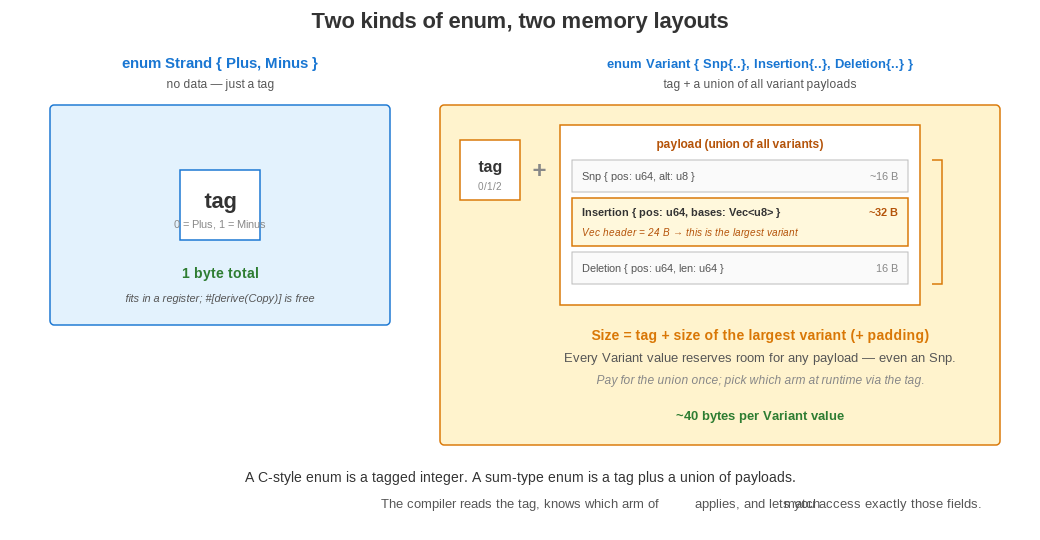
Every enum value reserves room for its largest variant.
In plain English: every Variant value reserves room equal to its biggest case, plus 1 byte to remember which case.
The simple enum (Strand) compiles down to a single small integer tag. The richer enum (Variant) is a tag plus a union of all variant payloads — every value reserves room for the largest variant. So even an Snp carries a slot the size of the Insertion payload, most of it unused.
“Tagged union” is the traditional CS name for this layout — a memory region (the “union”) that can hold one of several types, plus a small “tag” byte that records which type is currently in it. A C-style enum is just the tag part, with no payload.
This is the cost of the abstraction. In return, you get a value that is provably one of N shapes, you cannot read fields from the wrong variant, and the compiler can check that every match expression handles every case.
match lets you read enums
fn ref_alt_delta(v: & Variant) -> i64 { match v { Variant:: Snp { .. } => 0 , Variant:: Insertion { bases, .. } => bases. len() as i64 , Variant:: Deletion { len, .. } => - (* len as i64 ), } } match binds the variant’s fields by name inside the arm. The .. pattern means “ignore the rest”.
You can’t just read v.bases — there is no such field on a SNP variant. To get at the contents you have to first establish which variant you have, and match is the canonical tool.
Each arm pattern names the variant and destructures its fields. Inside the Insertion arm, bases is bound to the actual Vec; inside the Deletion arm, len is bound to the actual u64. The compiler enforces that you only touch fields that actually exist on the matched variant.
The .. in a struct pattern means “any remaining fields I don’t care about”. Use it freely — it documents intent and keeps the pattern short.
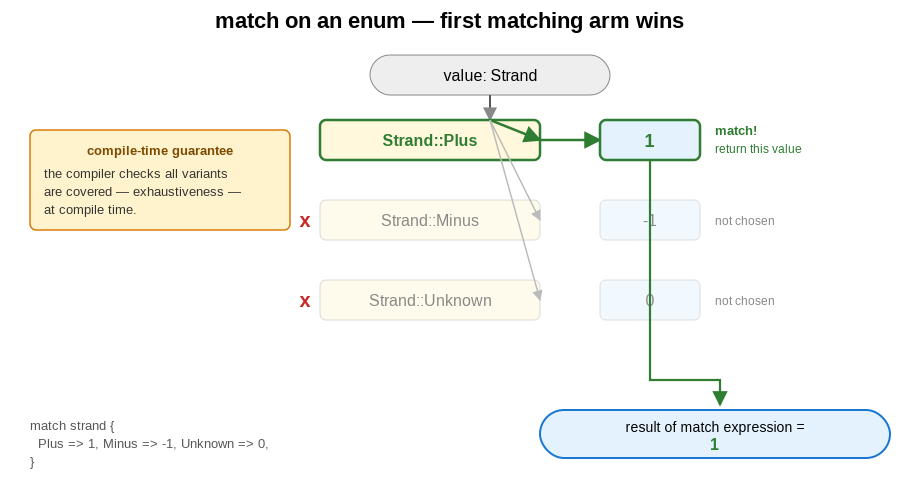
Control flow: a value enters from the top; arms are tried top-to-bottom; the first matching arm’s body runs; the result is the result of the match expression.
Exhaustiveness — the safety net
enum Strand { Plus, Minus } match strand { Strand:: Plus => 1 , // forgot Strand::Minus } The compiler refuses any match that does not cover every variant:
error[E0004]: non-exhaustive patterns: `Minus` not covered
 --> src/main.rs:8:11
  |
8 |     match strand {
  |           ^^^^^^ pattern `Minus` not covered
  |
  = note: ensure that all possible cases are being handled by adding
    a match arm with a wildcard pattern, or an explicit pattern as shown
This is one of the most practically valuable things in the language. When you add a new variant to an enum — a new strand type, a new variant call, a new file format — the compiler will tell you every single match expression in the entire codebase that needs to be updated to handle the new case.
You cannot ship “I updated the type but forgot one place” bugs of this shape in Rust. The wildcard _ defeats the check, so reach for it only when you really mean “any other”. The compile error is the feature.
match ensures you do not forget to add needed logic
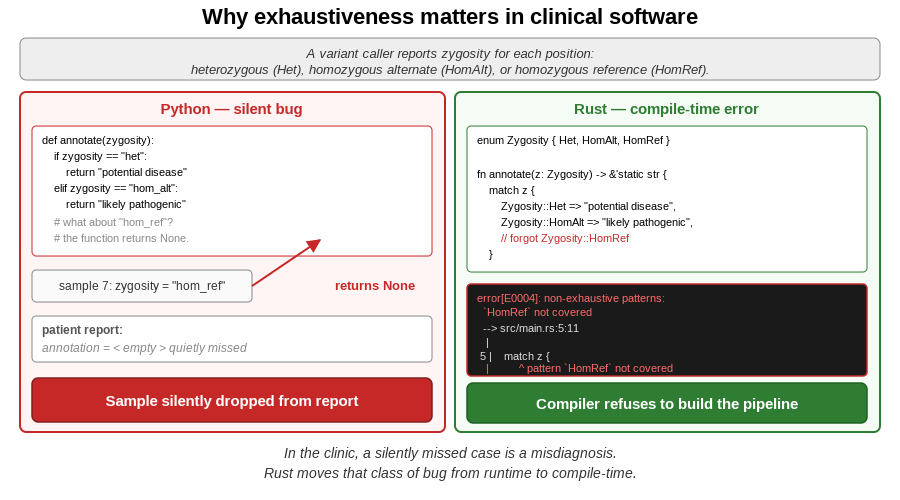
A missing case is a build error, not a runtime surprise.
The same idea visualised: on the left, the Python pipeline silently drops the missing case at runtime — a sample never appears in the report. On the right, the Rust build fails before it ever runs.
Option<T> — values that may be absentenum Option < T> { Some (T), None , } /// Returns the position of the first G base in `seq`, /// or `None` if there isn't one. fn first_g(seq: & [u8 ]) -> Option < usize > { for (i, & b) in seq. iter(). enumerate() { if b == b'G' { return Some (i); } } None } Option<T> replaces null. There is no other way to express absence in a typed value. The <T> is a generic parameter [a placeholder for “any type” — fill it in at the use site, e.g. Option<usize> or Option<&[u8]>].
A function that might not have an answer returns Option<T> rather than a “magic” sentinel value or a nullable pointer. Some(value) is “yes, here is one”; None is “no answer”.
<T> is the generic parameter — Option works for any type. Option<usize> is “maybe an index”; Option<&[u8]> is “maybe a slice”. The variant is the part that carries information about presence; the type parameter is the kind of thing that’s optionally present.
Generics are how Rust avoids writing one Option type per element type. The compiler does what’s called “monomorphisation” [generates a specialised copy of the code for each concrete T you use] — so Option<u64> and Option<String> are separate machine-level types under the hood, but you only write the source once.
Java has “Optional”, Python has “Maybe” libraries, but in Rust this is the way — there is no separate nullable pointer construct. The standard library uses Option for “no such key”, “end of iteration”, “first element of an empty slice”, everywhere.
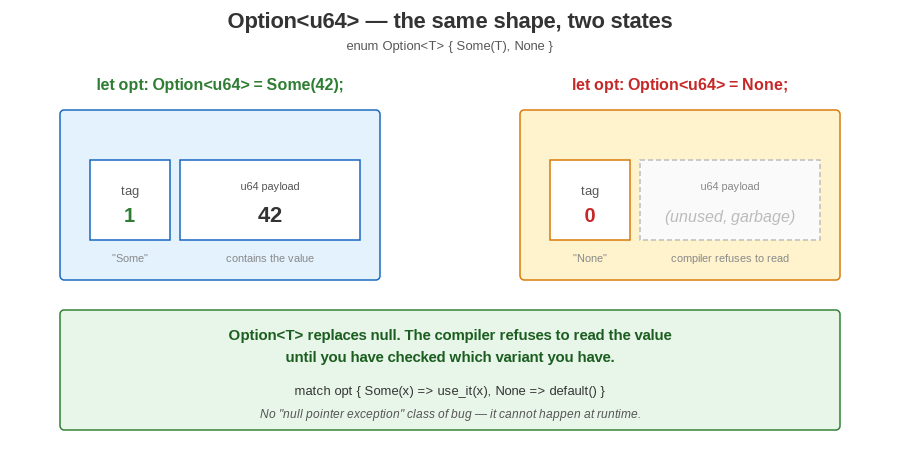
Option in memory
The compiler will not let you read the payload until you check the tag.
The memory shape of Option is exactly what you’d expect from a tagged union: a tag byte plus enough room for the inner value. For None, the payload region still exists, but its contents are undefined garbage — and the compiler enforces that you never look at it.
The compiler’s refusal to let you blindly read the payload is the whole point: a null pointer dereference simply cannot happen, because there is no .value() method that doesn’t first force you to handle the None case.
Using Option — match, if let, helpers
match first_g(seq) { Some (i) => println! ("first G at {i}" ), None => println! ("no G in this read" ), } if let Some (i) = first_g(seq) { // only care about Some println! ("first G at {i}" ); } let i = first_g(seq). unwrap_or(0 ); // missing G means 0 let i = first_g(seq). expect("read must contain a G" ); // panic if None → Option docs
Four ways to consume an Option, in decreasing order of how much they make you think about None.
match is the full case analysis — explicit, exhaustive, always correct.
if let Some(x) = opt is sugar for a match where you only care about one variant; the None case is silently dropped. Use when the absence is uninteresting.
unwrap_or(default) returns the inner value or the default — handy for “missing means zero” reductions.
expect("...") returns the inner value or panics with your message if None. Use when None really shouldn’t happen here and you want a loud crash if it does — never use it in code that could see real-world bad input.
There’s no plain .unwrap() on this slide on purpose; it’s the same as expect with a useless message.
Result<T, E> — operations that can fail
enum Result < T, E> { Ok (T), Err (E), } fn parse_start(s: & str ) -> Result < u64 , ParseError> { match s. parse:: < u64 > () { Ok (n) => Ok (n), Err (_) => Err (ParseError:: InvalidStart), } } Result is Option’s richer sibling — failure carries a value of its own.
Result is Option’s richer sibling: where Option says “value or nothing”, Result says “value or this specific error”. Both arms carry data; both arm types are generic.
Use Result when failure is meaningful and recoverable: parsing user input, opening a file, parsing a region string. Use Option when “missing” is the right framing and there’s no useful error to attach.
The second type parameter, E, is the error type. It can be anything: a string, a custom enum like ParseError with a variant per failure mode, or a library error type. For the parse_region exercise today, you’ll define your own.
The ? operator is a nice shorthand
A minimal example first — one fallible call, one ?:
With ?
fn parse_count(s: & str )-> Result < u64 , std::num:: ParseIntError> { let n: u64 = s. parse()?; Ok (n * 2 )} ? means if this is Err, return it; otherwise unwrap and continue .
Equivalent without ?
fn parse_count(s: & str )-> Result < u64 , std::num:: ParseIntError> { let n: u64 = match s. parse() { Ok (n) => n, Err (e) => return Err (e), }; Ok (n * 2 )} Four lines per fallible call, every time.
For ? to compile, the enclosing function must itself return Result (or Option).
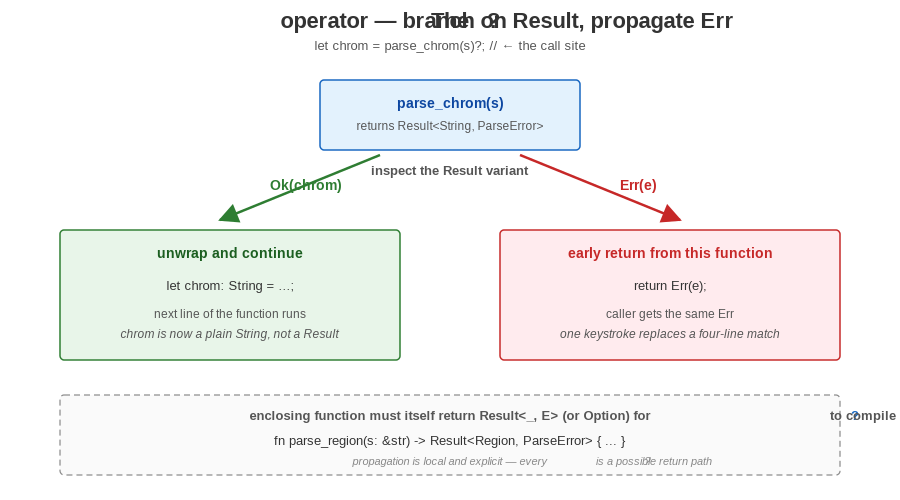
The question mark is Rust’s shorthand for the four-line match you’d otherwise write at every fallible call site. On Ok, it pulls out the inner value and the next line runs as if nothing happened. On Err, it returns that Err from the enclosing function immediately.
This minimal example uses the simplest case — a fallible call whose error type matches the function’s declared error type. The next slide shows the two helpers (ok_or, map_err) that bridge between different option/result/error types in a real parser.
? in a real parser — ok_or and map_err
fn parse_region(s: & str ) -> Result < (String , u64 , u64 ), ParseError> { let (chrom, rest) = s. split_once(':' ). ok_or(ParseError:: MissingColon)?; let (start_s, end_s) = rest. split_once('-' ). ok_or(ParseError:: MissingDash)?; let start: u64 = start_s. parse(). map_err(| _| ParseError:: InvalidStart)?; let end: u64 = end_s . parse(). map_err(| _| ParseError:: InvalidEnd)?; Ok ((chrom. to_string(), start, end))}
ok_or(err) turns Option<T> into Result<T, E> — split_once returns Option, but we want ? to propagate a ParseError.map_err(|_| ...) rewrites the error type — s.parse() returns the standard ParseIntError; we squeeze it into our own ParseError.
A real parser combines several fallible calls of different shapes. split_once returns Option<(_, _)> — Some if the separator is present, None if not. parse() returns Result<u64, ParseIntError> — the standard library’s error type.
To make ? work uniformly, we convert both into our function’s declared error type. ok_or is the Option-to-Result bridge; map_err is the error-rewriter. Together they let every ? in the function speak the same error language.
This is exercise 2 in shape — define a ParseError enum, use ? to short-circuit on the first failure, return a typed result.
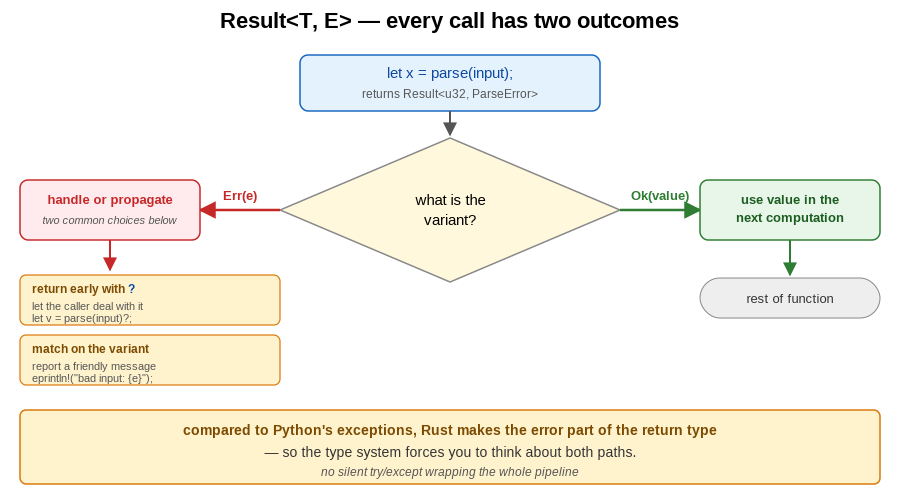
On the right: this is what ? desugars to. The call returns a Result. On Ok(value), control falls through to the next line of the function and value is bound. On Err(e), the same e is returned from the enclosing function — execution skips everything below the ?. Each ? in your code is a possible early-return path.
Exhaustive matching keeps codon tables honest
fn translate(codon: & [u8 ]) -> Option < u8 > { match codon { b"ATG" => Some (b'M' ), b"TAA" | b"TAG" | b"TGA" => Some (b'*' ), b"GCT" | b"GCC" | b"GCA" | b"GCG" => Some (b'A' ), // ... 60 more arms ... => None , // invalid / non-canonical } } 64 codons. match checks you cover every byte string in your domain.
Codon translation is a function from a 3-byte sequence to an amino acid. The natural Rust shape is a match on byte-string patterns: each arm is one codon, the body is the amino acid.
The pipe operator combines synonymous codons into one arm — alanine is GCT, GCC, GCA, GCG; the four arms collapse to one. The trailing _ => None covers anything that isn’t a valid codon — an ambiguous base, a partial codon at the end of a sequence.
The genetic code is a small finite table, so a match expression is faster, smaller, and easier to read than a HashMap lookup. This is exercise 3.
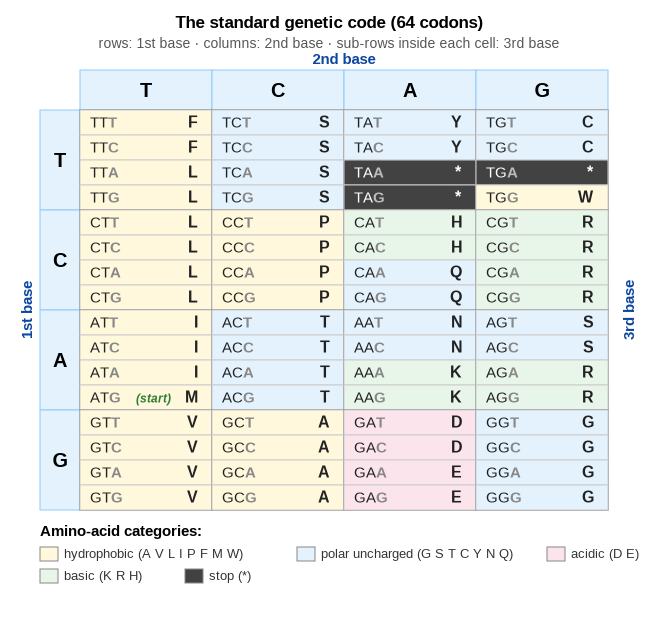
The standard genetic code as a 4x4 grid: rows are first base; columns are second base; each cell holds four sub-rows for the third base. Notice how synonymous codons cluster — most third-base changes don’t change the amino acid (wobble). This is why the match arm for alanine collapses four codons into one.
Iterators — describe, don’t loop
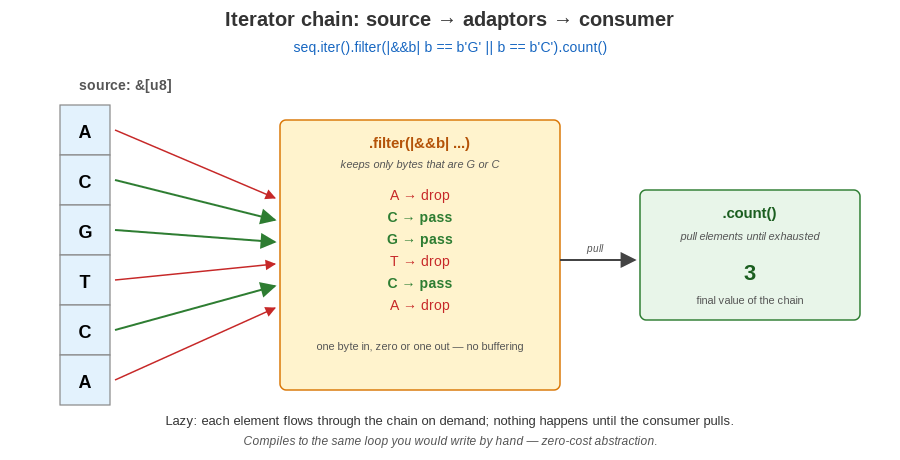
Iterators are lazy [no work happens until something asks for an element — the chain just describes what to do]. Adaptors (map, filter, take) build a chain; consumers (collect, count, sum, for) drive it.
let gc_count = seq. iter(). filter(|&& b| matches! (b, b'G' | b'C' )). count(); let upper: Vec < u8 > = seq. iter(). map(|& b| b. to_ascii_uppercase()). collect(); → Book: iterators
An iterator is a value that produces other values one at a time. The methods you call on it split into two families: adaptors that wrap one iterator into another (map, filter, take, enumerate) and consumers that actually pull elements through (count, sum, collect, for).
Each adaptor returns a new iterator — no work happens. The whole chain only runs when the consumer asks for elements. This means you can compose long chains without worrying about intermediate allocations.
For most “loop with an accumulator” patterns, an iterator chain is shorter, more declarative, and exactly as fast. The compiler is genuinely good at inlining the closures.
The picture on the right shows the mental model: elements flow left to right through the chain. The filter stage examines each one and either lets it pass or drops it. The count consumer is on the receiving end, pulling elements until the source is exhausted, incrementing a counter each time. The chain doesn’t materialise any intermediate Vec — each byte is checked and either counted or discarded in place.
HashMap — keys to values
Rust
use std::collections:: HashMap; let mut counts: HashMap<& [u8 ], usize > = HashMap:: new(); . insert(b"ATG" , 1 ); . insert(b"TAA" , 1 ); if let Some (& n) = counts. get(b"ATG" ) { println! ("seen ATG {n} times" ); } The standard hash table — generic over key type and value type. Lookup is constant-time on average.
→ HashMap docs
Python (dict)
= {}"ATG" ] = 1 "TAA" ] = 1 if "ATG" in counts:= counts["ATG" ]print (f"seen ATG { n} times" )Same data structure. Rust forces you to spell out the key and value types up front; Python infers everything at runtime.
HashMap is Rust’s standard hash table. The two type parameters are the key type and the value type — HashMap<Vec<u8>, usize> for “k-mer string to count”, HashMap<String, GenomicInterval> for “gene name to interval”, and so on.
insert and get are the basics. insert(k, v) puts an entry in; get(&k) returns Option<&V> — yes, you have to handle the absent case. Iteration over a HashMap yields key-value pairs in arbitrary order.
For DNA k-mer keys, Vec<u8> works but allocates per insertion. Smarter key types — fixed-size arrays, packed 2-bit encodings — exist; we’ll mention them but the exercise uses Vec<u8> for clarity.
The entry API — read-modify-write in one call
Rust — two steps, made explicit
use std::collections:: HashMap; let mut counts: < Vec < u8 >, usize > = HashMap:: new(); for window in seq. windows(k) { let key = window. to_vec(); let slot = counts. entry(key). or_insert(0 ); // step 1: get a &mut to the slot // (insert 0 if it wasn't there) * slot += 1 ; // step 2: deref the &mut and add one }
Python — same pattern
# Python equivalent: = counts.get(k, 0 ) + 1 # or: from collections import defaultdict= defaultdict(int )+= 1 The Rust entry API does the lookup, the maybe-insert, and the get-mut all in one — same effect as defaultdict, no extra import.
Idiomatic one-liner: *counts.entry(window.to_vec()).or_insert(0) += 1;
One lookup-or-insert per window builds the histogram.
This is the canonical histogram pattern in Rust. Without the entry API you’d write three lines per insert: look up, branch on Some/None, insert default or increment.
entry(k) returns an Entry enum that’s either occupied or vacant. .or_insert(default) collapses both cases into a single &mut V — a mutable reference to the value in the slot, either the one that was already there or the default you just inserted.
The deref-and-add-assign at the front (*entry... += 1) modifies the value in place. Net effect: one expression, one hash lookup, exactly one allocation if the key is new. This is exercise 4: count every k-mer in a sequence.
The Python side shows the two equivalent idioms. dict.get(k, 0) + 1 does the same job in a stricter way; defaultdict(int) is closer to the Rust pattern but requires an extra import and a different dict type.
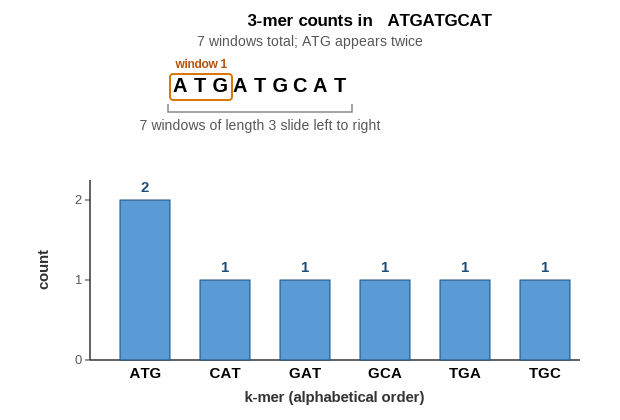
The figure shows 7 windows in ATGATGCAT; ATG appears twice. Each window does one entry-API lookup; new keys are inserted with value 0 then incremented; existing keys are incremented in place. Total: 7 hash lookups, 6 allocations for new keys.
Closures can replace small functions
With capture
let threshold = 30 ; let high_quality = quals. iter(). filter(| q| * q >= threshold)// captures `threshold` from outside . count(); |args| body. Closures capture the variables they mention from the enclosing scope.
Closure vs. named function
// closure (anonymous, one-shot): let bump = | q: u8 | q + 1 ; // equivalent named function: fn bump(q: u8 ) -> u8 { q + 1 } The closure form is shorter when the function is one-line and only used here. The named-function form is what you reach for when the function needs a stable name and is called from elsewhere.
A closure is a function value you can pass around — like a Python lambda, but more capable. Pipes around the parameter list, then the body.
What makes them “closures” rather than just “function literals” is capture: a closure can refer to variables in the surrounding scope, and the compiler arranges to keep those variables alive as long as the closure is. In the example, threshold is captured by the filter’s closure.
The *q dereferences once: quals.iter() yields &u8, and filter passes a reference to that — so q is &&u8 and *q reads the byte. The shorter |&&q| q >= threshold form destructures both layers in the pattern.
The named-function bump shows what the closure replaces when there are no captures: same body, more syntax, but a real top-level function you can call from anywhere. Pick the closure when the function is throwaway; pick the named function when it needs a stable name.
To the next lecture
Next lecture: recursion and trees — modelling a phylogeny.
We’ve built structs, enums, Option, Result, iterators, HashMap, and closures — enough to write five of today’s six exercises directly. The sixth, phylogenetic trees, needs one more idea: a type that contains itself. That’s the next lecture.