Choosing and defending a result
Evidence, withheld values and a reproducible conclusion
About this lecture
Defend a caffeine concentration from sample record to conclusion.
- Use a new calibration and independent QC.
- Keep range, separation and preparation evidence attached.
- State uncertainty and unresolved actions.
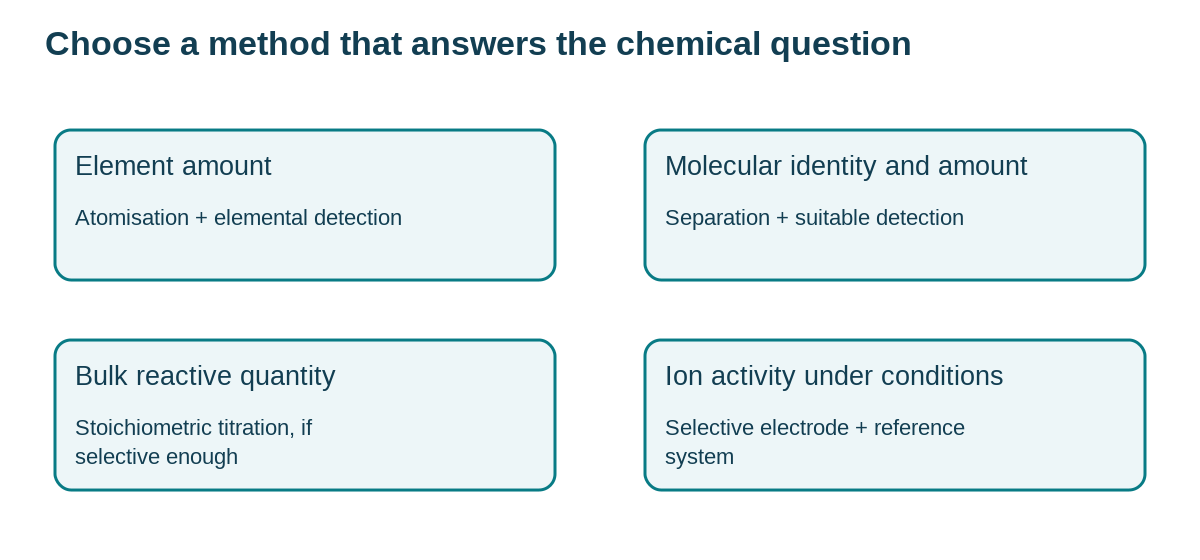
Choose the method for the chemical quantity
Element amount and molecular caffeine identity require different evidence.
![The intended measurand and sample constraints determine which measurement principle can answer the question.]()
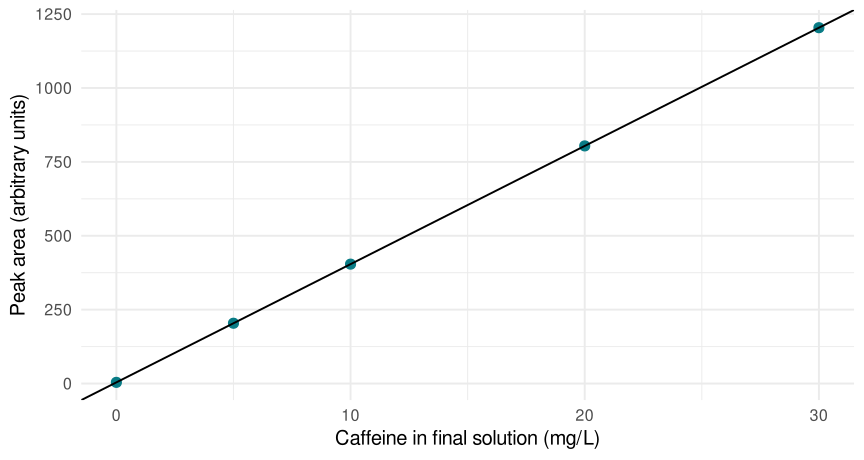
Use this case’s calibration and range
Area = 4 + 40 × caffeine concentration, valid over 0–30 mg/L final.
![The independent final-case calibration covers final caffeine concentrations from zero to thirty mg/L.]()
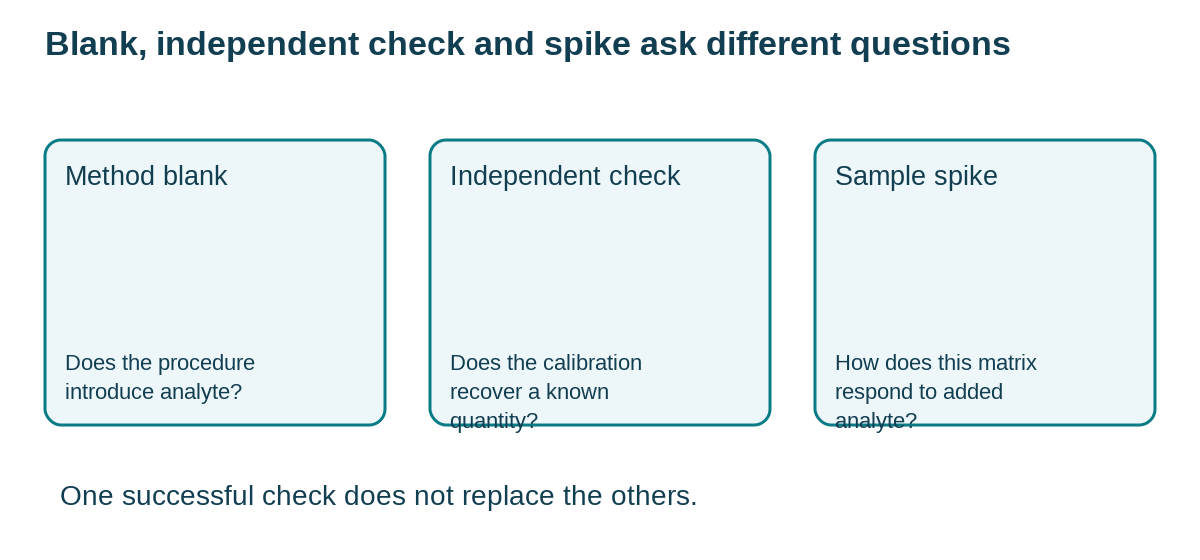
Check independently before using the line
The 15.00 mg/L check recovers 100.67%.
It passes the supplied 95–105% exercise window.
![An independent known check tests calibration performance, while blanks and sample spikes address other questions.]()
Preparation history is chemical evidence
C1 and C2 use 5.00 mL to 50.00 mL.
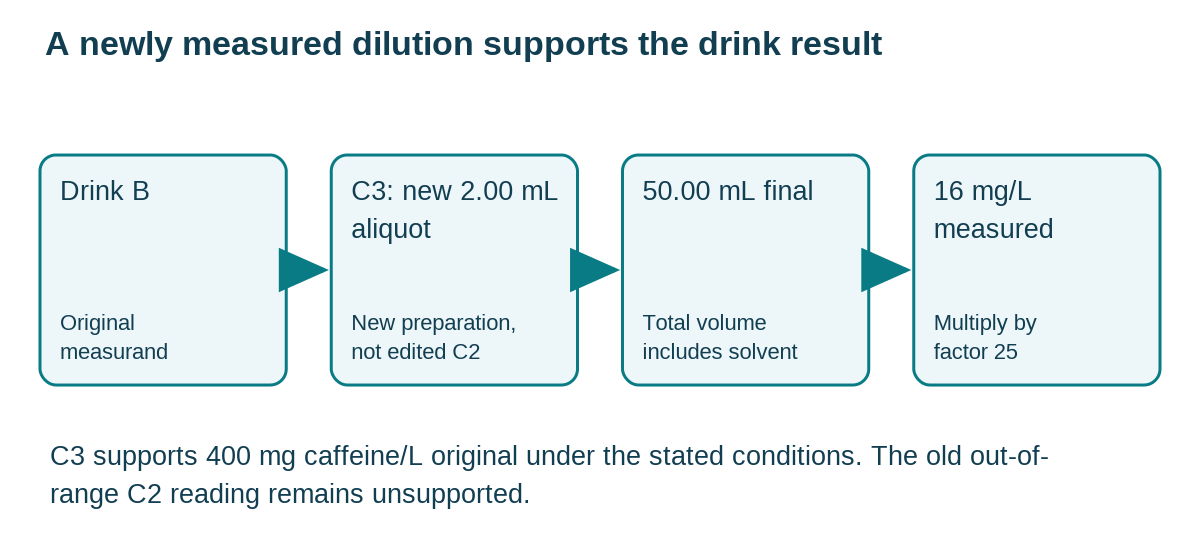
C3 is a new 2.00 mL aliquot of the same drink as C2.
![A newly measured smaller aliquot of drink B has a different preparation record from the old out-of-range measurement.]()
C1 supports a conditional amount
Area604 → 15 mg/L final → 150 mg/L drink A.
![C1’s response is within the final-solution calibration range.]()
C2 is an out-of-range candidate
Area1604 implies a candidate 40 mg/L final.
Do not report that extrapolated concentration.
![The calibration range ends at thirty mg/L final, so the old higher signal cannot establish a reported concentration.]()
C3 supplies new evidence
Area644 → 16 mg/L final.
Factor25 gives 400 mg/L drink B.
![A newly measured two-millilitre aliquot made to fifty millilitres supports a factor of twenty-five.]()
C4 fails a different requirement
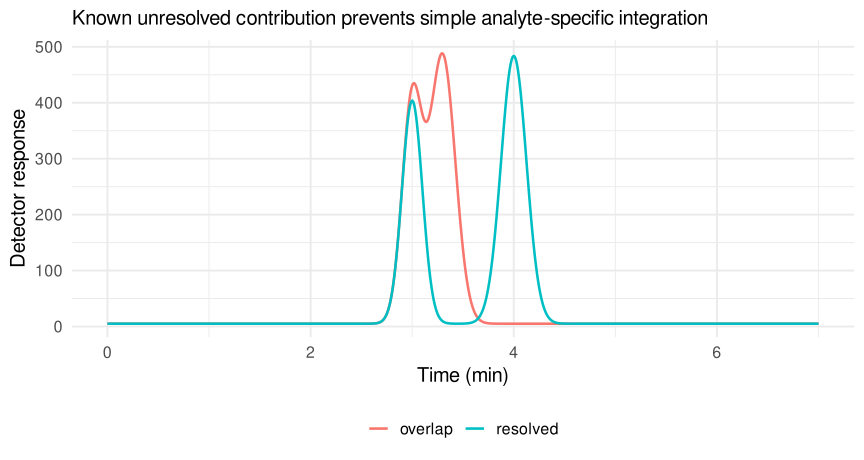
The area is inside range, but an unresolved component contributes.
Withhold the caffeine amount.
![Overlapping components can contribute to a response that would otherwise appear numerically in range.]()
Export reasons with the values
Withheld estimates are not zero concentrations.
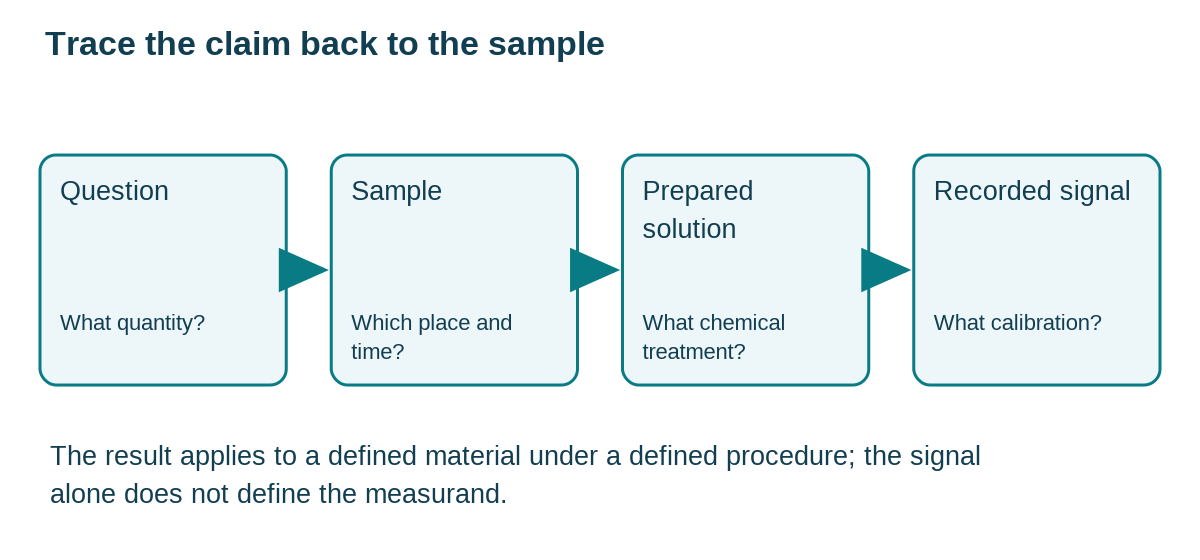
Keep sample ID, preparation ID, factor and decision in the same table.
![An auditable result connects a defined quantity to collected material, preparation and recorded signal.]()
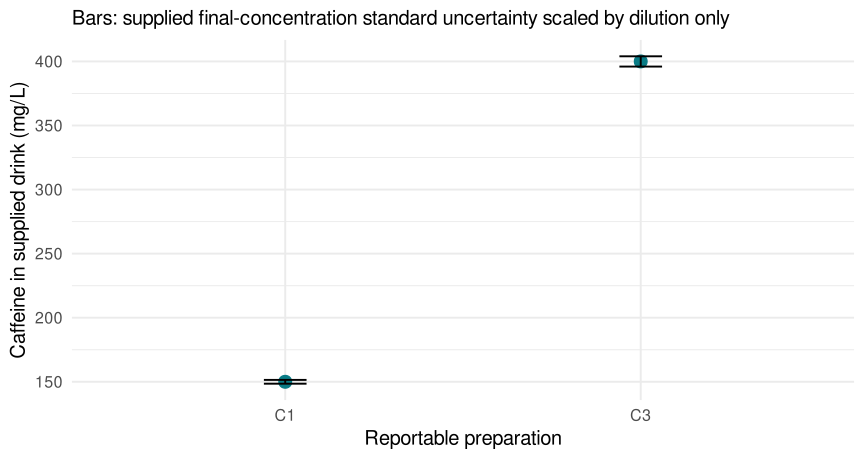
Read uncertainty on its stated scale
C1: standard uncertainty 1.5 mg/L original.
C3: 4.0 mg/L original from the supplied final uncertainty.
![Only supported preparations have plotted concentrations, with limited dilution-scaled standard uncertainty bars.]()
A conditional budget is not full method validation
Ideal calibration points cannot prove zero uncertainty.
What evidence is missing for the intended use?
![The measurement chain includes sources of uncertainty beyond a fitted line or reading repeatability.]()
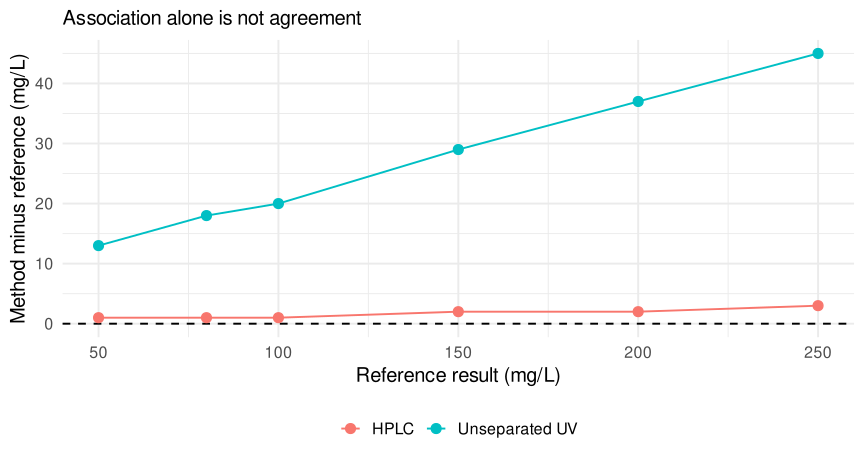
Agreement is not association
Both methods track concentration; their differences tell different stories.
![Method-minus-reference differences reveal concentration-dependent discrepancies that correlation alone would conceal.]()
A pattern motivates investigation; it does not prove cause
The UV discrepancy may motivate a matrix or selectivity study.
![A growing positive difference suggests a performance problem to investigate under the intended method scope.]()
What mass spectrometry can add
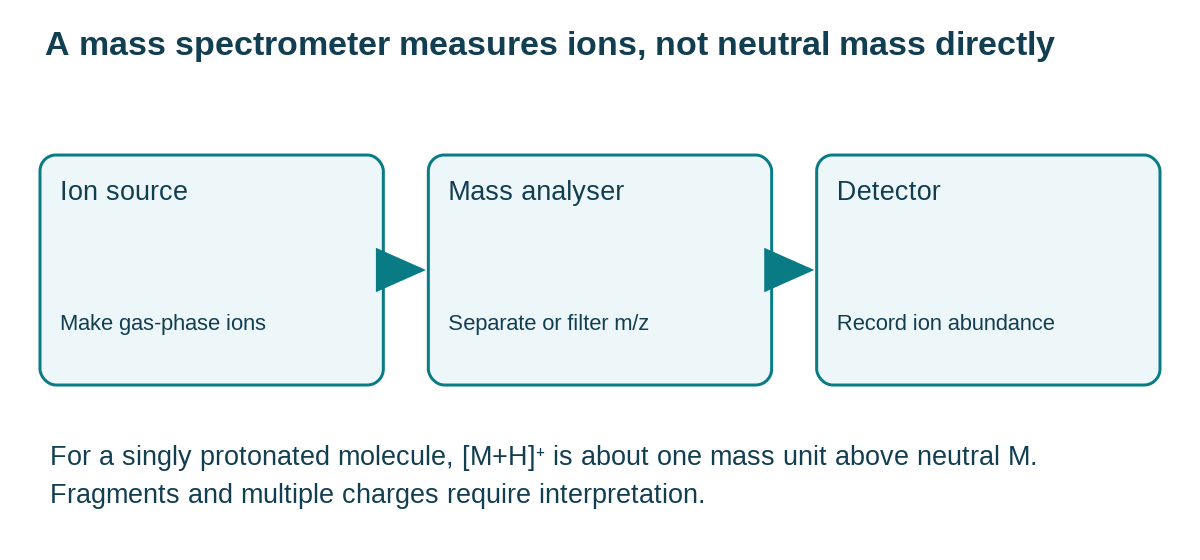
Ion source → mass analyser → detector.
The signal describes ions by mass-to-charge, not neutral mass directly.
![A mass-spectrometric signal path creates and filters ions before recording abundance.]()
Interpret a plausible caffeine ion carefully
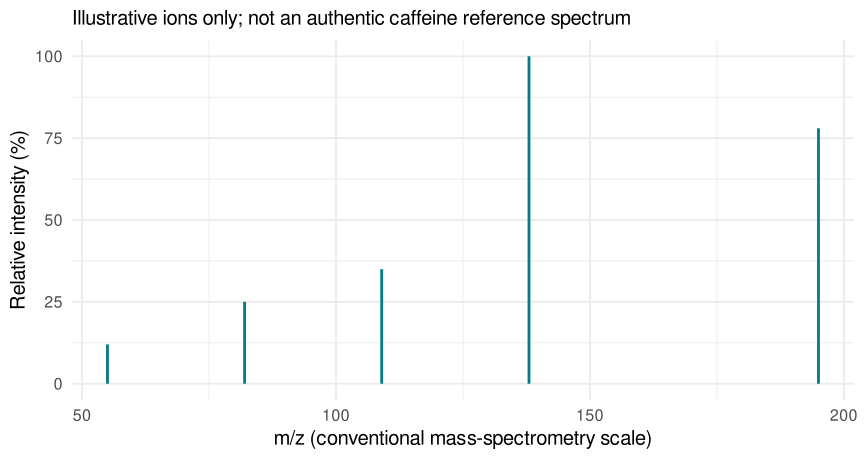
Neutral nominal mass 194; singly protonated [M+H]⁺ near m/z195.
One nominal ion mass is not a unique identification.
![Illustrative ion sticks include m/z195, but the pattern is not an authentic reference spectrum for caffeine.]()
Write the analytical conclusion
Report supported values, explicit withheld reasons and the next action.
Render from original inputs in a fresh R session.
![The final result must remain traceable to the question, collected sample, preparation and measurement.]()
Test a decision before accepting it
Exercise, embedded decision experiment and full solutions · Practice quiz
What new evidence would change your decision?