GC and HPLC
Choose a separation, calibrate an area, test a ratio
About this lecture
Choose how an analyte can enter and move through a column.
Then ask which sources of variation an internal standard can actually track.
Follow the GC sample
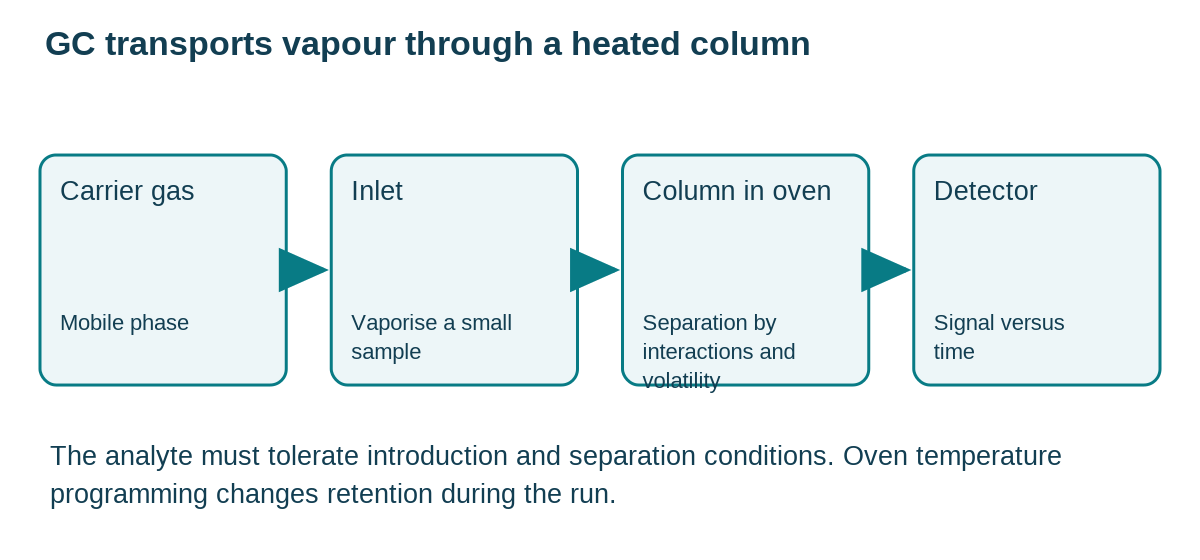
Carrier gas → inlet → column in an oven → detector.
![A GC flow path carries vaporised analyte in gas through an oven-controlled column to a detector.]()
Volatility concerns what is introduced
Headspace sampling can introduce volatiles above a nonvolatile matrix.
Retention depends on stationary-phase interactions as well as volatility.
![A schematic GC flow path supports discussion of sample entry, volatility and stationary-phase interactions.]()
Follow the HPLC sample
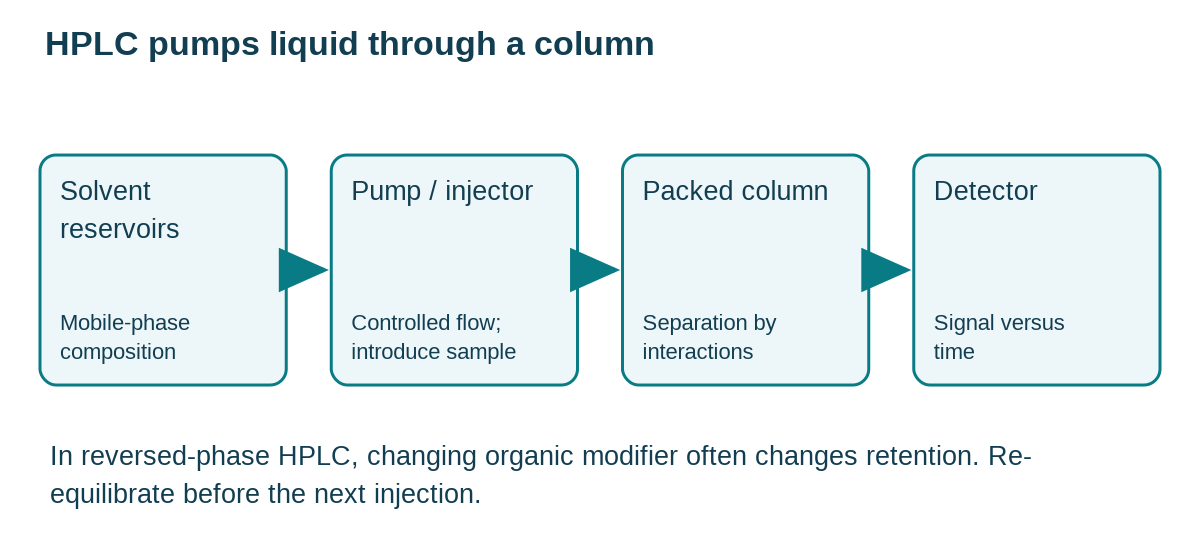
Solvent reservoirs → controlled flow and injection → packed column → detector.
![A liquid mobile phase is pumped through an injected sample, packed HPLC column and detector.]()
Reversed phase is an interaction regime
A relatively nonpolar stationary phase meets a more polar mobile phase.
Increasing organic modifier often reduces retention for appropriately retained compounds.
![An HPLC flow path is used to connect phase chemistry with controlled liquid transport.]()
A gradient must include the next starting state
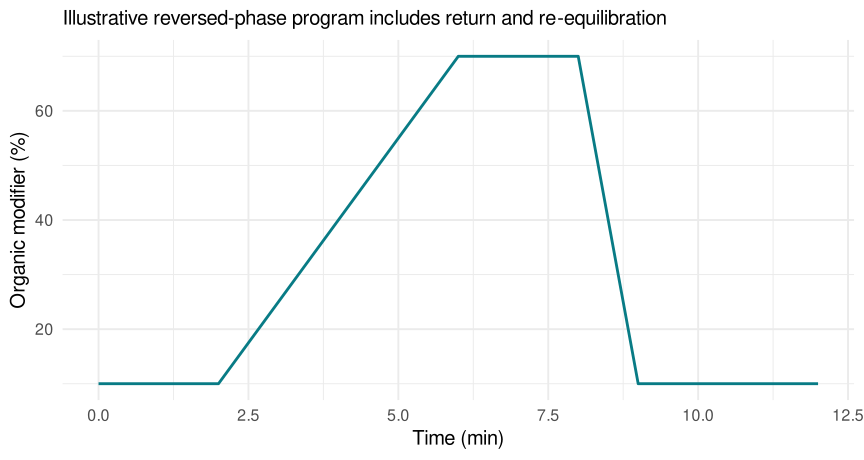
Composition changes during a gradient; an isocratic run holds it fixed.
Return and re-equilibrate before the next injection.
![An illustrative HPLC gradient rises from ten to seventy percent organic, then returns and re-equilibrates.]()
Detection adds another selectivity condition
UV absorption, flame-ionisation current and mass-to-charge signals are different responses.
![A detector receives separated components, but its response depends on its measurement principle.]()
Calibrate integrated caffeine area
Final-solution standards span 0–40 mg/L.
Area = 3 + 50 × caffeine concentration.
![Integrated caffeine area is linear with final-solution concentration in the simulated calibration.]()
A smaller injection need not mean a weaker vial
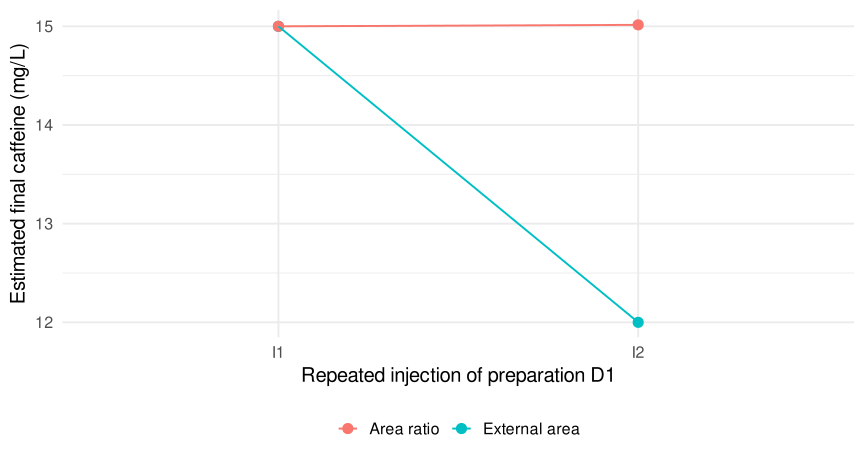
Two injections of D1 give external estimates 15.00 and 12.00 mg/L final.
![External-area estimates vary between two injections of one prepared solution.]()
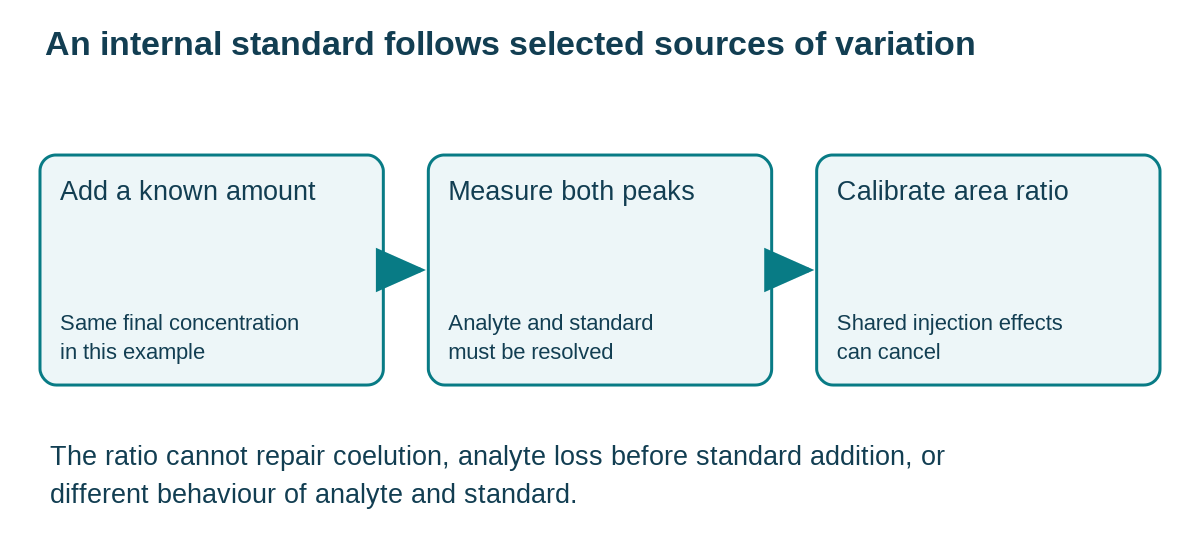
Add a distinguishable internal standard
Every final standard and sample here has 10 mg/L internal standard.
Both peaks must be appropriately resolved.
![An internal standard shares selected preparation and measurement steps with the analyte.]()
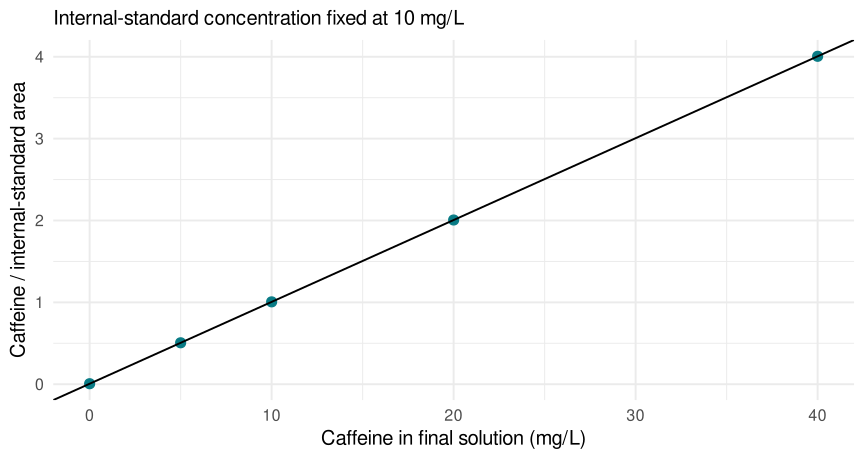
Calibrate the matched ratio
R=A_{caffeine}/A_{IS}=0.006+0.100c.
![A retained-intercept ratio calibration relates caffeine concentration to caffeine/internal-standard area ratio.]()
Compare the repeated-injection estimates
Ratio estimates: 15.000 and 15.015 mg/L final.
The common injection effect mostly cancels.
![Area-ratio estimates remain close while the external estimates change substantially.]()
Return to the original drink
The preparation factor is 10, giving about 150 mg caffeine/L original.
![Calibration and the recorded dilution factor connect measured peak areas to the original drink basis.]()
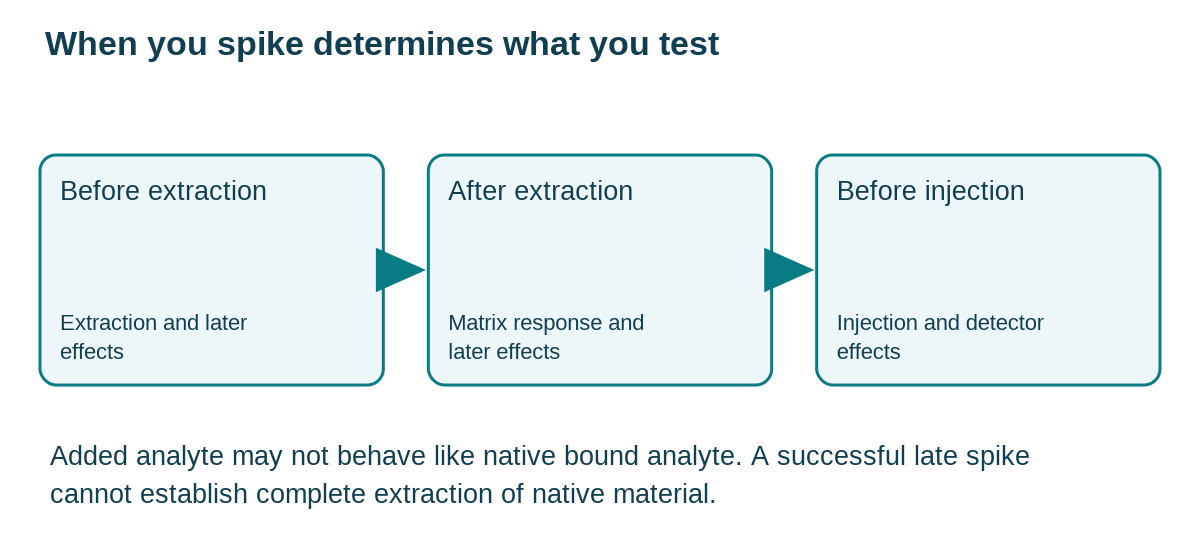
Timing determines which loss is tracked
A standard added after extraction cannot establish recovery of native analyte through that extraction.
![A spike or internal standard passes through only the steps following its point of addition.]()
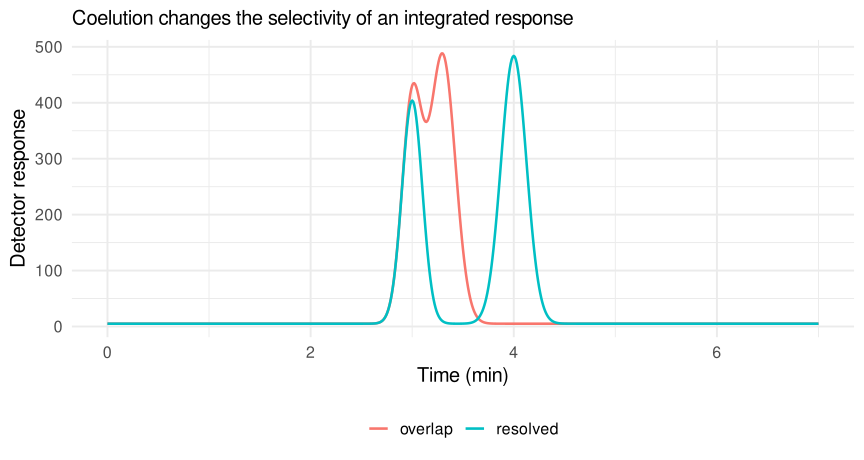
Ratios cannot restore missing selectivity
I3 is unresolved. I4 has failed QC.
Both concentration results are withheld despite calculable areas and ratios.
![Coelution can invalidate a compound-specific area even when a ratio can be calculated.]()
Encode the chemical decision
reportable <- resolved & qc_pass & in_range
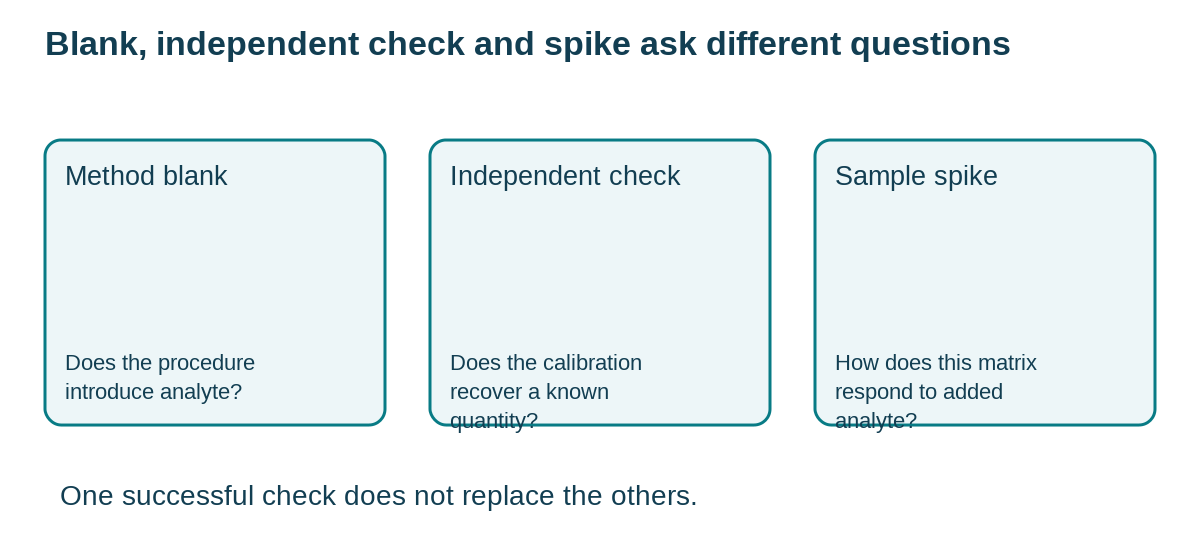
![Independent checks and sample-specific evidence address different aspects of analytical validity.]()
Predict before exploring
Change only injection amount. Then introduce a loss that occurs before a late internal standard.
Which error cancels, and which remains?
![The comparison plot motivates separating shared injection effects from unshared chemical effects.]()
Transfer the calibrated ratio
Areas 903 and 600; same IS concentration; original-to-final factor 5.
What amount would you report, and what could still prevent reporting?
![The ratio model supports a transfer calculation only under its matched-standard and selectivity assumptions.]()
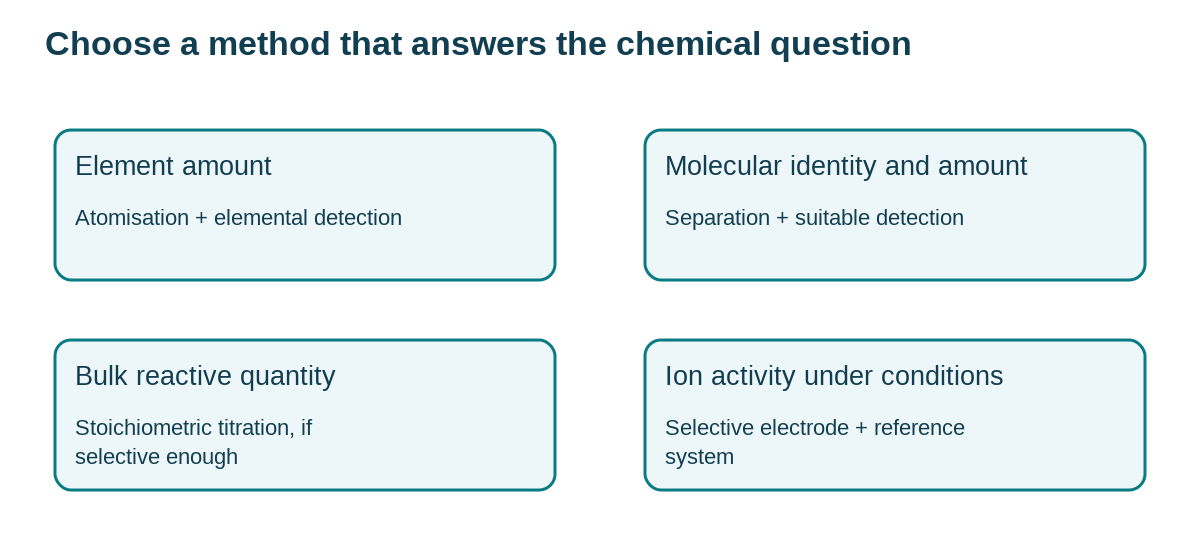
Choose the complete method
Volatile solvent mixture versus heat-sensitive nonvolatile solutes.
Exercise and embedded exploration · Practice quiz
![Different chemical questions and sample constraints call for different measurement strategies.]()