Matrix effects and recovery
A straight line can still give a biased sample
About this lecture
- Separate multiplicative response effects, additive interference and earlier analyte loss.
- Calculate incremental recovery and a fixed-volume standard addition.
- State which assumptions make the negative intercept meaningful.
Why can a good external line give a low result?
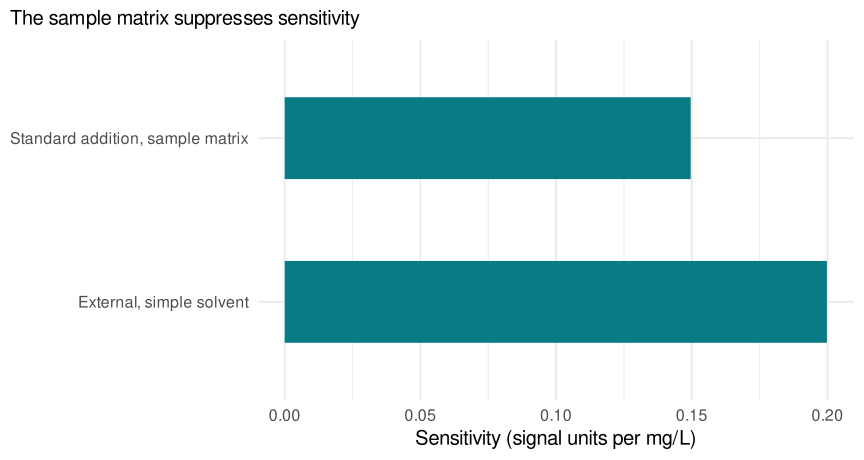
![Sample-matrix sensitivity is about 0.1496 response units per mg/L, below the external-standard slope of 0.1998.]()
The sample changes the response per unit analyte.
Separate multiplicative and additive effects
![Sample-matrix sensitivity is about 0.1496 response units per mg/L, below the external-standard slope of 0.1998.]()
Changed sensitivity and unrelated background are different problems.
A spike tests incremental response
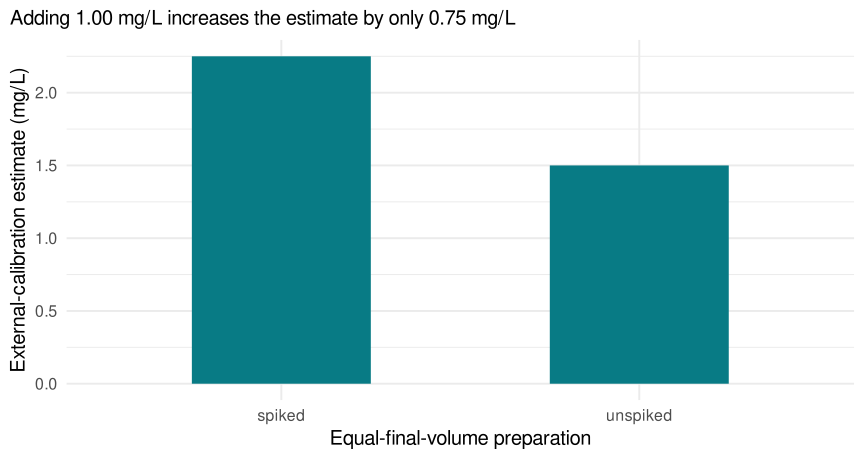
![Adding 1.00 mg/L increases the external estimate by 0.75 mg/L, giving 75 percent incremental recovery.]()
What should adding a known amount change?
Put all terms on the same volume basis
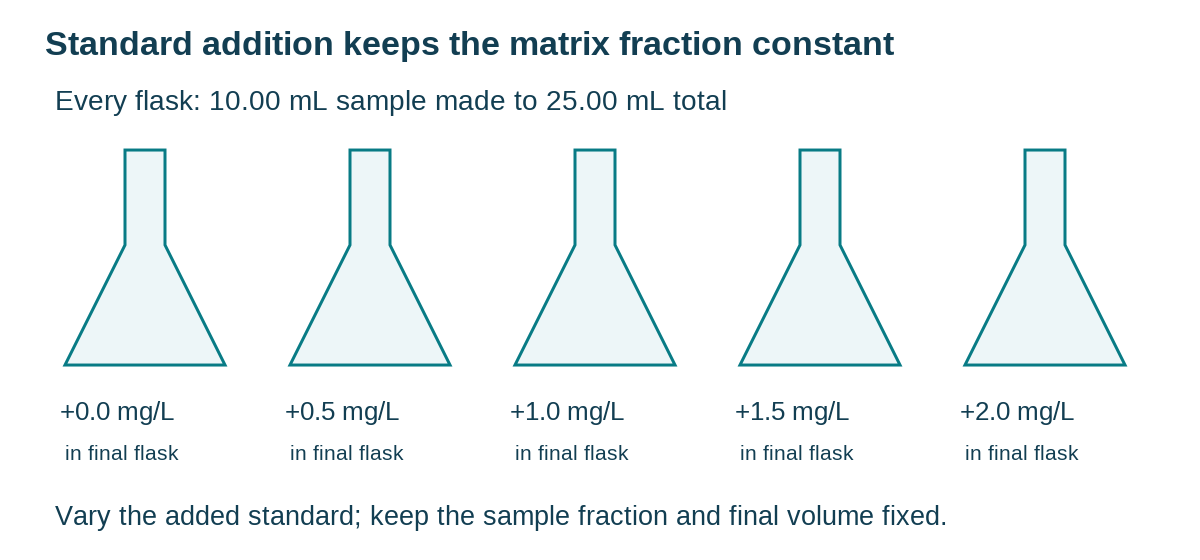
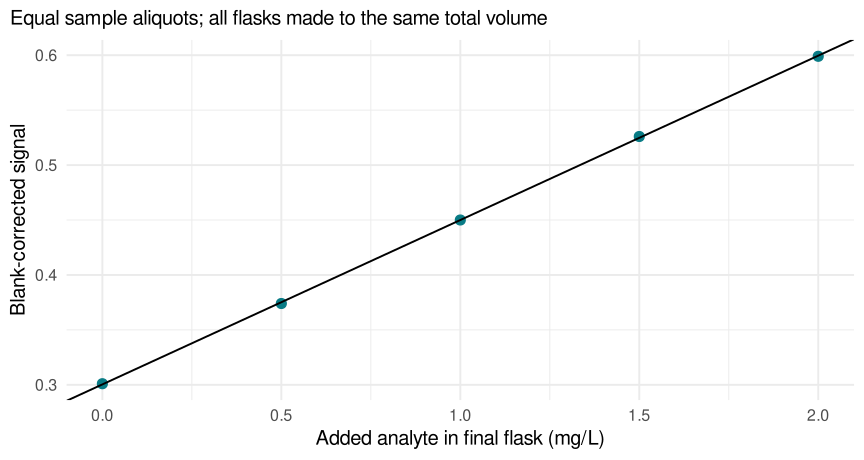
![Five flasks have equal sample aliquots and equal final volume, but increasing standard additions expressed as final-flask concentration.]()
Both final flasks have the same sample fraction and total volume.
Calculate the observed recovery
![Adding 1.00 mg/L increases the external estimate by 0.75 mg/L, giving 75 percent incremental recovery.]()
Estimate rises from 1.50 to 2.25 mg/L after adding 1.00 mg/L.
Interpret 75% correctly
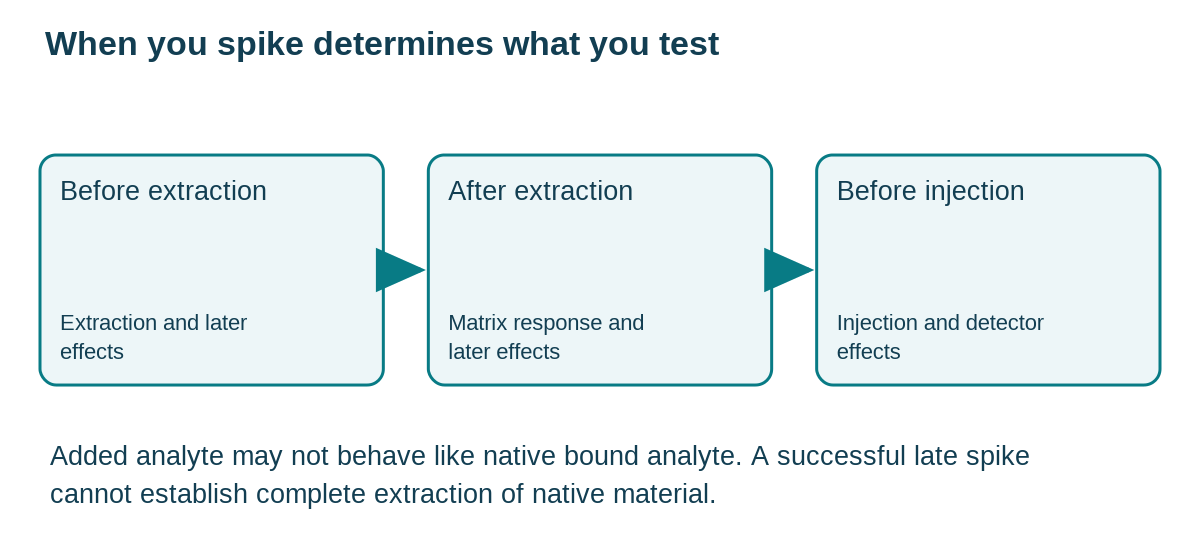
![Added analyte may not behave like native bound analyte. A successful late spike cannot establish complete extraction of native material.]()
It is evidence about the added analyte from its addition point onward.
Build a fixed-volume standard-addition series
![Five flasks have equal sample aliquots and equal final volume, but increasing standard additions expressed as final-flask concentration.]()
Every flask: 10.00 mL sample made to 25.00 mL.
Write the sample contribution in the final flask
![Five flasks have equal sample aliquots and equal final volume, but increasing standard additions expressed as final-flask concentration.]()
c_{native,final}=c_s V_s/V_f.
State the response model
y=b(c_sV_s/V_f+c_{added,final}).
Fit the familiar straight line
![Blank-corrected response rises with final-flask added analyte; the intercept includes native sample analyte.]()
lm(blank_corrected_signal ~ spike_mg_l_final, data = additions)
Read the slope
![Sample-matrix sensitivity is about 0.1496 response units per mg/L, below the external-standard slope of 0.1998.]()
Matrix slope ≈ 0.1496, versus external ≈ 0.1998.
Read the intercept
![Blank-corrected response rises with final-flask added analyte; the intercept includes native sample analyte.]()
Response at zero added analyte ≈ 0.3004.
Locate the negative intercept
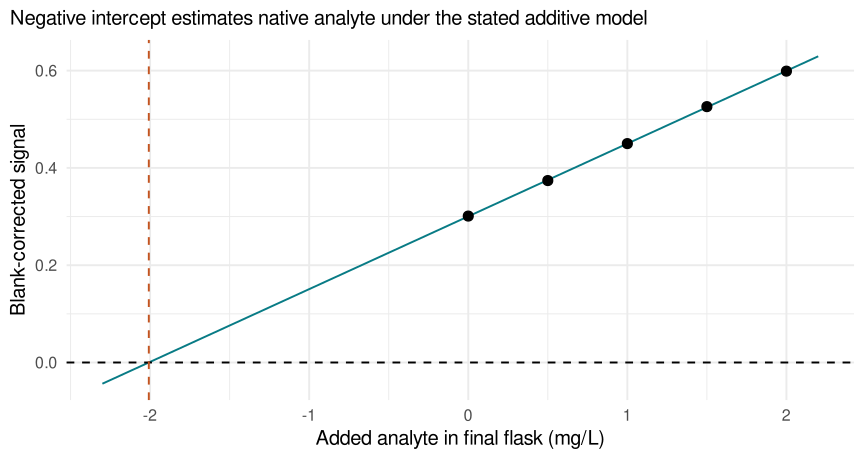
![The standard-addition line extrapolates to a negative x-intercept near minus 2.008 mg/L in the final flask.]()
x_0=-a/b\approx-2.0080 mg/L.
Undo the dilution of the sample aliquot
![Five flasks have equal sample aliquots and equal final volume, but increasing standard additions expressed as final-flask concentration.]()
2.0080 × 25.00/10.00 = 5.020 mg/L original.
Compare external calibration
![Sample-matrix sensitivity is about 0.1496 response units per mg/L, below the external-standard slope of 0.1998.]()
The external answer is about 3.761 mg/L original.
An additive interferent can survive standard addition
![Blank-corrected response rises with final-flask added analyte; the intercept includes native sample analyte.]()
A positive non-analyte signal can shift the intercept.
Changing final volume changes the design
![Five flasks have equal sample aliquots and equal final volume, but increasing standard additions expressed as final-flask concentration.]()
Do not use a fixed-volume intercept formula without its fixed-volume conditions.
Uncertainty belongs to the inferred intercept too
![The standard-addition line extrapolates to a negative x-intercept near minus 2.008 mg/L in the final flask.]()
Slope, intercept, their covariance and volume factors contribute.
Do not turn one recovery into a universal correction
![Added analyte may not behave like native bound analyte. A successful late spike cannot establish complete extraction of native material.]()
What evidence would support applying a correction to another sample?
Transfer the design
![Five flasks have equal sample aliquots and equal final volume, but increasing standard additions expressed as final-flask concentration.]()
5.00 mL to 20.00 mL; y=0.240+0.120c_{added,final}.
Take the reasoning into R
By hand, embedded experiment and R tasks · Practice quiz.
Save the calculation and a chemical interpretation in your reproducible report.
Interactive experiment · Predict, change, explain.