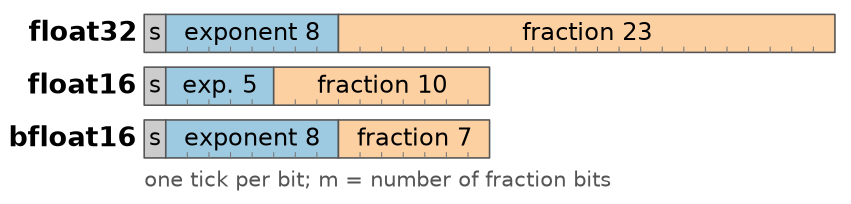
6.02 \times 10^{23}: a few significant digits and an exponent. Floats do the same in base 2:
x = \pm\, 1.f_1 f_2 \dots f_m \;(\text{binary}) \times 2^{E}.
format
bits
largest
relative precision
float32
32
3.4 \times 10^{38}
2^{-23} \approx 1.2 \times 10^{-7}
float16 (half)
16
65 504
2^{-10} \approx 0.001
bfloat16
16
3.4 \times 10^{38}
2^{-7} \approx 0.008
About 7 significant decimal digits in float32, 3 in float16, 2 in bfloat16.
bfloat16 keeps float32’s exponent range but very few digits (used in machine learning).
Try it: the bits of a float
Floats are spaced unevenly
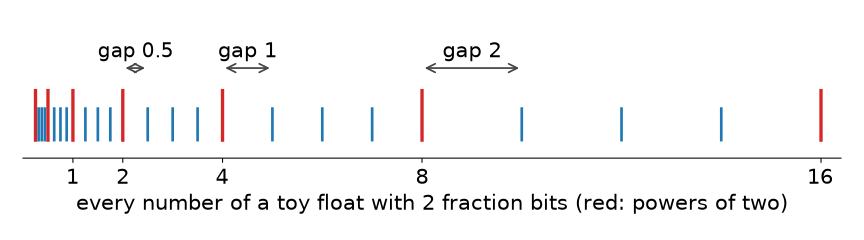
Between two powers of two there are always the same number of floats (2^m), evenly spaced. The next interval is twice as long, so the gaps double:
float16 near
1
1000
3000
65 000
gap to the next float
0.000 98
0.5
2
32
The relative gap is about the same everywhere: 2^{-10} to 2^{-11} for float16. This is machine epsilon, the gap above 1.
Rounding to the nearest float makes a relative error of at most half that: about 0.05 % for float16, 6 \times 10^{-8} for float32.
0.1 is not exactly a float (like 1/3 in decimal). In float16 it is 0.099 975 585 937 5.
Integers in floats
Every integer is exact as long as the gap is at most 1:
format
all integers exact up to
first one that is not
float32
2^{24} = 16\,777\,216
16 777 217
float16
2^{11} = 2048
2049 (→ 2048)
bfloat16
2^{8} = 256
257 (→ 256)
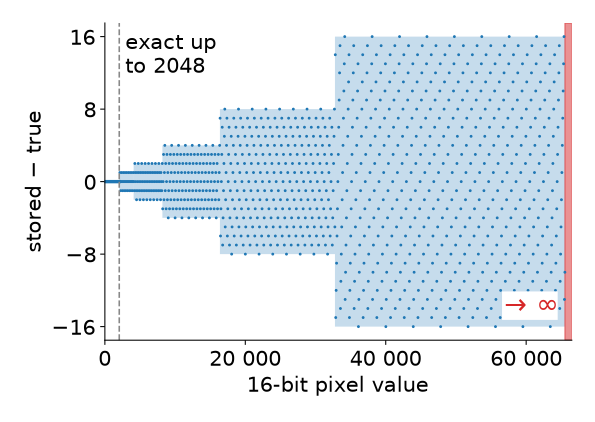
A 16-bit image stored in half floats:
values up to 2048 survive; 2049 → 2048, 3001 → 3000, 40 001 → 40 000 (gap 32);
65 535 → infinity: the largest half float is 65 504.
Normalised to [0, 1] instead, the gap near 1 is 2^{-11}: about 11 bits. Half float is fine for 8- or 10-bit data, not for 16-bit.
Special values
±0: two zeros (the sign is kept, e.g. for 1/(-0) = -\infty).
±∞: overflow (65 535 in half), or 1/0.
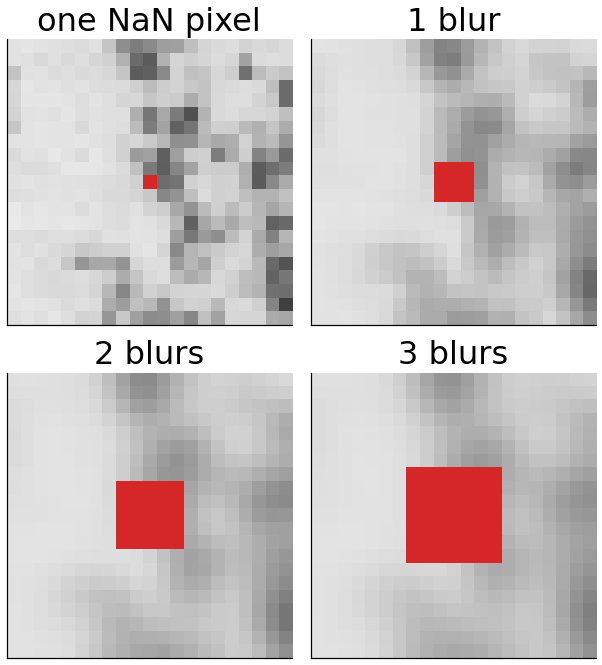
NaN (“not a number”): 0/0, \infty - \infty, \sqrt{-1}. Any arithmetic with NaN gives NaN, and NaN ≠ NaN. One NaN pixel spreads through a blur to every pixel it touches; a mean over an image with one NaN is NaN.
Subnormals: below the smallest normal number (2^{-14} \approx 6 \times 10^{-5} in half) the spacing stops shrinking, so the floats run down evenly to 0. Tiny values lose relative precision gradually instead of dropping to 0 at once.
A 3 × 3 blur, repeated: the one NaN pixel becomes 9, 25, 49.
The math: IEEE 754 numbers
With sign s, stored exponent field E (e bits), fraction field F (m bits) and biasb = 2^{e-1} - 1 (15 for half, 127 for float32):
x = \begin{cases}(-1)^s\, 2^{E - b}\,(1 + F/2^m) & 0 < E < 2^e - 1 \text{ (normal)}\\ (-1)^s\, 2^{1 - b}\,(F/2^m) & E = 0 \text{ (zero, subnormal)}\\ \pm\infty \text{ if } F = 0, \text{ NaN otherwise} & E = 2^e - 1.\end{cases}
In [2^k, 2^{k+1}) the spacing is 2^{k - m}; the relative spacing is between 2^{-m-1} and 2^{-m}; \varepsilon = 2^{-m}.
Round to nearest, ties to even: \operatorname{fl}(x) = x(1 + \delta) with |\delta| \le \varepsilon/2.
Integers are exact while the spacing is \le 1: up to 2^{m+1}.
Cancellation
Subtracting two nearly equal numbers keeps their absolute error but not their size: the relative error explodes.
In half: 2049 - 2048 gives 0, because 2049 was already stored as 2048.
Textbook variance, \overline{x^2} - \bar x^2: two large, nearly equal numbers. For pixels 10 000, 10 001, 10 002 in float32 it gives 0 (the true value is 2/3): the sum of squares, 300 060 005, is stored as 300 060 000 (gap 32 there).
Fix: compute the mean first, then the squared deviations (two passes), or an update formula that does the same in one pass.
Summing many pixels
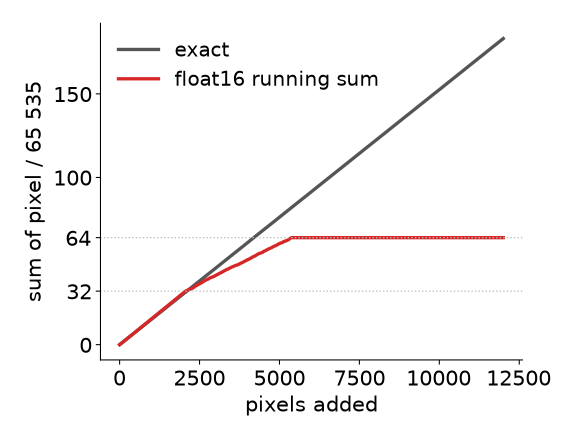
A running sum grows. Once the sum is large, the gap at the sum is larger than the pixel values: each addition rounds, and the small values lose their low bits.
float32: adding 1 to 2^{24} gives 2^{24}. A 2048 × 2048 image with mean 1000 sums to 4 \times 10^9: the naive float32 mean is off by 1 %.
float16: summing normalised pixel values (≈ 0.015 each) gets stuck at 64: from there, adding a pixel rounds back to the same sum.
Pairwise summation (add in a tree: pairs, pairs of pairs, …) keeps partial sums of similar size: error grows like \log n instead of n.
Kahan summation carries the rounding error of each addition into the next one: nearly exact.
Summing as pseudocode
naive:     s = 0
           for each x:  s = s + x                      # every + rounds

pairwise:  sum(list) = sum(first half) + sum(second half)     # one number: itself

Kahan:     s = 0;  c = 0
           for each x:  y = x − c                      # put back what was lost last time
                        t = s + y
                        c = (t − s) − y                # what this addition lost (sign flipped)
                        s = t
Same number of additions; only the order (pairwise) or a correction term (Kahan) differs.
Kahan only works if the computer does not “simplify” (t - s) - y to 0.
Try it: summing 4 million pixels
The math: how errors grow when summing
Each addition s_k = \operatorname{fl}(s_{k-1} + x_k) makes a relative error |\delta| \le u = \varepsilon/2. For n non-negative terms (to first order in u):
The naive sum stalls when x_k < \tfrac12\operatorname{gap}(s_{k-1}): the addition rounds back to s_{k-1}. Kahan’s trick: after t = \operatorname{fl}(s + y), the quantity c = \operatorname{fl}(\operatorname{fl}(t - s) - y) is exactly the part of y that was lost (with the sign flipped); it is subtracted from the next term.
Rules of thumb
Do image arithmetic in float32; accumulate long sums (means, histograms of large stacks, integrals) in float64, or pairwise.
Compute variances from deviations from the mean, not from \overline{x^2} - \bar x^2.
Do not test two floats for exact equality; compare with a tolerance relative to their size.
Half floats: fine for display and for values of similar size; not for 16-bit raw data or long sums.
Check for NaN and ∞ after every step that can divide or overflow.
Summary
A float is \pm 1.f \times 2^E: a fixed number of significant bits, so precision is relative; the gap doubles at every power of two.
float32: 24 significant bits, integers exact to 2^{24}; float16: 11 bits, to 2048, max 65 504; bfloat16: 8 bits.
Special values: ±0, ±∞, NaN (spreads), subnormals.
Subtraction of near-equal values cancels significant bits; long sums drift or stall. Use two-pass variances and pairwise or compensated sums.