Shape features
Same size, different shape
Digitised on a 64 × 64 grid (numbers from the demo):
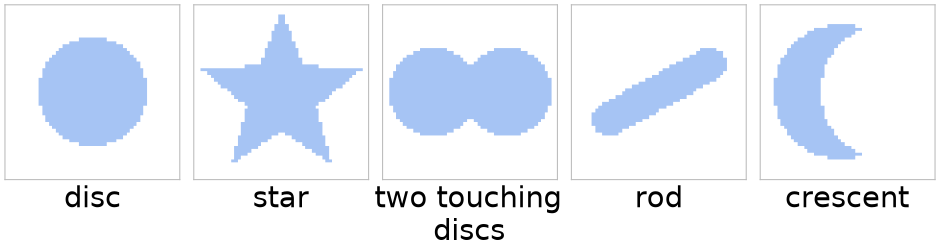
| area | solidity | form factor | max / min Feret | inscribed radius | |
|---|---|---|---|---|---|
| disc, r = 16 | 812 | 0.96 | 1.02 | 33.3 / 32.0 | 15.0 |
| star (same area) | 804 | 0.54 | 0.33 | 48.0 / 44.0 | 10.3 |
| two touching discs | 1040 | 0.92 | 0.76 | 48.7 / 26.0 | 12.0 |
| rod | 420 | 0.90 | 0.52 | 44.9 / 11.3 | 4.9 |
| crescent | 548 | 0.61 | 0.46 | 40.8 / 26.0 | 6.5 |
(Form factor with the Crofton perimeter.) Each column separates some shapes and not others: a feature table needs several.
The convex hull
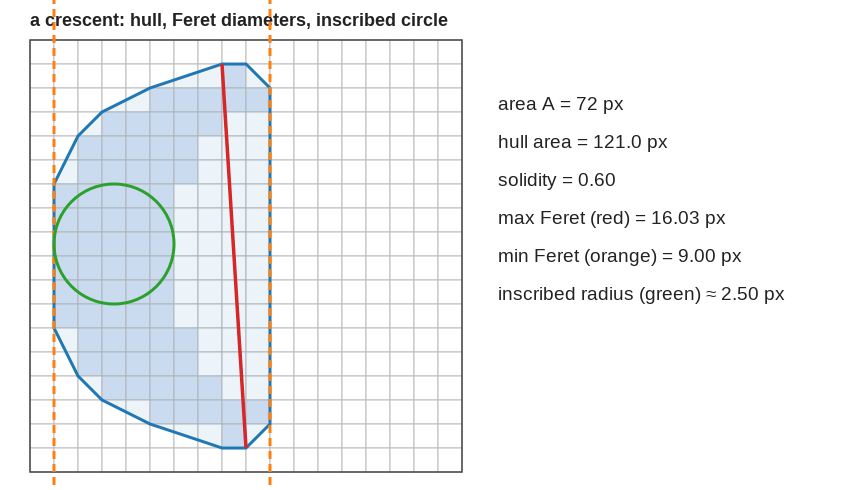
The convex hull is the smallest convex set that contains the object: a rubber band around it.
- For pixels, take the hull of the pixel corners (blue). The hull of the pixel centres is half a pixel smaller all round: for a one-pixel-wide line it has area 0. The choice matters a lot for small objects.
- Only the leftmost and rightmost pixel of each row can be on the hull: few candidates.
- Algorithm (Andrew’s monotone chain): sort the points by x; walk left to right keeping only right turns (upper hull), then right to left (lower hull). O(n\log n).
- Area of the hull polygon: the shoelace formula.
Solidity
Solidity = A / A_{\text{hull}}: 1 for a convex object, lower the more is missing.
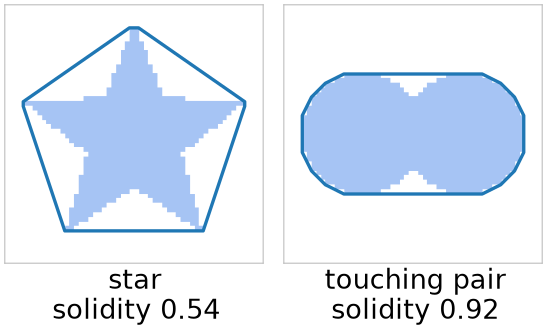
- Disc 0.96, rod 0.90 (on pixels, convex shapes get a little less than 1: the staircase of the outline is not convex), star 0.54, crescent 0.61.
- Two touching nuclei: 0.92 against 0.96 for one nucleus. A low solidity for an object of nucleus size says “two objects merged here, consider splitting” (watershed day).
- Exact solidity from the outline: disc 1.00, star 0.52, crescent 0.61, touching pair 0.93.
- With the centre convention, small objects can get solidity above 1 (pixel area larger than the hull of the centres).
Form factor and its bias
Form factor (circularity) 4\pi A/P^2: 1 for a disc, smaller for everything else (isoperimetric inequality).
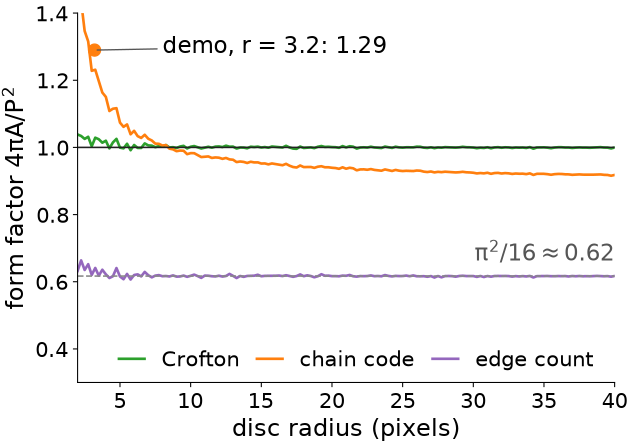
- It inherits the perimeter bias: with the edge count a digital disc gets (\pi/4)^2 = \pi^2/16 \approx 0.62, at every resolution.
- With a better perimeter it is close to 1 for large discs, but small discs come out above 1: a disc of radius 3.2 pixels gets 1.29 with the chain code (the polygon through the centres is too short).
- Rule: compare form factors only within one estimator and one resolution, and not for objects of a few pixels.
Compactness is a name with several meanings:
| disc | square | 2:1 rectangle | |
|---|---|---|---|
| P^2/(4\pi A) | 1 | 1.27 | 1.43 |
| 2\pi\,\overline{r^2}/A (second moments) | 1 | 1.05 | 1.31 |
(and in 3D S^3/(36\pi V^2), 1 for a sphere).
Feret diameters
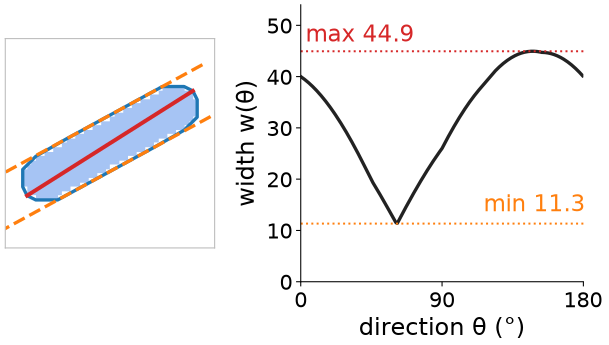
The Feret diameter (caliper diameter) w(\theta): the distance between two parallel lines that touch the object, measured in direction \theta.
- Max Feret = the largest distance between two points of the object (red).
- Min Feret = the smallest width (orange calipers): what a sieve measures.
- Both are attained on the convex hull, so only hull vertices matter.
- Rotating calipers: turn the pair of lines around the hull; the opposite vertex moves forward as the edge advances: O(h) for h hull vertices. The min width always has one caliper flush with a hull edge.
Radii from the distance transform
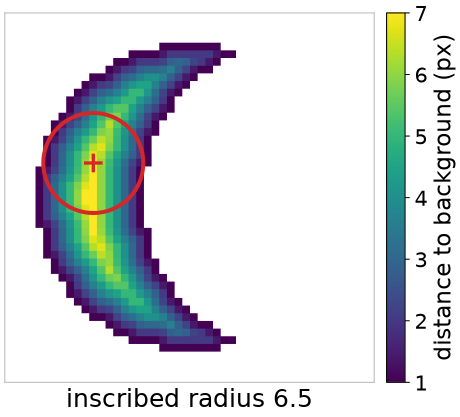
The distance transform (morphology day): \mathrm{DT}(p) = distance from object pixel p to the nearest background pixel.
- Maximum inscribed radius \approx \max \mathrm{DT} - \tfrac12 (DT is measured between pixel centres): the largest disc that fits inside. A thickness that ignores protrusions.
- Mean radius: the mean of DT over the object.
- A rod of width w has inscribed radius \approx w/2 whatever its length; its min Feret is \approx w too. A crescent has min Feret 26 but inscribed radius only 6.5: it is thin but curved.
- The centre of the largest disc lies on the medial axis (skeleton day). Also used: the minimum enclosing circle (Welzl’s algorithm).
Contour descriptors
Walk the boundary and write each point as a complex number z(t) = x(t) + i\,y(t): a periodic signal. Its Fourier coefficients c_k (recall the Fourier unit) describe the outline:
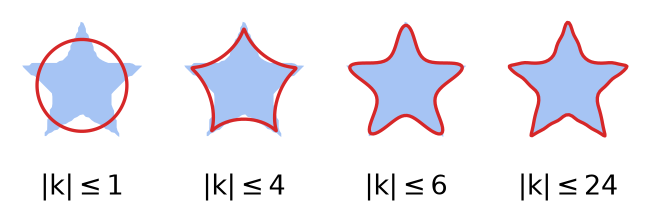
The demo’s “k Fourier coefficients” star (blue) and its outline rebuilt from the coefficients with |k| \le K (red), 128 boundary points.
- c_0 is the centroid of the contour; drop it for translation invariance.
- c_{\pm1} is the best-fitting ellipse; divide by |c_1| for scale invariance; use magnitudes |c_k| for rotation and starting-point invariance.
- Keep only |k| \le K and transform back: a smoothed outline. A 5-pointed star needs |k| up to about 4–6 to show its points (an exactly 5-fold symmetric outline has only |k| = 1, 4, 6, 9, 11, \dots).
- Low k: overall shape; high k: detail and pixel noise.