Quiz: pedigree analysis
Short questions on reading pedigrees and on simple risk calculations. Try each on paper first, then open the answer. Unless a question says otherwise, assume one gene, full penetrance and no new mutations.
Q1. Why do human geneticists use pedigrees, when geneticists studying peas or flies use controlled crosses?
Think about who chooses the parents, how many children there are, and how long a generation takes.
We cannot set up crosses in humans: people choose their own partners, families have only a few children, and a generation takes 25–30 years. So we collect the crosses that have already happened: who is affected and how they are related. With so few children, ratios such as 3:1 are hardly visible within one family. Instead we look for transmissions that are impossible under a mode.
Q2. Two unaffected parents have an affected daughter. Which modes of inheritance does this rule out: AR, AD, XR, XD?
Take each mode in turn. Under that mode, what genotype must the daughter have, and could two unaffected parents give it to her?
- AD is ruled out: an affected child needs at least one affected parent.
- XD is ruled out: the daughter needs an XA from one parent, and both are unaffected.
- XR is ruled out: an affected daughter is XaXa, so she got Xa from her father, who would then be affected.
- AR remains: both parents are carriers (Aa × Aa).
One trio with an affected daughter of unaffected parents leaves only autosomal recessive.
Q3. An affected man has an affected son. The son’s mother is unaffected. Which mode does this rule out, and why? Does it rule out X-linked recessive?
Which chromosome does a father give to his son?
A father gives his son a Y, not his X. So the son cannot have got an X-linked allele from his father.
- XD is ruled out: the son needs XA from his mother, and she is unaffected, so she has none.
- XR is not strictly ruled out: the son could have got Xa from a carrier mother, who is unaffected. But this needs a carrier to marry into the family, which is unlikely for a rare allele. So male-to-male transmission makes XR very unlikely.
Male-to-male transmission is the classic evidence for autosomal inheritance.
Q4. An affected woman with an X-linked recessive disease has children with an unaffected man. What do you expect among their sons and their daughters?
Write her genotype with Xa and XA, then make a Punnett square with his XA and Y.
She is XaXa and he is XAY.
- All sons get Xa from her and Y from him: XaY, all affected.
- All daughters get Xa from her and XA from him: XAXa, unaffected carriers.
So an affected woman with even one unaffected son rules out XR.
Q5. Look at the autosomal recessive pedigree in the lecture (fig02). Why are III-2 and III-3 called obligate carriers, even though nobody has tested them?
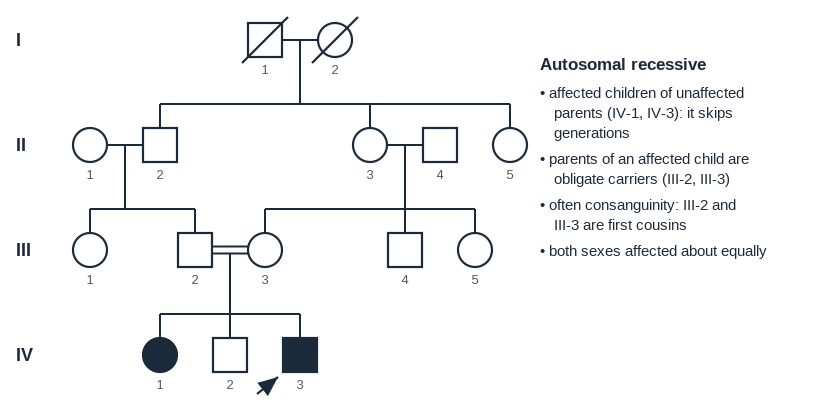
What genotype must IV-1 have, and where did each of her two alleles come from?
IV-1 and IV-3 are affected, so they are aa. Each got one a from each parent. Both parents are unaffected, so each must be Aa. The logic of the pedigree forces it: no test is needed. “Obligate” means must be.
Q6. Two unaffected parents have a child with cystic fibrosis (autosomal recessive). What is the probability that their unaffected son is a carrier? Why is it not 1/2?
Start from Aa × Aa. Which part of the outcomes can you cross out, given that he is unaffected?
Aa × Aa gives ¼ AA, ½ Aa, ¼ aa. He is unaffected, so he is not aa. Conditional on that:
\[P(Aa \mid \text{unaffected}) = \frac{1/2}{1/4 + 1/2} = \frac{2}{3}.\]
It is not 1/2 because the 1/2 is a share of all children, including the affected ones. Once we know he is unaffected, the aa quarter is gone, and two of the three remaining quarters are Aa.
Q7. The son from Q6 has a child with a woman from a population with a carrier frequency of 1/25. She has no family history. What is the risk that their child has cystic fibrosis?
Three things must all happen. Multiply their probabilities (product rule).
\[P = \underbrace{\tfrac23}_{\text{he is }Aa} \times \underbrace{\tfrac1{25}}_{\text{she is }Aa} \times \underbrace{\tfrac14}_{\text{both pass }a} = \frac{2}{300} = \frac{1}{150} \approx 0.0067.\]
Q8. An affected man with an X-linked dominant disease has four children with an unaffected woman. Predict the phenotypes of his sons and daughters. Under autosomal dominant inheritance, what is the probability of exactly the same outcome?
Under XD, what does a father give to each daughter and to each son? Under AD, each child is an independent coin toss.
Under XD he gives his XA to every daughter and his Y to every son: all daughters affected, all sons unaffected.
Under AD (Aa × aa) each child is affected with probability ½, independently of sex. The chance that the four children show exactly the XD pattern (every daughter affected, every son unaffected) is (½)4 = 1/16. One such family is suggestive; several such families make XD much more likely than AD.
Q9. Why does consanguinity (for example, a first-cousin marriage) increase the risk of recessive disease, but not of dominant disease?
For a recessive disease, both parents must carry the same rare allele. How likely is that for unrelated partners, and for cousins?
Relatives share alleles inherited from common ancestors. If a grandparent carried a rare recessive allele, it can reach both cousins and meet again in their child: the child of first cousins is homozygous by descent at about 1/16 of its genes. For unrelated partners, both carrying the same rare allele is very unlikely. A dominant disease needs only one copy, so it shows in the carrier parent anyway; the parents being related adds no new risk.
Q10. An autosomal dominant disease shows up in generations I and III of a family, but the person in generation II who links them is unaffected. Give two explanations.
One explanation is about the link between genotype and phenotype; the other is about where the allele came from.
- Incomplete penetrance: the person in generation II carries the dominant allele but does not show the disease. They are an obligate carrier.
- New mutation in generation III, so the allele in III was not inherited through generation II. (It is also possible that the disease in generation I has a different cause, or that biological parentage differs from the drawn pedigree.)
These are the cases where the strict rule “every affected person has an affected parent” breaks down.
Q11. A clinic collects families with three children, in which both parents are carriers of a recessive disease. It finds them through an affected child. Is the fraction of affected children among these families 1/4? If not, is it higher or lower, and why?
Which Aa × Aa families never come to the clinic?
It is higher, about 0.43 rather than 0.25. Aa × Aa families with three unaffected children (probability (3/4)3 ≈ 0.42) never come to the clinic, so they are missing from the count. Among the families that are seen, the expected number of affected children is
\[\frac{nq}{1 - (1-q)^n} = \frac{3 \times 1/4}{1 - (3/4)^3} \approx 1.30,\]
that is 1.30/3 ≈ 0.43 per child. This is ascertainment bias: how families are found changes the ratio we observe.
Q12. A woman’s maternal grandfather had haemophilia A (X-linked recessive). Her mother and she are unaffected, and her father is unaffected. What is the probability that her first son has haemophilia A?
Which X did the grandfather give to his daughter? Then walk down the family one transmission at a time.
An affected man gives his Xa to every daughter, so her mother is an obligate carrier (probability 1). She got one of her mother’s two X chromosomes: carrier with probability ½. Her son gets one of her two X chromosomes: ½. Her father does not matter, because a son gets his father’s Y.
\[P = 1 \times \tfrac12 \times \tfrac12 = \tfrac14.\]