Other short-read platforms
Foundations · NGS library preparation
Illumina is not the only short-read machine
Several instruments read the same kind of library — a population of short fragments, each carrying a known sequence at both ends — by quite different chemistry.
- Cost and access are the usual reasons to care: platforms win at different scales, and the sequencer you can get time on is a real constraint
- What does not change is the library. The ends differ, the read lengths are similar, and every design decision in the rest of this course still applies
- What does change is the sequence of the ends, the tolerance for homopolymers, and sometimes the error profile
Reading a native, full-length molecule is a different matter, and it waits until long reads, once the short-read protocols are in place.
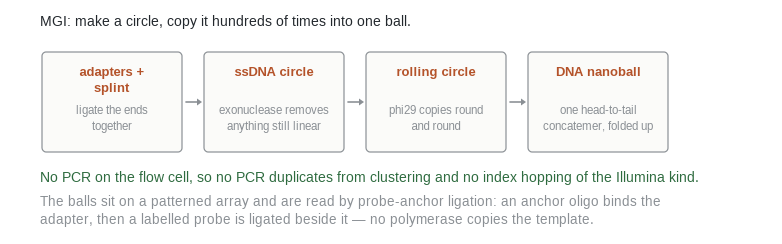
MGI: circularise, then copy
![]()
- No on-slide PCR, so no cluster duplicates and no index hopping of the Illumina kind
- The nanoball is a rolling circle, the same copying step used in the lab (amplification)
Drmanac et al. 2010, doi:10.1126/science.1181498
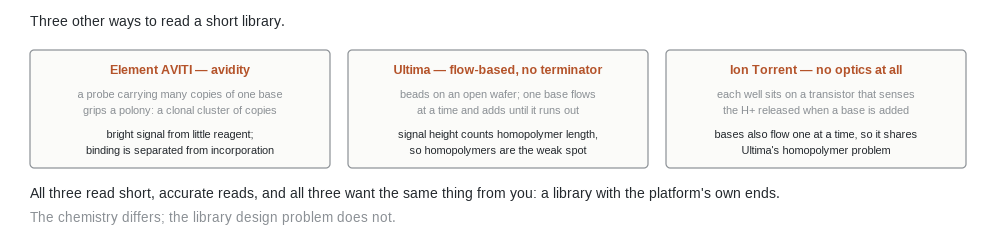
Three more short-read readouts
![]()
- Different chemistry, same library problem: give the platform its own ends
- Ion Torrent is the odd one out: no camera, no fluorophore. A base is added, a proton is released, and a transistor under the well measures the pH change
Avidity: Arslan et al. 2023, doi:10.1038/s41587-023-01750-7; Ion Torrent: Rothberg et al. 2011, doi:10.1038/nature10242
Where this connects
Read this next
What a platform dictates
Later, when the short-read protocols are in place
Every protocol in NGS 101 names its platform; look at how the first and last steps change when the platform does.