Amplification
Building blocks · NGS library preparation
What this deck is for
One nanogram of human DNA is about 150 cells’ worth of genome. A sequencer wants billions of molecules. Amplification bridges the gap, and every method of doing it pays for it in a different currency.
- Exponential copying (PCR) is powerful and biased, and its errors compound
- Linear copying (in vitro transcription, single-primer extension) makes each copy from the original
- Isothermal copying needs no thermal cycler — the block below — and some of it works from one cell
- Directed copying (inverse, nested, anchored, tiled) reads from a known sequence into an unknown one
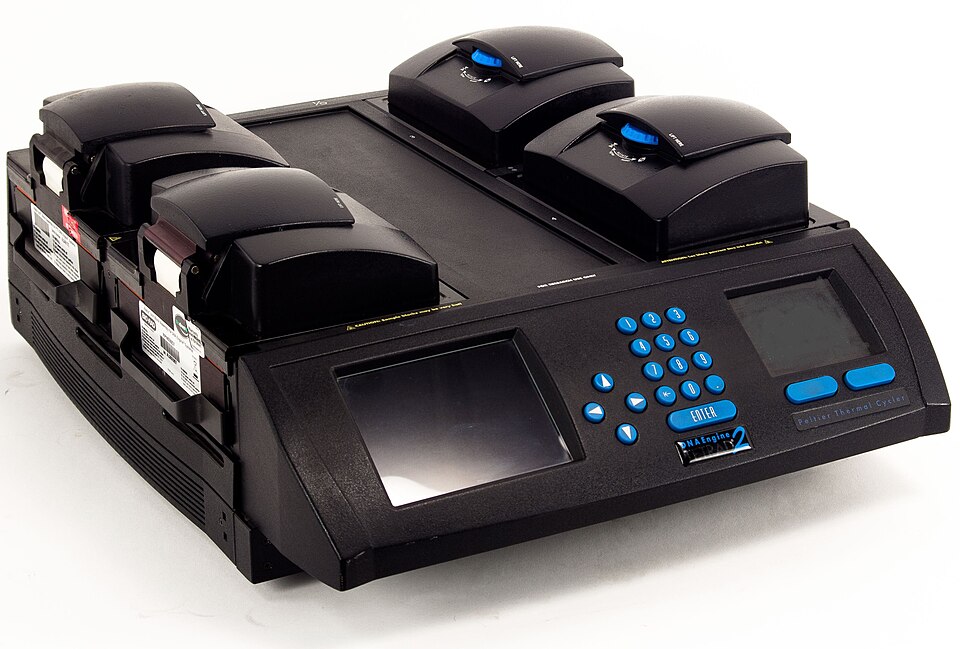
A sequence you amplify is a sequence you have changed the abundance of. The question is always how. Photo: Labcare, CC0
Exponential until it is not
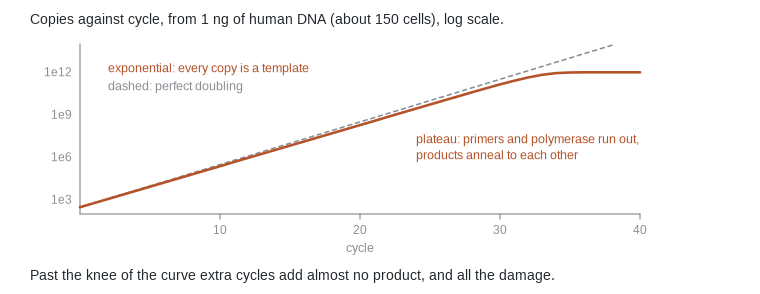
- Each cycle ideally doubles every molecule, so ten cycles give about a thousand-fold
- Real efficiency is below 100 %, and falls as primers and polymerase are consumed and products anneal to each other
- The plateau is not a safe place to stop: the knee is where the curve first bends away from doubling, and product made after it is mostly damage
Saiki et al. 1988, doi:10.1126/science.2448875
Fidelity and cycles
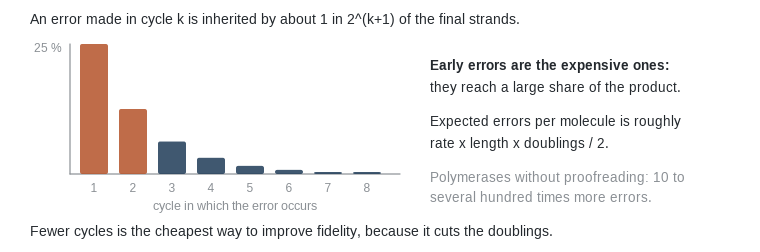
- A polymerase misincorporates at a small rate per base per doubling. Proofreading enzymes make 10 to several hundred times fewer errors than Taq
- An error is copied along with the molecule: one made in the first cycles is carried into a large share of the library
- Fewer cycles are therefore better than any change of enzyme
Over-amplification
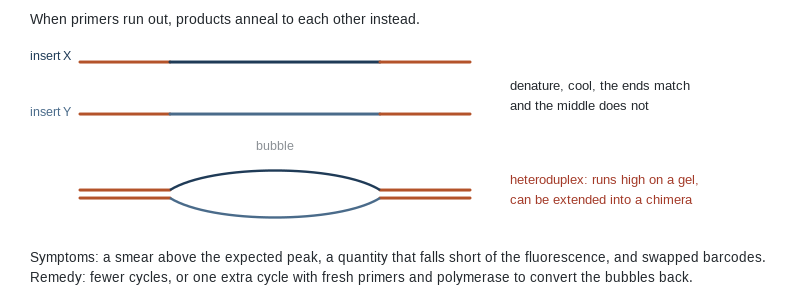
- When primers run out, strands of different molecules that share adapter ends anneal, leaving a bubble in the middle
- The bubble products run high on a gel and cause chimeras, including molecules with swapped barcodes
Kebschull and Zador 2015, doi:10.1093/nar/gkv717
GC and length bias
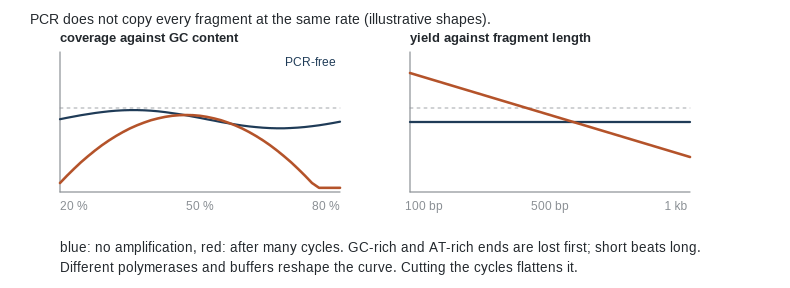
- GC-rich fragments denature and anneal poorly, AT-rich ones are sensitive to the extension step, and short fragments copy faster than long
- In a human genome, with its isochores and CpG islands, this shows up as uneven coverage across regions of different GC content
Aird et al. 2011, doi:10.1186/gb-2011-12-2-r18
Duplicates and library complexity
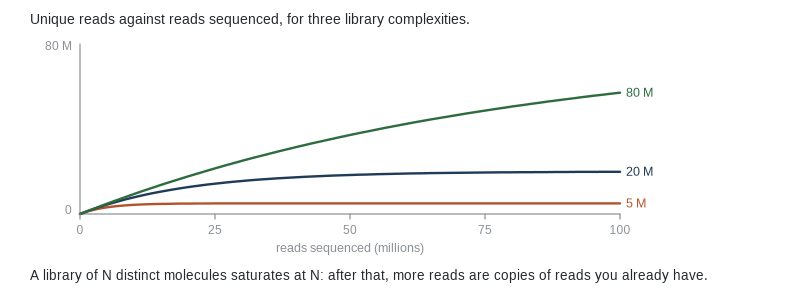
- A library of N distinct molecules gives at most N distinct reads: after that, each new read has a growing chance of being a copy
- Duplicates are a sign of complexity, not just a nuisance. Their rate lets you predict whether more sequencing is worth the money
- Duplicates made in PCR cannot be told from real coincident fragments without a molecular tag (barcodes and UMIs)
Daley and Smith 2013, doi:10.1038/nmeth.2375
PCR-free, and the cycle budget
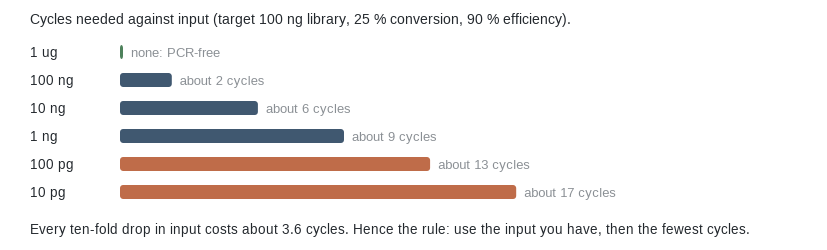
- With enough input, skip the PCR: TruSeq DNA PCR-free and NEBNext Ultra II FS PCR-free remove the bias and the duplicates
- Below that, compute the cycles from what you have and what you need, or settle it with a diagnostic qPCR on an aliquot (QC); the figure’s assumptions are illustrative
Adapter dimers
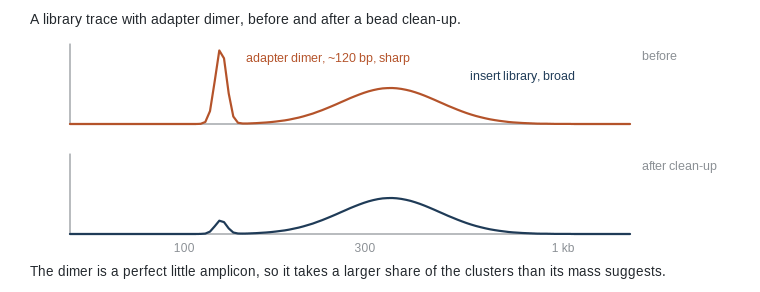
- Two adapters ligated together make a complete, short template that primes with the same primers as the library
- Prevention: match adapter to input, use an A/T overhang, or modify the adapters chemically so only adapter-plus-insert is a substrate (end chemistry). Removal: beads, or a gel when the dimer is too close to the product
Shore et al. 2016, doi:10.1371/journal.pone.0167009
Trick: pre-amplify, then split
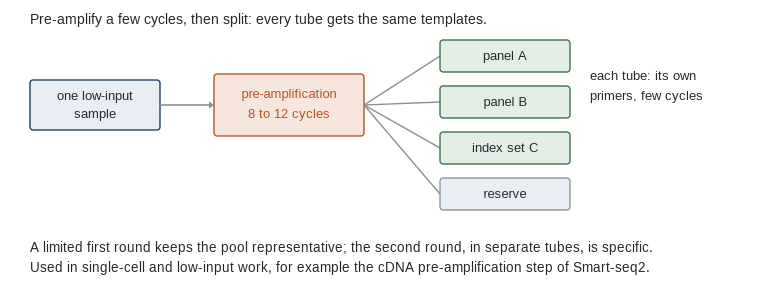
- A small sample can feed several assays if it is first copied in a limited number of cycles, then divided
- Every tube then carries the same representation of templates, and each does a specific second round
- Used in low-input RNA protocols such as Smart-seq2
Trick: polymerases and uracil
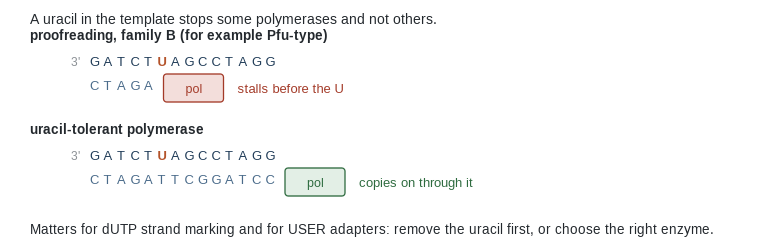
- Some proofreading polymerases stall when the template contains uracil. Others read through it
- Strand-specific RNA-seq marks the second strand with dUTP, and USER adapters carry a uracil that is removed before PCR (nucleases). In each case, the enzyme must match the plan (NEBNext USER protocol)
- Check the datasheet for uracil tolerance before choosing the polymerase
Linear amplification: in vitro transcription
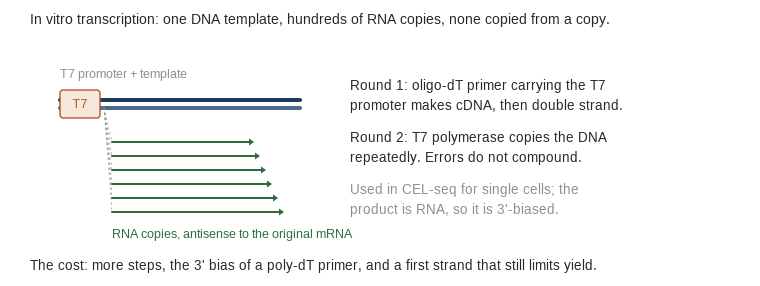
- A T7 promoter is built onto the cDNA, and T7 RNA polymerase transcribes it many times. Every RNA is copied from the original DNA, so errors and biases do not compound
- The price is extra steps and 3’ bias. CEL-seq uses it for single cells
Van Gelder et al. 1990, doi:10.1073/pnas.87.5.1663; Eberwine et al. 1992, doi:10.1073/pnas.89.7.3010; Hashimshony et al. 2012, doi:10.1016/j.celrep.2012.08.003
Linear amplification: single-primer extension
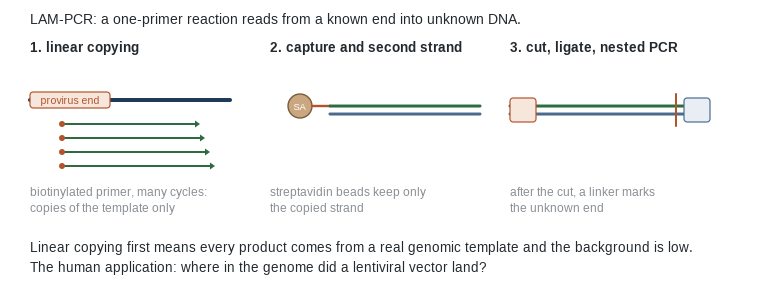
- One primer, many cycles: each cycle makes a new copy from the same template, so nothing is copied from a copy
- LAM-PCR maps where a lentiviral vector or provirus integrated in human cells: the primer sits in the known long terminal repeat and reads into the flank
- Related method: LAM-HTGTS
Schmidt et al. 2007, doi:10.1038/nmeth1103
Isothermal: rolling circle and displacement
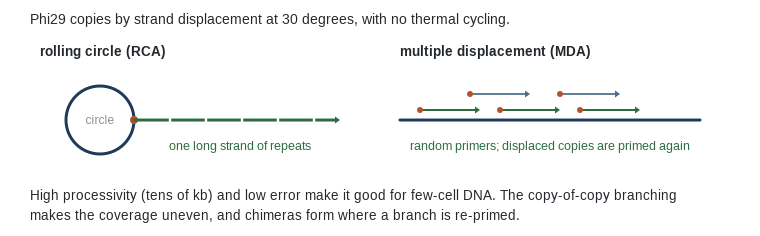
- Phi29 polymerase displaces the strand ahead of it and is highly processive. On a circle it rolls forever; on a genome with random primers it branches
- Whole-genome amplification by MDA works from a few human cells; its weakness is uneven coverage and chimeras
Fire and Xu 1995, doi:10.1073/pnas.92.10.4641; Dean et al. 2002, doi:10.1073/pnas.082089499
Single cells: MDA, MALBAC, PTA
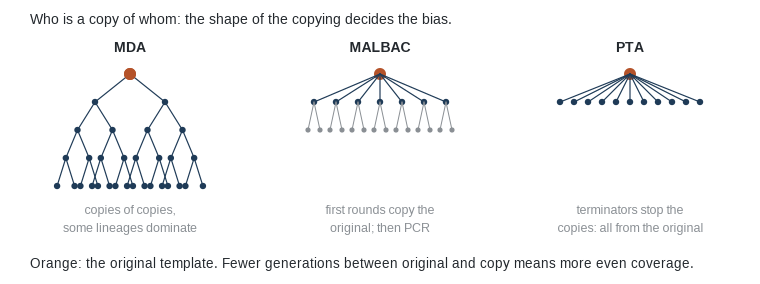
- The question is how many generations stand between the original molecule and each copy. Branching MDA has many; MALBAC copies the original first and then runs a PCR on the products; PTA terminates the copies so that they stay primary
- Cleaner, more even copies give better variant calls from a single human cell. Protocols: MALBAC, PTA
Zong et al. 2012, doi:10.1126/science.1229164; Gonzalez-Pena et al. 2021, doi:10.1073/pnas.2024176118
LAMP
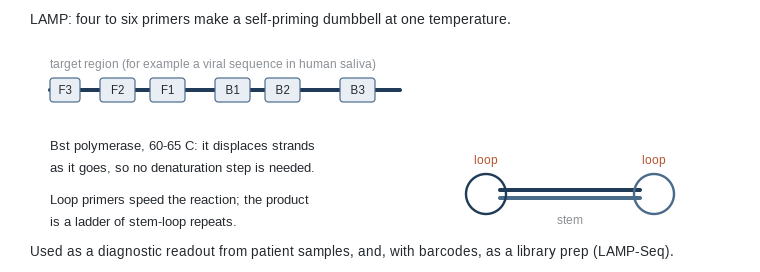
- Four to six primers and a strand-displacing polymerase make stem-loop products that prime themselves. No thermal cycling: a heating block or a water bath will do
- Its home is detection, for instance of a virus in a human sample; LAMP-Seq adds barcodes so many samples are read in one run
Notomi et al. 2000, doi:10.1093/nar/28.12.e63; Ludwig et al. 2021, doi:10.1038/s41587-021-00966-9
Nicking-enzyme SDA
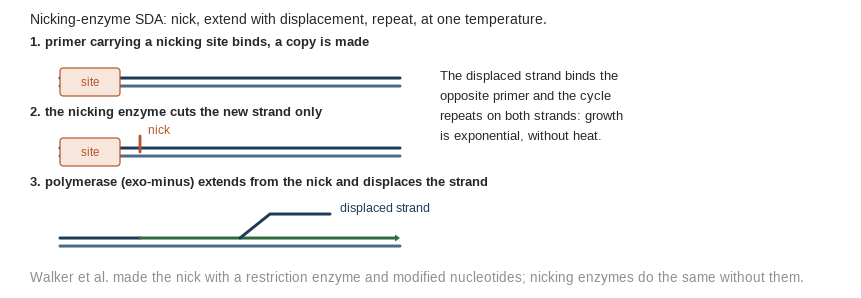
- A nicking enzyme cuts one strand at its site; a strand-displacing polymerase extends from the nick; the displaced strand is the next template
- Strand displacement amplification was first made with a restriction enzyme and modified nucleotides, and has been adapted to nicking enzymes
Walker et al. 1992, doi:10.1093/nar/20.7.1691
Inverse PCR
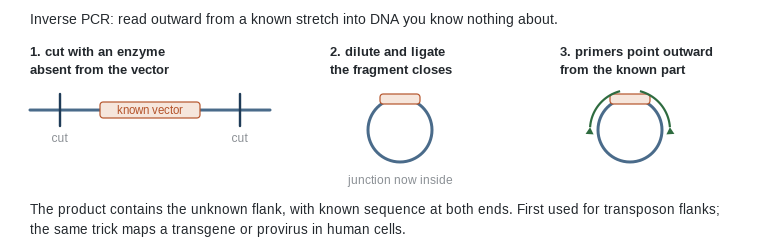
- Ordinary PCR needs sequence on both sides. Cut, circularise, and the known part is flanked by the unknown on both sides: outward-facing primers now work
- Applied here to mapping where a vector or provirus sits in a human genome. Protocol: inverse PCR
Ochman et al. 1988, doi:10.1093/genetics/120.3.621
Nested and anchored PCR
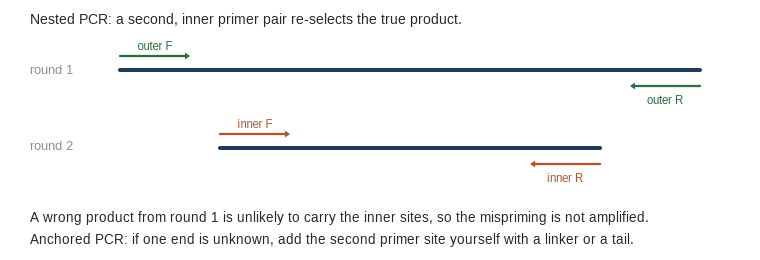
- A second pair of primers inside the first selects the right product from a messy first round. Mispriming products rarely carry both inner sites
- Anchored PCR adds the missing primer site: a linker (an adapter, in the older vocabulary of these methods), a poly-G tail or a template-switch oligo gives you something to prime from at the unknown end
- A related design is nested patch PCR
Trick: splinkerettes against one-sided background
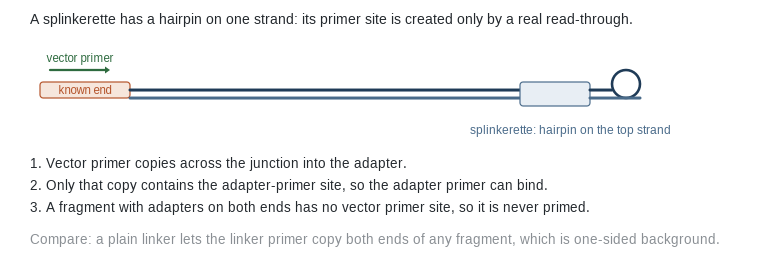
- A linker-ligation PCR, where an adapter goes on every fragment and the primers sit in it, amplifies every fragment that has a linker at each end, with or without your target. The splinkerette has a hairpin, so its primer site only exists after the vector-specific primer has copied into it
- The method is described for mapping transposon insertions; used here for mapping integrations in human cells. Protocol: splinkerette PCR
Potter and Luo 2010, doi:10.1371/journal.pone.0010168
Multiplex and tiled amplicons
- Multiplex: many primer pairs in one tube. Pairs interfere, so each amplicon’s yield must be balanced
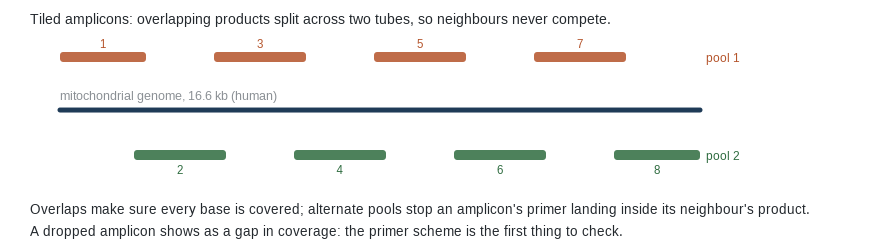
- Tiled: overlapping amplicons that together cover a long target, split into two pools so neighbours are never in the same tube. Shown on the 16.6 kb human mitochondrial genome; the scheme comes from viral genomics
- The ARTIC protocol is the standard example
Quick et al. 2017, doi:10.1038/nprot.2017.066
Emulsion PCR
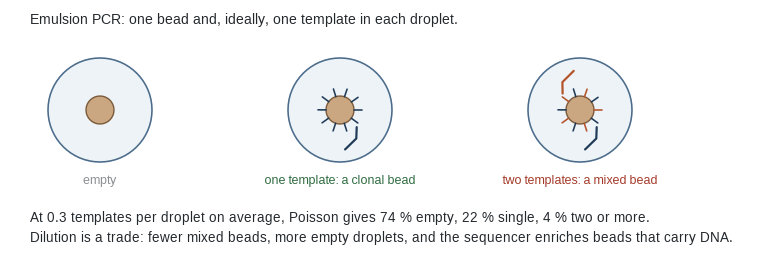
- Water-in-oil droplets turn one tube into millions of isolated reactors (compartments). With one bead and one template per droplet, each bead is covered in copies of a single molecule
- The same idea gave clonal beads for early sequencers, and, as BEAMing, a way to count rare mutations in human colorectal tumours
Dressman et al. 2003, doi:10.1073/pnas.1133470100
Trick: rolling-circle consensus
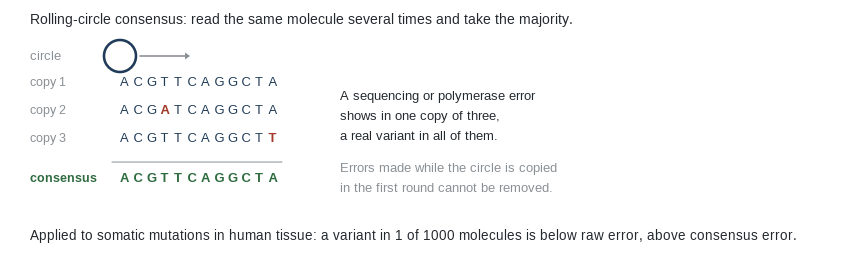
- Circularise the fragment, copy it by rolling circle, and read the same molecule several times in a row. Errors in one copy are outvoted by the others (consensus tricks)
- Errors made while the circle is first copied stay in every repeat; later errors are removed. Protocol: DNA circle sequencing
Lou et al. 2013, doi:10.1073/pnas.1319590110