Attaching a handle: the five ways
Building blocks · NGS library preparation
The problem every library has
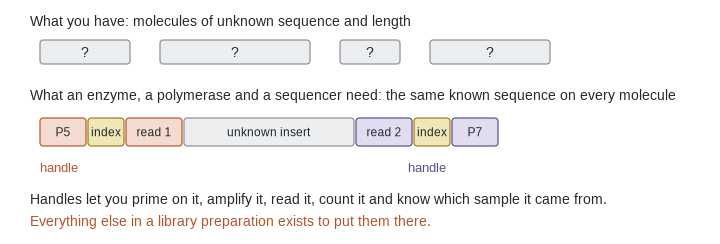
- Your molecules have unknown sequence, so no primer can be designed for them
- A handle is a known sequence put on every molecule: a place to prime, a barcode, a flow-cell anchor
- There are only a few ways to put one on. Learn those and any protocol becomes a combination of them
Five ways to attach a handle
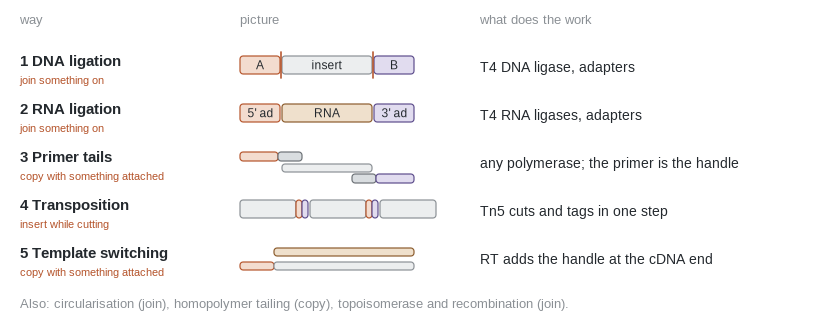
- All five use the same three ideas: join something on, copy with something attached, or insert while cutting. Every family slide below says which
- Circularisation joins a molecule to its own other end and homopolymer tailing makes an end worth copying from, so neither is a sixth way; topoisomerase and recombination also join without a ligase, and are cloning tools more than library chemistry
- Each way differs in which end it uses, what it needs the end to look like (end chemistry gives every end state named here), and what it does to the rest of the molecule
- The last slide of this deck is a table from starting material to family
DNA ligation: four flavours
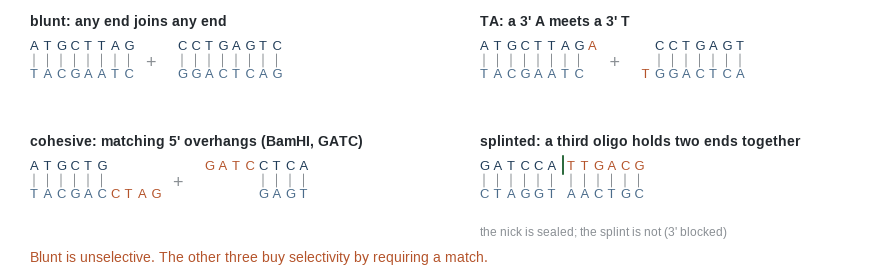
- Join something on. T4 DNA ligase joins a 5’-phosphate to a 3’-OH when both sit side by side in a duplex (ligases, kinases, phosphatases)
- The end shape sets how selective it is. A splint turns ligation of any two ends into ligation of two chosen ends
- Protocol: TruSeq DNA PCR-Free ligates adapters this way
Ligase requirements: Lehman 1974, doi:10.1126/science.186.4166.790
Blunt against TA: what the overhang is for
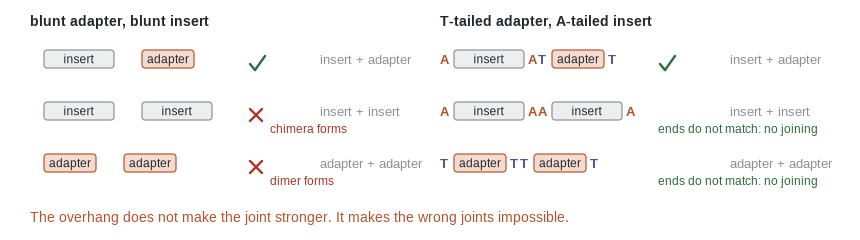
- Blunt ends join to anything: inserts to each other, adapters to each other
- One extra A on the insert and one T on the adapter allows only insert-adapter pairs
- The A comes from a polymerase that adds a base without a template
Non-templated A addition: Clark 1988, doi:10.1093/nar/16.20.9677
Asymmetric adapters
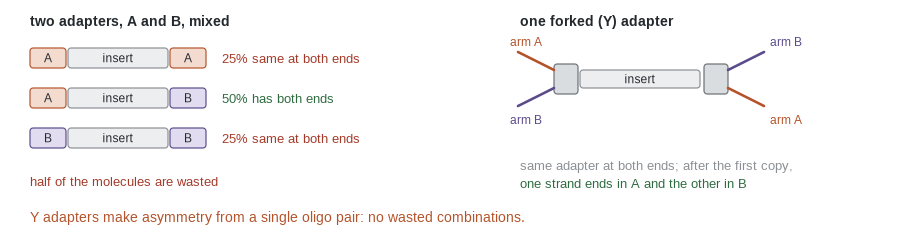
- Two different adapters mixed leave half the molecules with the same handle at both ends
- A forked (Y) adapter puts both arms on every end; the strands become different after the first copy
- This is how nearly all Illumina libraries get a P5 end and a P7 end
Index design and adapters: Kircher et al. 2012, doi:10.1093/nar/gkr771
Splinted ligation
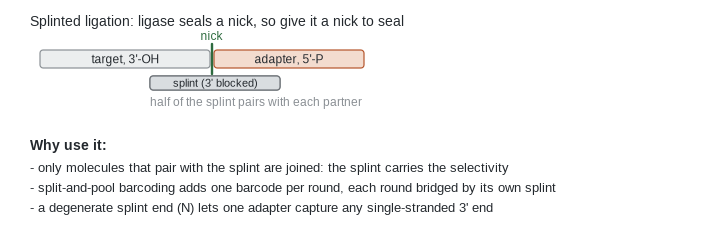
- The splint is a third oligo that pairs across the junction, so ligase sees a nick
- Block its 3’ end, so the splint is neither extended nor ligated
- Used where one specific pair must join: split-and-pool barcoding adds one barcode per round this way (combinatorial indexing)
RNA ligation: the 3’ adapter first
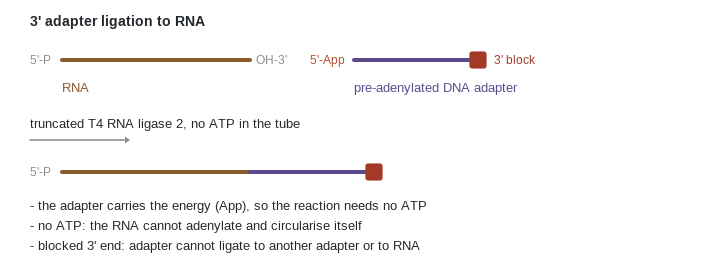
- Join something on. RNA ligase 2 truncated, the K227Q mutant (T4 RNA ligase 2), joins a pre-adenylated adapter to a 3’-OH without ATP
- The adapter is blocked at its 3’ end and has an adenylated 5’ end, so it cannot join to itself
- Protocol: NEBNext Low-bias Small RNA
Small-RNA cloning: Hafner et al. 2008, doi:10.1016/j.ymeth.2007.09.009
The 5’ adapter goes on second
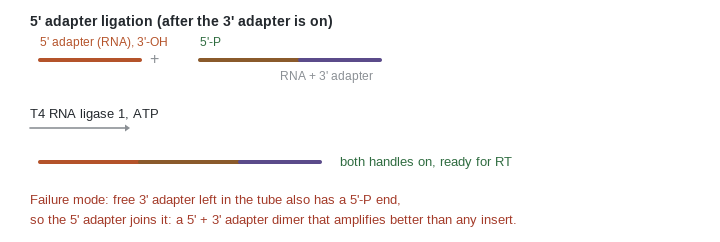
- T4 RNA ligase 1 needs ATP and a 5’-phosphate on the donor RNA; the 5’ adapter provides the 3’-OH
- The order matters: the 3’ adapter is already on, so the RNA 3’ end is no longer free to react
- The adapter dimer is this method’s characteristic failure and is removed by size selection
eCLIP uses a variation of these steps: Van Nostrand et al. 2016, doi:10.1038/nmeth.3810
Circularisation
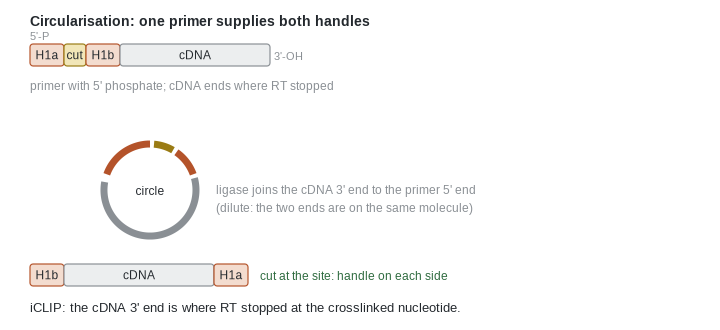
- Join something on, to the molecule’s own other end: a ligase joins both ends of one molecule when the concentration is low enough
- The cDNA 3’ end meets the primer’s 5’ end, so one primer supplies handles at both ends
- iCLIP uses this (the CLIP family); the cDNA 3’ end marks where RT stopped at the crosslink
iCLIP: König et al. 2010, doi:10.1038/nsmb.1838; protocol: Huppertz et al. 2014, doi:10.1016/j.ymeth.2013.10.011
Primer tails
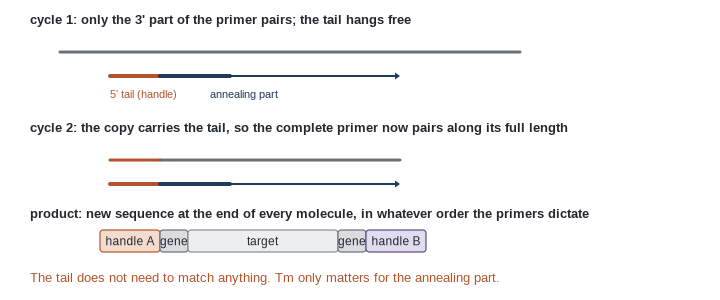
- Copy with something attached. Any sequence on a primer’s 5’ end is copied into the product from the second cycle on (amplification)
- The tail adds no specificity: only the 3’ part decides where the primer anneals
- This is how amplicon, RACE (rapid amplification of cDNA ends) and many single-cell methods add their handles
The RT primer as the handle
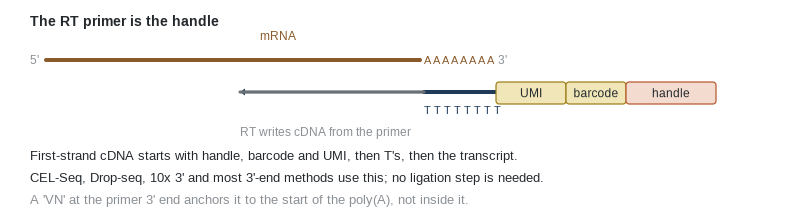
- Copy with something attached. Handle, barcode and UMI all ride on one oligo-dT primer
- The handle is on the 5’ end of the cDNA first strand, in the same tube as RT
- SMART-seq2 uses the plainest version of this primer, a handle and a T-run and nothing else, and is picked up again at template switching below
- CEL-Seq and Drop-seq add the barcode and the UMI to the same oligo
CEL-Seq: Hashimshony et al. 2012, doi:10.1016/j.celrep.2012.08.003; Drop-seq: Macosko et al. 2015, doi:10.1016/j.cell.2015.05.002
Tailed random primers
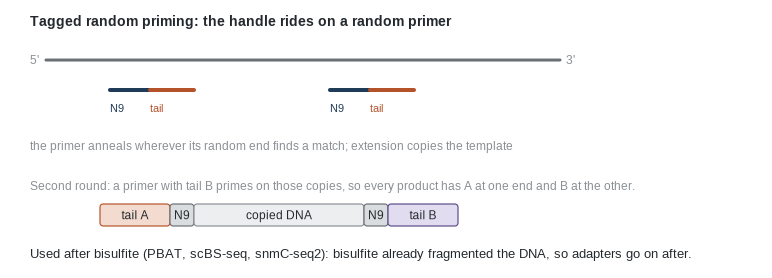
- Copy with something attached. When the DNA is already fragmented, random primers carrying a tail attach the handle anywhere
- Bisulfite conversion breaks DNA, so ligating adapters beforehand wastes the input
- Protocol: PBAT
Miura et al. 2012, doi:10.1093/nar/gks454; Smallwood et al. 2014, doi:10.1038/nmeth.3035
Transposition: cut and tag in one step
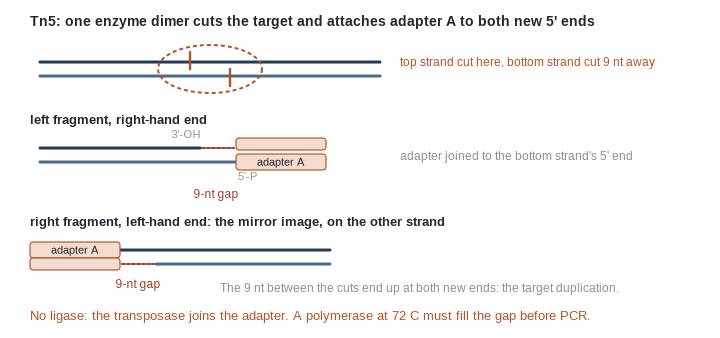
- Insert while cutting. Tn5 loaded with adapter oligos cuts the target and joins the adapter’s 3’ end to each new 5’ end (transposases)
- No fragmentation, end repair or ligation is needed beforehand
- The 9 nt between the two cuts leave a gap that is filled in later
- Protocol: ATAC-seq
Reznikoff 2008, doi:10.1146/annurev.genet.42.110807.091656; Adey et al. 2010, doi:10.1186/gb-2010-11-12-r119; Buenrostro et al. 2013, doi:10.1038/nmeth.2688
What tagmentation produces
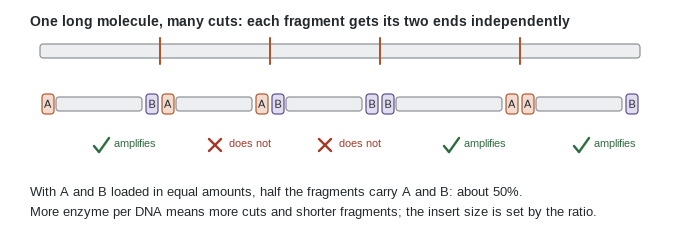
- Each fragment’s two ends are tagged independently, so some molecules carry A at both ends
- Only A-B fragments amplify well: this wastes about half of the product
- Enzyme-to-DNA ratio sets the insert size, which is why input must be measured accurately
- Home-made Tn5 can be loaded and tested cheaply
Picelli et al. 2014, doi:10.1101/gr.177881.114
Template switching
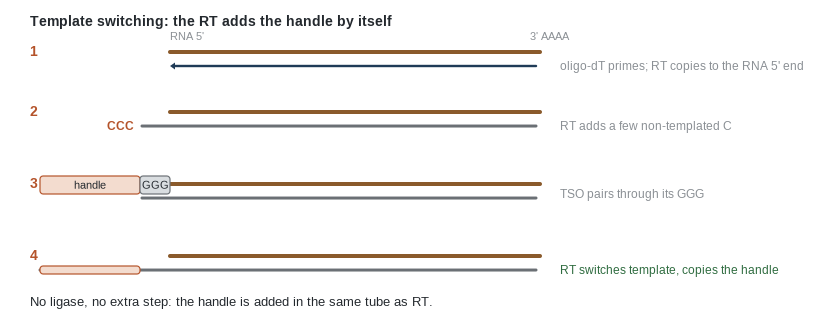
- Copy with something attached. Reverse transcriptase reaches the 5’ end of the RNA, adds a few C’s, and uses a GGG oligo as a new template (polymerases and RTs)
- The handle lands on the first-strand cDNA, which now has the same end at both ends
- This is SMART-seq2’s second handle, added in the same tube as its RT primer. Its oligo-dT and its TSO carry the same sequence, so one primer amplifies every full-length cDNA
- SMART-seq3 keeps the step and changes the oligo
Zhu et al. 2001, doi:10.2144/01304pf02; Picelli et al. 2013, doi:10.1038/nmeth.2639
Homopolymer tailing
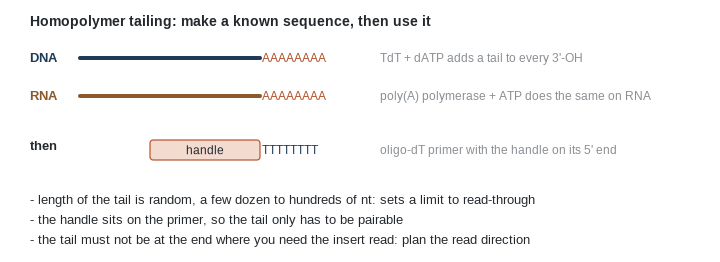
- Copy with something attached, once there is something to copy from: terminal transferase adds nucleotides to any 3’-OH on DNA, and poly(A) polymerase does the same for RNA
- The tail gives a pairing sequence, so a primer with a handle can start from it
- Handy for input with no usable ends, but tail length varies and the tail takes read length
Trick: truncated adapters and index PCR
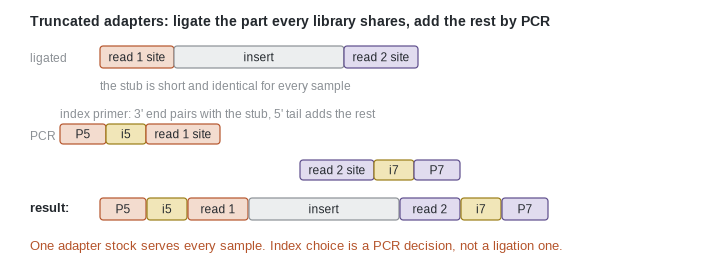
- Ligate or tag only the stub, the truncated adapter every sample shares; add P5, P7 and the index by PCR
- One adapter stock for the whole lab; the index is chosen at the PCR step
- Double indexing guards against reads that carry the wrong sample’s index
Meyer and Kircher 2010, doi:10.1101/pdb.prot5448; Kircher et al. 2012, doi:10.1093/nar/gkr771
Trick: two-step PCR
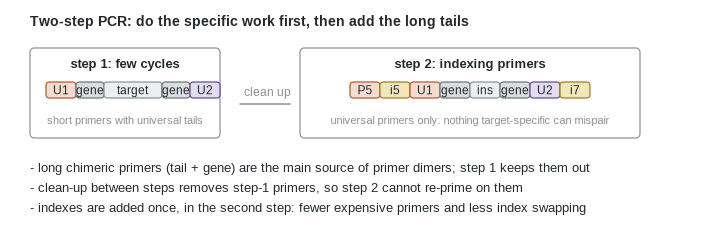
- Step 1 is specific and has few cycles; step 2 uses only universal primers
- Long chimeric primers mispair and make dimers; keeping them to step 1 limits what they can do
- General practice in amplicon sequencing; the cycle numbers are protocol-specific
Trick: nested handles
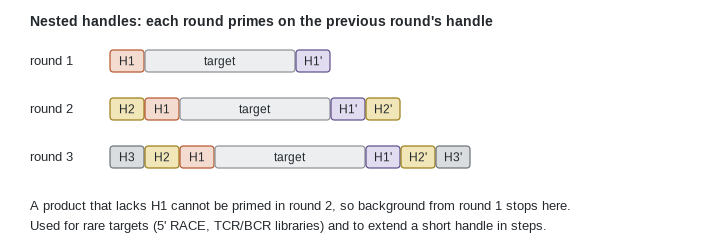
- Each round primes on the previous handle and adds a new one outside it
- Background from the earlier round lacks the inner handle and stops
- Also a way to add a long handle that a single oligo would synthesise badly
Trick: bead-bound handles
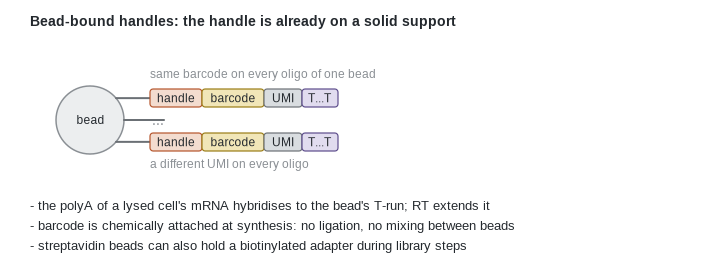
- The handle is chemically attached to a bead, so the barcode is fixed per bead
- Cells are lysed in contact with the bead, which captures mRNA by its poly(A)
- Beads link one barcode to one cell’s RNA without a ligation step
Choosing a way
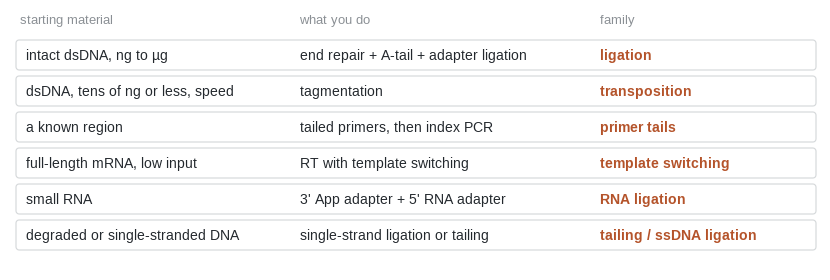
- Start from the material you have, not from the kit you own
- The families combine: tagmentation then index PCR, template switching then tagmentation of the cDNA, ligation then index PCR