Barcodes, UMIs and where information lives
Building blocks · NGS library preparation
Four questions, four addresses
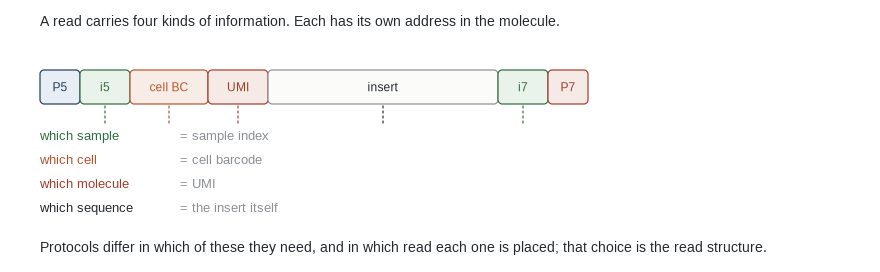
- Sample, cell and molecule are added by you; only the insert comes from the biology
- Every label costs cycles, oligo cost and a way to get it wrong
Demultiplexing is a distance calculation
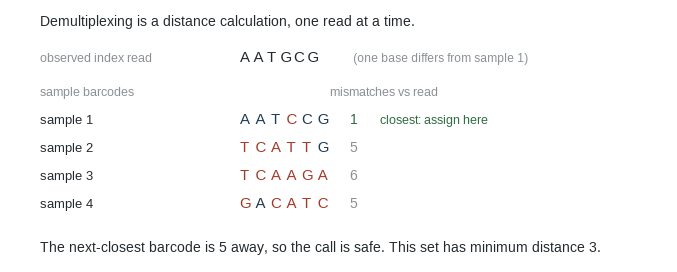
- Compare the observed index to every barcode; assign to the nearest if it is near enough and clearly nearer than the second
- A read that matches nothing lands in Undetermined: the place to look first when a run seems empty
Minimum distance decides what an error does
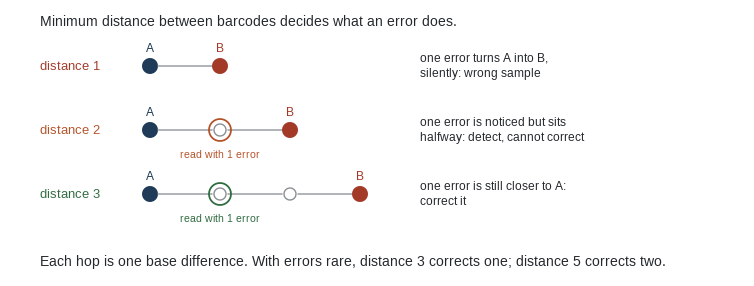
- Hamming distance: the number of positions at which two barcodes differ
- A set with minimum distance d detects d − 1 errors and corrects ⌊(d − 1)/2⌋
Hamady et al. 2008, doi:10.1038/nmeth.1184
Insertions and deletions break the Hamming picture
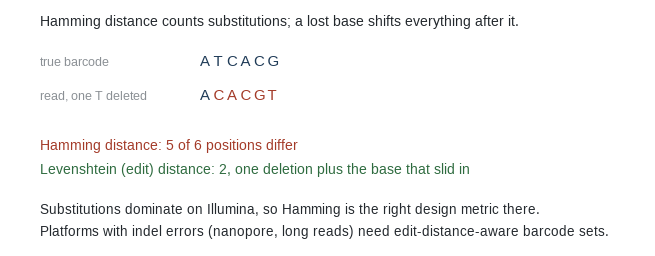
- One lost base shifts every later position, so a barcode that is one edit away looks five away
- Illumina’s errors are mostly substitutions, so Hamming is the right metric there; for platforms with indel errors, design with edit distance
Buschmann and Bystrykh 2013, doi:10.1186/1471-2105-14-272
Colour balance: a set that is far apart can still fail
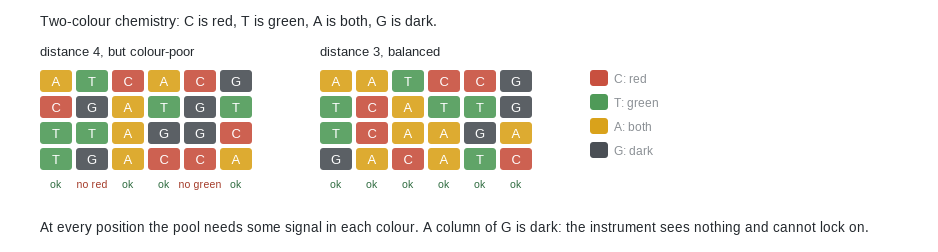
- On two-colour instruments, each cycle needs some signal in both colours across the pool; a column of G is dark
- The left set has distance 4 and still fails at two positions; the right has distance 3 and passes
- This is a rule of thumb: check your instrument’s index guide
Unique dual indexes
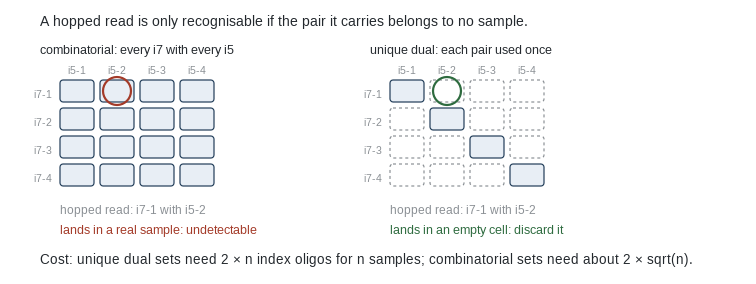
- Both indexes are read, and each pair is used for one sample
- A hopped read carries a pair that no sample owns: it is discarded rather than reassigned
Kircher et al. 2012, doi:10.1093/nar/gkr771, Costello et al. 2018, doi:10.1186/s12864-018-4703-0
Cell barcodes: bead-bound
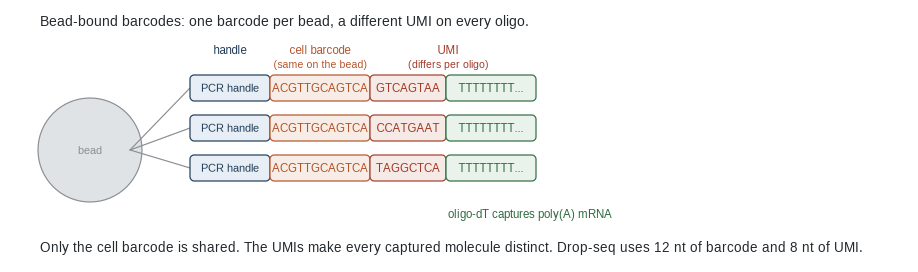
- Beads are made by split-pool synthesis, so each bead carries millions of copies of one barcode
- A cell in a droplet with a bead has all its mRNA tagged with that barcode
Macosko et al. 2015, doi:10.1016/j.cell.2015.05.002, Drop-seq on NGS 101
Cell barcodes: split-pool
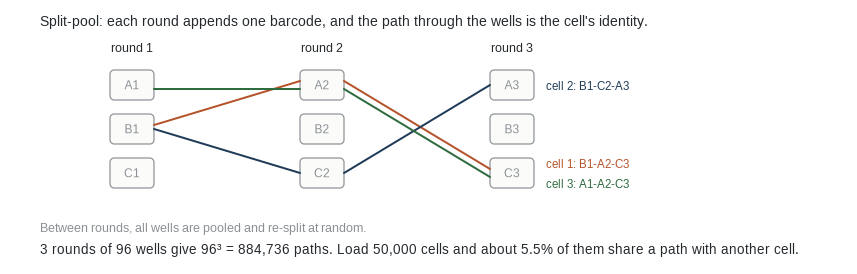
- No droplets and no beads: cells are barcoded in wells, pooled, re-split, and barcoded again
- The cell is identified by the path it took (combinatorial indexing); the oligos needed are few
Rosenberg et al. 2018, doi:10.1126/science.aam8999, Cao et al. 2017, doi:10.1126/science.aam8940
Cell barcodes: plate-based
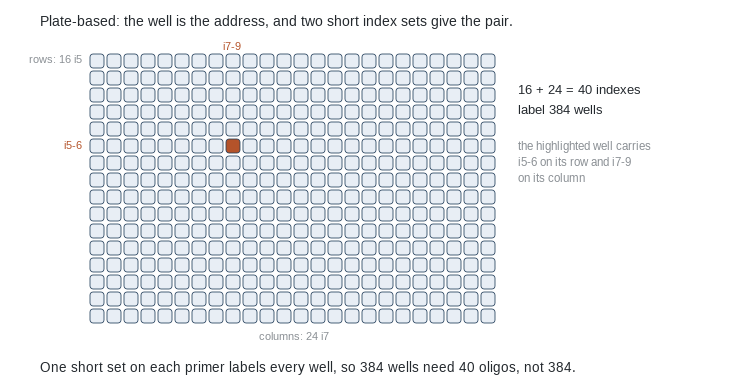
- Each well gets its own barcode through the primer, so the well is the cell
- Two index sets, one along rows and one along columns, label the whole plate
Hashimshony et al. 2016, doi:10.1186/s13059-016-0938-8, CEL-Seq2 on NGS 101
Trick: combinatorial barcodes from a small oligo set
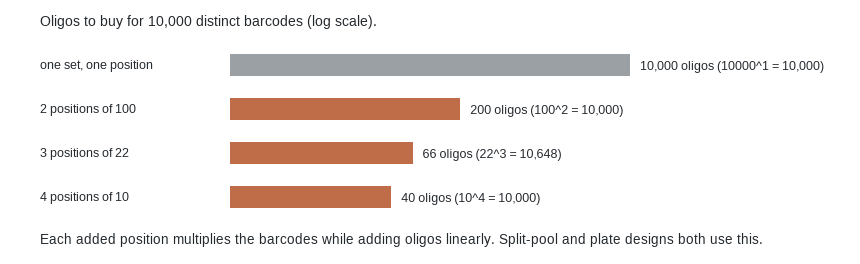
- Barcodes that are the product of several short sets need oligos that are only the sum
- Split-pool, plate indexing and dual indexing all use this; the limit is how many wells or rounds you can handle
UMIs count molecules, not reads
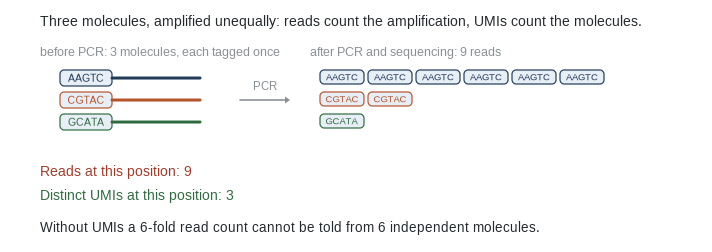
- A UMI is a short random sequence added to each molecule once, before amplification
- Reads that share position and UMI are copies of one molecule; reads with different UMIs are not
Kivioja et al. 2012, doi:10.1038/nmeth.1778, Islam et al. 2014, doi:10.1038/nmeth.2772
Where a UMI can be added
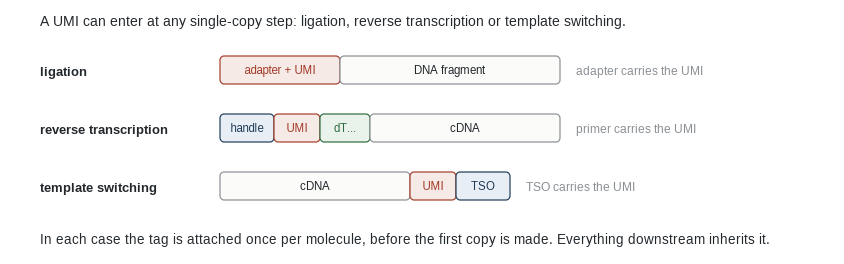
- Ligation: on the adapter, for DNA libraries — each route is one of the five handles
- Reverse transcription: on the primer, in CEL-Seq2 and droplet methods
- Template switching: on the TSO, which tags the 5’ end of the cDNA in Smart-seq3
Hagemann-Jensen et al. 2020, doi:10.1038/s41587-020-0497-0, Smart-seq3 on NGS 101
Why never in the PCR
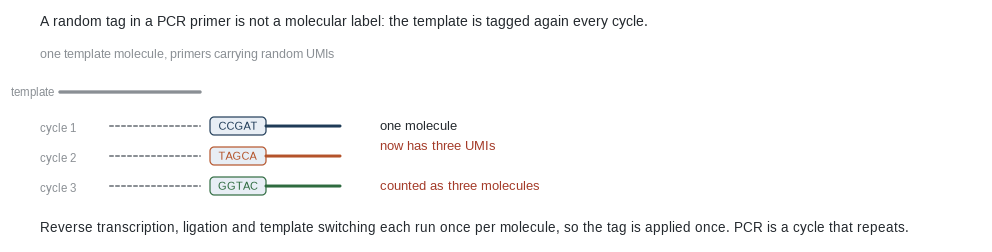
- A PCR primer meets the template again in every cycle, so one molecule collects many UMIs
- A tag that appears at a single-copy step is a label; one added by a repeated step is not
Kebschull and Zador 2015, doi:10.1093/nar/gkv717
Collapsing: UMIs are read with errors too
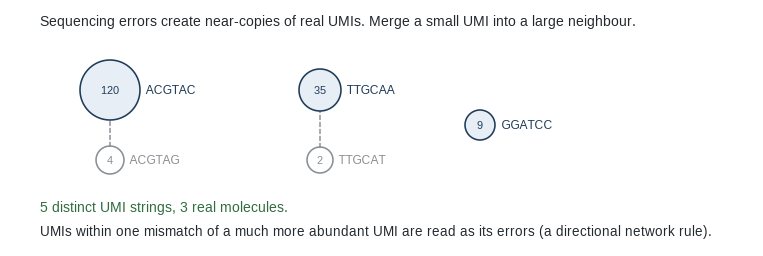
- An error in a UMI makes a new UMI. A UMI one base from a far more abundant one is treated as its error
- Without this, counts are inflated, most strongly for genes with many reads
Smith et al. 2017, doi:10.1101/gr.209601.116
How long should a UMI be?
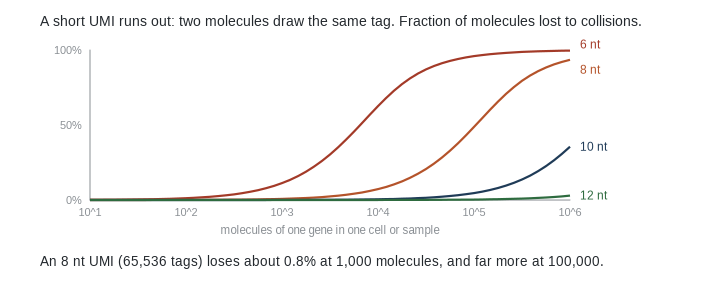
- With N possible UMIs and m molecules, the number of different tags seen is about N(1 − e^(−m/N))
- Choose the length for the most abundant molecule you expect, not the average
Trick: UMI plus duplex tags
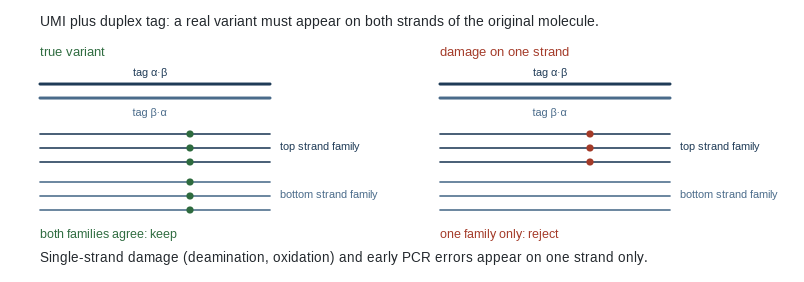
- Tag each strand of the original duplex so that reads from its two strands can be told apart
- A real variant appears in both strand families; damage on one strand does not (rare variants)
Schmitt et al. 2012, doi:10.1073/pnas.1208715109, Duplex Sequencing on NGS 101
Read-structure budgeting
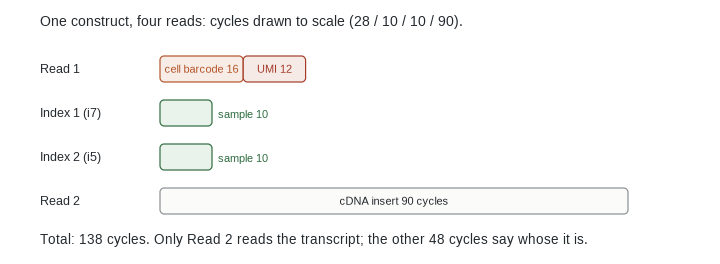
- Every cycle costs time and money; 138 cycles here carry 48 cycles of labels and 90 of transcript
- The construct sets the read structure, and the run must be set up to match it
Where do the labels go?
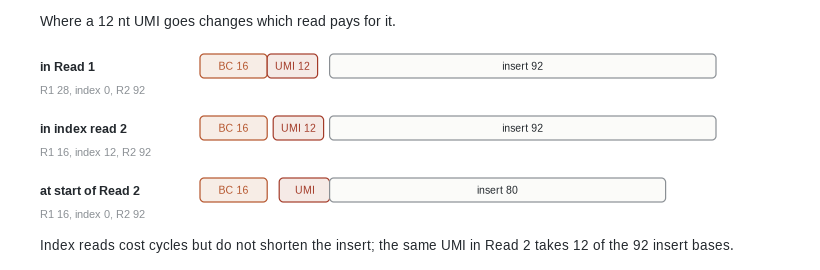
- Putting the UMI in an index read leaves the insert reads full length, at the price of extra index cycles
- Putting it in Read 2 shortens the transcript read
- Check what your kit and sequencing facility allow before committing a design
Trick: staggered primers for base diversity
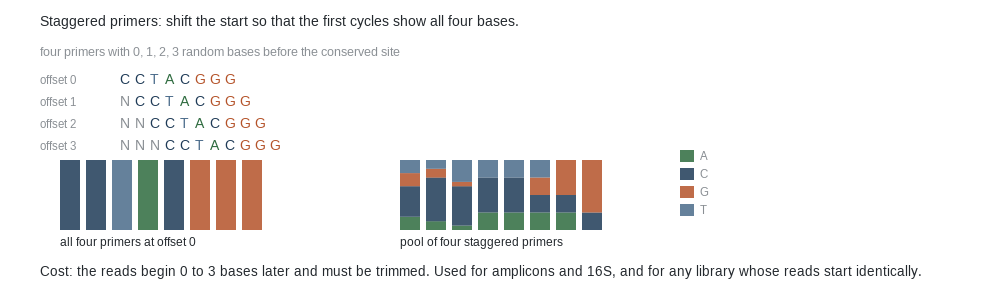
- Primers with 0 to 3 extra bases shift the amplicon start, so the first cycles contain a mix of bases
- The extra bases cost cycles at the start of each read and must be trimmed (screen readouts need this)
Fadrosh et al. 2014, doi:10.1186/2049-2618-2-6
Trick: hashing with antibodies or lipids
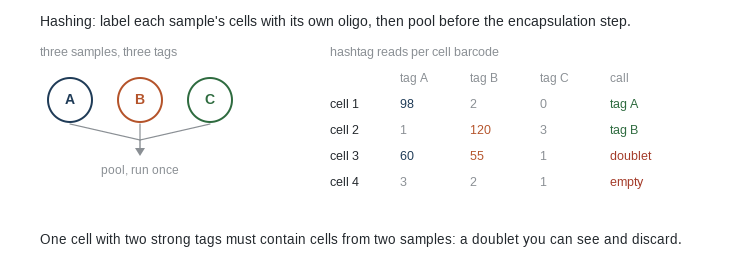
- Each sample’s cells are labelled with an oligo attached to an antibody or a lipid; the tags are read out with the cells
- It lets you pool samples before the costly step and find doublets
- Nuclei can be hashed the same way
Stoeckius et al. 2018, doi:10.1186/s13059-018-1603-1, McGinnis et al. 2019, doi:10.1038/s41592-019-0433-8, Srivatsan et al. 2020, doi:10.1126/science.aax6234