Organic contaminants and environmental fate exercises
Use the values given; do not look up other constants. Predict the direction of change before calculating.
1. Organic-carbon fraction
Take foc = 0.0200 and Koc = 5000 L/kg organic C for a suitable neutral compound. Find Kd. What mistake results from entering 2.00 instead of 0.0200?
Convert percent to a mass fraction first.
Kd = 100 L/kg dry solid. Using 2.00 would give 10000 L/kg, a hundredfold overestimate. The model also needs evidence that organic carbon dominates sorption.
2. Ionisation
A fictitious organic acid has pKa 4.50. Find the neutral fraction at prescribed pH 4.50 and 6.50. Can a neutral-form Koc automatically describe total sorption in both waters?
Use 1/(1 + 10^(pH − pKa)).
Neutral fractions are 0.500 and 0.009901. A neutral-form coefficient alone cannot describe the total charged-plus-neutral pool without an appropriate ionisation/sorption model.
3. Another half-life
For compound U in the worked example, find total and aqueous parent after 30.0 days. State what the model says about products.
Three half-lives leave one eighth of the starting parent.
Total parent = 0.125 mg; water contains 0.0625 mg, so Cw = 0.0625 mg/L. The model records parent transformation but does not specify product identity, product toxicity, or elemental mineralisation.
4. A decline is not a mechanism
Water parent concentration falls after sediment is added. What would distinguish sorption from transformation, and why does log Kow alone not answer the question?
Measure both phases and plausible products on a consistent time basis.
Track total parent across water, solids, and any gas phase, plus products and analytical recoveries. Sorption conserves parent across phases; transformation changes identity. Log Kow describes partition preference, not a measured degradation mechanism or rate.
Activity C: a fate model in R
Download compounds.csv, fate.R, and fate-report.Rmd into one folder. Read the input dictionary. Reuse readr, dplyr, ggplot2, and the R Markdown workflow. The new mathematical operation is exp(), the inverse of the natural logarithm.
The script creates a regular daily table for the two cases and evaluates:
remaining_fraction = exp(-k_per_day * time_days)
total_parent_mg = initial_parent_mg * remaining_fraction
water_mg_l = total_parent_mg / (water_volume_l + kd_l_kg * dry_solid_kg)
These lines are expressions used inside mutate() in the supplied script. The starting mass is already distributed between phases at time zero. The coefficient k applies equally to parent in water and solids; this assumption is what lets total parent follow one exponential.
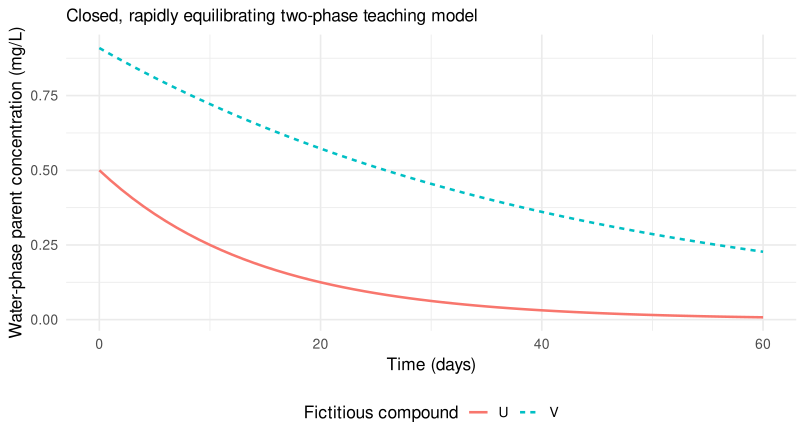
- Predict which compound has more parent in water initially. Calculate U’s day-20 state by hand before running the code.
- Run
source("fate.R"), inspectfate, and printfate_plot. - Check time zero, one half-life, and the sum of the two phase inventories.
- Explain why a smaller water concentration does not automatically mean a shorter half-life, less total parent, or lower biological risk.
- Complete the report, restart R, and Knit it from saved inputs. Use its final section to make the separate catchment and sediment arguments in the integrated case.
At day zero, U has 0.500 mg/L water parent and V has 0.9091 mg/L, because their Kd values differ. At day 20, U has 0.250 mg total parent, split equally between phases, giving 0.125 mg/L water concentration. At day 30, U has 0.125 mg total and 0.0625 mg/L water concentration; V has 0.500 mg total and 0.4545 mg/L water concentration.
The two parent phase inventories sum to the declining total. Total parent plus the transformed-parent accounting term equals the initial mass. The latter term records loss of parent identity, not a measured product mass or proof of mineralisation. These are model predictions under supplied constants, not a fit, a statistical comparison, or field evidence.
Explore: sorption and parent transformation
Predict which control changes the phase split and which changes total-parent half-life. Place the boundary around both water and solid before interpreting a falling water concentration.
Reference U at day 20: 0.250 mg total parent remains, with 0.125 mg in water and 0.125 mg on solid.
E1. Choose U at day 20. Sum parent in water, parent on solid, and the transformed-parent accounting term. Where is the initial 1.00 mg accounted for?
E2. Change only Kd at the selected time. Explain why this model changes the phase split while leaving total parent and its half-life unchanged.
E3. Compare U at day 30 with V at day 30. Separate the effects of partitioning and transformation rate rather than explaining the water curves with a single property.
Model conditions and hand check
| Reference case | Total parent | Water parent concentration |
|---|---|---|
| U, day 20 | 0.250 mg | 0.125 mg/L |
| U, day 30 | 0.125 mg | 0.0625 mg/L |
| V, day 30 | 0.500 mg | 0.4545 mg/L |
The initial parent is 1.00 mg in 1.00 L water plus 0.0100 kg dry solid. U has Kd 100 L/kg and half-life 10 days; V has Kd 10 L/kg and half-life 30 days. Partitioning is rapid at fixed Kd. Parent transforms with the same first-order coefficient in both phases; there is no input, export, or volatilisation. The transformed-parent term records initial parent that changed identity, not measured product mass, proof of mineralisation, or a toxicity result. Slow exchange or transformation confined to one phase requires another kinetic model.