Crosslinking and fixation
Building blocks · NGS library preparation
An association is not a molecule
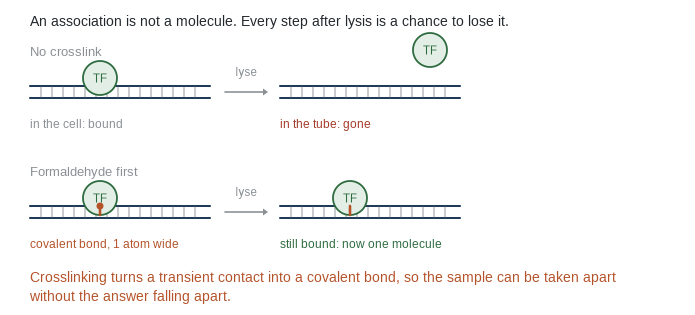
- A transcription factor on its site, a protein on an mRNA, two loci touching in the nucleus: all of these are held by affinity, and affinity does not survive a lysis buffer
- A crosslink converts the association into a covalent bond, so the cell can be taken apart without the answer coming apart with it
- Formaldehyde fixation of chromatin is the original form of the trick
Jackson 1978, doi:10.1016/0092-8674(78)90278-7; Solomon and Varshavsky 1985, doi:10.1073/pnas.82.19.6470
What the bond has to survive
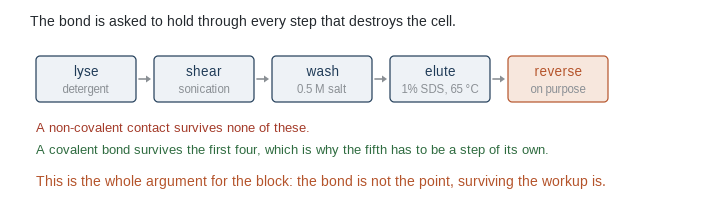
- The crosslink is not made for its own sake. It is made so that one association outlives detergent, sonication, high salt and a hot SDS elution
- That is also why removing it has to be a planned step, with its own chemistry, rather than something that happens on its own
- Every property in this deck follows from these two sentences
Formaldehyde: a methylol adduct, then a bridge
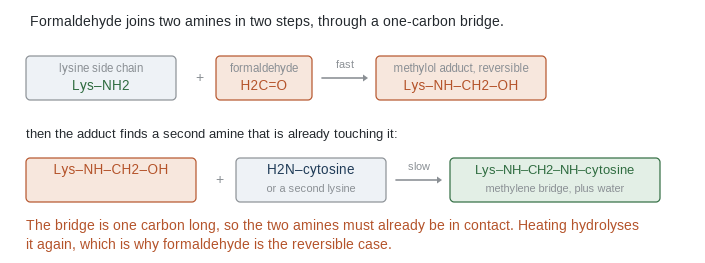
- Formaldehyde attacks a primary amine — a lysine side chain, or the exocyclic amino group of adenine, cytosine or guanine — and forms a methylol adduct, which is fast and reversible
- The adduct then condenses with a second amine nearby to give a methylene bridge, one carbon long, releasing water. That second step is slow, and it is the crosslink
- Both protein–protein and protein–nucleic-acid pairs are joined, because both have amines
McGhee and von Hippel 1975, doi:10.1021/bi00677a029; Hoffman et al. 2015, doi:10.1074/jbc.R115.651679
The arm length is the specification
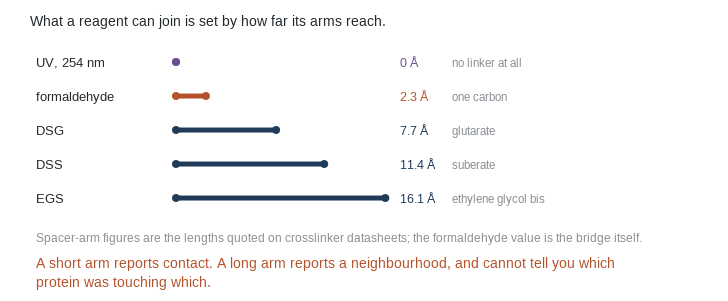
- A one-carbon bridge means the two amines were already touching. Formaldehyde therefore reports contact, not proximity
- The succinimidyl-ester crosslinkers reach 7–16 Å and report a neighbourhood: anything within the arm can be joined, and you cannot tell afterwards which pair it was
- The trade is between a bond that is informative and a bond that is likely to form at all
Dose, time and the quench
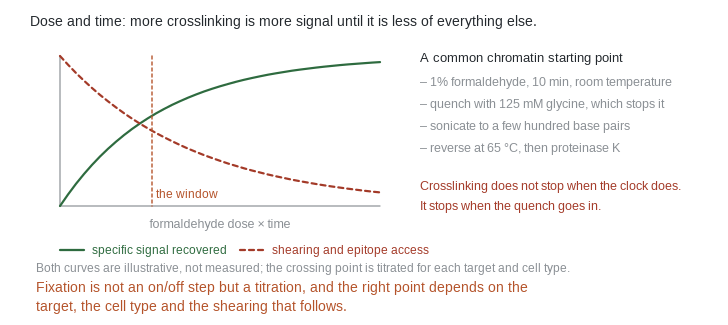
- 1% formaldehyde for 10 min at room temperature is a common chromatin starting point, stopped with 125 mM glycine, a small free amine that competes for the aldehyde
- The reaction runs until it is quenched, so the quench is part of the dose. Fixation is a titration, not a switch
- Longer fixation crosslinks more, and the same bonds then hide the epitope and stop the chromatin shearing or dissolving
Schmiedeberg et al. 2009, doi:10.1371/journal.pone.0004636; Baranello et al. 2016, doi:10.1007/s10577-015-9509-1
A second reagent, for protein to protein
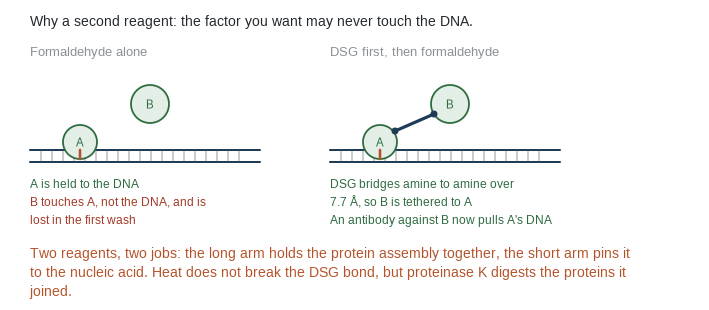
- A factor that binds chromatin only through a partner is never within one carbon of the DNA, so formaldehyde alone cannot hold it there
- DSG, disuccinimidyl glutarate, is an amine-reactive ester at both ends with a 7.7 Å arm. It joins protein to protein and nothing else, and goes in as a separate step, commonly before the formaldehyde
- Heat does not reverse it. It does not have to: the proteins it joined are digested at the end anyway
Zeng et al. 2006, doi:10.2144/000112297; Krietenstein et al. 2020, doi:10.1016/j.molcel.2020.03.003 (Micro-C)
Reading a crosslinker datasheet
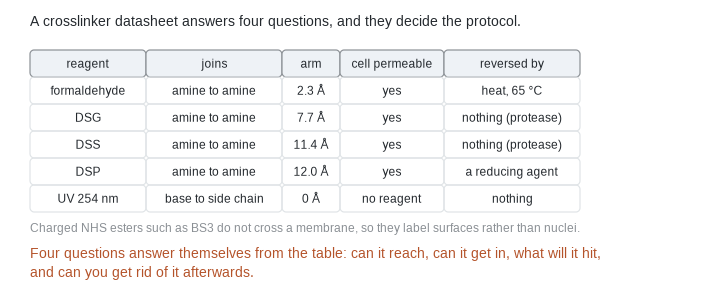
- Four properties decide whether a reagent can be used: what groups it reacts with, how far it reaches, whether it crosses a membrane, and what takes it apart again
- A charged ester such as BS3 stays outside the cell, so it labels surfaces; DSP carries a disulphide in the arm, so a reducing agent cleaves it
- The same four questions apply to any new crosslinker you meet
UV: zero-length, and it stays
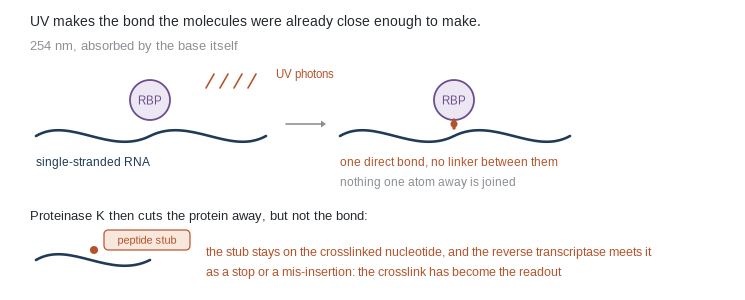
- At 254 nm the base itself absorbs, becomes reactive, and bonds directly to an amino acid side chain that is touching it. There is no linker, so the reach is zero
- In practice this works for RNA and protein: single-stranded RNA is accessible and the photochemistry is efficient enough to use
- Nothing undoes the bond. Proteinase K removes the protein and leaves a peptide stub on the crosslinked nucleotide
Greenberg 1979, doi:10.1093/nar/6.2.715; Wagenmakers et al. 1980, doi:10.1111/j.1432-1033.1980.tb07207.x; Ule et al. 2003, doi:10.1126/science.1090095
4-thiouridine moves the wavelength
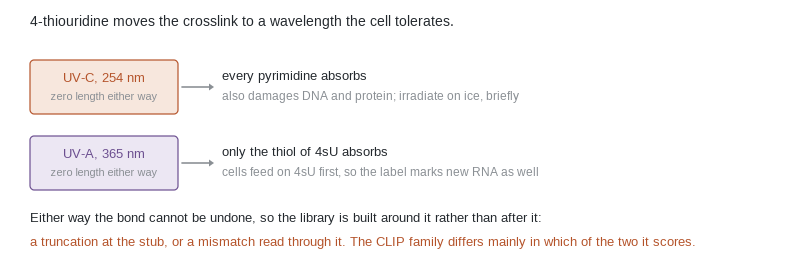
- UV-C damages everything that absorbs it, so the dose is kept low and the cells are kept cold
- Feed cells 4-thiouridine and the sulphur gives a group that absorbs in the UV-A, so 365 nm light activates it where the rest of the cell is nearly transparent. The crosslink is still zero-length
- The label also marks RNA made during the pulse, so one reagent carries both a crosslink and a time axis
Hafner et al. 2010, doi:10.1016/j.cell.2010.03.009 (PAR-CLIP); Lee and Ule 2018, doi:10.1016/j.molcel.2018.01.005
Fixing a cell rather than a complex
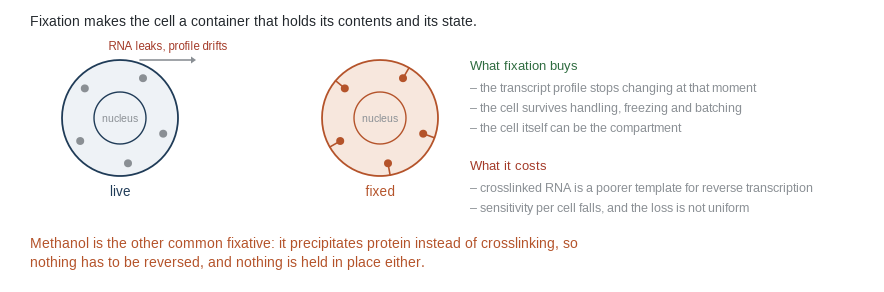
- The same chemistry applied to a whole cell holds the contents in place and stops the transcript profile changing while the sample waits
- A fixed cell tolerates handling, freezing and batching, and can serve as its own compartment
- The cost is that crosslinked RNA is a poorer template for reverse transcription, so sensitivity falls, and not evenly across transcripts
Alles et al. 2017, doi:10.1186/s12915-017-0383-5
Permeabilisation pulls the other way
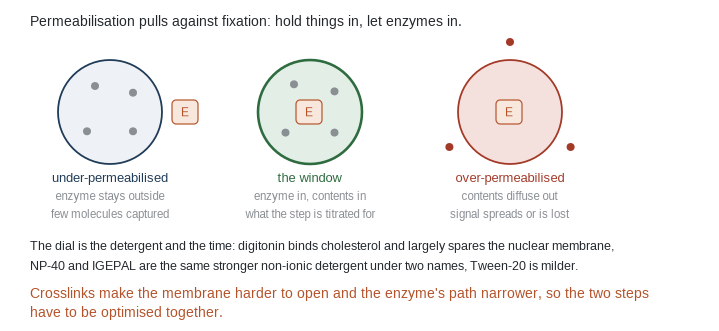
- Holding molecules in and letting enzymes in are opposite requirements, set by the same two dials: which detergent, and for how long
- Under-permeabilised, the enzyme never reaches the target; over-permeabilised, the contents leave before the reaction happens
- Crosslinks narrow the window from both sides, which is why fixation and permeabilisation are optimised as one step
Corces et al. 2017, doi:10.1038/nmeth.4396 (Omni-ATAC)
Reversal: heat first, then protease
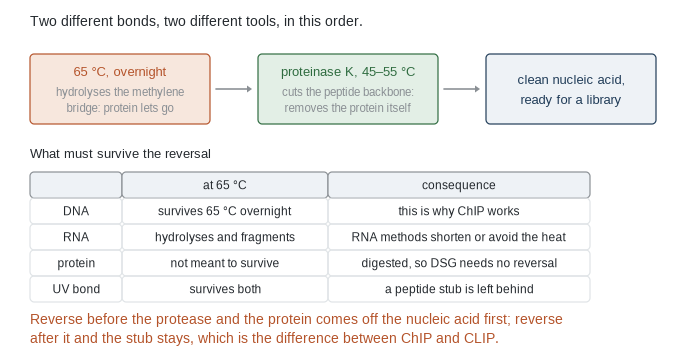
- Heating to 65 °C hydrolyses the methylene bridge; proteinase K cuts the peptide backbone. They are different jobs and the order changes what is left behind
- DNA survives the heat, which is why ChIP works at all. RNA does not survive it as well, so RNA protocols shorten the heat step or do without one
- Reversal is a choice rather than a rule: FAIRE keeps the crosslink and selects on it, since crosslinked chromatin partitions into the phenol phase and open DNA stays in the aqueous phase
Giresi et al. 2007, doi:10.1101/gr.5533506
Worked example: formaldehyde ChIP
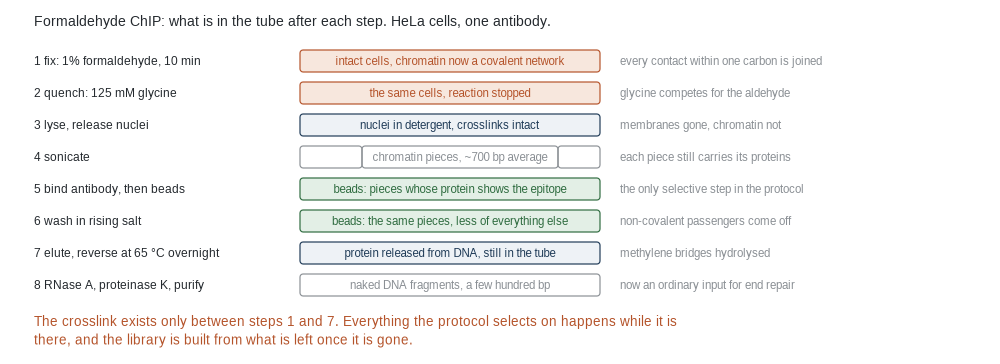
- The assay itself — antibody, controls, what the read pile-up means — belongs to chromatin. Here we follow only the material, and ask at every step what is holding it together
- The protocol is the original STAT1 ChIP-seq in HeLa cells, 1% formaldehyde for 10 min, quenched with glycine, sonicated to an average of about 700 bp
Robertson et al. 2007, doi:10.1038/nmeth1068 (ChIP-seq)
The contrast: UV CLIP cannot be reversed
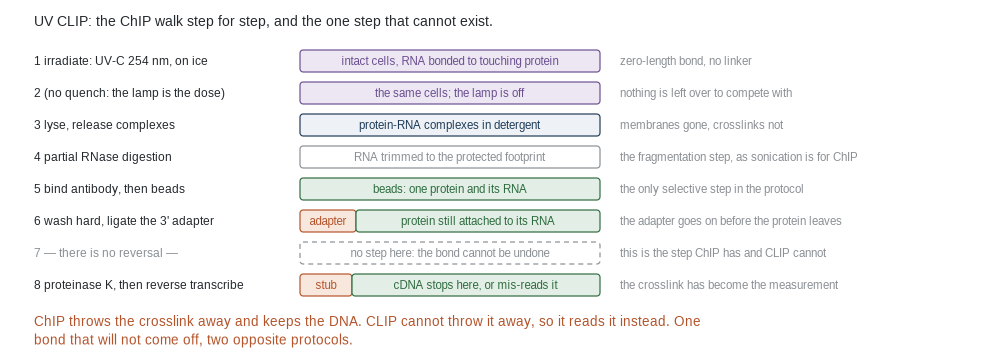
- The same shape of walk, with step 7 missing. The 3′ adapter is ligated while the protein is still attached, because there is no later point at which the RNA is free and intact
- Proteinase K leaves the stub, the reverse transcriptase stops at it or mis-reads it, and that event is the measurement
- The CLIP family differs mainly in which consequence of the stub it scores
König et al. 2010, doi:10.1038/nsmb.1838 (iCLIP)
What crosslinking costs
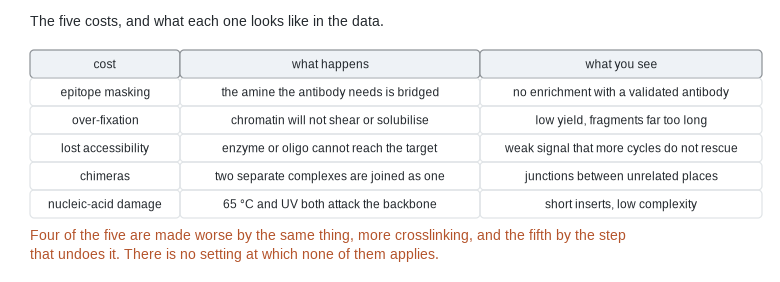
- Epitope masking, over-fixation and lost accessibility all get worse with more crosslinking, and the damage from reversing it gets worse with less
- Chimeras are the cost specific to methods that read a junction: two complexes joined, or two ends meeting by chance, look like one observation
- There is no dose at which none of these applies, which is why every crosslinking protocol states a concentration, a time and a temperature
Gavrilov et al. 2015, doi:10.1093/bfgp/elu037
Methods built around avoiding it
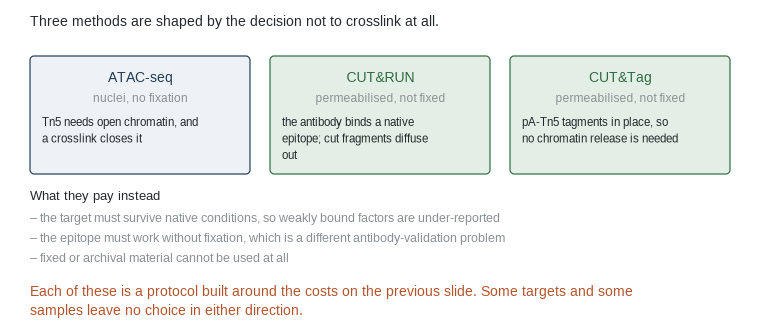
- ATAC, CUT&RUN and CUT&Tag work on unfixed nuclei or permeabilised cells, and each is shaped by that decision: Tn5 needs chromatin that a crosslink would close, and the antibody has to bind a native epitope
- What they pay for it: weakly bound factors are under-reported, antibody validation is a different problem, and archival fixed material cannot be used
- The assays themselves are in chromatin; what matters here is that the chemistry of this deck is what they were designed around