Chromatin and protein–DNA
Use cases · NGS library preparation
Three questions about one stretch of chromatin
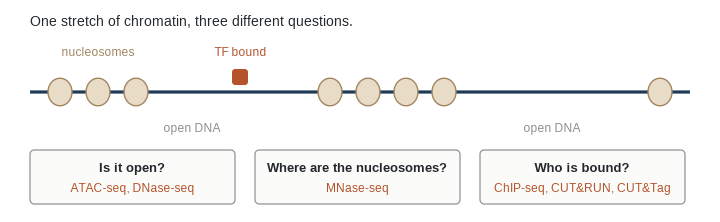
- Which DNA is open, and which is wrapped around histones?
- Where exactly do the nucleosomes sit?
- Which protein is bound, and where?
A library for any of these is the ordinary DNA library of the earlier units, plus a way of making the position of something show up in the reads.
A read is the address of a cut
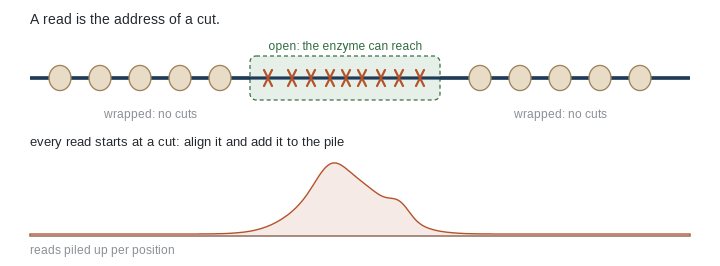
- Nothing in the library is the protein or the nucleosome. What you sequence is where an enzyme or a chemical got access
- Align the reads and count starts per position: the pile-up is the measurement
- Every method in this deck is a choice of which enzyme, where it is placed, and what is done with the ends
- The deck works through those choices one protocol at a time. Ask of each: what is cut, what is kept, and what do the ends look like?
DNase-seq: cut open DNA and keep the ends
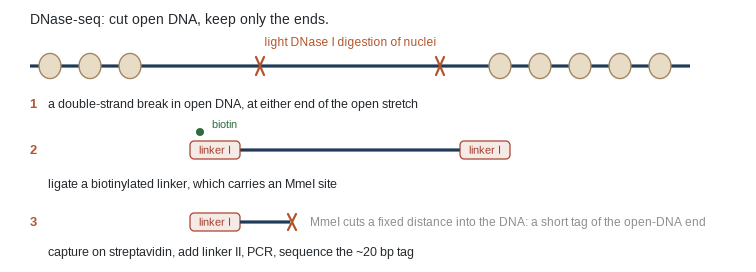
- DNase I cuts DNA that is not wrapped or covered. Digest lightly, so that most open stretches are cut at most once on each side
- The first genome-wide human maps used a biotinylated linker with an MmeI site: MmeI cuts a fixed distance away, giving a ~20 bp tag per cut
- Hypersensitive sites are regulatory elements: promoters, enhancers, insulators
Boyle et al. 2008, doi:10.1016/j.cell.2007.12.014 · protocol page
What a footprint is
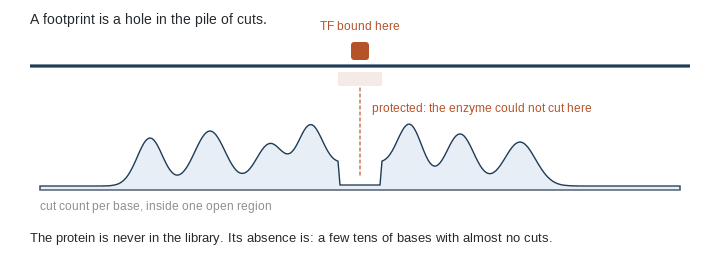
- A bound transcription factor shields a short stretch of DNA from the enzyme. Counted cuts dip there
- Footprinting from DNase data was first shown in yeast and then used to build a human map of motif occupancy
- Caution: nucleases and transposases have sequence preferences. A dip can be a cutting bias rather than a protein, so footprints are corrected against naked-DNA controls and need deep data
Hesselberth et al. 2009, doi:10.1038/nmeth.1313 · Neph et al. 2012, doi:10.1038/nature11212
Tn5: cut and ligate in a single step
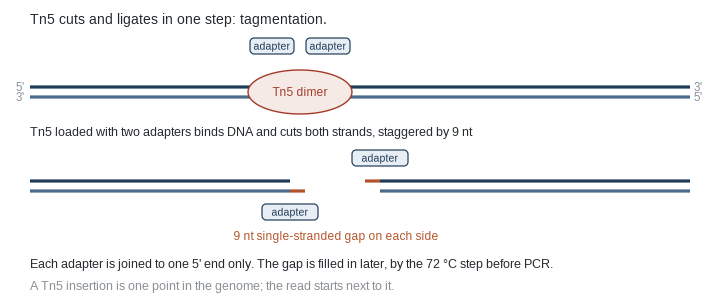
- A transposase, preloaded with two adapters, inserts them into DNA. This is tagmentation
- It replaces fragmentation, end repair, A-tailing and ligation by one reaction (handles), and needs very little DNA
- The 9 nt gaps are filled by the polymerase in the first PCR cycle, at 72 °C. Skip that step and nothing amplifies
- Insertions are not random: they follow accessibility, with a mild sequence preference of their own
Picelli et al. 2014, doi:10.1101/gr.177881.114
ATAC-seq: Tn5 as the probe
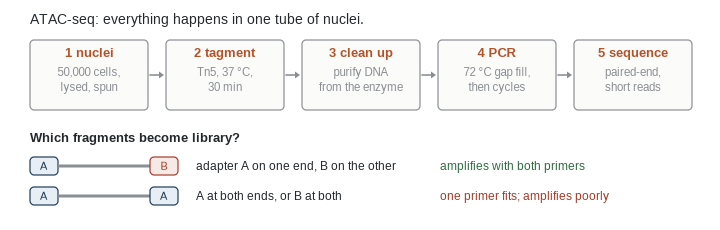
- Tn5 inserts its adapters into open DNA; the nucleosome-bound DNA is mostly out of reach
- 50,000 nuclei, 30 min at 37 °C: a few hours at the bench, and far less input than DNase-seq needs
- Reads are mapped, and the insertion point (shifted by a few bases to the Tn5 centre) is what is counted
Buenrostro et al. 2013, doi:10.1038/nmeth.2688 · protocol page
Fragment length carries information too
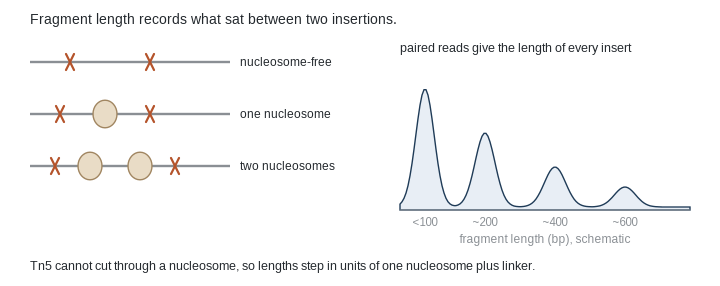
- Tn5 cuts twice per molecule, so each fragment has two insertion points and a length
- Short fragments come from open DNA; ~200 bp from one nucleosome; ~400 bp from two
- The length histogram is a quality check: a healthy library shows the nucleosome ladder, a failed one shows only large fragments
- Paired-end reads are needed to see this
Buenrostro et al. 2013, doi:10.1038/nmeth.2688 · Schep et al. 2015, doi:10.1101/gr.192294.115
MNase-seq: sequence what the nucleosome protected
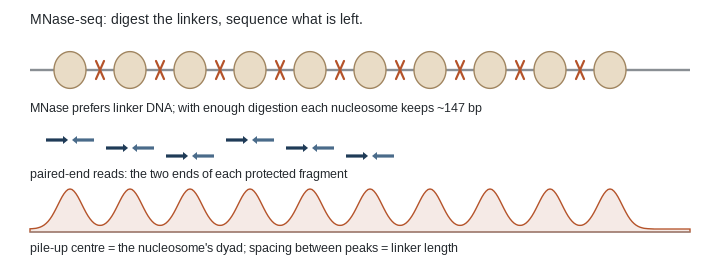
- Micrococcal nuclease prefers linker DNA over DNA wrapped on a histone octamer. With extended digestion, only ~147 bp per nucleosome survives
- The length of the surviving fragment is the read: its centre is the nucleosome position
- The opposite logic to ATAC. Here the protected DNA is the library and open DNA is destroyed
- Over-digestion loses weakly positioned nucleosomes; under-digestion keeps linkers
Schones et al. 2008, doi:10.1016/j.cell.2008.02.022
Methyltransferase footprinting: mark first, read later
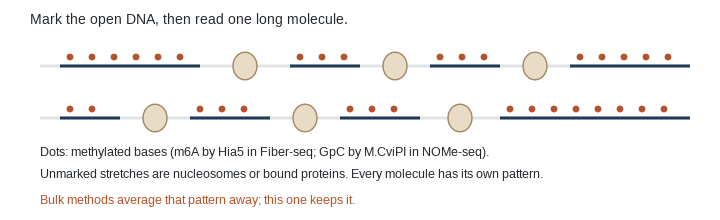
- Instead of cutting, add a mark to every accessible base. NOMe-seq uses a GpC methyltransferase and bisulfite. Fiber-seq uses an m6A methyltransferase and long reads
- Long reads see nucleosomes, factors and open DNA on the same molecule: which sites co-occur on one allele
- The cost is the read technology, and the need for nuclei that tolerate the enzyme
Kelly et al. 2012, doi:10.1101/gr.143008.112 · Stergachis et al. 2020, doi:10.1126/science.aaz1646
ChIP-seq: fix, break up, pull down
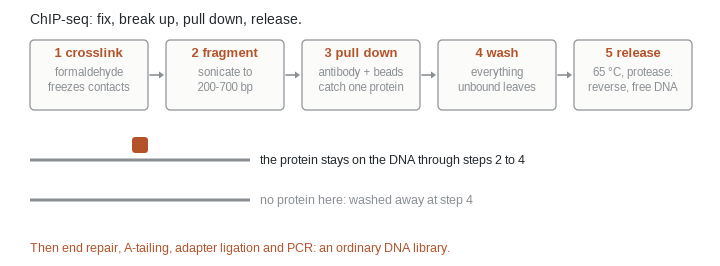
- The protein has to stay on the DNA through lysis, shearing and washing, so it is fixed in place first
- The antibody on beads is the only step that selects. Everything else is generic
- Release is the reverse of fixation: heat, protease, then purify the DNA (crosslinking and fixation is the block)
Johnson et al. 2007, doi:10.1126/science.1141319 · Robertson et al. 2007, doi:10.1038/nmeth1068 · protocol page
Crosslinking and reversal
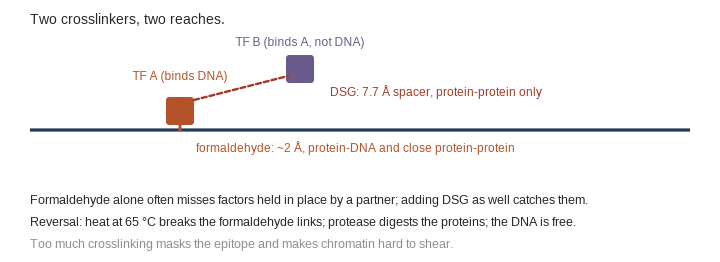
- Formaldehyde, typically 1% for 10 min at room temperature, then quenched with glycine
- DSG, disuccinimidyl glutarate, is added as a second crosslinker, before or after formaldehyde depending on the protocol, for factors that bind chromatin through partners. Its arms reach further than formaldehyde’s and join protein to protein only. Heat does not reverse it, but the proteins are digested anyway
- More crosslinking gives more signal until it hides the epitope or the chromatin will not shear. Titrate it
Robertson et al. 2007, doi:10.1038/nmeth1068
What ChIP reads mean
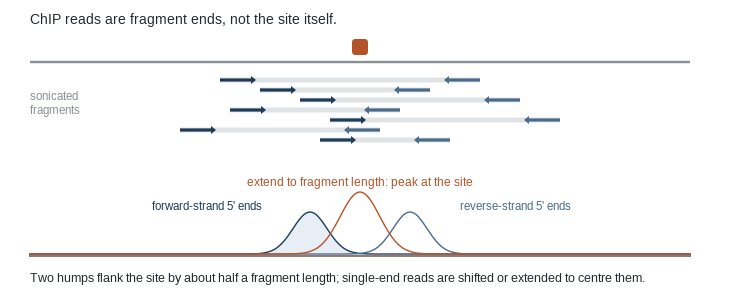
- Sonication gives fragments of a few hundred bp. The sequencer reads only the ends, and the protein sits somewhere in between
- Forward-strand and reverse-strand start counts form two humps. The site lies between them, at about half a fragment length from each
- ChIP-exo and ChIP-nexus add an exonuclease that trims each fragment back to the crosslink, so the hump collapses to base-pair resolution
Rhee and Pugh 2011, doi:10.1016/j.cell.2011.11.013
The trap: easy-to-break chromatin looks like binding
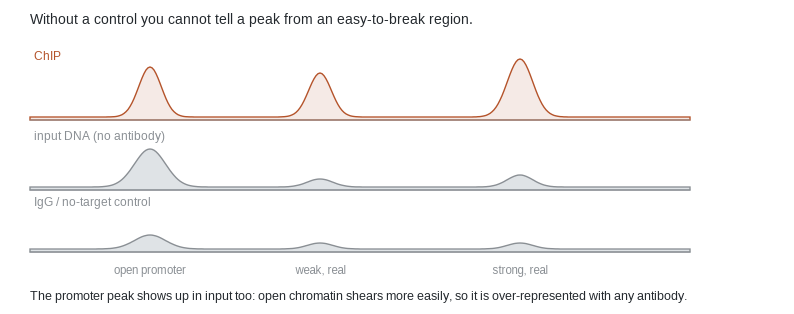
- Open, active chromatin shears more easily than closed chromatin, so it is over-represented in every ChIP, even with no antibody
- Without an input or IgG control, promoters of active genes look like binding sites for every factor
- Some loci seem to pull down unrelated proteins from several experiments. Controls and replicates are not optional
Teytelman et al. 2013, doi:10.1073/pnas.1316064110 · Landt et al. 2012, doi:10.1101/gr.136184.111
The tethered-enzyme idea
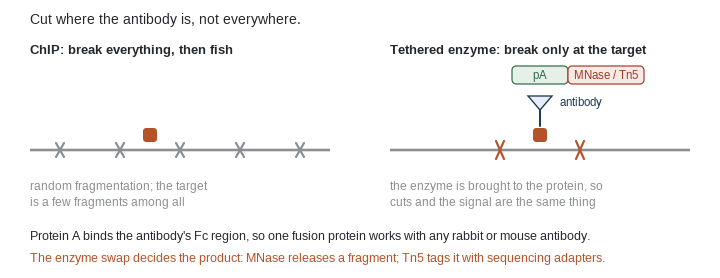
- In ChIP, cutting is random and selection is by antibody afterwards. A tether reverses the order: the antibody goes on first, and the enzyme is brought to it
- Protein A binds the constant region of IgG, so a protein A fusion works with any suitable antibody
- Swap the enzyme and the whole protocol changes: MNase gives CUT&RUN, Tn5 gives CUT&Tag
- This is a block in its own right, and the same idea sits behind several other methods
Schmid et al. 2004, doi:10.1016/s1097-2765(04)00540-4
CUT&RUN: cut out, then release
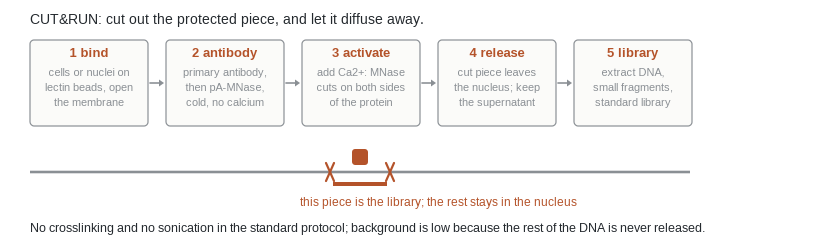
- No crosslinking by default and no sonication. Cells are permeabilised on beads and kept cold
- MNase is inactive without calcium, so the antibody and pA-MNase can bind and be washed first. Calcium starts the reaction
- The cut-out fragments diffuse out of the nucleus. The rest of the genome never leaves, which is why the background is low
Skene and Henikoff 2017, doi:10.7554/eLife.21856 · protocol page
CUT&Tag: cut and tag in one reaction
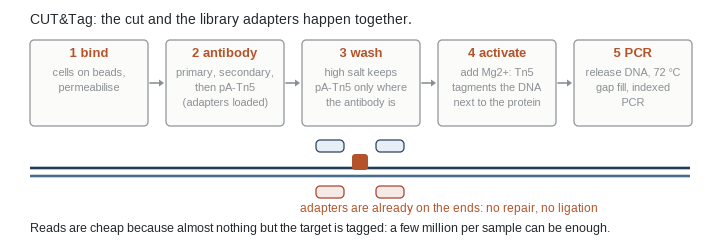
- The same logic with pA-Tn5, preloaded with adapters. Magnesium activates it, and the product is already a library fragment
- High-salt washes remove pA-Tn5 that is bound non-specifically, since Tn5 otherwise lands in open DNA
- Works from small samples and single cells; sequencing needs are modest
Kaya-Okur et al. 2019, doi:10.1038/s41467-019-09982-5 · protocol page
What the reads look like
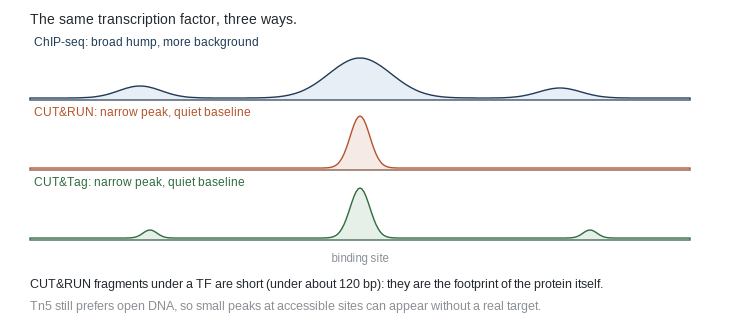
- Tethered methods give narrower peaks and a quieter baseline than ChIP
- For a transcription factor, CUT&RUN fragments are short: the protein protects only a few tens of bp, so the fragment is the footprint
- Both methods are sensitive to antibody quality and to the permeabilisation. An IgG control is still needed
Meers et al. 2019, doi:10.7554/eLife.46314
DamID: no antibody, no crosslinking
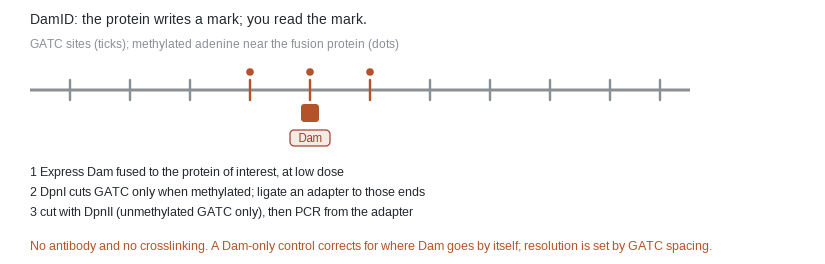
- Fuse E. coli Dam to the protein of interest. Wherever the fusion sits, nearby GATC sites are methylated on adenine
- DpnI cuts only methylated GATC; DpnII cuts only unmethylated GATC. The two together select the marked fragments
- The mark is a record, written in living cells. A single-cell version was used to map lamina contacts in human cells
van Steensel and Henikoff 2000, doi:10.1038/74487 · Kind et al. 2015, doi:10.1016/j.cell.2015.08.040
Calling cards: a record that keeps
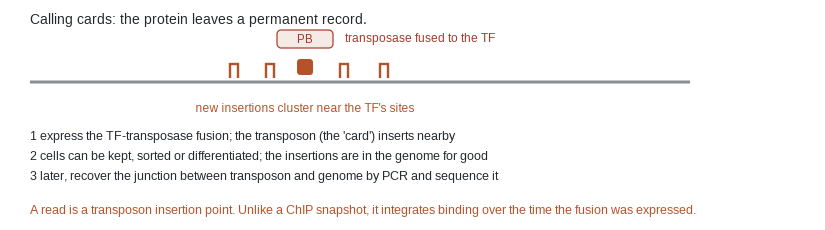
- A transposase fused to a TF drops transposons into the genome near the TF’s binding sites
- Reads are insertion points. Because the insertions are permanent, they accumulate over time instead of showing one moment
- Mammalian versions use piggyBac. The collection page shows the earlier implementation in yeast, which used Ty5, a yeast retrotransposon, as the element being dropped in
Wang et al. 2012, doi:10.1534/genetics.111.137315 · protocol page
DAP-seq: binding without the cell
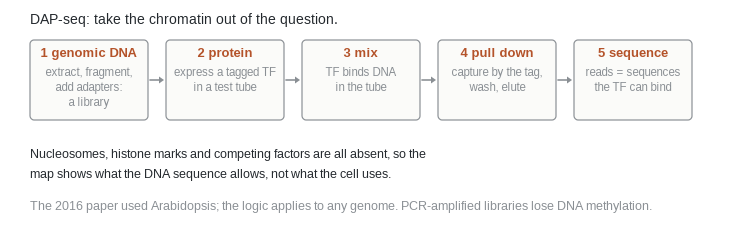
- DNA from any genome is made into a library, and a tagged TF made in vitro is allowed to bind it
- The result is the intrinsic specificity of the protein, without nucleosomes or competitors. Comparing with ATAC or ChIP tells you what the cell adds
- Libraries made with PCR lack DNA methylation, which may matter for the factor
O’Malley et al. 2016, doi:10.1016/j.cell.2016.04.038 · protocol page
Choosing a method
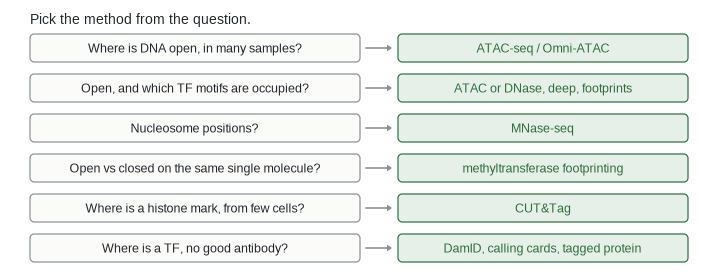
- Start from what you want to say about the genome, then pick the block that gives the read that carries it
- Single-molecule questions push towards long reads; few cells push towards tethered Tn5
What one read means
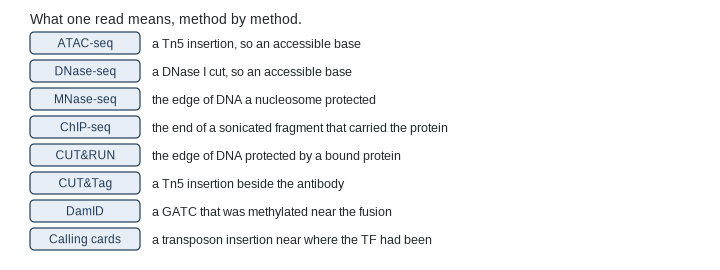
- Write this sentence for any new method before reading the protocol: **one read is ___**
- If you cannot complete it, you cannot interpret the track