End chemistry
Building blocks · NGS library preparation
A catalogue of ends
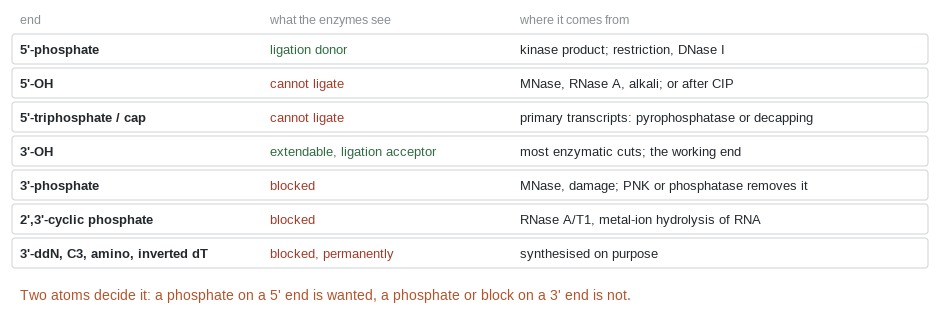
- Phosphate is wanted on a 5’ end and unwanted on a 3’ end
- Several different groups make a 3’ end permanently inert; one, the phosphate, can be removed again
Where ends come from
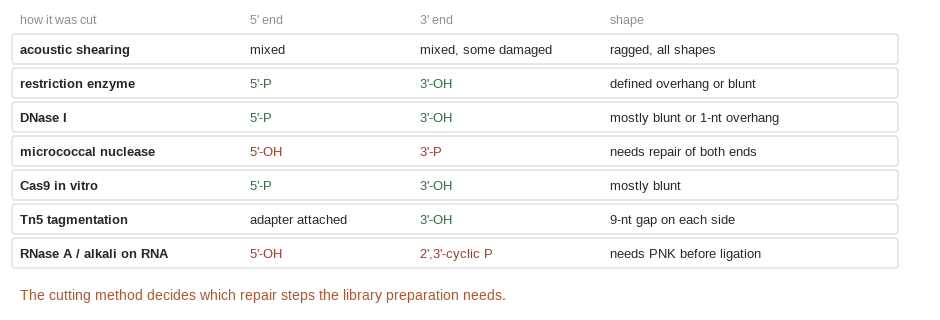
- The cutting method decides the end state (nucleases): a restriction digest gives tidy ends, MNase and RNases give the opposite polarity
- Shearing gives a mixture, which is why it needs the most repair
Shapes: overhangs and recessed ends
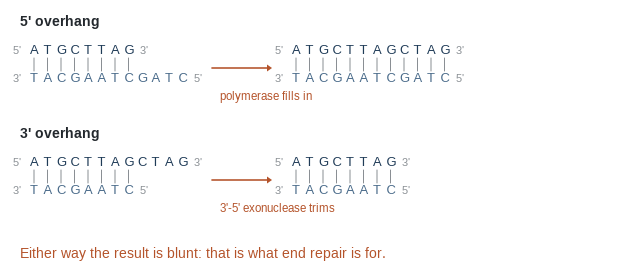
- A 5’ overhang has a 3’-OH recessed in the duplex, a place a polymerase can extend
- A 3’ overhang is an unpaired tail that a 3’-5’ exonuclease trims
- Blunt is the point where neither has anything to do
Nicks, gaps and flaps
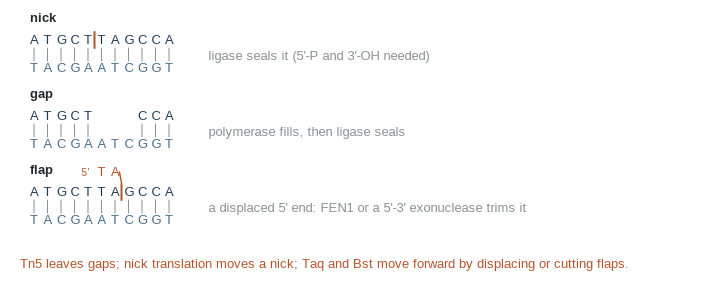
- A nick needs a ligase; a gap needs a polymerase and then a ligase
- A flap is displaced 5’ sequence; it needs a flap endonuclease or a polymerase with 5’-3’ exonuclease activity
- Whether a strand-displacing polymerase makes flaps or a non-displacing one stops at a nick decides what comes out of a reaction
End repair
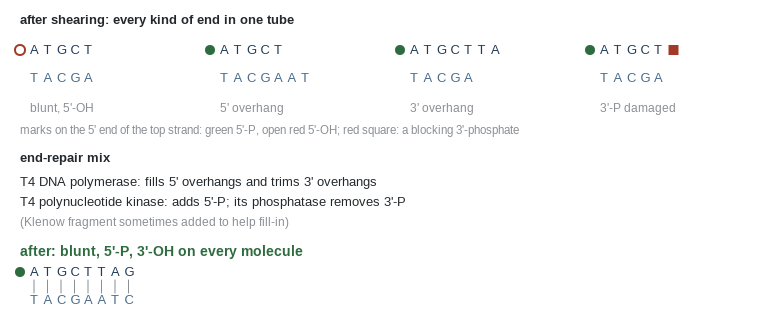
- T4 DNA polymerase fills 5’ overhangs and trims 3’ overhangs (why this polymerase and not another); T4 PNK phosphorylates 5’ ends and removes 3’ phosphates
- The mix is usually sold as one tube; it needs ATP for the kinase and dNTPs for the polymerase
- Protocol: NEBNext Ultra II FS DNA PCR-free
Blunting is an equilibrium
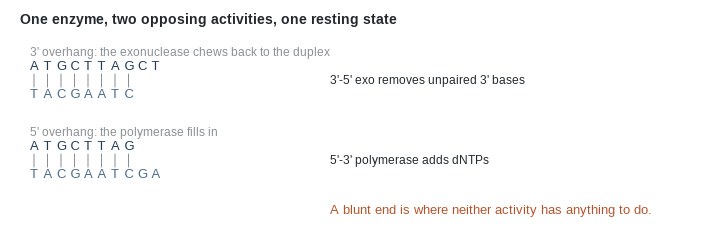
- T4 DNA polymerase has both activities, so it removes and adds until nothing is left to do
- With dNTPs present, the polymerase wins on 5’ overhangs and the exonuclease on 3’ overhangs
- Without dNTPs, the exonuclease alone chews back and can eat into the duplex
dA-tailing
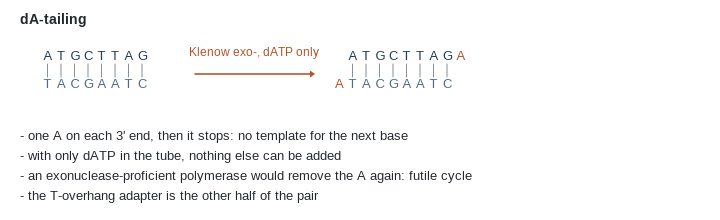
- Klenow fragment lacking exonuclease, or Taq, adds one non-templated A
- Only dATP in the tube, and a polymerase that cannot take it back off
- Proofreading enzymes fail here silently: the A is added and removed in cycles
Clark 1988, doi:10.1093/nar/16.20.9677
Tracking the ends through a protocol
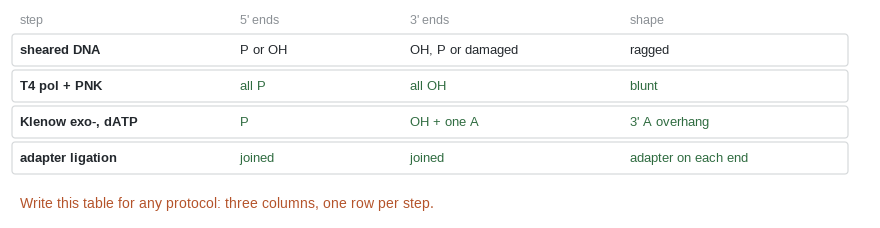
- Three columns and one row per step: the habit that finds bugs in a protocol before the bench does
- The table shows a standard ligation library; every step prepares the ends for the next
- Protocol: TruSeq DNA PCR-Free
Fill-in
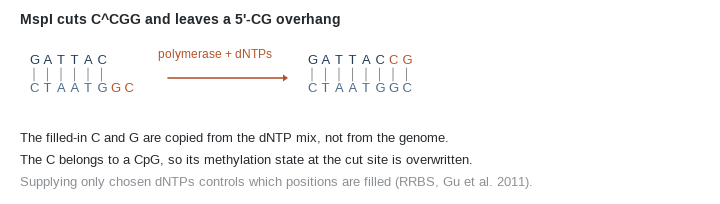
- Restriction enzymes such as MspI leave overhangs that a polymerase can fill with chosen dNTPs
- What the polymerase adds is a copy of the mix, so the filled positions carry no information about the sample
- In bisulfite sequencing this decides which cytosines can still be read (converting chemistry into sequence)
- Protocol: RRBS
Meissner et al. 2008, doi:10.1038/nature07107; Gu et al. 2011, doi:10.1038/nprot.2010.190
Gap repair after tagmentation
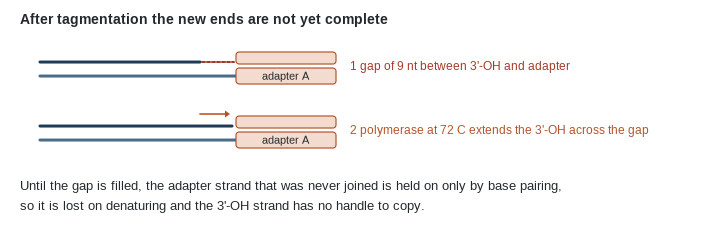
- Tn5 attaches adapters to the 5’ ends only, leaving a 9-nt gap on each side (transposases)
- A polymerase at 72 C extends the 3’-OH across the gap before PCR
- Until then the second adapter strand is held on by base pairing only, so skipping the step costs yield
Picelli et al. 2014, doi:10.1101/gr.177881.114
Dephosphorylation: switch the old ends off
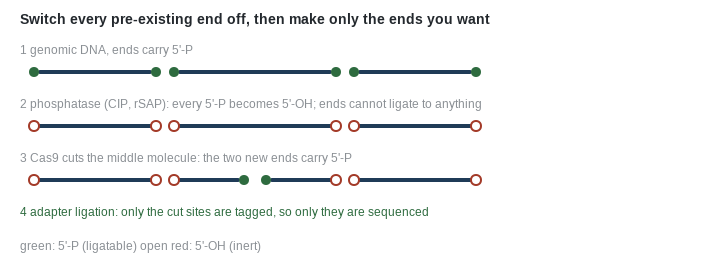
- A phosphatase (CIP, rSAP) turns every 5’-P into 5’-OH, which no ligase can use (ligases, kinases, phosphatases)
- Then make the ends you want: a cut, a kinase step
- Used in Cas9 cleavage mapping, so only the Cas9 ends get adapters; RGEN-seq describes optional blocking of pre-existing ends
Kuzin et al. 2021, doi:10.1038/s41598-021-03160-8
Selective re-phosphorylation
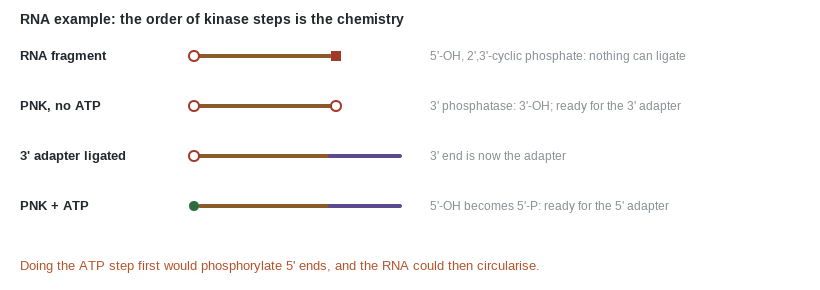
- The same kinase does two jobs depending on whether ATP is present: 3’ phosphatase without, 5’ kinase with
- That sets the order of an RNA library: clear 3’ ends, ligate the 3’ adapter, phosphorylate 5’ ends, ligate the 5’ adapter
- Getting the order wrong is a quiet failure: yield falls and nothing reports it
Blocked 3’ ends force one-sided ligation
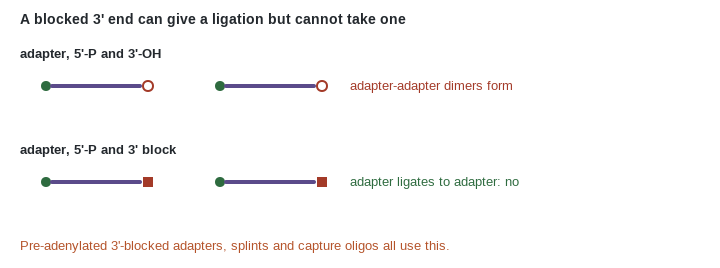
- If an adapter can only donate, it cannot be joined to another adapter: the end state RNA ligation and splinted ligation both demand (attaching a handle)
- The block is on the adapter’s 3’ end; the insert provides the 3’-OH
- Pre-adenylated adapters, splints and capture oligos use this
Which block?
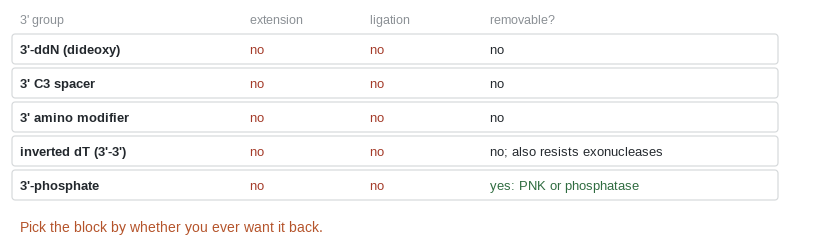
- Dideoxy, C3, amino and inverted dT are permanent; a 3’-phosphate can be removed later by a phosphatase
- TdT with a ddNTP puts a dideoxy block on existing 3’ ends of DNA, which is how pre-existing ends are masked
- Pick by whether the block must ever come off
dU in adapters and USER
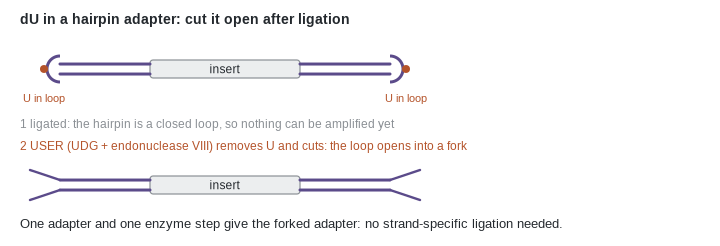
- A hairpin adapter with a uracil in the loop is ligated closed; UDG and endonuclease VIII (USER) open it into a fork
- One adapter and no strand-specific ligation
- Protocol: NEBNext Ultra II DNA Library Prep, USER adaptor
USER: Bitinaite et al. 2007, doi:10.1093/nar/gkm041
Methylated adapters
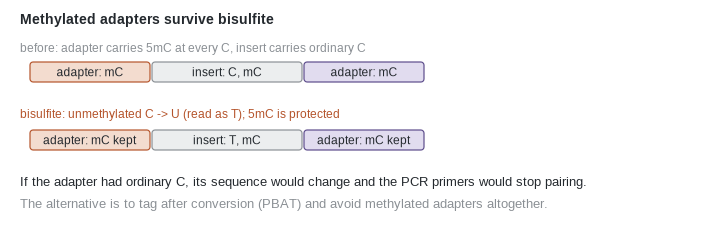
- Bisulfite changes unmethylated C to U, which would change an adapter too
- Adapters built with 5mC survive, so primers still anneal
- Used in RRBS, where ligation comes before conversion
Meissner et al. 2008, doi:10.1038/nature07107
Hairpin adapters
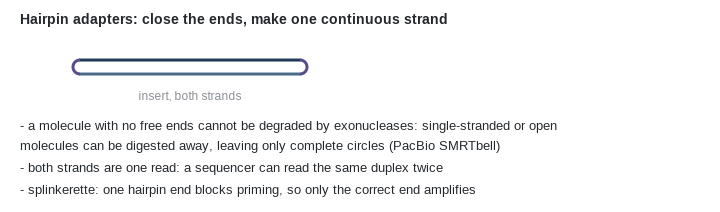
- A hairpin removes a free end: no 5’ or 3’ end is left to ligate, extend or digest
- SMRTbell libraries close both ends this way; see the long-read instruments
- Splinkerette uses a blocked hairpin to stop one-sided priming (splinkerette PCR)
Degraded and single-stranded input
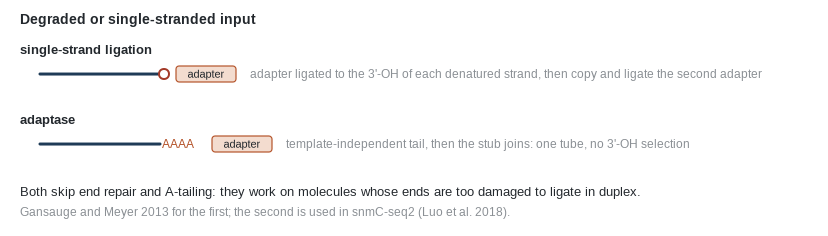
- When ends are too damaged for duplex ligation, work on one strand at a time
- Single-strand ligation: ligate an adapter to the 3’-OH of denatured DNA, copy, then add the other
- Adaptase, a vendor enzyme mix, tails the 3’ end without a template and ligates a stub to it in one tube
- Protocol: single-stranded ancient DNA
Gansauge and Meyer 2013, doi:10.1038/nprot.2013.038; Luo et al. 2018, doi:10.1038/s41467-018-06355-2
Dilute ligation
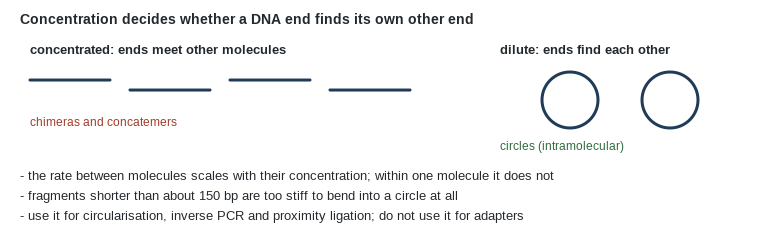
- Joining two ends of the same molecule does not depend on concentration; joining two molecules does
- Dilute: circles. Concentrated: chimeras, one molecule made of two unrelated pieces
- Do the opposite for adapters, where you want molecules to meet