Compartments
Building blocks · NGS library preparation
Why compartments exist
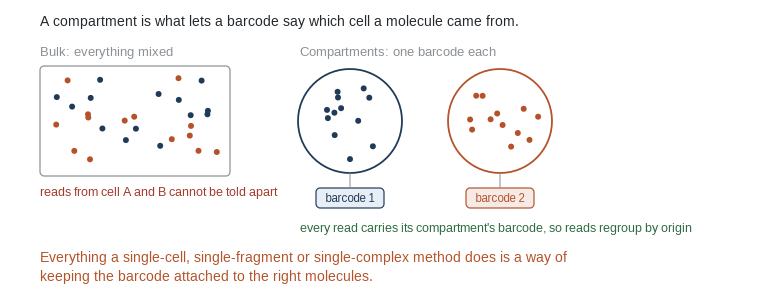
- Pool the molecules of two cells and you can never separate them again
- A compartment holds one cell’s molecules together long enough to give them a shared barcode
- The barcode is the only thing that survives into the sequencer
What is being kept together
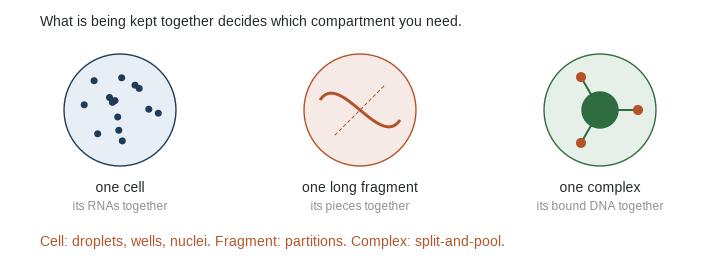
- A cell, so that its RNAs or accessible DNA can be counted as one profile
- A long fragment, so that short reads can be linked back to one molecule
- A complex, so that pieces bound together can be read as contacts
The barcode is printed on the bead
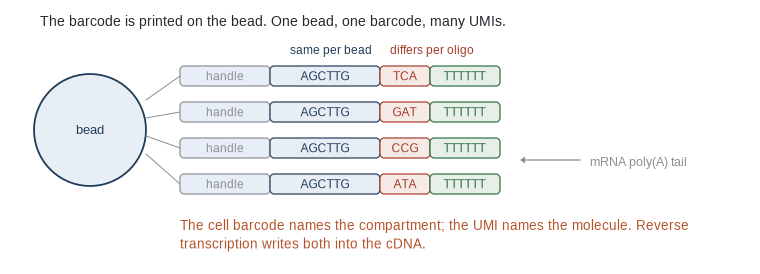
- Every oligo on a bead has the same cell barcode and a different UMI
- A cell lysed beside the bead has its mRNA captured on those oligos
- Barcode and UMI are then written into the cDNA, and every read can be traced to its compartment (Drop-seq)
Macosko et al. 2015, doi:10.1016/j.cell.2015.05.002
Wells and plates
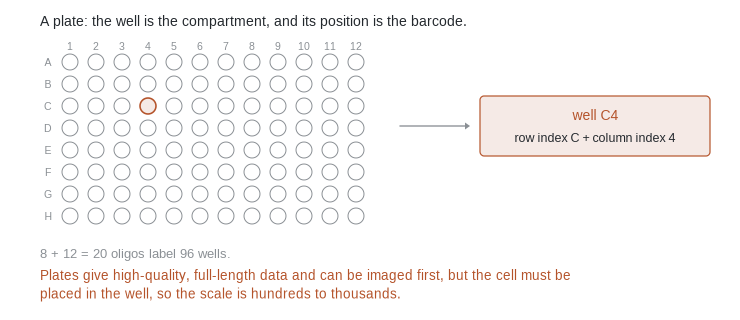
- Place one cell (or nucleus) per well, and let the well’s position be the barcode
- Row index plus column index is enough: 20 oligos label 96 wells
- Cost is hands and time, not statistics, so the cell count stays small
Microwells
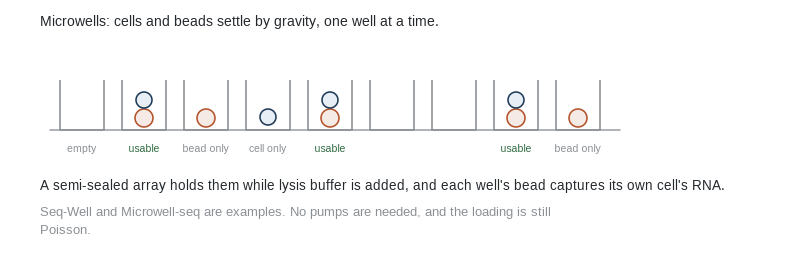
- Cells and barcoded beads sink into an array of wells; the array is sealed and lysed
- Seq-Well and Microwell-seq work this way, with no instrument beyond a pipette (Seq-Well, Microwell-seq)
- Fill is random, so Poisson statistics apply
Gierahn et al. 2017, doi:10.1038/nmeth.4179
Droplets
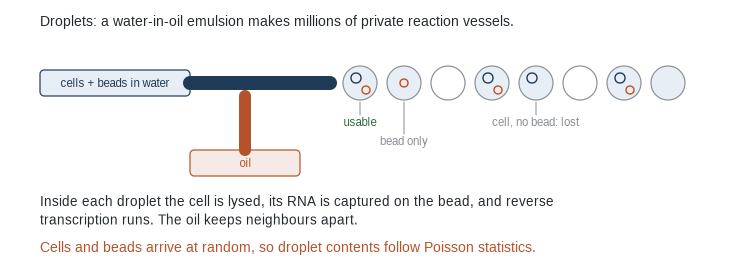
- Oil and water meet at a junction, and each drop becomes a compartment, as in emulsion PCR
- Cell, bead and lysis mix are co-encapsulated, so RNA capture happens in each drop (inDrop)
- Cells and beads arrive at random
Klein et al. 2015 (inDrop), doi:10.1016/j.cell.2015.04.044; Zheng et al. 2017, doi:10.1038/ncomms14049
Loading is a random process
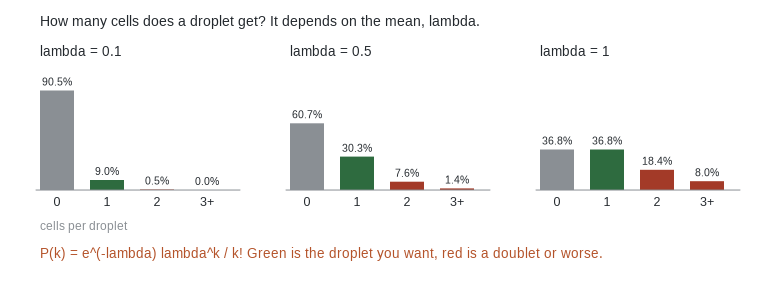
- If cells enter at random with a mean of \lambda per droplet, the chance of exactly k is P(k)=e^{-\lambda}\lambda^k/k!
- Lower \lambda: mostly empty droplets, few doublets
- Higher \lambda: fewer empties, more doublets
The calculation by hand
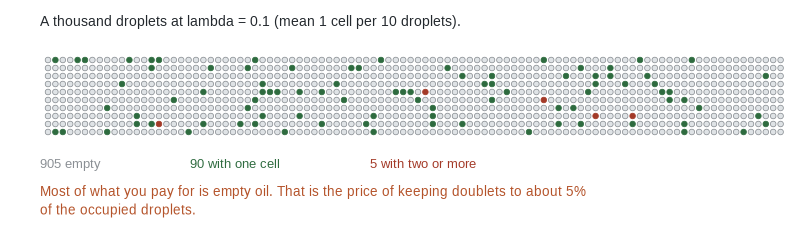
Load at \lambda = 0.1. Use e^{-x}\approx 1-x+x^2/2, so P(0)=e^{-0.1}\approx 0.905.
- One cell: P(1)=\lambda\,P(0)=0.1\times 0.905=0.0905; two cells: P(2)=\lambda^2/2\times P(0)=0.0045
- Two or more: 1-P(0)-P(1)=0.0047, about 5 in 1000 droplets
- Of the occupied droplets, 0.0047/(0.0905+0.0047)\approx 5\% are doublets
Choosing the loading rate
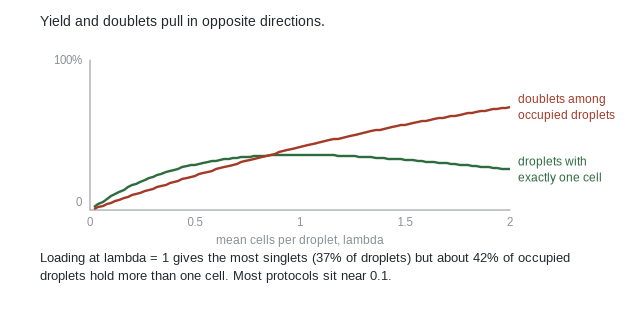
- Singlets peak at \lambda=1, but then about 42% of occupied droplets hold more than one cell
- At \lambda=0.5: 23% doublets; at 0.1: 5%; at 0.05: 2.5%
- A rule of thumb: doublet fraction among occupied droplets is about \lambda/2 when \lambda is small
Cells and beads are two draws
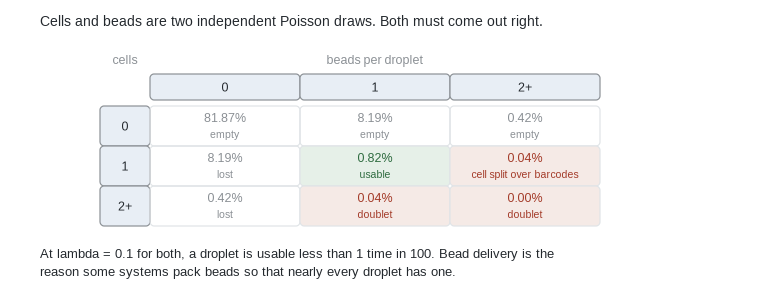
- A usable droplet needs one cell and a bead; each arrives at random
- A droplet with two beads can split one cell’s RNA over two barcodes
- This is why systems that deliver beads as a packed, ordered stream are efficient: a cell finds a bead nearly every time
Seeing doublets
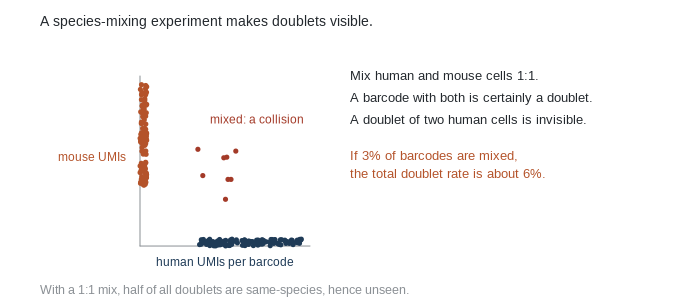
- Mix human and mouse cells; barcodes with both species are collisions
- Only half of doublets are mixed-species, so double the observed fraction
- Cell hashing and genotype mixing — pooling donors and telling them apart by their common SNPs — mark samples so that doublets can be flagged without species mixing
Stoeckius et al. 2018, doi:10.1186/s13059-018-1603-1; Kang et al. 2018, doi:10.1038/nbt.4042
Nuclei as compartments
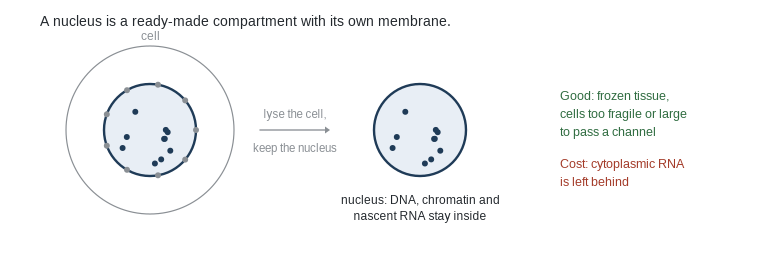
- A nucleus has its own membrane, so DNA, chromatin and nuclear RNA stay inside
- Nuclei can be isolated from frozen tissue and from cells too large or fragile for a channel
- Cost: cytoplasmic mRNA is lost, and nuclear RNA is more intronic
Habib et al. 2017, doi:10.1038/nmeth.4407
Fix and permeabilise instead of isolating
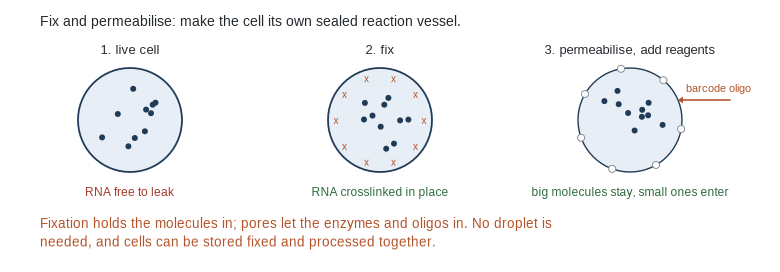
- Formaldehyde or methanol fixation holds the RNA in the cell
- Mild permeabilisation lets small enzymes and oligos enter
- The cell is now a reaction vessel with no oil around it (in-vessel tricks), and fixed cells keep for batch processing
Split-and-pool is a virtual compartment
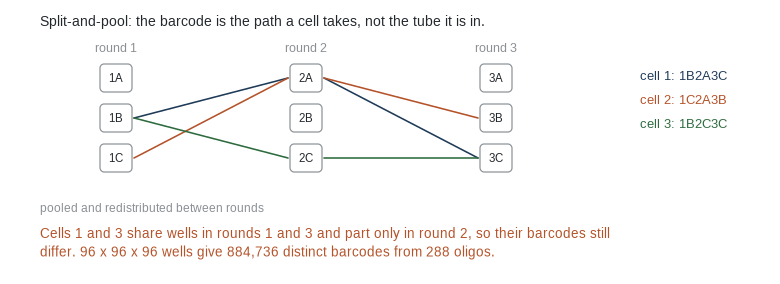
- Distribute cells to wells, add a barcode inside the cells, pool, redistribute, add the next
- A cell’s barcode is its path; two cells collide only if every round matches
- Three rounds of 96 give 884,736 combinations from 288 oligos; published designs vary the round sizes (SPLiT-seq uses 48 wells in the first round, sci-RNA-seq3)
Rosenberg et al. 2018, doi:10.1126/science.aam8999; Cao et al. 2017, doi:10.1126/science.aam8940
Collisions are Poisson too
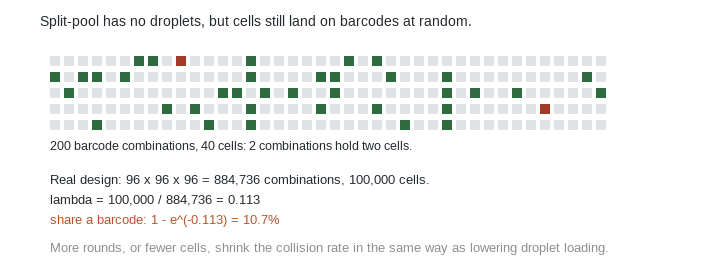
- With n cells and N combinations, each combination holds \lambda=n/N cells on average
- 100,000 cells over 884,736 combinations: \lambda=0.113, so 10.7% of cells share a barcode
- Fewer cells or more rounds lower it; doublets cannot be seen without a species mix or a genotype
In-situ reactions in nuclei
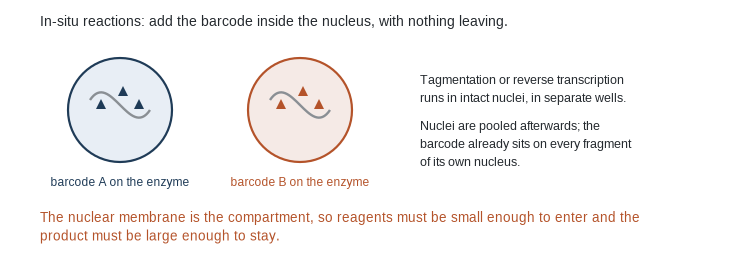
- Tagmentation or reverse transcription runs with a barcoded enzyme or primer in each well
- The barcode goes in, and nothing comes out: the nucleus holds it
- This is the first round of most combinatorial protocols (sci-ATAC-seq)
Cusanovich et al. 2015, doi:10.1126/science.aab1601
Two-stage encapsulation
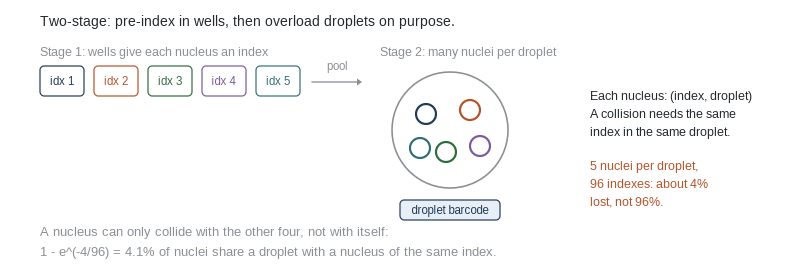
- Pre-index nuclei in wells, then load many per droplet
- Nuclei in one droplet share a droplet barcode but differ in the first index
- Worked: 5 nuclei per droplet, 96 indexes. A nucleus can only collide with the other four, so 1-e^{-4/96}\approx 4\% are ambiguous
Lareau et al. 2019, doi:10.1038/s41587-019-0147-6; Datlinger et al. 2021, doi:10.1038/s41592-021-01153-z
Capsules and hydrogels
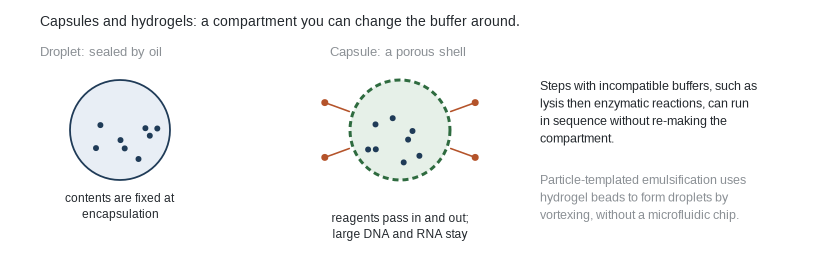
- A porous shell keeps cells and nucleic acids in, yet lets reagents pass
- Buffer exchange between steps becomes possible, which droplets do not allow
- Hydrogel beads can form droplets by vortexing, so no microfluidic device is needed
- The barcoded oligo is built into the gel rather than stuck to its surface: an acrydite group on the oligo copolymerises with the acrylamide, and the oligo is cleaved off when the reaction needs it (oligo modifications)
Clark et al. 2023, doi:10.1038/s41587-023-01685-z
From read to compartment
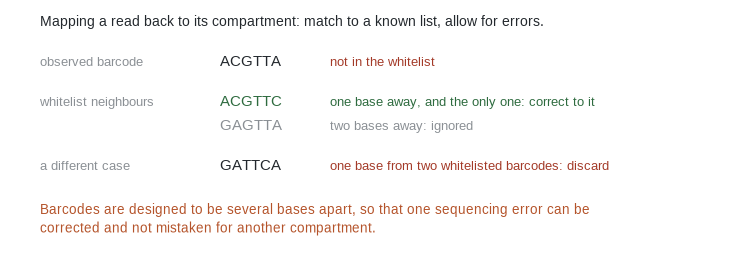
- Barcodes come from a known list, and a read’s barcode is matched to it
- A barcode one base away from exactly one entry is corrected; one that is near two is discarded
- Barcode sets are designed with large pairwise differences for this reason
Which barcodes are cells?
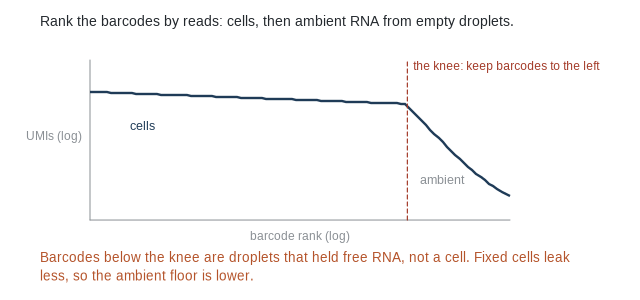
- Rank barcodes by their reads: real cells form a plateau, then a drop to droplets that held free RNA
- A cut at the knee separates them, with ambient RNA as the floor
- Leaky cells raise the floor, and fixed cells leak less
Zhang et al. 2019, doi:10.1016/j.molcel.2018.10.020
Compartments for fragments
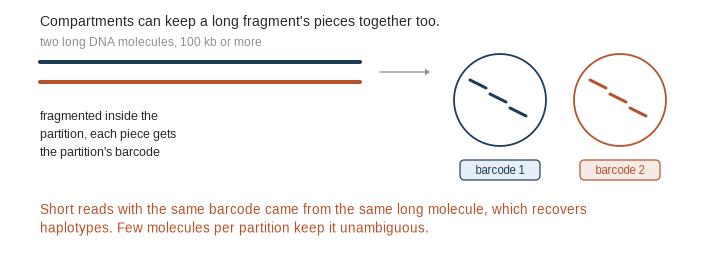
- Long DNA is partitioned so that each compartment holds a few molecules
- Short reads sharing a barcode are linked back to one long fragment
- Poisson again: too many molecules per partition and neighbours are confused
Compartments for complexes
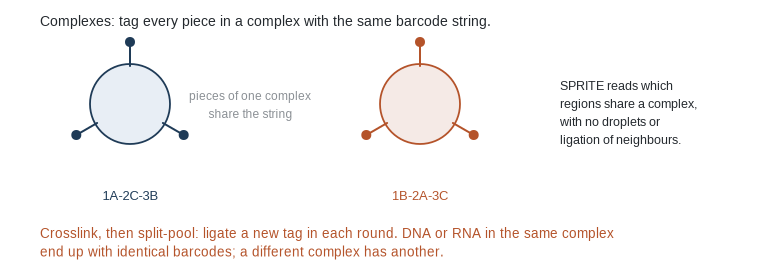
- Crosslinked complexes are split-pooled; each round ligates a tag onto every piece
- Pieces of one complex receive the same string of tags
- A shared barcode string means a shared complex, a ligation-free route to contacts (SPRITE)
Quinodoz et al. 2018, doi:10.1016/j.cell.2018.05.024
Choosing a compartment
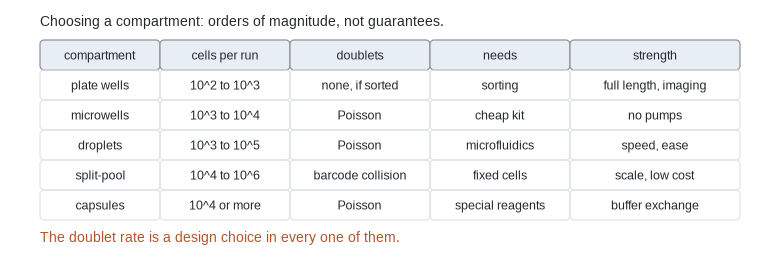
- Scale falls out of how many compartments you can make without hands
- Fixation, nuclei and capsules widen what can be profiled
- Figures are orders of magnitude, so check the current kit sheet