The enzyme toolbox: nucleases
Building blocks · NGS library preparation
A map of the nucleases
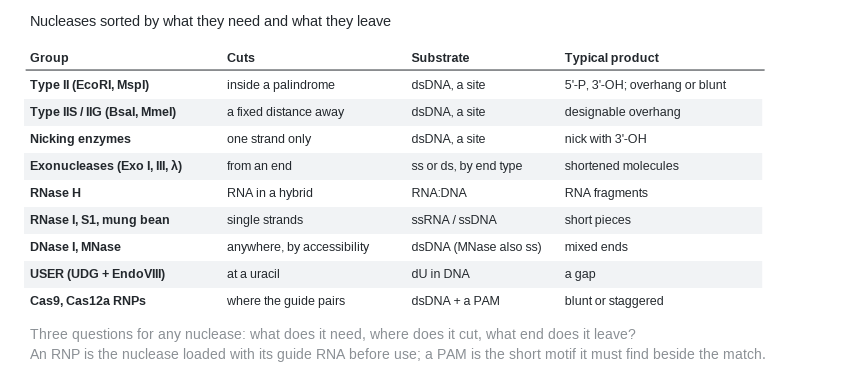
- Sort first by substrate (DNA or RNA, single or double stranded), then by position
- Group names hide big differences: “exonuclease” alone tells you almost nothing, the end it needs does
Type II and Type IIS restriction enzymes
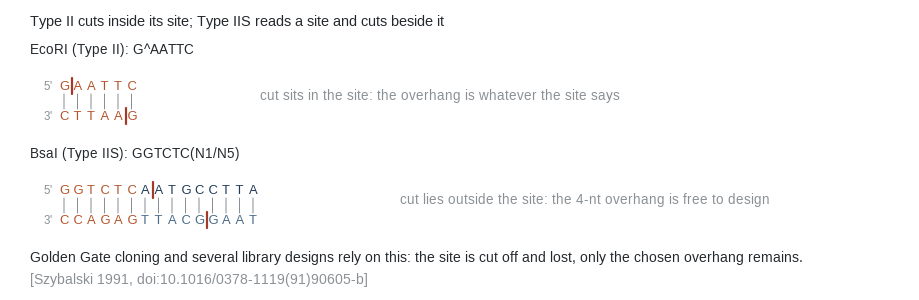
- Type II: cuts inside a short, usually palindromic site. Overhangs are fixed by the site
- Type IIS / IIG: recognises a site and cuts a defined distance away, so the overhang is yours to design, and the site is cut off and lost
- Library uses: Golden Gate assembly, and tag-trimming enzymes that cut 20 bp from their site to give a fixed-length tag (fragmentation)
Szybalski 1991, doi:10.1016/0378-1119(91)90605-b
Methylation-sensitive pairs
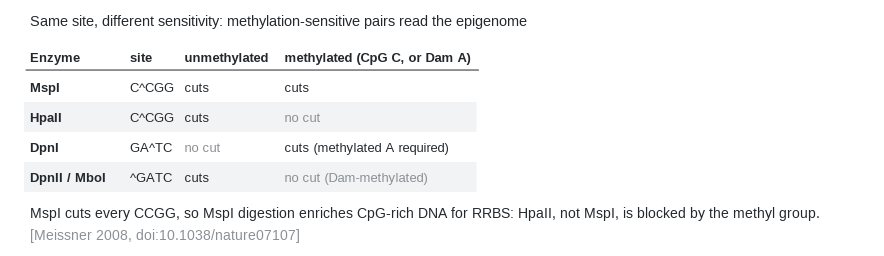
- The same site, a different answer when the C is methylated. The pair reads the epigenome without any conversion chemistry
- RRBS digests with MspI and so enriches the genome for CpG-rich DNA, which is why it is cheap, and why it sees only a minority of all CpGs
- Methylation is erased by PCR, so the same digest of genomic DNA and of its own PCR product can give different answers
Meissner 2008, doi:10.1038/nature07107
Nicking enzymes

- A nicking enzyme cuts one strand of its site. The nick has a free 3’-OH
- Combined with a displacing polymerase it makes a loop: nick, extend, displace, nick
- This is the engine of several isothermal amplifications and of strand-specific cuts in library designs
Exonucleases
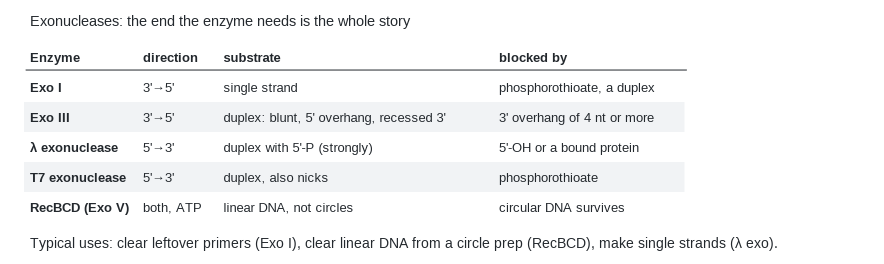
- Pick by the end the molecule has: single or double strand, 3’ or 5’, protected or not
- Exo I cleans up leftover primers after PCR; λ exonuclease needs a 5’-phosphate, which makes it a way to turn a duplex into a single strand
- A phosphorothioate at an end resists most of them: a protection you can order with the oligo (nucleic acids)
RNase H and the two sides of one activity
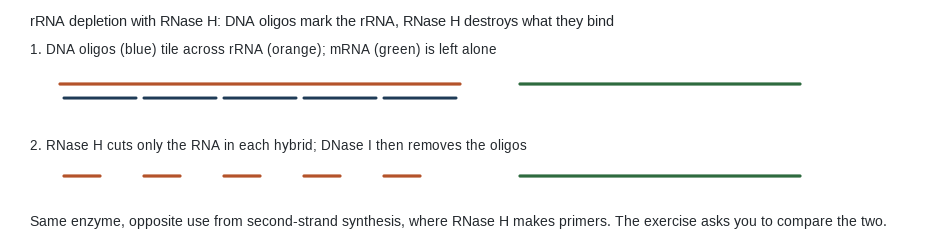
- RNase H cuts the RNA in an RNA:DNA hybrid and leaves everything else
- In second-strand synthesis it makes RNA primers; in rRNA depletion it removes the RNA that an oligo marked (selection)
- The same enzyme, opposite goals: the other component (what the DNA oligos are) decides
DNase I and MNase: cutting by accessibility
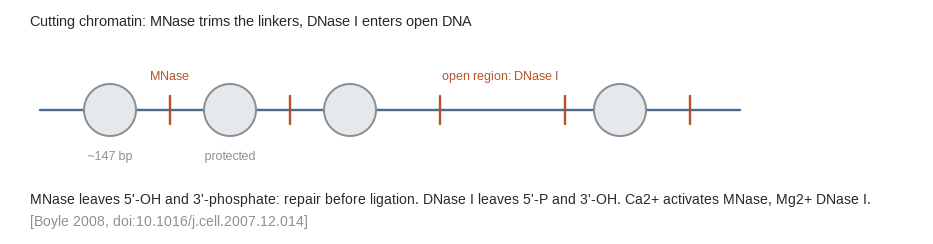
- MNase cuts linker DNA between nucleosomes and leaves ~147 bp protected: it maps positions and occupancy
- DNase I preferentially cuts open chromatin: its sites are the hypersensitive sites (chromatin)
- Their ends differ: DNase I leaves 5’-P/3’-OH, MNase leaves 5’-OH and 3’-P, which must be repaired before ligation (end chemistry)
Boyle 2008, doi:10.1016/j.cell.2007.12.014
USER: a cut at every uracil
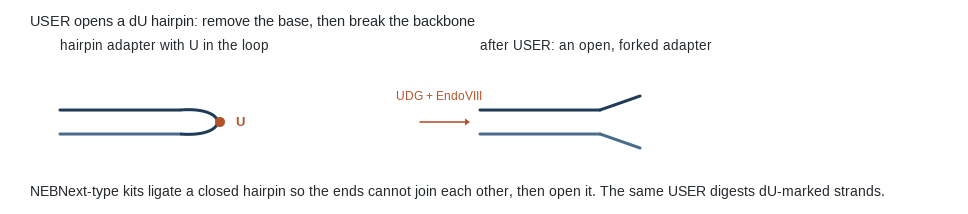
- A glycosylase (UDG) removes the uracil base; a lyase (EndoVIII) breaks the backbone on both sides, so the cut leaves a gap, not a nick
- A U placed in a hairpin loop gives a closed adapter that is opened only when you want it (the trick, and where it is used)
- Uracil in a whole strand (dUTP) gives strand removal; nothing else is cut
Cas9 and Cas12a: nucleases you aim
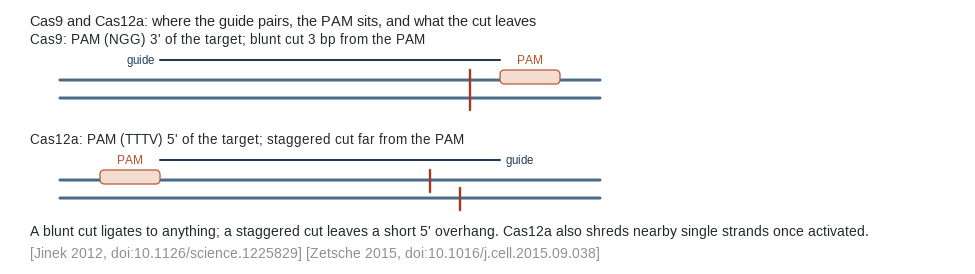
- An RNA guide loads the nuclease, which cuts wherever the guide pairs next to a PAM — a short fixed motif the enzyme must find beside the match, so not every sequence is targetable
- Cas9: blunt cut. Cas12a: a staggered cut with a short 5’ overhang
- In libraries they deplete unwanted sequences (DASH removes abundant sequences before amplification) or cut a target to attach adapters (targeted sequencing)
Gu 2016, doi:10.1186/s13059-016-0904-5