Quiz: Derived tables and figures
Try each question before opening its hint or answer.
Q1. A plant begins at 25.7 mm and ends at 44.3 mm. What should growth_mm = final_mm - initial_mm produce? Does adding this column change the source CSV?
Distinguish the derived R table from the file it was imported from.
18.6 mm. mutate() creates or changes a column in its returned table. The source CSV stays unchanged unless a separate write operation replaces it.
Q2. Which chooses rows and which chooses columns?
filter(seedlings, treatment == "treated")
select(seedlings, plant_id, growth_mm)Ask whether the operation selects observations or variables.
filter() chooses rows meeting the treatment condition. select() chooses the two named columns.
Q3. 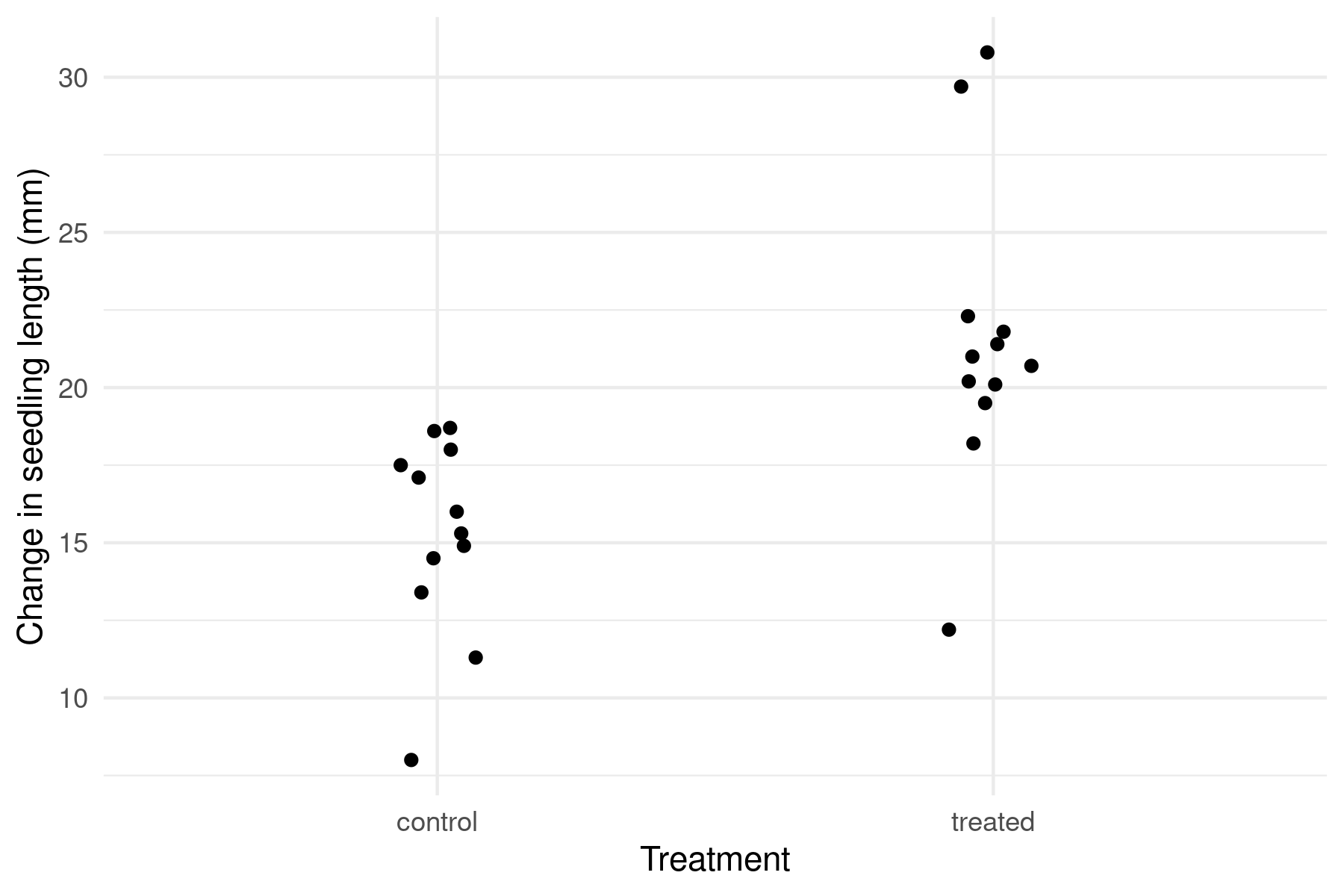
What does one point represent, and why does horizontal jitter not create additional observations?
Read the vertical axis and distinguish display position from a measurement.
One point is one plant’s change in length, in mm. Horizontal jitter separates overlapping points; height = 0 keeps every growth value unchanged. The number of plants is unchanged.
Q4. Collected product is 0.62 g from a supplied maximum of 1.00 g. Another run collects 0.90 g from a maximum of 2.00 g. Using 100 × collected / maximum, which has the higher percentage yield?
Compare ratios rather than collected masses alone.
The first yields 62% and the second 45%. The larger collected mass has the smaller percentage because the starting scales differ.
Q5. Required stock volume is target concentration × final volume / stock concentration. For stock 500 mmol/L, target 50 mmol/L, and final volume 50 mL, how much stock is required? What if stock is instead 100 mmol/L and target is 200 mmol/L?
The concentrations use the same units. Compare the calculated volume with the requested total.
The first case needs 5 mL. The second formula gives 100 mL for a requested 50 mL total, so that request cannot be met by adding solvent alone. Keep and flag the impossible request.