Design patterns, failure modes and the capstone

Quality control and design · NGS library preparation

Johan Henriksson

A protocol is a program of blocks

A library preparation looks like a list of reagents and times. Read it as a sequence of blocks, each of which does one thing to the ends or the content of the molecule.

The skill this deck teaches:

  1. Read a protocol as blocks, and draw the construct after every step
  2. Predict how it fails, from what each block leaves behind
  3. Choose controls that tell the failures apart
  4. Design your own, which is the capstone exercise

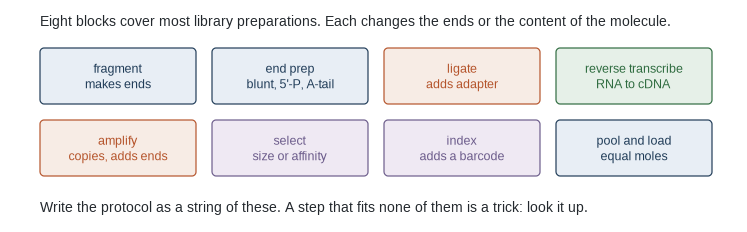
Eight blocks

  • Every protocol in the NGS 101 collection is a string of these, with some tricks inside
  • When a step fits none of the blocks, it is a trick: look it up in the catalogue
  • Most designs differ in how they add ends and how they select

Draw the construct: DNA
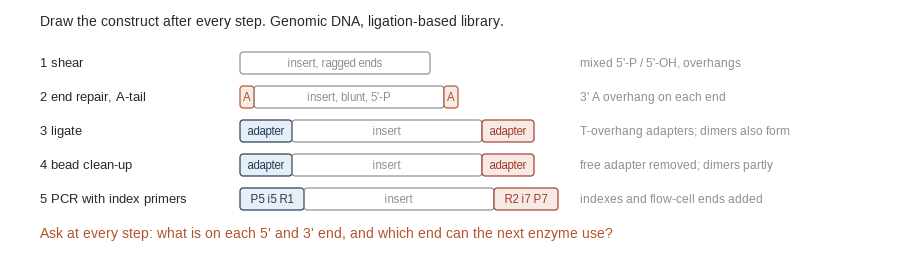
  • Example: a ligation-based library, as in NEBNext Ultra II or TruSeq DNA PCR-Free
  • The question at each step is what is on the 5’ and 3’ end: that decides what the next enzyme can do (end states)
  • A proofreading polymerase would remove the A-tail at step 2: this is the kind of error a drawing exposes

Draw the construct: RNA
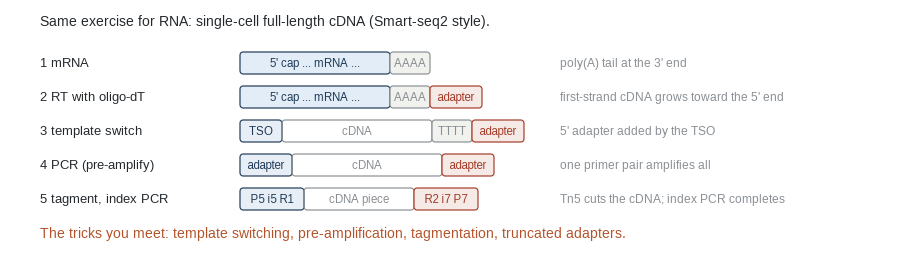
  • Example: SMART-seq2 Picelli et al. 2013, doi:10.1038/nmeth.2639
  • RNA brings new questions: which end is which (cap, poly(A)), and which strand is read (full-length cDNA from one cell)
  • Drawing also shows what cannot happen: without a poly(A) tail, step 2 has nothing to prime on

The ledger

For each step, write four things beside the drawing:

What Why it matters
5’ and 3’ chemistry of each end decides ligation and extension
strands: single, double, hybrid decides which enzymes act
what can prime, and what is blocked decides what amplifies
what is removed afterwards decides what carries over

An unexplained step is an unexplained failure mode. If you cannot fill in a row, find the source paper or the kit’s notes before you run it.

Tool: Annotate

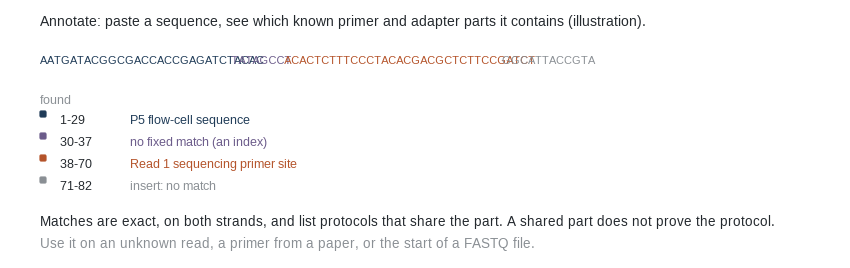
  • The NGS 101 Annotate sequence tab recognises known adapter and primer parts in pasted DNA
  • The variable parts, the indexes and your insert, are left unmatched: that is informative
  • Try it on the first 100 bases of a FASTQ file when you do not know what library you hold

Tool: Anneal
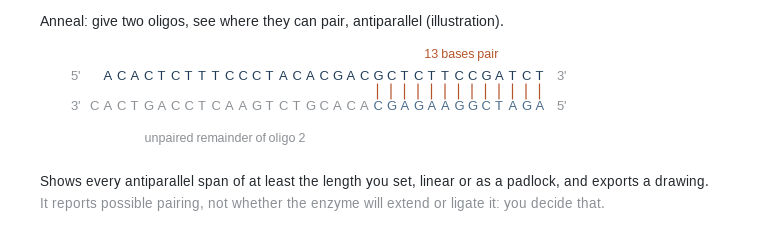
  • The Anneal primers tab lists every place two oligos can pair, linear or as a padlock
  • Use it to check a design: does the primer pair with the adapter where you intend, and nowhere else?
  • It shows possible pairing: whether an enzyme extends or ligates it is your call

Tool: Sample-sheet indexes
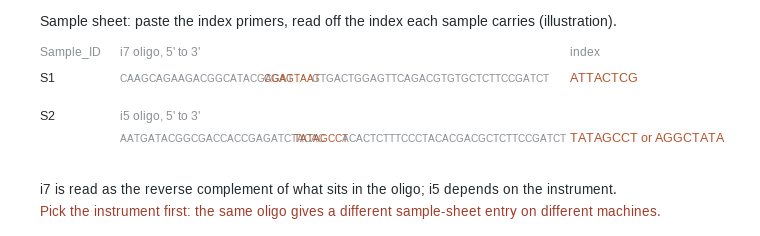
  • The Sample-sheet indexes tab locates i7 and i5 in primer oligos and gives the entry for the sample sheet
  • It is the quickest check that an order sheet and a sample sheet agree
  • The i5 orientation depends on the instrument Kircher et al. 2012, doi:10.1093/nar/gkr771

Failure modes: signature and control

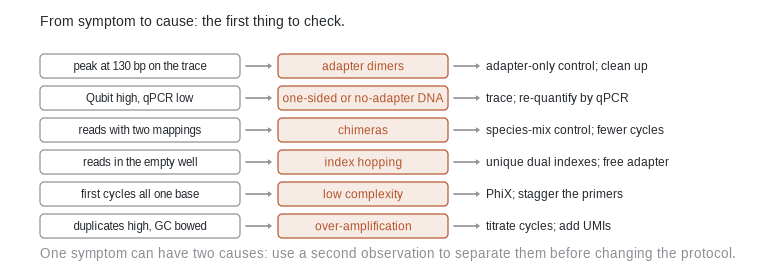
Every failure has a signature (what you see) and a control (what proves the cause).

Failure Signature Control
adapter dimers 130 bp peak; reads all adapter adapter-only reaction
one-sided products Qubit well above qPCR qPCR; reference sample
chimeras split reads species mix
index hopping reads in empty wells blank in pool; unique dual indexes
low complexity skewed first cycles PhiX; staggered primers
over-amplification duplicates; GC bias titration; UMIs
off-target ligation skewed abundance spike-in; no-template control

The controls in the last column are defined later in this deck, under What each control means.

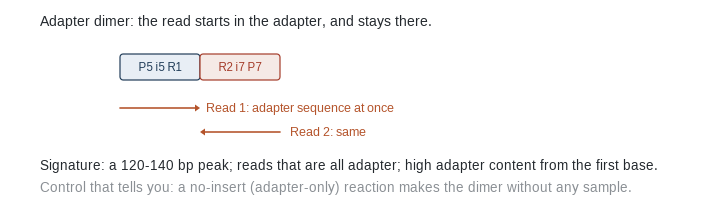
Adapter dimers

  • Cause: adapters ligate to each other when insert is scarce or adapter is in excess
  • Why it is bad: the dimer clusters better than the library and the reads are all adapter Head et al. 2014, doi:10.2144/000114133
  • Control: a reaction with adapters and no insert makes the dimer on its own, so you know its size

One-sided products
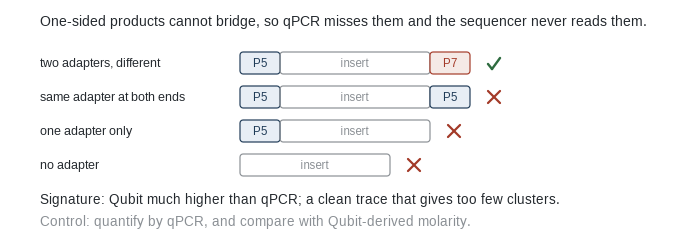
  • Cause: one adapter missing, or the same adapter on both ends
  • Why it is bad: it is DNA that carries mass but no clusters, so you over-estimate the library
  • Control: quantify by qPCR, which only counts both-adapter molecules, and compare with Qubit

Chimeras
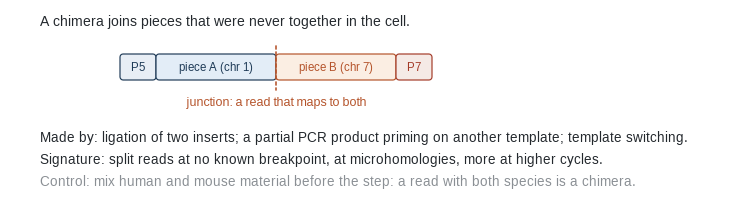
  • Cause: ligation of two inserts; an incomplete PCR product priming on another template; template switching
  • Known source: chimeras form in whole-genome amplification (MDA, MALBAC and PTA) Lasken and Stockwell 2007, doi:10.1186/1472-6750-7-19
  • Control: mix human and mouse cells or DNA before the step: a read with both species is a chimera

Index hopping
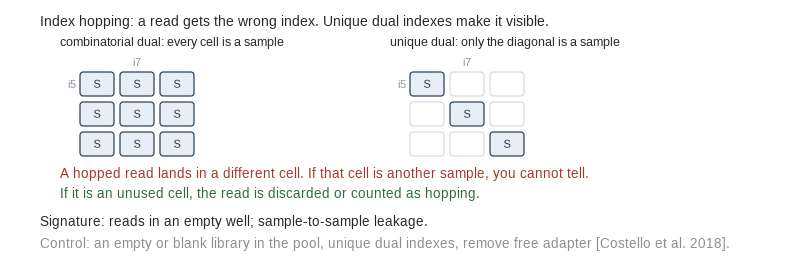
  • Cause: free adapter or primer in the pool primes an extension on another molecule on the flow cell Costello et al. 2018, doi:10.1186/s12864-018-4703-0
  • Seen in: patterned flow cells, and a leak of reads between samples van der Valk et al. 2019, doi:10.1111/1755-0998.13009
  • Fix: unique dual indexes; thorough clean-up of free adapter before pooling

Low complexity
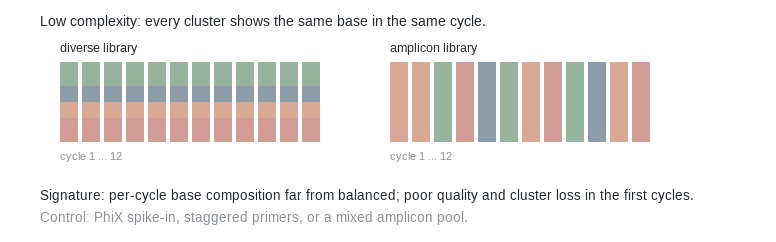
  • Cause: every molecule starts the same: amplicons, CRISPR guides, restriction-site libraries
  • Effect: the instrument cannot find clusters or estimate phasing in the first cycles
  • Fix: PhiX, staggered primers, or a mixed pool; the sequencer deck covers why, and guide readouts are where it bites

Over-amplification
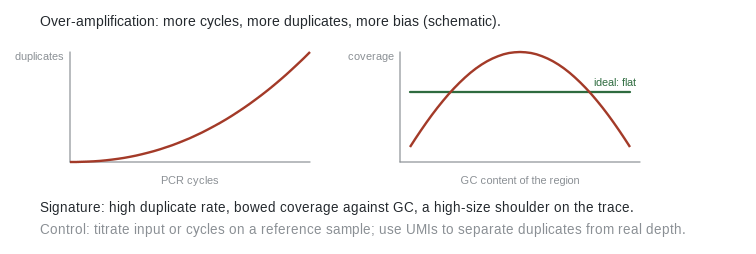
  • Cause: too many cycles, or too little input
  • Effect: duplicates, GC bias, and small differences amplified into large ones Aird et al. 2011, doi:10.1186/gb-2011-12-2-r18; see also Ross et al. 2013, doi:10.1186/gb-2013-14-5-r51 and Kebschull and Zador 2015, doi:10.1093/nar/gkv717
  • Control: a diagnostic qPCR, and UMIs where input is low (collapsing reads to molecules)

Off-target ligation
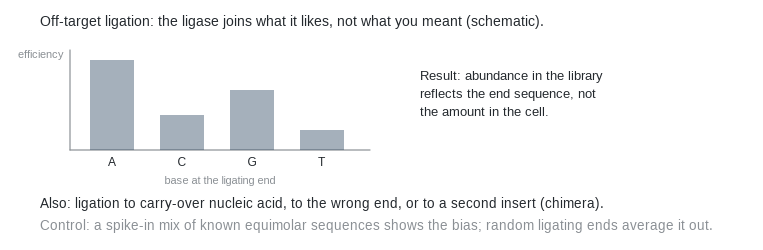
  • Cause: ligases prefer some end sequences, and join what is present: carry-over, second inserts, the wrong end (which ends a ligase joins)
  • Effect: abundance in the library is a property of the ligase, not the sample
  • Control: a spike-in mix of known equimolar sequences; a no-template reaction for what the tube brings

Controls: which one for which
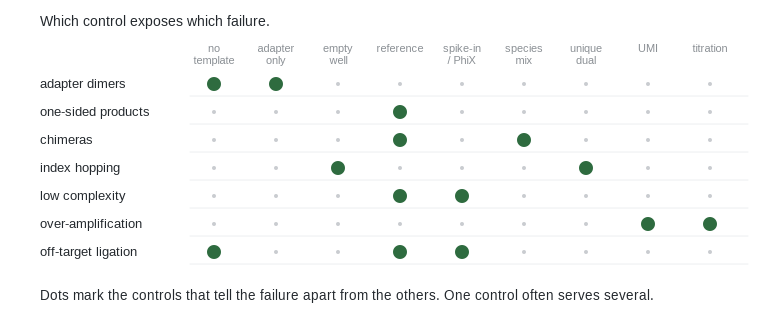
  • One control can cover several failures: a reference sample runs through the whole protocol
  • Write the expected result before the experiment, not after
  • A control you cannot afford to run on every batch can be run once per kit lot

What each control means

  • No-template: reagents and carry-over only; reads here are contamination
  • Adapter-only: shows the dimer’s size and the cycle at which it appears
  • Empty well in the pool: any reads are hopping or index contamination
  • Reference sample: a cell line or standard DNA, whose result you know; flags drift between batches
  • Spike-in / PhiX: known sequences in known amounts; show bias, error rate and diversity
  • Species mix: human and mouse cells together; cross-species reads are chimeras or doublets (the barnyard test)
  • Titration: the same sample at three inputs or cycle numbers; the trend shows saturation

A worked diagnosis

  • The table gives the first suspect. Two symptoms together give a cause
  • Example: duplicates high and Qubit well above qPCR points to over-amplification, not to one-sided products alone
  • Change one thing at a time, and write what changed

The capstone

Design a library preparation for a question of your own choosing, and hand in a document that satisfies every line:

The rest of this deck works one design against that list: chromatin accessibility in 500 human CD34+ cells. The exercise page repeats the list.

A worked outline

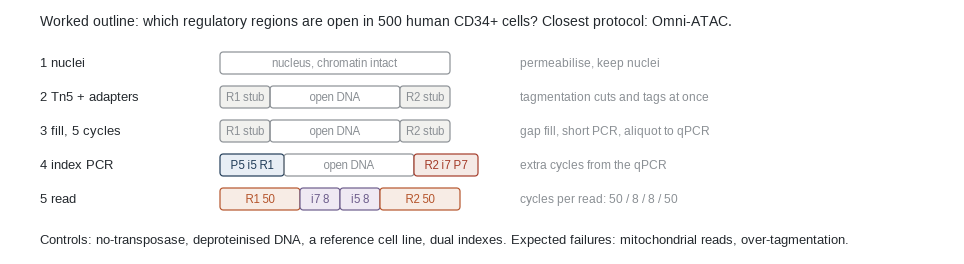
  • Question: which regulatory regions are accessible in 500 human CD34+ cells? (accessibility assays)
  • Closest protocol: Omni-ATAC Corces et al. 2017, doi:10.1038/nmeth.4396, with the cycle choice from ATAC-seq
  • Differences to state: the cell type, the low input, and any change you would make for a smaller sample

The construct, after every step
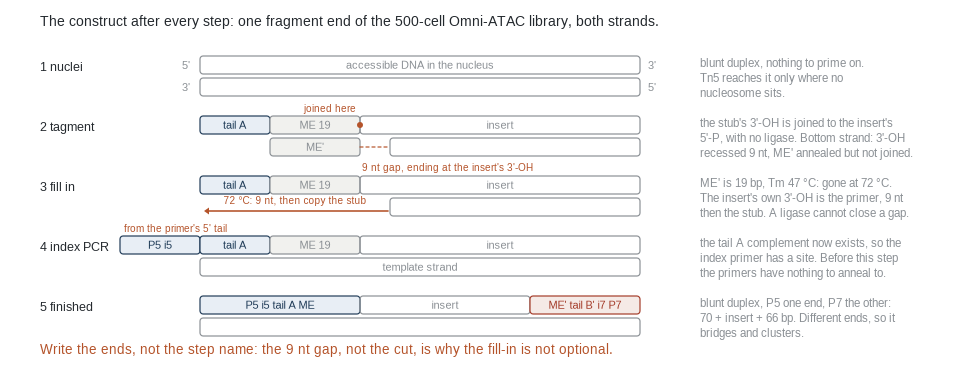
  • One fragment end, both strands; the note beside each row is that step’s ledger entry
  • Tn5 joins its own 3’ end to the insert’s 5’ end, so no ligase appears (transposases)
  • The gap is filled from the insert’s own 3’-OH at 72 °C; before that the index primers have no site

The oligos, written out
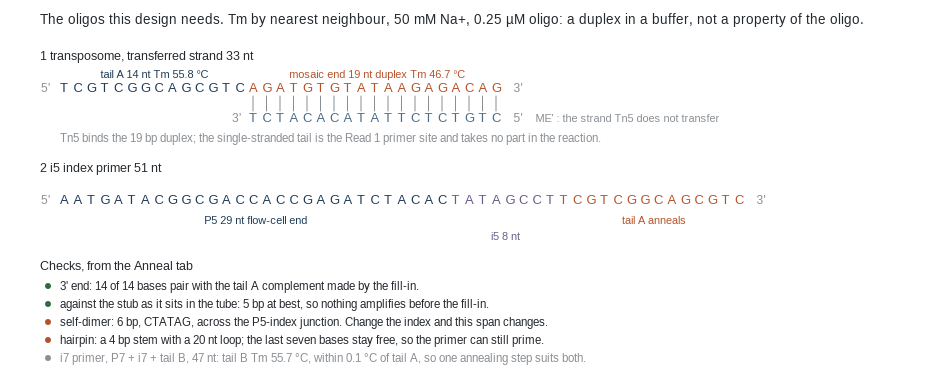
  • Parts from the construct the course already uses (the library molecule)
  • Only the 14 nt tail anneals, so the Tm that matters is the tail’s (a duplex in a buffer)
  • What the Anneal primers tab is for: intended pairing long, unintended pairing short and off the 3’ end

Justify enzymes from the selection charts

Vendor charts (for example NEB’s polymerase, ligase and nuclease selection tools) are organised by properties, as in the nuclease chart. Write which property decides:

Choice Deciding property
A-tailing polymerase no 3’→5’ exonuclease, so it does not remove the A
PCR polymerase proofreading and bias versus speed and yield
RNA adapter ligase needs ATP or pre-adenylated adapter; truncated ligase gives fewer side products
reverse transcriptase template switching; RNase H activity; temperature
uracil cleavage USER (UDG plus endonuclease VIII) only cuts at U

A choice with no deciding property is not yet a choice.

The same, for this design

Step Enzyme Deciding property
tagment hyperactive Tn5, loaded with the two stubs cuts and transfers the adapter in one step, leaving a 9 nt stagger; the amount per nucleus sets the fragment size
stop none: SDS, heat or a column Tn5 stays on the product and blocks the next step, so it is stripped rather than inhibited
fill the gap the PCR polymerase, first cycle at 72 °C extends a recessed 3’-OH at 72 °C, hot-start so nothing extends while Tn5 is still bound
index PCR high-fidelity, low-bias polymerase even yield across the GC-rich sequence of open chromatin; errors made early are carried into the library

Displacement is not a property this design has to choose on: ME’ is 19 bp, Tm 47 °C, so it has left the molecule before 72 °C. No ligase appears anywhere, so adapter dimers cannot form the way they do in a ligation protocol.

Predict the read structure

Work from the construct to cycles per read.

  • Reads start at the sequencing-primer site, so Read 1 reads the first insert bases (construct to read structure)
  • Indexes are read by their own primers: 8 + 8 cycles for two 8-nt indexes
  • Insert length sets how far reads run before reaching the other adapter: a 120 bp ATAC fragment read 50 + 50 never reaches the adapter, a 40 bp one does, and needs trimming
  • Say which read holds a barcode or UMI, and how many cycles it needs

Write: Read 1 / Index 1 / Index 2 / Read 2 as cycles, as in the example: 50 / 8 / 8 / 50.

Compared with Omni-ATAC

500 cells is 3.3 ng (6.6 pg per cell): 1000 copies of every locus, of which about half carry one stub of each kind, and two clean-ups at 80% leave roughly 320 amplifiable molecules per accessible site.

What Taken, or changed and why
lysis in NP-40, Tween-20 and digitonin; the Tween-20 wash; the reaction in PBS with digitonin taken unchanged: mitochondrial reads are the same problem at any input (the detergents, one by one)
transposome per reaction scaled down with the nuclei: fragment size is set by enzyme per DNA, so the published amount would over-tagment 500 nuclei
cycles 5 pre-amplification cycles, then the diagnostic qPCR, as published. ATAC-seq is written for 50,000 nuclei; 100-fold less is about seven doublings, so expect about that many more cycles, with the qPCR fixing the number
depth capped by the budget above, not by the instrument: at 30 reads per site, 30/320 is 0.09 reads per molecule and about 96% are unique; at 300 it is 0.94 and about 65%

Closing the design at QC

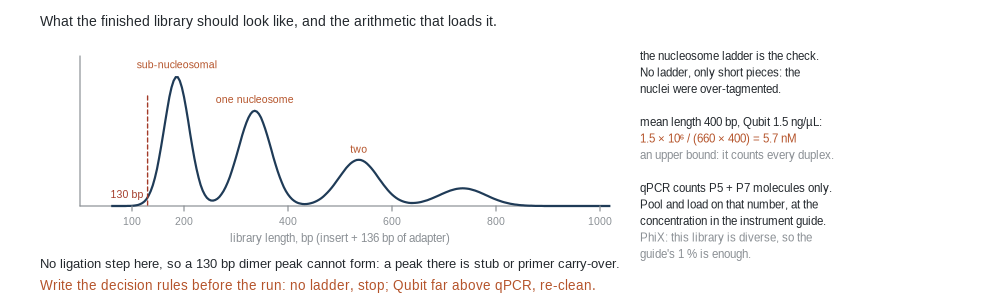
  • The trace is the first place this design can be shown to be wrong: the nucleosome ladder is the evidence that the enzyme-to-nuclei ratio was right (fragment length carries information)
  • Qubit gives mass and qPCR gives molecules that can cluster; the two disagreeing is the one-sided-product signature from earlier in this deck
  • The loading concentration is instrument and kit specific, so it comes from the guide (cleanup and QC); the stop rules are written before the run, not after it

Where this connects

The whole course, in the order a designer meets it.

What the data must show

Getting the molecule into shape

  • Fragmentation — the size the question and the sequencer both need
  • Attaching a handle — the five ways to put known sequence on unknown DNA
  • End chemistry — which ends may ligate, and which are switched off
  • Selection — keeping what you came for, and what the ratio costs
  • Compartments — when every molecule must carry its cell of origin

Labelling and copying

Reagents, instrument, verdict