The enzyme toolbox: transposases and modifying enzymes
Building blocks · NGS library preparation
What this deck is for
Two groups of enzymes that do not fit the cut-copy-join pattern:
- Transposases cut DNA and attach adapters in one step
- Modifying enzymes exist to make something readable that the sequencer cannot otherwise see: a methyl group, an undamaged base, which 5’ ends were capped, an end with no sequence of its own, an RNA too scarce to sequence directly
- A sequencer reports bases, so every one of them turns a property into a base, an end or a copy number (converting chemistry into sequence)
Both groups are used for what they happen to do, so the skill is the same: identify the activity, then ask what else the enzyme does in the tube. The deck closes with the skill itself.
Tn5: cutting and tagging in one step
![]()
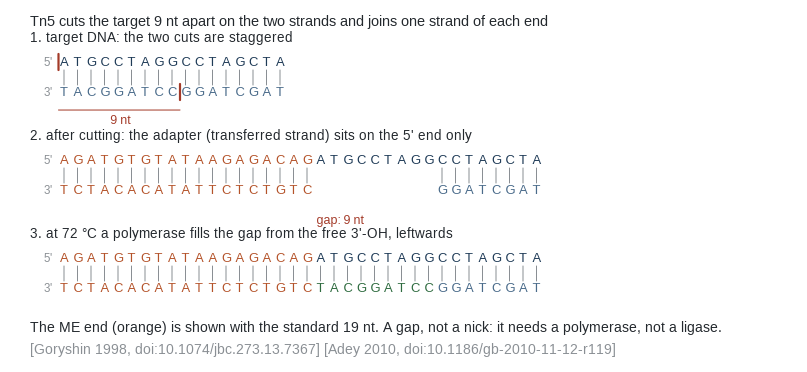
- A Tn5 dimer carrying two 19 nt ends cuts the target 9 nt apart on the two strands and joins the adapter’s 3’-OH to each new 5’ end
- The result: adapter on each fragment’s 5’ end only, and a 9 nt gap between the fragment’s 3’-OH and the adapter beyond
- This is tagmentation: fragmentation and adapter addition in one reaction (fragmentation)
Two adapters, four outcomes
![]()
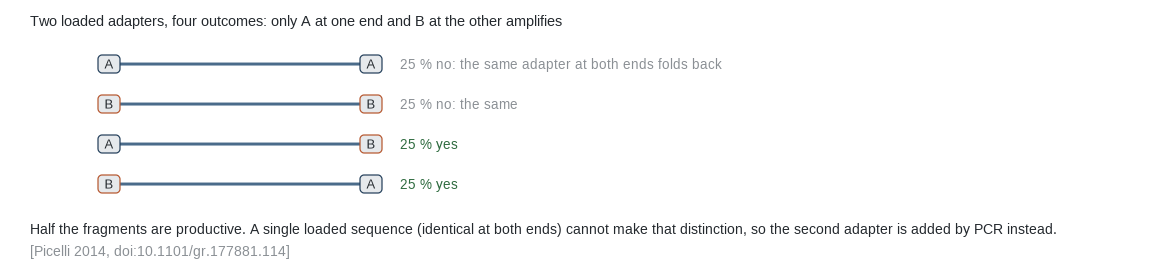
- With two loaded adapters (A, B), half of the fragments carry A at one end and B at the other
- Fragments with the same adapter at both ends mostly do not amplify: they fold back on themselves
- The proportion is a property of the chemistry, not the sample, and it is why the yield of usable library is lower than the DNA mass suggests (attaching a handle compares this with ligation)
Controlling size and stopping the reaction
- Fragment size is set by transposome per DNA: more enzyme, more cuts, shorter pieces
- Mg2+ starts the reaction, and Tn5 stays bound to the product after cutting
- It must be stripped (SDS, heat, or a column) before PCR, or the fragments will not amplify
- A hyperactive Tn5 with a few point mutations is what makes in vitro tagmentation efficient
Goryshin 1998, doi:10.1074/jbc.273.13.7367
The gap is a polymerase step, not a ligase step
- A gap has bases missing; a ligase cannot close it (end chemistry)
- At 72 °C a polymerase extends the fragment’s 3’-OH across the gap and copies the adapter beyond it. Ordinary PCR enzymes do this, which is why the step is hidden inside the first cycle
- Any polymerase that can extend a 3’-OH and is happy at 72 °C will do it. The step shows why the choice of PCR enzyme still matters: a gap needs a polymerase, not a ligase
Adey 2010, doi:10.1186/gb-2010-11-12-r119
Where Tn5 lands is set by what it is attached to
![]()
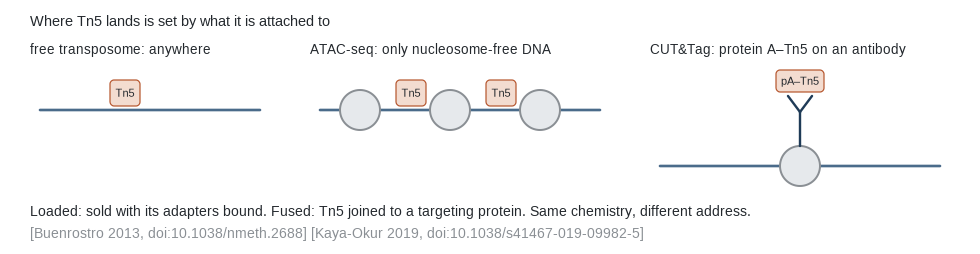
- Free transposome: genome-wide, a little sequence bias
- ATAC-seq: nucleosomes block Tn5, so tags land in open chromatin (chromatin)
- Fused variants carry Tn5 to a protein target: CUT&Tag uses protein A, which binds any antibody, to park Tn5 at an antibody-bound histone mark (tethering)
Buenrostro 2013, doi:10.1038/nmeth.2688
A 9 bp offset that matters at base resolution
![]()
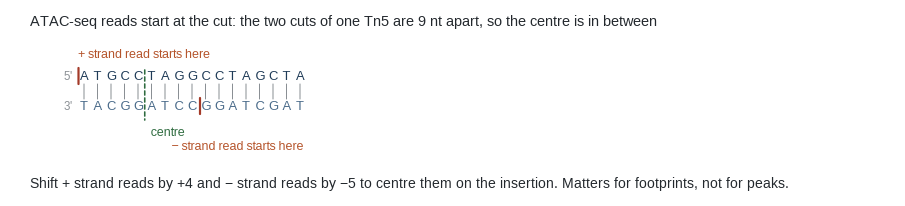
- Read starts mark the cut, not the centre of the insertion
- The two ends of one Tn5 event are 9 nt apart, so reads from the two strands are offset by 9
- Footprinting analyses shift + strand reads by +4 and − strand reads by −5
Other transposases, and Tn5 on RNA
- Tn5 on RNA:DNA hybrids: the enzyme will tagment a hybrid, which lets RNA-seq libraries be made without ligation or second-strand synthesis (small RNA, tag protocols, low input)
- MuA is a phage transposase that works in vitro on the same principle, leaving a 5 bp stagger rather than 9
- Because transposition has sequence preferences, choice of transposase changes which regions are under-represented
Di 2020, doi:10.1073/pnas.1919800117 Haapa 1999, doi:10.1101/gr.9.3.308
Converting methylation without bisulfite
![]()
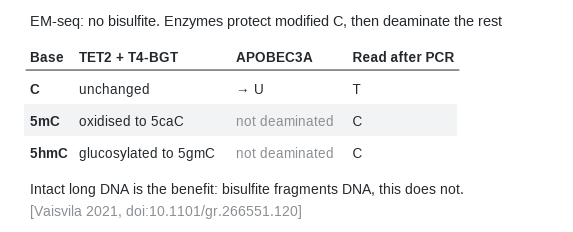
- Made readable: a methyl group, as the cytosines that are not converted
- TET2 oxidises 5mC and 5hmC; T4-BGT glucosylates 5hmC. Both are protected
- APOBEC3A deaminates the cytosine that is left, turning C into U, read as T
- The DNA is not damaged by harsh chemistry — bisulfite conversion deaminates C but fragments the DNA as it goes (modifications) — so libraries can be built from far less input
Vaisvila 2021, doi:10.1101/gr.266551.120
Glycosylases and repair mixes
- Made readable: the base that was there, instead of the damage that reads as a variant
- A uracil glycosylase (UDG) removes U from DNA: used to clean ancient DNA and FFPE-damaged DNA of deaminated cytosines, which would read as C→T
- FPG and similar enzymes remove oxidised bases such as 8-oxoG
- “Repair mixes” bundle glycosylases, lyases, polymerases and ligase so damaged templates can be copied
- Used on a library that depends on U (dUTP strand marking) a glycosylase destroys the mark: check what a master mix contains
Capping and decapping
![]()
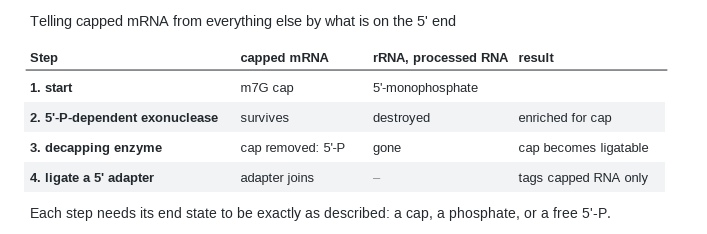
- Made readable: which 5’ ends were capped, because only those can carry the handle
- A 5’ cap is a 7-methylguanosine joined by a triphosphate. A ligase cannot use it
- A decapping enzyme leaves 5’-P, which a ligase can use. A 5’-P-dependent exonuclease removes uncapped RNA first
- The sequence of enzymes makes the difference between “all 5’ ends” and “capped 5’ ends only”
T7 RNA polymerase: linear amplification
![]()
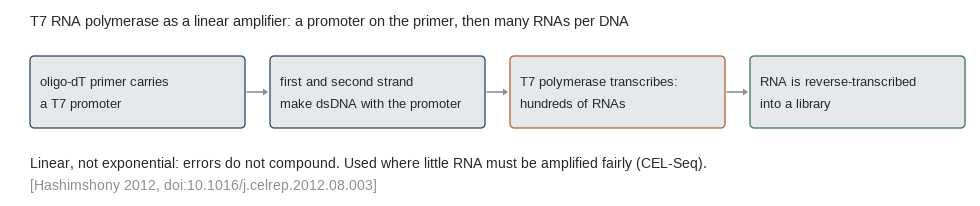
- Made readable: a sample too small to sequence, copied without compounding its errors
- T7 recognises a ~17 bp promoter and makes hundreds of RNA copies per DNA
- Linear amplification compounds no copy errors, so it is fairer than exponential PCR (amplification)
- The cost is an extra RT round, and a bias towards the 3’ end of transcripts
Hashimshony 2012, doi:10.1016/j.celrep.2012.08.003
TdT and poly(A) polymerase: tails without a template
![]()
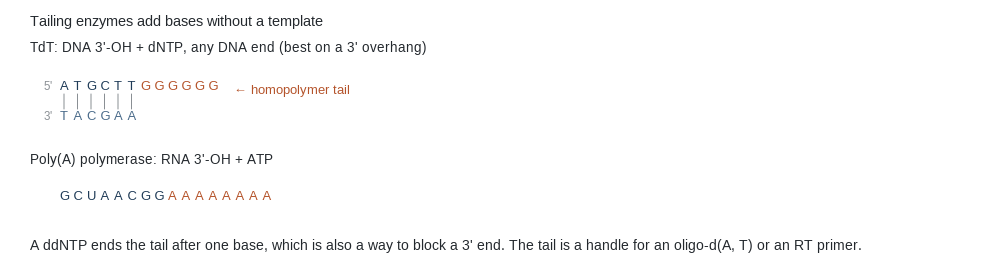
- Made readable: an end with no sequence of its own, by giving it one to prime from
- TdT adds nucleotides to a DNA 3’-OH with no template. Use a single dNTP for a homopolymer, a ddNTP to stop and block
- Poly(A) polymerase adds A’s to RNA 3’ ends, so any RNA can be primed by oligo-dT
- Both generate a handle on an end that has no sequence of its own (tailing as a trick)
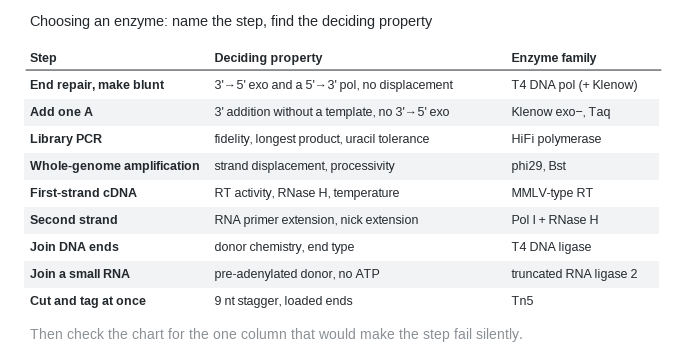
The skill: choosing an enzyme
![]()
- Name the step, then the deciding property: the family follows
- Then find the one chart column that could make the step fail silently, and check it
What to take away
- Polymerases: read the chart columns, not the product name
- Ligases need a 5’-phosphate and a 3’-OH, and everything else is about substrates
- Nucleases: ask what end they need and what end they leave
- Transposases combine cutting and tagging; the gap is a polymerase job
- Those four rows of ligation chemistry, collapsed into one reaction, are the backbone of the polymerase deck: read a protocol by lining up its end states
- Modifying enzymes make a property readable, which is a whole unit of its own (converting chemistry into sequence)
- A silent failure is nearly always an activity you did not know the enzyme had
Next in Part B: attaching a handle to an unknown molecule, using these enzymes.
Where this connects
Also in the toolbox
Where these enzymes are the protocol
- Library molecule — the Nextera construct, and why tagmented libraries start from a stub
- Genomic DNA — tagmentation does fragmentation, repair and adapter addition in one tube
- Combinatorial indexing — sci-ATAC uses Tn5 itself as the first barcoding round
- Modifications: RNA — decapping and cap trapping decide whether a 5’ end is readable
If this fails
- QC — insert size is set by the enzyme-to-DNA ratio and shows up directly on the trace