RNA libraries: mRNA and total RNA
Use cases · NGS library preparation
Start from the question
An RNA library is built around what you want to know. The same cell gives different libraries for different questions:
- How much of each gene? Count molecules, either at the 3’ end or across the gene
- Which isoform, which variant? You need reads that cover the whole transcript, or the whole transcript in one read
- Which strand? Needed wherever genes overlap or antisense transcription matters
- Which class of RNA? Small RNAs, nascent RNA and translated RNA each need a different handle
This deck covers the first of these for bulk mRNA and total RNA, and follows one protocol through: TruSeq Stranded mRNA. The next deck covers small RNA and tag protocols, and follows SMART-seq2 through for full-length cDNA from very little RNA.
Know your RNA
![]()
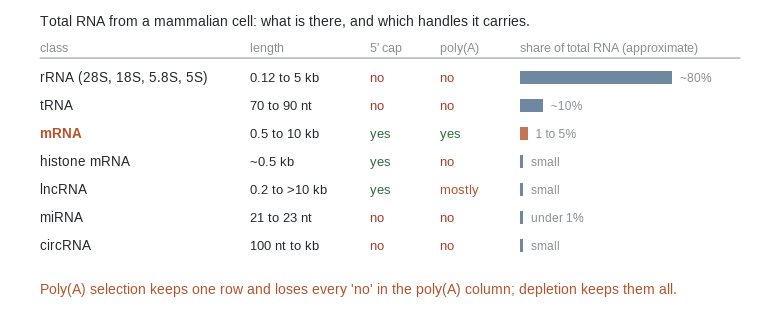
- The ends are your handles: a cap and a poly(A) tail for selection, a 5’ phosphate and 3’ hydroxyl for ligation
What poly(A) selection keeps, and what it loses
Oligo-dT beads hold the 3’ tail of mature mRNA. That is selective, cheap and clean, and it has a price:
- Kept: polyadenylated mRNA, and polyadenylated lncRNA
- Lost: histone mRNA, circRNA, many non-polyadenylated lncRNAs, and everything small
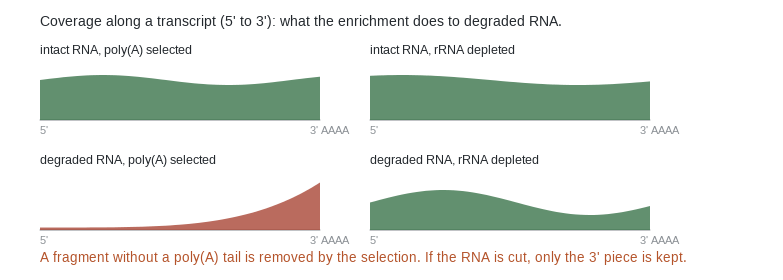
- Lost by degradation: an RNA that has been cut loses its tail, and the 5’ piece is washed away with the rRNA
- Needs intact RNA. Fixed, archival or degraded samples are better served by depletion
The question is whether the RNA class you need has a tail.
Four ways to remove rRNA
![]()
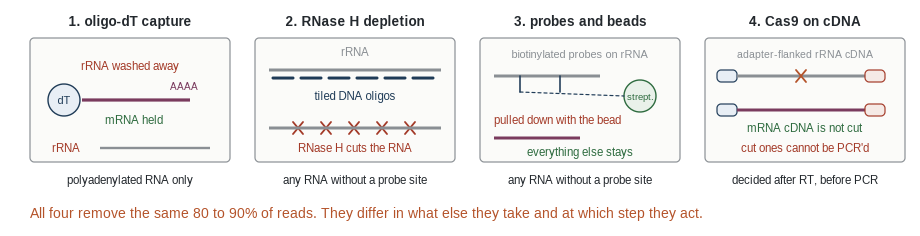
- Positive selection and three kinds of depletion (the four families); depletion keeps non-polyadenylated RNA
Morlan et al. 2012, doi:10.1371/journal.pone.0042882
RNase H depletion
![]()
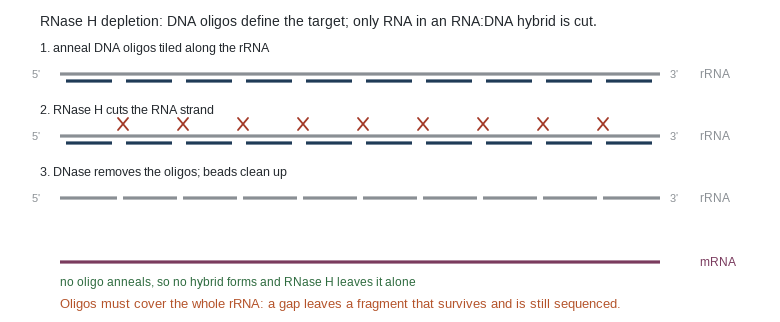
- The oligo set is the product: a probe set for human rRNA must tile all of it, and one designed for another species will not do. RNase H cuts only the RNA of an RNA:DNA hybrid
Morlan et al. 2012, doi:10.1371/journal.pone.0042882
Cas9 on cDNA
![]()
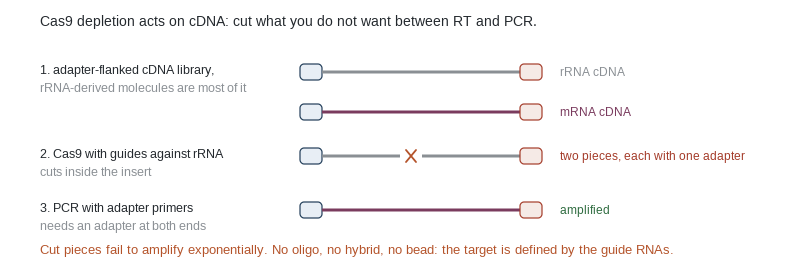
- A guide RNA per target site replaces a bead step; the same idea has been used to remove other abundant cDNAs
Gu et al. 2016, doi:10.1186/s13059-016-0904-5
Choosing between selection and depletion
| Fresh, intact RNA, mRNA is the question |
poly(A) selection |
cheapest, lowest rRNA, deepest per read |
| Degraded or fixed RNA (FFPE) |
rRNA depletion |
tails are lost, so selection loses the 5’ piece |
| Need non-polyadenylated RNA |
rRNA depletion |
histone mRNA, many lncRNAs, nascent RNA |
| Very low input |
neither; amplify from the tail or from a TSO, as SMART-seq2 does |
each bead step loses material |
Depletion costs more reads per transcript because the intronic and pre-mRNA fraction is higher.
Adiconis et al. 2013, doi:10.1038/nmeth.2483
Degraded RNA and 3’ bias
![]()
- Poly(A) selection of cut RNA keeps only the 3’ piece, so the coverage tilts towards the 3’ end
Adiconis et al. 2013, doi:10.1038/nmeth.2483
Priming the first strand
![]()
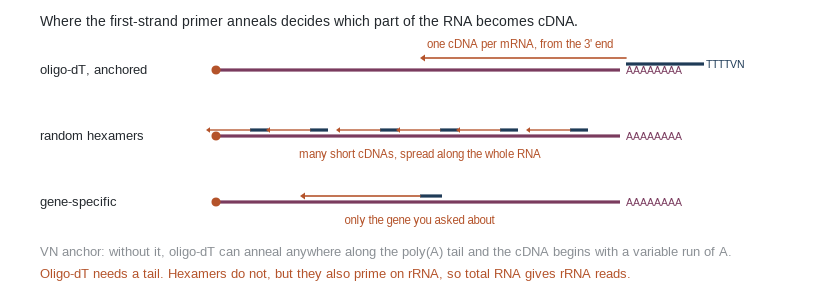
- Choose the primer by what you want covered: the 3’ end, the whole body, or one gene. The primer is also where a tail can carry a handle
What the primer costs you
- Anchored oligo-dT (VN). The V and N pin the primer at the junction between tail and transcript. Without them the primer slips along the tail
- Random hexamers. Even coverage, no tail needed, but the first bases of every read are not random: hexamers anneal preferentially to some sequences Hansen et al. 2010, doi:10.1093/nar/gkq224
- Antisense artefacts. Reverse transcriptase can also copy DNA. Actinomycin D in the first-strand mix blocks DNA-templated extension, which would otherwise make a spurious second strand Perocchi et al. 2007, doi:10.1093/nar/gkm683
A strand-specific library depends on an RT that copies only RNA, so this chemistry is part of the design, not a detail.
Second strand
![]()
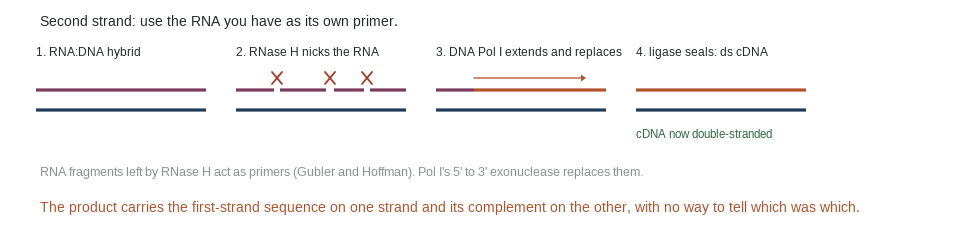
- The RNA is its own primer: RNase H nicks it and DNA polymerase I replaces each piece
Why strand matters
![]()
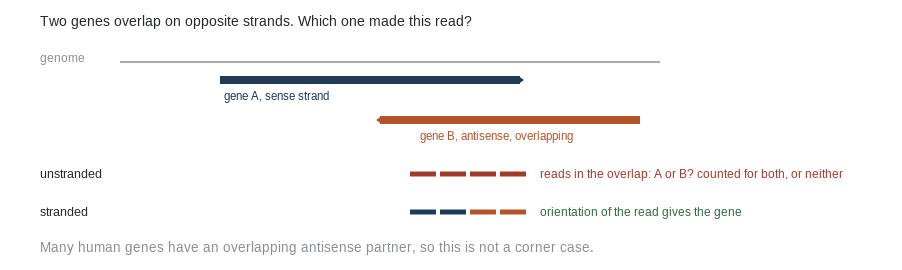
- A standard double-stranded library loses the information in orientation, so overlapping genes and antisense transcripts cannot be told apart
Levin et al. 2010, doi:10.1038/nmeth.1491
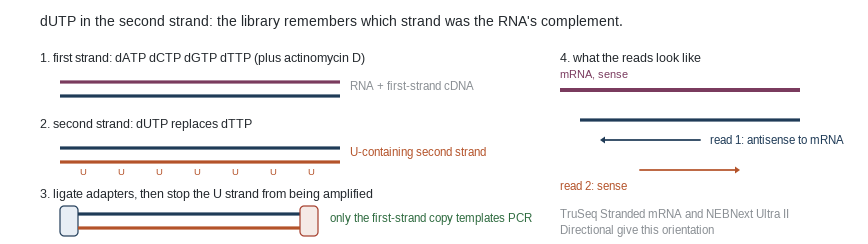
The dUTP trick
![]()
- Replace dTTP with dUTP in the second strand only; the marked strand is then not amplified
Parkhomchuk et al. 2009, doi:10.1093/nar/gkp596
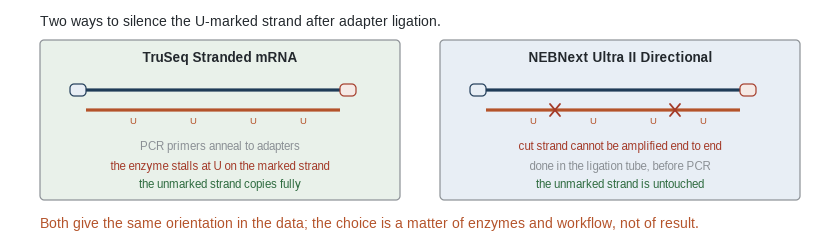
Two ways to silence the U-marked strand
![]()
- The same idea implemented with a polymerase that stalls at dU, or with USER enzyme
Source: Illumina and NEB reference guides; links on the next slides
TruSeq Stranded mRNA, followed to the end
![]()
- Every slide so far is one row of this walk; TruSeq Stranded mRNA is the protocol, and in it the order is the logic
- Fragmenting the RNA rather than the cDNA is what gives the insert size, because RNA breaks at random positions under heat and metal ions — where you cut changes the answer
NEBNext Ultra II Directional: what differs
| Entry |
poly(A) beads |
poly(A) beads or rRNA depletion, as separate modules |
| Fragmentation |
RNA, with priming |
RNA, 94 °C with random primers |
| Strand mark |
dUTP, second strand |
dUTP in the second-strand mix |
| Silencing |
polymerase stalls at dU |
USER enzyme acts in the ligation tube |
| Adapter |
indexed adapter ligated |
hairpin adapter opened by USER |
| PCR |
15 cycles in the guide’s example |
6 to 13, set by input |
Read the NEBNext Ultra II Directional page and ask why a hairpin adapter lets USER do two jobs in one tube. How the USER step acts exactly is not fully published, so check it against the vendor’s manual.
What to look at in the data
- Strandedness: the fraction of reads on the expected strand should be very high; a low value means row 7 did not silence the U strand, or the RT in row 3 copied DNA
- rRNA fraction: a poly(A) library should have very little; a high value says the beads in row 1 did not hold
- 3’ bias: coverage tilted towards the 3’ end says the RNA was already cut before row 1, so only its tailed piece was kept
- Intronic fraction: higher after depletion, since pre-mRNA is retained — a different entry into row 1
Every one of these is a row of the walk failing. That is what following one protocol to the end buys you.
Where this goes next
- Small RNA, tag protocols, low input and full length are in the next deck: it shares the ideas here, adds ligation chemistry for short RNAs and linear amplification, and runs SMART-seq2 through as this deck ran TruSeq
- Try the exercises on choosing a route for a given sample
- The readings cover the primary papers for every protocol named here
Where this connects
Blocks this protocol uses — select the RNA, cut it, copy it, mark the strand, add adapters, amplify
- Selection — oligo-dT, RNase H and Cas9 depletion are three of its families, applied to rRNA
- Fragmentation — heat and metal ions cut RNA, and cutting before the RT is what sets the insert
- Polymerases and RTs — an RT that copies RNA but not DNA, and a polymerase that stalls at dU
- Handles — the RT primer, the tailed primer and the ligated adapter as alternatives
- End chemistry — blunt ends from second-strand synthesis, dA-tailing, USER on a hairpin
- Amplification — the cycle count, and why the dU-marked strand never becomes a template
- Barcodes — index design, and why the index sits in the adapter that is ligated before PCR
If this fails
- Cleanup and QC — the trace of a library made from degraded RNA, and the adapter dimers below it