The enzyme toolbox: polymerases and reverse transcriptases
Building blocks · NGS library preparation
The backbone: TruSeq DNA PCR-free
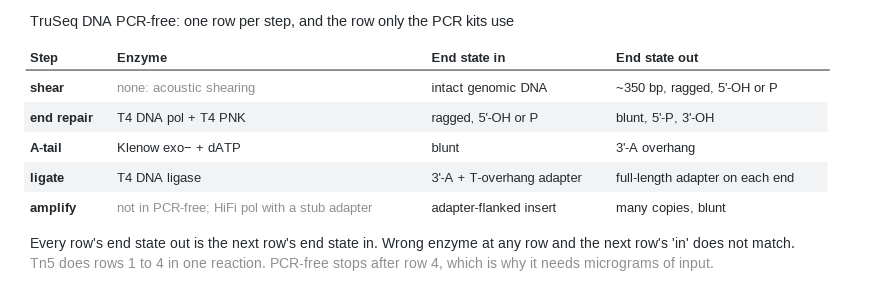
- Each row’s end state out is the next row’s end state in, and one enzyme property decides each row
- Rows 1 to 4 are the ligation route; tagmentation does all four in one reaction (transposases)
- TruSeq DNA PCR-free is traced block by block in genomic DNA
- If two end states in a protocol do not line up, there is a step you cannot see or an enzyme doing something unasked
What a polymerase does
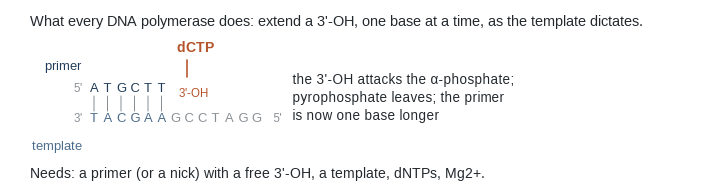
- One chemistry for every enzyme in this deck: a 3’-OH attacks an incoming dNTP
- Everything that differs between enzymes is what else they do: check, cut, displace, tail
- Backbone rows 2, 3 and 5 are polymerase jobs; row 4 belongs to a ligase and row 1 to no enzyme at all
- A polymerase that cannot find a free 3’-OH does nothing, which is why blocked ends matter (end chemistry)
Error rate: what it costs, and when it matters
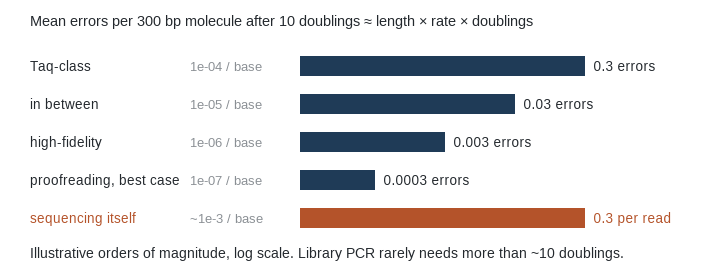
- Decides row 5, and nothing else: with no PCR, no base of the library has been copied
- A high-fidelity library PCR changes the sequence of far fewer molecules than sequencing itself does. For counting reads, error rate rarely matters
- It matters for variant calling from low-frequency molecules (targeted sequencing), long amplicons, cloning and long reads where each error is a single base on a single molecule
- Rates are assay-dependent: compare enzymes inside one vendor’s chart, not across vendors
Lundberg 1991, a proofreading archaeal polymerase, doi:10.1016/0378-1119(91)90480-Y
3’→5’ exonuclease: the proofreader

- A misincorporated base at the primer’s 3’ end stalls extension. The strand frays, slides into the exonuclease site and the base is removed
- That is the whole mechanism of proofreading, and it costs speed
- The enzyme has no memory of why a 3’ base is unpaired: any unpaired 3’ base is treated as an error
- Which is what row 2 uses it for: a 3’ overhang is unpaired, so it is trimmed away
The same exonuclease repairs ends
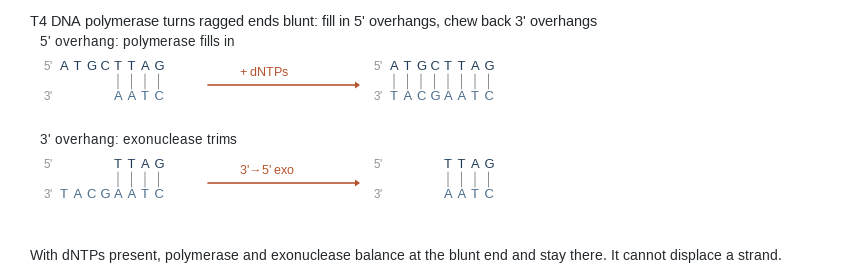
- Row 2 of the backbone: T4 DNA polymerase has a strong 3’→5’ exo and no strand displacement
- On a 3’ overhang the exo trims back until the strand is paired
- On a 5’ overhang the polymerase fills in. With dNTPs present both reach the same blunt end
- Because it cannot displace, it will not wreck the other strand of a nick or a gap
5’→3’ exonuclease and flap endonuclease
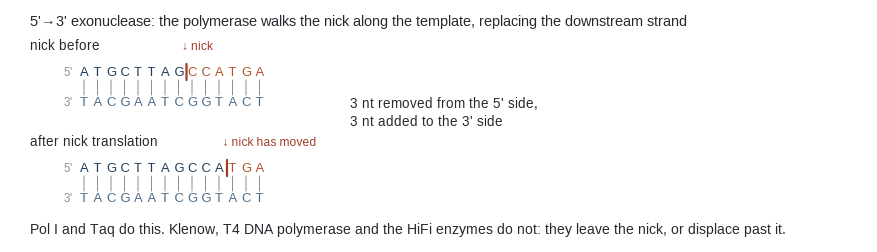
- Pol I and Taq cut away the strand in front of them as they copy. That is nick translation
- Taq’s activity cuts a flap, not a nucleotide at a time: the basis of hydrolysis probes, the labelled oligos a real-time PCR cuts apart to give its signal
- It is why a nick is not a stable mark in a reaction with these enzymes, and why row 2 cannot be done with one of them
- Klenow lacks it (the large fragment was made by removing that domain); T4 DNA polymerase and the HiFi enzymes never had it — HiFi here names the high-fidelity enzyme class, not PacBio’s HiFi reads (long-read instruments)
Strand displacement: three ways to meet a downstream strand
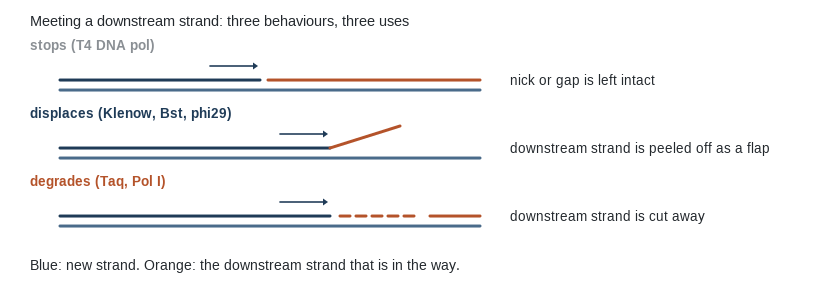
- Stop: leaves nicks and gaps in place. Good for end repair, so row 2 wants it
- Displace: peels the strand off and keeps going. Needed for amplification at constant temperature, and for copying through a nick
- Degrade: chews the strand away. Good for replacing RNA primers, bad for preserving a mark
Using displacement: rolling circles and whole-genome amplification
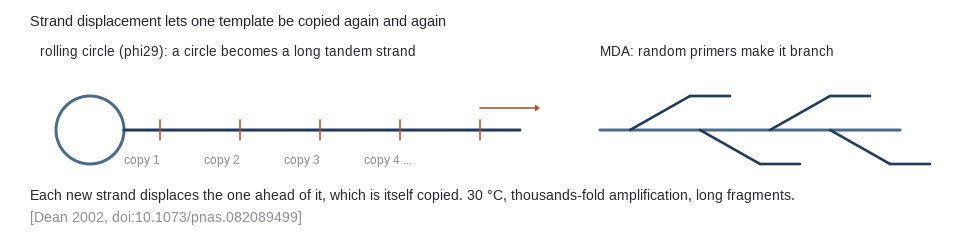
- No row of the backbone needs this: it is displacement spent outside library preparation
- phi29 proofreads, has very high processivity — bases added before letting go — and very strong displacement at 30 °C: no cycling, and products tens of kb long
- MDA adds random primers, so each displaced strand is itself primed and copied (amplification)
- Bst large fragment does the same at 60–65 °C, which is why it is the enzyme of LAMP and of many nicking-based amplifications
The 3’ end the enzyme leaves
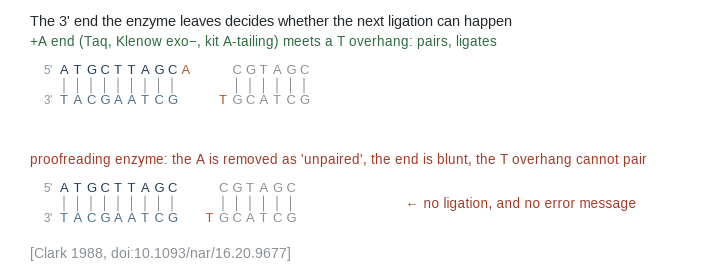
- Row 3 is this property and nothing else: enzymes without a 3’→5’ exo often add one non-templated A, and Klenow exo− does it efficiently, which is why row 3 uses it
- A proofreading enzyme removes that A again, so it makes blunt ends
- Row 4 is what the choice is for: a T-overhang adapter needs the A, a blunt adapter needs blunt (attaching a handle)
An activity RT was not sold for: template switching
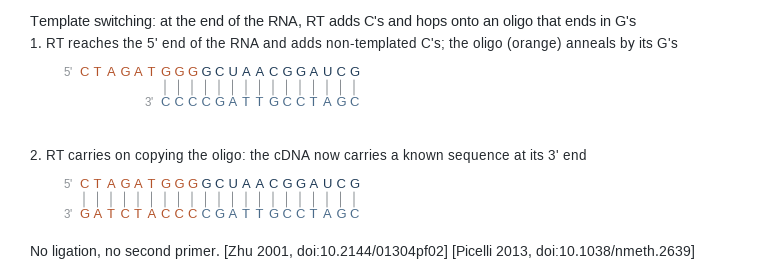
- At the 5’ end of the RNA, MMLV RT adds a few non-templated C’s
- An oligo ending in G’s pairs with them and RT hops onto it as a second template
- The cDNA gets a known sequence at its 5’ end with no ligation: this is how Smart-seq2 makes full-length libraries (NGS 101)
RNA primers and nicks: second-strand synthesis
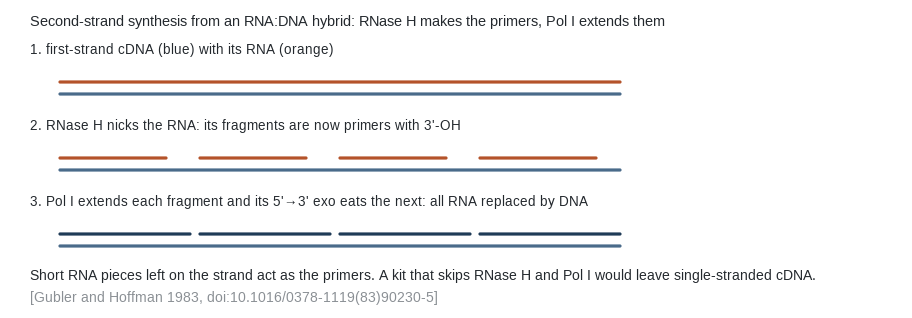
- The RNA route’s own row 2, and it needs two properties at once
- RNA primer extension: the polymerase must extend an RNA 3’-OH with DNA. Pol I-family enzymes do; the HiFi enzymes do not. The primers come from RNase H (nucleases)
- Nick extension: it must start at a nick. Displacers and degraders do, a pure filler like T4 DNA polymerase does not
- Gubler–Hoffman second strand needs both, plus a 5’→3’ exo to remove the RNA ahead
dU tolerance: reading through uracil
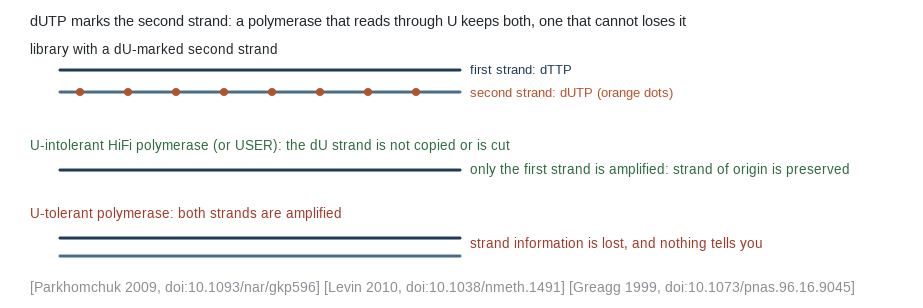
- Archaeal family-B enzymes (Pfu and its engineered descendants) have a read-ahead pocket that detects uracil in the template and stalls. It protects them from deaminated cytosine
- dUTP second strand exploits it: stranded RNA-seq kits (RNA) mark the second strand with dU, then put a stalling enzyme in row 5 — or USER before it (a cut at every uracil) — so only the first strand is amplified
- Uracil-tolerant variants have the pocket engineered out: pick them when the template contains dU you want to keep
Parkhomchuk 2009, doi:10.1093/nar/gkp596
Extension temperature
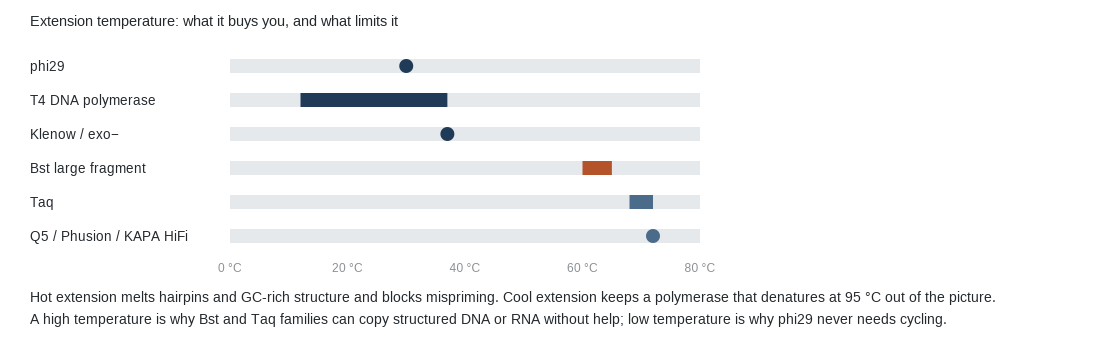
- A row-5 property: 72 °C is also where a tagmented library’s gap is filled, inside the first cycle
- Temperature is about more than speed. It sets how much secondary structure the enzyme must cope with and how specific priming is
- The longest product follows processivity, not temperature: phi29 is the extreme, HiFi enzymes with a processivity domain come next
- Library inserts are short, so maximum product rarely limits a library, but it limits long-read and long-range work
Reference: the chart, part 1
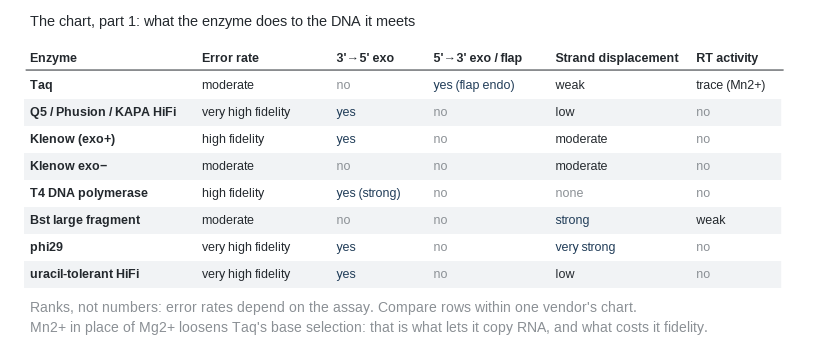
- Read a row to learn what an enzyme can do; read a column to pick an enzyme for a step
- Note how the groups separate: proofreading enzymes have a 3’→5’ exo, Pol I-like enzymes have the 5’→3’ one, and displacement is the third axis
Reference: the chart, part 2
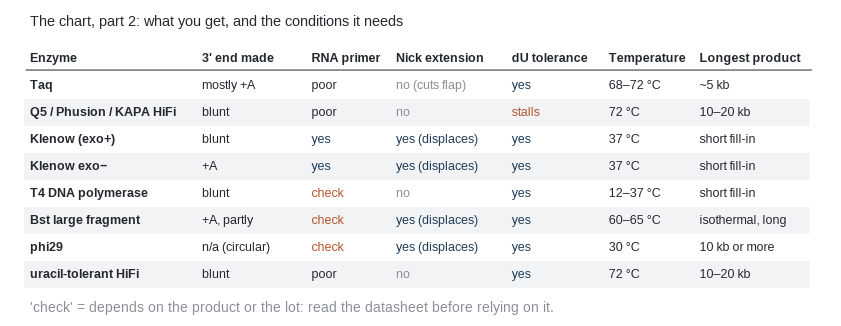
- The cells marked check vary between products and lots: vendors change the formulation
- Blunt versus +A is not a quirk. It decides whether the next ligation can happen at all
Four silent failures
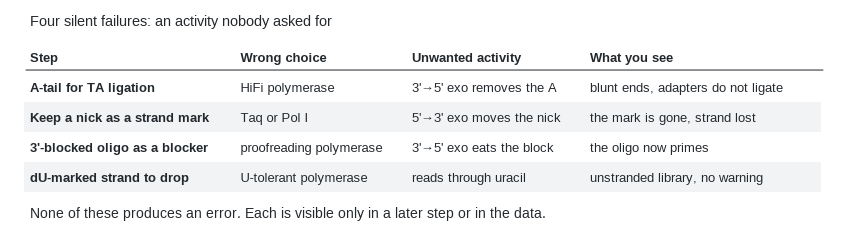
- None of these gives an error. A reaction with the wrong activity looks like a reaction that worked
- The defence is to ask of every step: which activity of this enzyme could act on the molecule I just made?