RNA libraries: small RNA, tag protocols and low input
Use cases · NGS library preparation
Small RNA is a different problem
A 22 nt microRNA has no tail to prime from, and is too short to fragment. Two things follow:
- Handles must be put on by ligation, because the RNA is shorter than most primers — of the five ways, only one is left
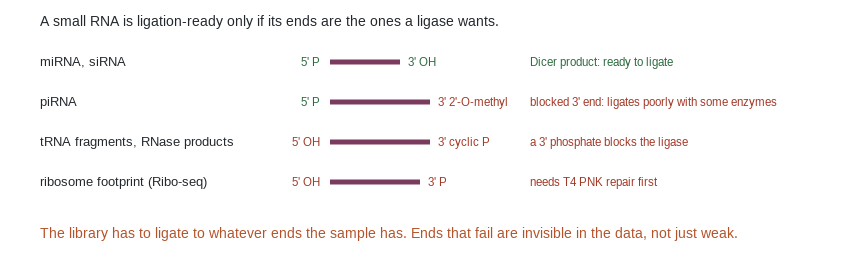
- Ends decide everything. Whether an RNA enters the library depends on its 5’ and 3’ chemistry, not its sequence
The same logic covers the ribosome footprints of Ribo-seq — the piece of mRNA a ribosome shields from nuclease, with its own slide later in this deck — at about 28 nt, and tRNA fragments, snoRNAs and piRNAs.
This deck first covers the tricks for short RNAs: ligation order, dimer suppression and circularisation. It then covers tag and full-length protocols, which solve a different problem: seeing very little RNA, or seeing a whole transcript.
The ends decide
![]()
- An RNA with a blocked end is not weakly represented; it is absent
Step 1: the 3’ adapter, pre-adenylated
![]()
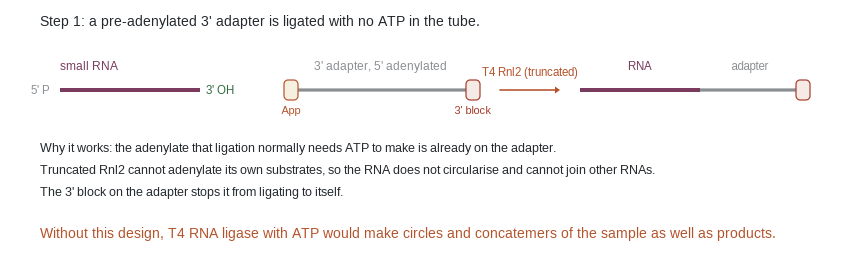
- No ATP means the ligase can only use the adapter that already carries the adenylate
Hafner et al. 2008, doi:10.1016/j.ymeth.2007.09.009
Step 2: the 5’ adapter
![]()
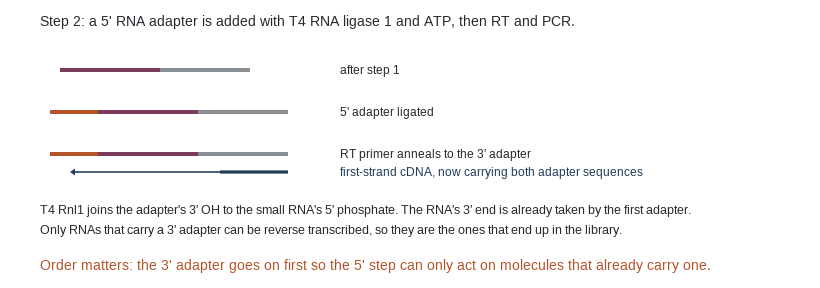
- Two ligations in a fixed order, then one RT and PCR: only molecules that took both adapters amplify
Hafner et al. 2008, doi:10.1016/j.ymeth.2007.09.009
Adapter dimers
![]()
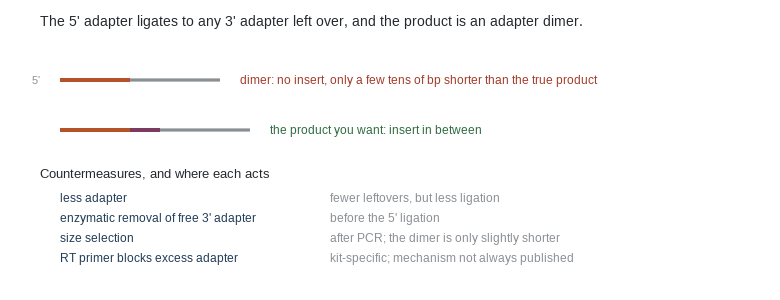
- A dimer is almost as long as a real product, so it competes for clusters and resists size selection (what to do)
Choosing the size window
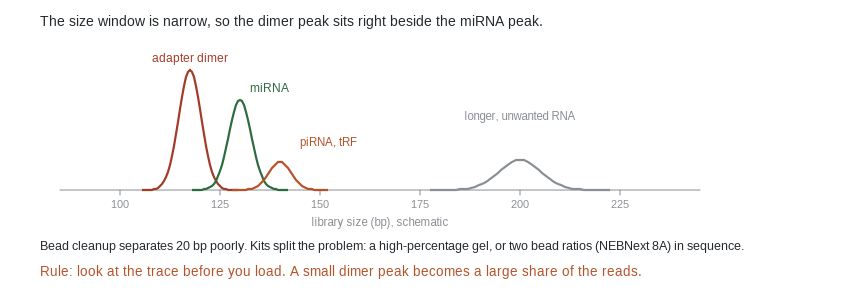
![]()
- Choose the window from the biology: miRNA only, or miRNA with piRNA and tRNA fragments
Ligation bias
The library you get is not the RNA you had.
- Each ligase prefers certain end sequences and structures, so the counts for two microRNAs can differ several-fold for reasons unrelated to how many there were
- Fixed adapters with the same ends join RNAs unequally. Degenerate bases at the ligation junction of the adapters, and PEG crowding, reduce this
- Kits advertised as low-bias have done both. A bias that is the same in every sample does not break a comparison between samples, but it makes absolute abundance meaningless
Jayaprakash et al. 2011, doi:10.1093/nar/gkr693
Ask of any small-RNA count: compared with what? Within a miRNA across conditions is safe; between two miRNAs it is not.
NEBNext low-bias small RNA
The NEBNext Low-bias Small RNA kit follows this scheme with the following choices:
- RNA with a 5’ phosphate and 3’ hydroxyl, up to about 120 nt, is eligible
- 3’ adapter ligation, then an enzyme that removes excess adapter before the second ligation; the manual does not give the mechanism in full
- RT creates the first strand; PCR adds dual indexes
- A short-insert purification branch uses two bead ratios in sequence to keep the small product and discard larger products
- A single 56-base read is typically enough
Compare with the generic scheme on the previous slides, and ask which of its steps the kit has replaced.
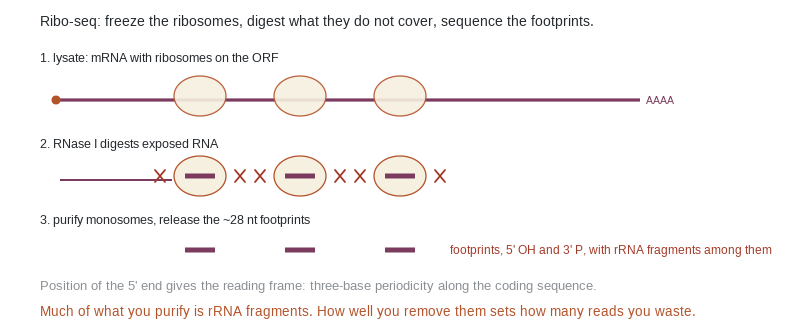
Ribo-seq: sequence what a ribosome covers
![]()
- A footprint of about 28 nt tells you where the ribosome was and in which frame
Ingolia et al. 2009, doi:10.1126/science.1168978
Counting, or reading the whole transcript
The remaining protocols answer a different question. For expression you need to count molecules; for isoforms you need the structure.
- A tag protocol reads one end only. All the reads for a gene land in one place, so each cell needs very few reads and barcodes can go into the first primer
- A full-length protocol spreads reads along the whole transcript. You see exons, junctions and variants, and you pay in reads and in the lack of early barcoding
- Both start from small amounts of RNA, so both must add a known sequence to the cDNA without a ligation. Template switching is the step that does this
The full-length protocol followed through here is SMART-seq2: the next three slides build its molecule, and the ones after that are variations on it.
Template switching
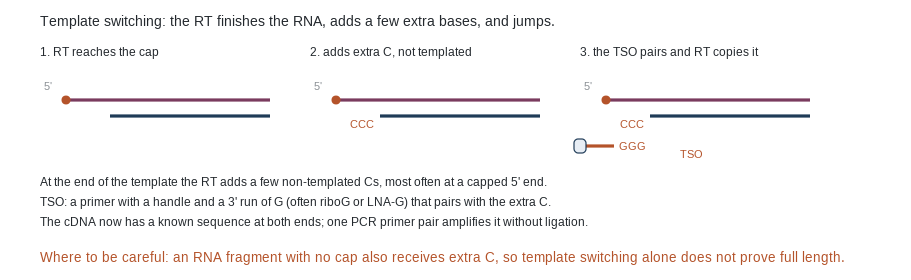
![]()
- The extra Cs are added by the RT itself; a primer ending in G pairs with them, and the RT copies the primer
- This is the second reaction in SMART-seq2, and it happens in the same tube as the first
Zhu et al. 2001, doi:10.2144/01304pf02
Designing the TSO
![]()
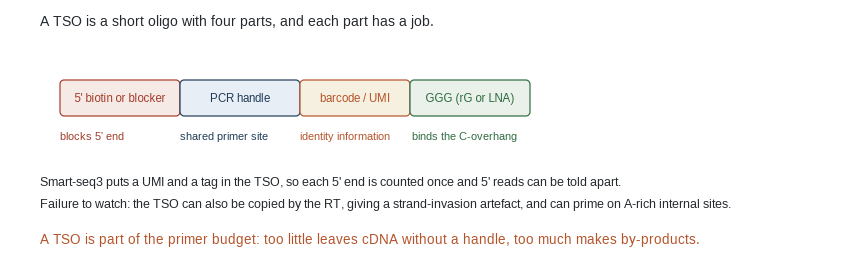
- Each of the four parts has a failure that you can recognise in the data
- SMART-seq2 fills the handle and the GGG and leaves the barcode slot empty; Smart-seq3 uses that slot, which is where its UMIs come from
Hagemann-Jensen et al. 2020, doi:10.1038/s41587-020-0497-0
SMART-seq2, followed to the end
![]()
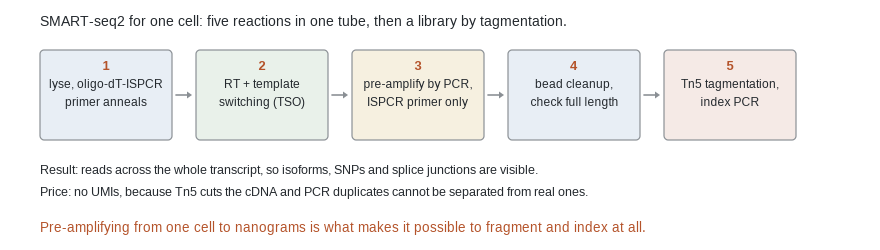
- SMART-seq2 reads the whole transcript, at the cost of one tube per cell and no early barcodes
- Steps 1 and 2 are the two previous slides; steps 3 to 5 are an ordinary tagmentation library made from the cDNA those two produced. Everything after this slide is a variation on one of the five
Picelli et al. 2013, doi:10.1038/nmeth.2639
Linear amplification by IVT
![]()
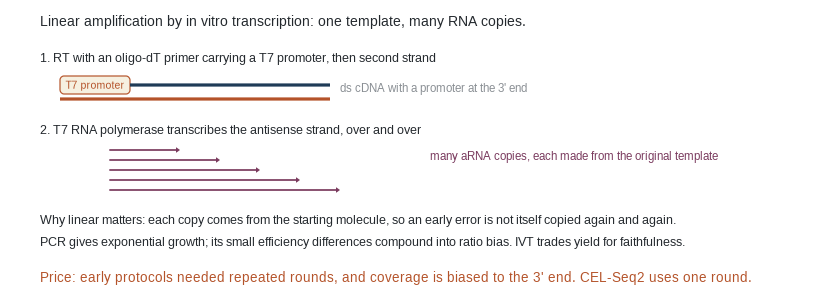
- Pooling cells before the IVT step is what lets one reaction serve many cells
Eberwine et al. 1992, doi:10.1073/pnas.89.7.3010
Three constructs, one idea
![]()
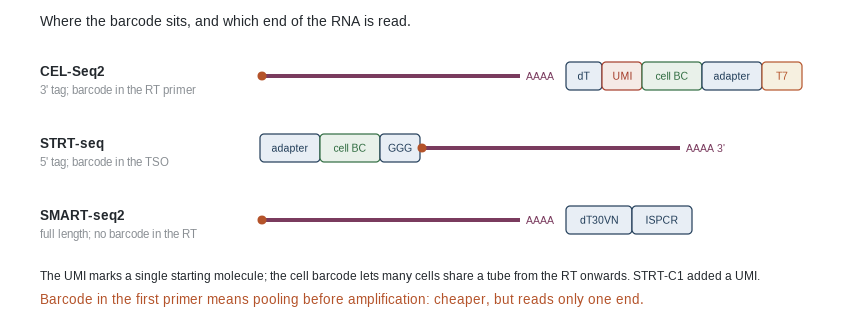
Hashimshony et al. 2016, doi:10.1186/s13059-016-0938-8; Islam et al. 2011, doi:10.1101/gr.110882.110
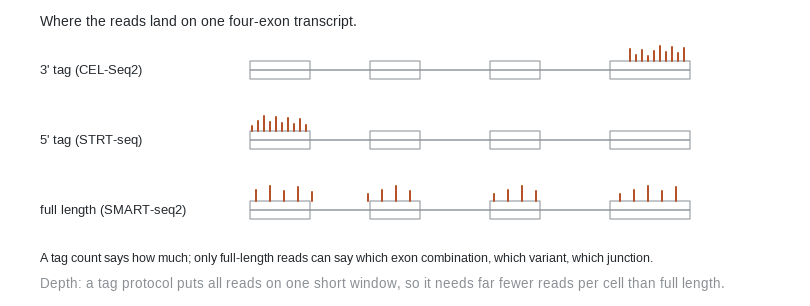
Where the reads land
![]()
- Tag reads can quantify a gene; only full-length reads can tell which exons were used
When there is very little RNA
A single cell holds only picograms of RNA, and every step now loses a visible fraction. SMART-seq2 makes the first three choices below; the fourth is where Smart-seq3 differs:
- Keep the reaction in one tube. Lyse, RT and template switch without a cleanup, because each bead step loses material
- Amplify before you split. PCR to nanograms first, then fragment and index
- Count cycles. Extra cycles add duplicates and the bias of the early cycles, so use the fewest that give enough library
- Add a UMI where the question is counting; the TSO can carry it, as in Smart-seq3
- Know the background. A tube with no cell gives a library too, so a no-input control is part of the design
Picelli et al. 2013, doi:10.1038/nmeth.2639; Hagemann-Jensen et al. 2020, doi:10.1038/s41587-020-0497-0
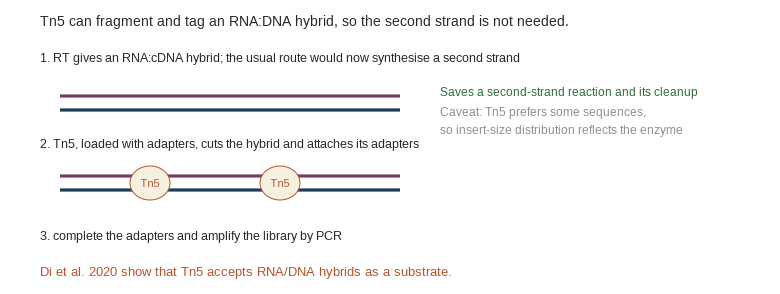
Tn5 on RNA:DNA hybrids
![]()
- Skipping second-strand synthesis shortens the workflow, and it can be done because the transposase accepts the hybrid
- SMART-seq2 tagments double-stranded cDNA after the pre-amplification; here the same enzyme cuts before any second strand exists
Di et al. 2020, doi:10.1073/pnas.1919800117
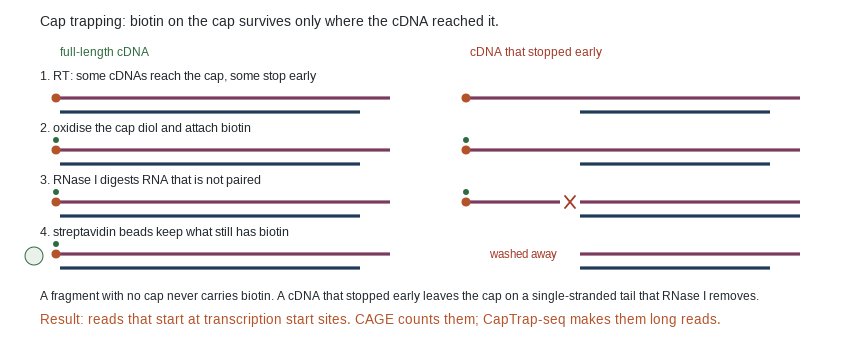
Cap trapping
![]()
- Selecting through the cap takes only RNAs that were copied all the way, so reads start where transcription starts
Carninci et al. 1996, doi:10.1006/geno.1996.0567; Takahashi et al. 2012, doi:10.1038/nprot.2012.005
Choosing a route
| microRNAs, tRNA fragments |
two ligations, size select |
NEBNext Low-bias Small RNA |
| Translation, codon by codon |
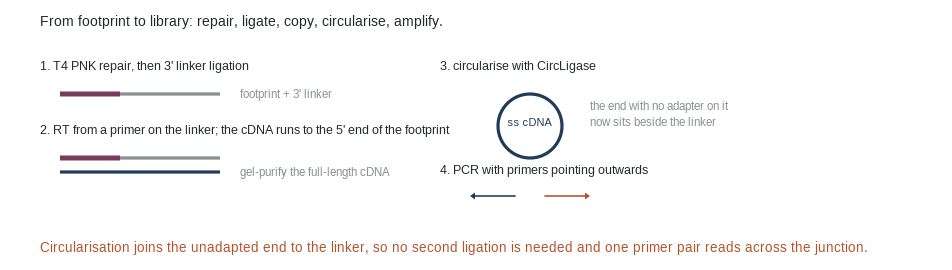
footprint, repair, circularise |
Ribo-seq |
| Counts from many cells |
3’ tag with barcode in the RT |
CEL-Seq2 |
| Where transcription starts |
5’ tag or cap selection |
STRT-seq, CAGE |
| Isoforms from few cells |
full length by template switching |
SMART-seq2 |
What to take with you
- Every RNA library is a decision about which end to put a handle on, and how
- Ligation works on small RNAs if the ends are right, the order is right and the dimers are controlled
- Template switching is the way to give a cDNA a second handle without a second ligation, and SMART-seq2 is that idea run from one cell to a finished library
- Tag against full length is a decision about counting against structure
- The exercises ask you to make these choices for a given sample
Where this connects
Blocks this protocol uses — pick by the ends, ligate both adapters, size-select, reverse transcribe, amplify
- End chemistry — 5’-P and 3’-OH decide which RNAs can enter the library at all
- Ligases and kinases — pre-adenylated donors, splints, and circularising a footprint
- Handles — RNA ligation and template switching, two of the five ways, compared side by side
- Fragmentation and size control — the bead ratios and the gel that keep a 22 nt insert
- Amplification — IVT as linear amplification, and the cycle count at picogram input
- Barcodes and UMIs — why the UMI goes in the TSO or RT primer and never in the PCR
Also drawn on here
- Selection — the gradient that keeps ribosome-bound RNA; selection as a ratio, not a switch
- Compartments — the plate well that makes CEL-Seq2 and STRT one reaction per cell