The trick catalogue, 2: counting, low input, compartments and bases
Tricks · NGS library preparation
D5. Reads are not molecules
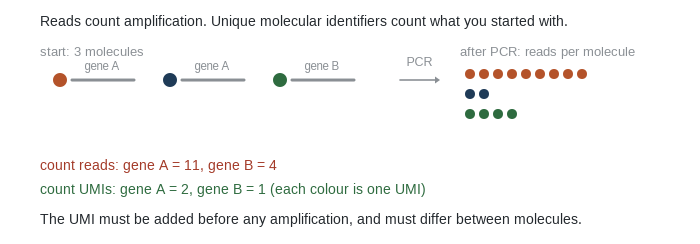
- Problem: PCR copies some molecules far more than others, so read count tracks amplification (PCR bias and duplicates)
- Trick: a unique molecular identifier (UMI) is a random tag added to each molecule before any PCR; count distinct UMIs
- Reason: copies share a tag, independent molecules rarely do Kivioja et al. 2012, doi:10.1038/nmeth.1778
Where may the UMI be added?
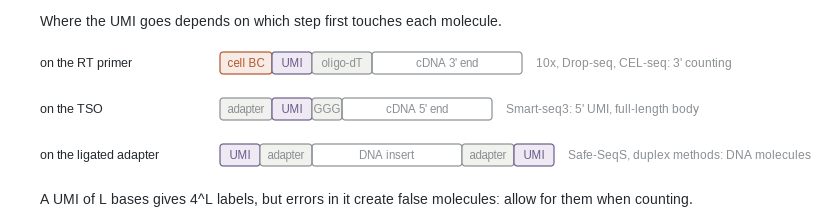
- It must be added before the first amplification, by whichever step first touches each molecule (where a label can sit)
- RT primer: 10x 3’, Drop-seq, CEL-Seq2; template-switch oligo: SMART-seq3 Hagemann-Jensen et al. 2020, doi:10.1038/s41587-020-0497-0
- DNA molecules: Safe-SeqS Kinde et al. 2011, doi:10.1073/pnas.1105422108
Duplex tags
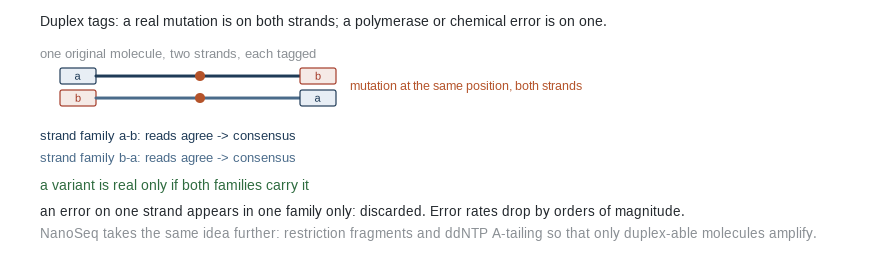
- Problem: polymerase and chemical damage errors reach 1 in 10^3 to 10^4 bases, which swamps a mutation at 1 in 10^6
- Trick: tag both strands of each molecule; accept a variant only if both strand families carry it (rare variants)
- Used in: Duplex Sequencing Schmitt et al. 2012, doi:10.1073/pnas.1208715109; NanoSeq Abascal et al. 2021, doi:10.1038/s41586-021-03477-4
Rolling circle consensus
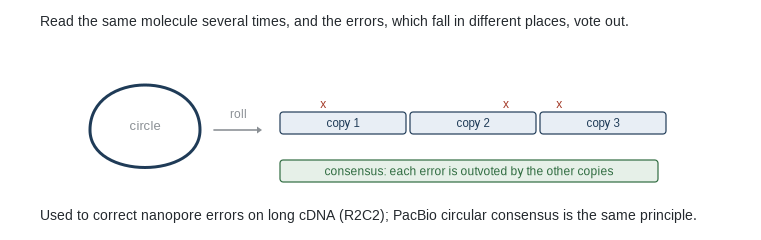
- Problem: nanopore reads have random errors in each pass
- Trick: circularise the molecule and copy it around the circle, so one long read contains it several times
- Reason: errors fall in different places in each copy, so the consensus is far better than any single pass (the same idea as PacBio HiFi)
- Used in: R2C2 Volden et al. 2018, doi:10.1073/pnas.1806447115
Spike-ins
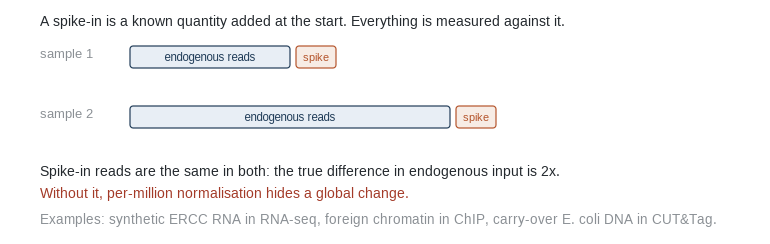
- Problem: normalising to total reads assumes the total did not change
- Trick: add a known amount of a foreign sequence at the start, and scale to that (spike-in standards)
- Examples: synthetic ERCC RNAs in RNA-seq Jiang et al. 2011, doi:10.1101/gr.121095.111; foreign chromatin in ChIP; carry-over E. coli DNA from the tethered transposase in CUT&Tag
The molecule budget and PCR-free
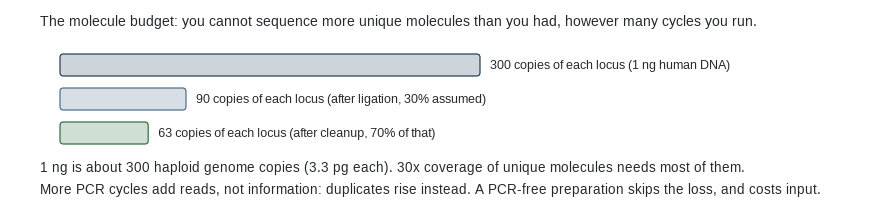
- 1 ng of human DNA is about 300 haploid genomes (3.3 pg each), so each locus exists in at most 300 copies (counting the molecules you have)
- Trick: use as much input as you have and as few PCR cycles as you can; with enough DNA, skip PCR
- Used in: TruSeq DNA PCR-Free; the case for it is in Kozarewa et al. 2009, doi:10.1038/nmeth.1311
- How to choose the cycle number is in the QC unit: a small qPCR on an aliquot
Pre-amplify, then split
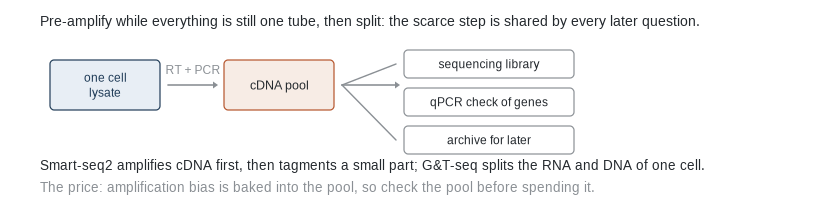
- Problem: one cell has a few picograms of RNA, and you want several assays from it (one cell, several libraries)
- Trick: amplify the whole transcriptome while it is still one tube, then take aliquots
- Used in: SMART-seq2; G&T-seq Macaulay et al. 2015, doi:10.1038/nmeth.3370; whole-genome amplification MALBAC
Bead-bound handles
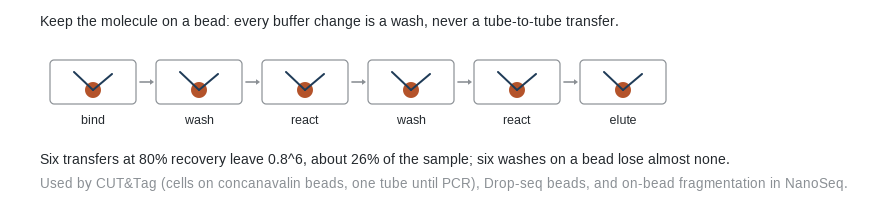
- Problem: moving a sample between tubes loses a fraction every time
- Trick: hold the molecule on a bead by an affinity handle and exchange buffers around it (bead-bound handles)
- Used in: CUT&Tag (cells on beads until PCR); Single-stranded ancient DNA (streptavidin capture); NanoSeq (on-bead fragmentation)
Low-volume reactions
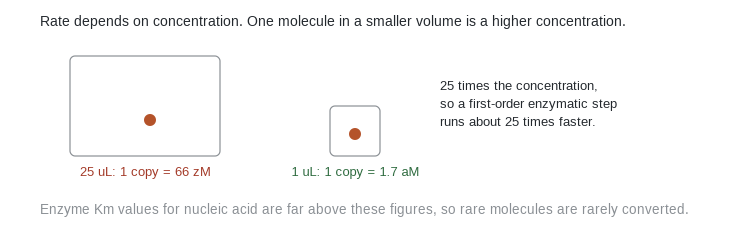
- 1 copy in 1 µL is 1.7 aM; in 25 µL it is 66 zM. A first-order step runs 25× faster in the smaller volume
- Trick: shrink the volume to microlitres, or nanolitres in a droplet or nanowell
- Used in: SMART-seq3xpress Hagemann-Jensen et al. 2022, doi:10.1038/s41587-022-01311-4
D7. A droplet is a test tube
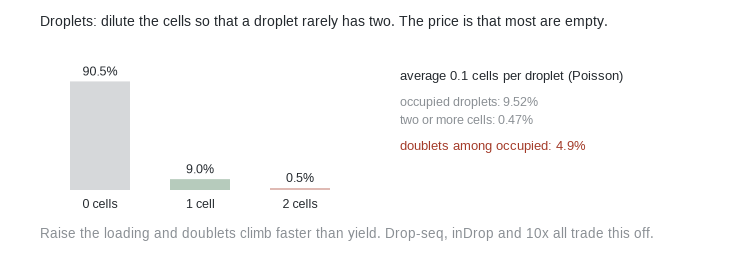
- Problem: pooling cells loses which one a molecule came from
- Trick: isolate each cell in its own compartment with its own barcode
- Used in: Drop-seq; inDrop v1; 10x
- Cell loading follows Poisson statistics: you choose the doublet rate by choosing how many cells are empty (the calculation)
Split-and-pool
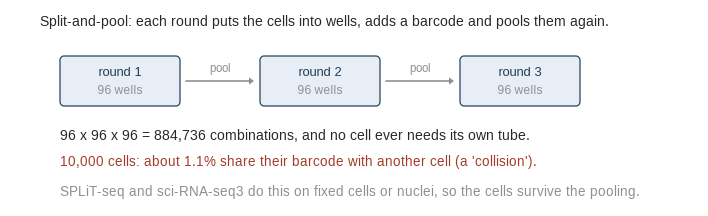
- Problem: droplets need a microfluidic device
- Trick: the cells themselves are the compartments: split into plates, tag, pool, repeat (combinatorial indexing)
- Used in: SPLiT-seq Rosenberg et al. 2018, doi:10.1126/science.aam8999; sci-RNA-seq3; sci-ATAC-seq Cusanovich et al. 2015, doi:10.1126/science.aab1601
Fix and permeabilise, then react in place
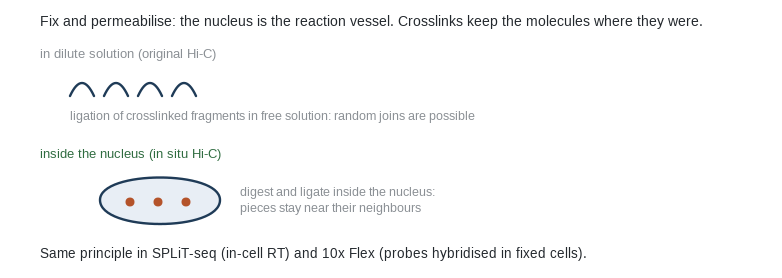
- Problem: isolating a live cell is slow and sensitive
- Trick: fix it, permeabilise it, and do the reactions inside the intact cell or nucleus
- Reason: crosslinks hold the molecules where they are; enzymes and oligos are small enough to enter (fixation in tissue)
- Used in: in situ Hi-C Rao et al. 2014, doi:10.1016/j.cell.2014.11.021; 10x Flex
Two-stage encapsulation
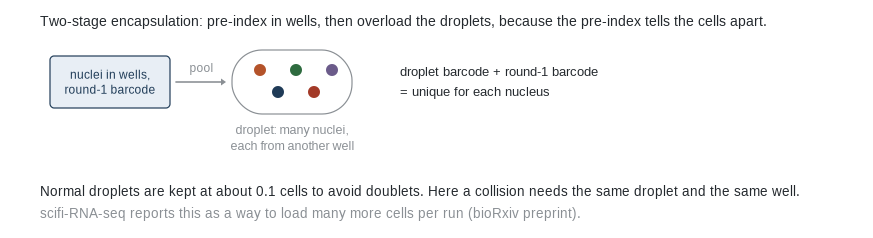
- Problem: droplets are mostly empty, so most of the device’s capacity is wasted
- Trick: pre-barcode nuclei in wells, then load many per droplet; collisions need the same droplet and the same well
- Used in: scifi-RNA-seq Datlinger et al. 2019, bioRxiv, doi:10.1101/2019.12.17.879304
D8. Chemical conversion
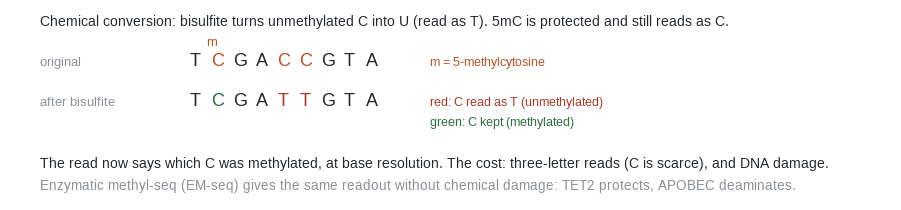
- Problem: methylation is not in the sequence, so a read cannot show it
- Trick: change the chemistry so that the property decides which base is read (converting chemistry into sequence)
- Used in: scBS-seq; RRBS; SLAM-seq, where labelled uridines become T-to-C changes Herzog et al. 2017, doi:10.1038/nmeth.4435
Protect, then convert
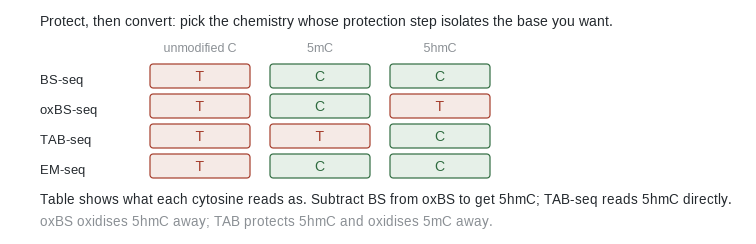
- Problem: 5mC and 5hmC both survive bisulfite, so they look the same
- Trick: protect or oxidise one form first (oxBS, TAB-seq and EM-seq)
- Used in: oxBS-seq Booth et al. 2012, doi:10.1126/science.1220671; TAB-seq Yu et al. 2012, doi:10.1016/j.cell.2012.04.027; EM-seq, an enzymatic replacement
Position is the information
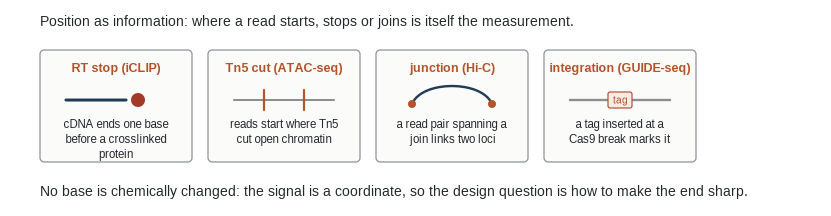
- Problem: there is no chemical mark to read
- Trick: make the read start, stop or join exactly at the feature (a read as the address of a cut)
- Used in: iCLIP, ATAC-seq Buenrostro et al. 2013, doi:10.1038/nmeth.2688, in situ Hi-C, GUIDE-seq Tsai et al. 2015, doi:10.1038/nbt.3117
Affinity for a modification
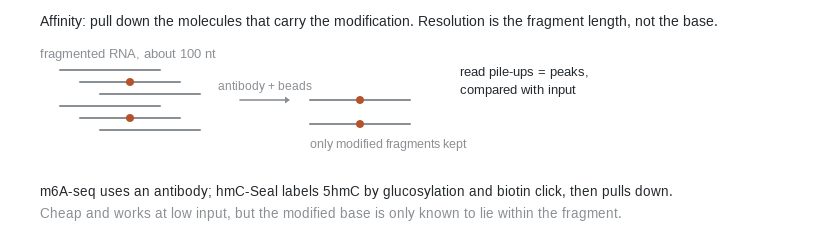
- Problem: the modification is rare, and conversion is too harsh
- Trick: enrich the molecules that carry it with an antibody or a chemical handle (m6A by antibody)
- Used in: m6A-seq Dominissini et al. 2012, doi:10.1038/nature11112; hmC-Seal Song et al. 2011, doi:10.1038/nbt.1732
- You trade base resolution for sensitivity
Native signal readout
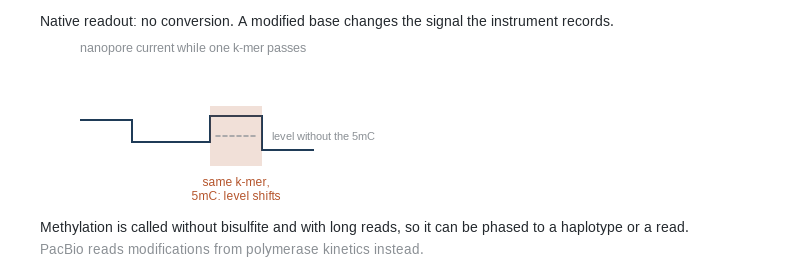
- Problem: conversion destroys DNA and shortens reads
- Trick: read the modification directly from the signal of a long-read instrument (native, with no conversion)
- Used in: nanopore methylation calling Simpson et al. 2017, doi:10.1038/nmeth.4184; ONT kits