Nucleic acids as a building material
Foundations · one fragment through TruSeq DNA PCR-free
One fragment, carried from ragged ends to a clusterable molecule
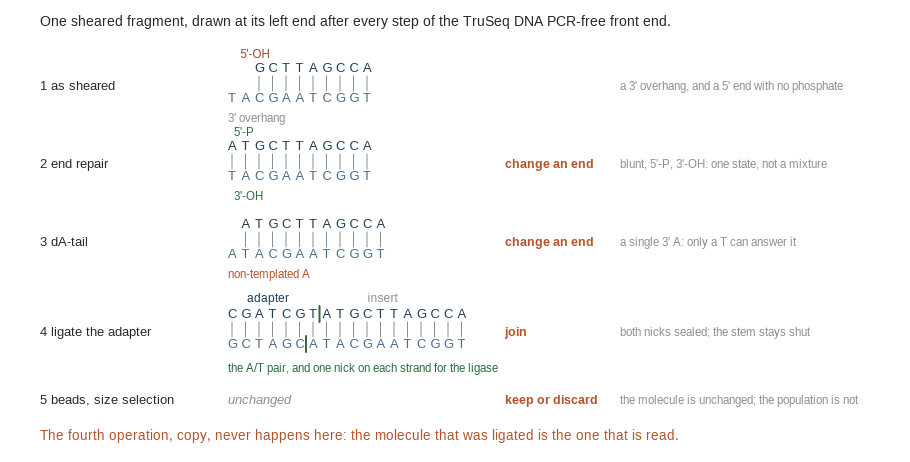
- The thread is the front end of TruSeq DNA PCR-free: one sheared piece of human genomic DNA, drawn at its left end until it carries an adapter, the sequence the sequencer needs
- Each step is one of the four operations, named on the right; the absent one is copy
- Steps, not the protocol’s five blocks: those run on to the loaded flow cell and are traced in genomic DNA libraries. This deck stays on the molecule
Change an end: which end can an enzyme even touch?
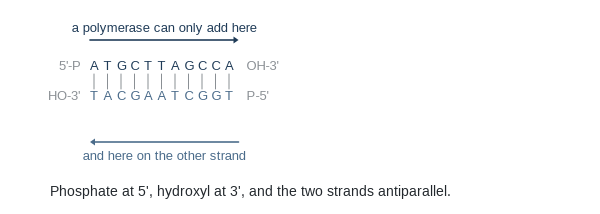
- The backbone is asymmetric: a 5’-phosphate at one end, a 3’-hydroxyl at the other
- Polymerases only ever add to a 3’-OH. There is no enzyme that extends a 5’ end
- The two strands run antiparallel, so our fragment’s left end is 5’ on one strand and 3’ on the other. Step 2 therefore needs two different enzymes, one for each
What the sheared ends actually are
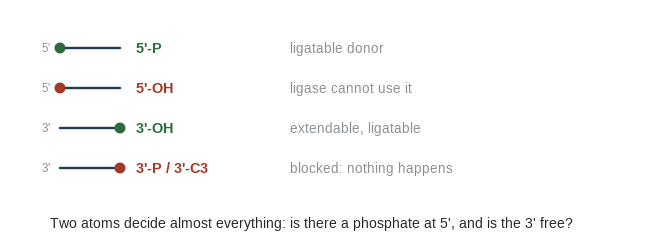
- Shearing breaks the backbone wherever it likes, so our fragment arrives carrying a mixture of these four states, and only some of them are usable
- A ligase needs a 5’-phosphate on one side and a free 3’-OH on the other, so an end left with 5’-OH is invisible to it
- Synthetic oligos, adapters included, arrive without a 5’-phosphate unless you pay for one — which matters at step 4
And what shape they are
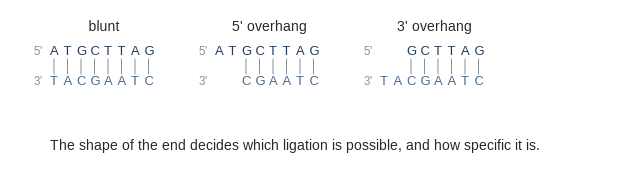
- Blunt: ligates to anything, inefficiently and unselectively
- Overhangs: ligate only to a matching overhang, efficiently and selectively
- Our fragment has all of these at once, each end different. That mixture is the problem end repair exists to remove
A nick is not a gap
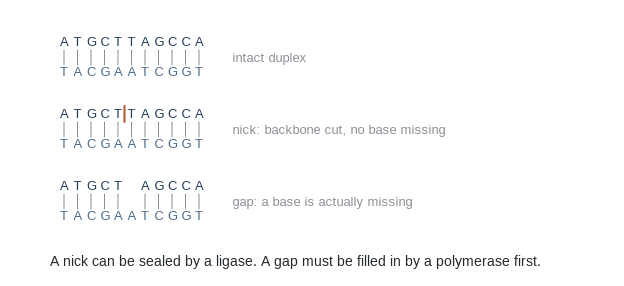
- A nick is a broken backbone with every base present: a ligase can seal it
- A gap is missing bases: a polymerase must fill it in first, then a ligase seals
- Both ideas appear in our walk: at step 2 a polymerase fills in a recessed 3’ end, and at step 4 the ligation leaves one nick on each strand for a ligase to seal
- Elsewhere: Tn5 leaves a 9 nt gap (transposases), and nick translation walks a nick along a molecule (enzymes)
Step 2, change an end: what end repair must produce
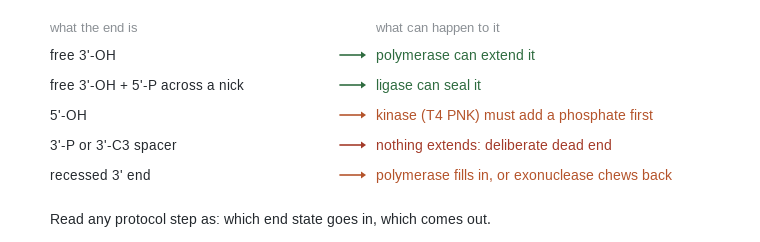
Read every step as a transformation: which end state goes in, which comes out. End repair takes the mixture above and returns one state: blunt, 5’-phosphate, free 3’-OH, on every end of every fragment in the tube.
Making a chosen end state on purpose — and switching an end off so that only one reaction can happen — is the whole of end chemistry.
Step 4, join: what the ligase is given on each strand
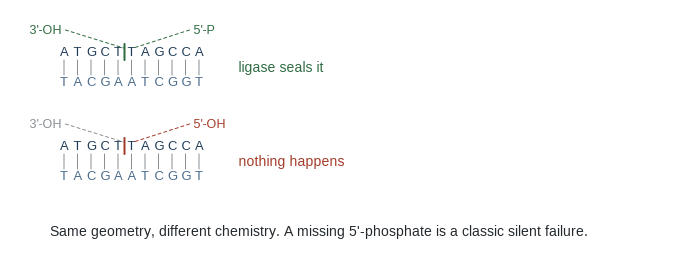
- At the top nick the adapter brings the 3’-OH and our insert — the unknown piece between the adapters — brings the 5’-phosphate that end repair put there
- At the bottom nick it is the other way round, so the adapter has to carry a 5’-phosphate of its own, which is why it is ordered with one
- Leave that phosphate off and there is no error and no warning and no product: a missing 5’-phosphate is the classic silent failure of library prep
Lehman 1974, DNA ligase: structure, mechanism, and function, doi:10.1126/science.186.4166.790
Why the adapter is still a duplex at room temperature
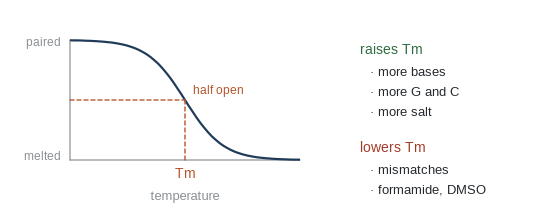
- Tm is a property of a duplex in a buffer, not of one oligo on its own
- The adapter is two oligos paired over a 12 bp stem (the Y adapter). A ligase needs a double-stranded end, so if the stem opened there would be nothing to join
- It stays shut because the ligation runs at room temperature in a high-salt buffer, and salt, length and GC all push Tm up
- Every primer, probe, splint and bait later in the course is this same calculation, made on purpose (selection)
SantaLucia 1998, nearest-neighbour thermodynamics, doi:10.1073/pnas.95.4.1460
Step 5, keep or discard: what the beads take out
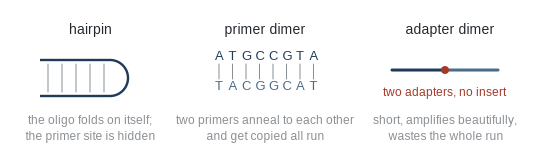
- The join step also makes adapter dimers — two adapters and no insert, ~120 bp against our ~350 bp insert. Short molecules cluster more readily (how a cluster forms), so a dimer can take over a run
- The other two panels are the same fault, earlier: an oligo folded into a hairpin, or two oligos annealed to each other, pair with the wrong partner and do nothing you wanted
- A bead ratio chosen to leave short fragments behind discards the dimers; a sharp low peak on a trace is the signature (QC)
- Note what this operation does not do: not one molecule is altered, only the mixture is
Head et al. 2014, Library construction for NGS: overviews and challenges, doi:10.2144/000114133
Writing the walk’s molecule down
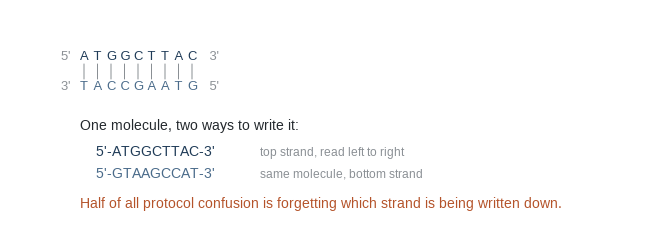
- Convention: sequences are always written 5’→3’ unless stated otherwise
- Every construct in this deck was drawn from the top strand only; the same molecule has two equally valid written forms
- When a protocol gives you an oligo — an adapter arm, say — you must work out which strand it anneals to before you can see what the step does
The same five questions, asked of RNA
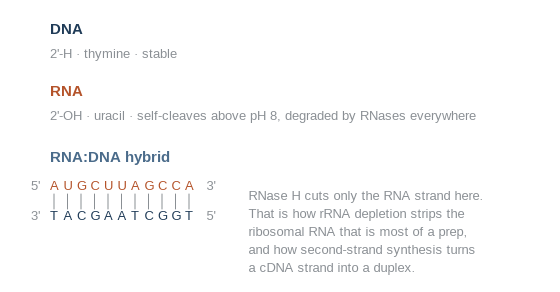
The walk was a DNA molecule. Ask question 1 of an RNA one and the answers to the other four change, because the material is not the same:
- The 2’-OH makes RNA chemically reactive: it self-cleaves at alkaline pH and at high temperature
- RNases are everywhere, need no cofactors, and survive autoclaving
- The RNA:DNA hybrid is its own substrate, with its own enzymes
RNA ends are more varied than DNA ends
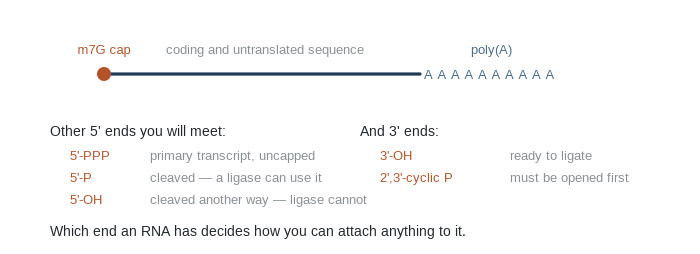
The end a transcript happens to have determines which chemistry can attach anything to it — a small RNA library is built around nothing else (small RNA and tag protocols).
Reference: degenerate positions
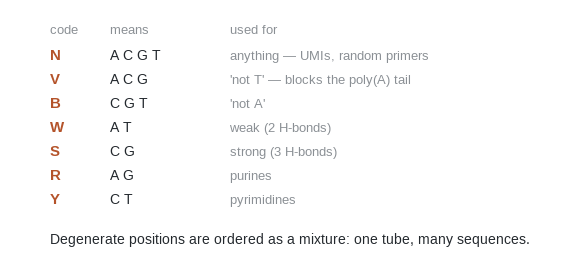
The last three slides are reference, not part of the argument: they are what you will look up when you come to order an oligo of your own.
Nmeans the synthesiser used all four bases at that position: one tube, many molecules- This is how UMIs and random hexamers are made; how long a random stretch has to be, and where it may sit, is barcodes and UMIs
VNanchors an oligo-dT primer at the start of the poly(A) tail
UMIs: Kivioja et al. 2012, doi:10.1038/nmeth.1778
Reference: an oligo is more than its sequence
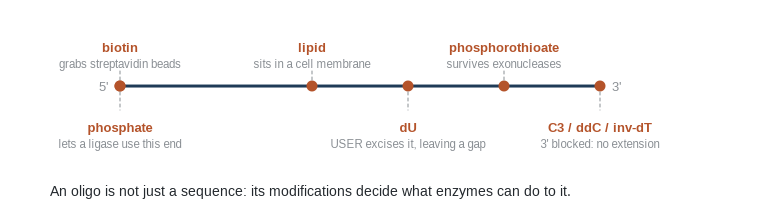
What you specify when ordering decides which enzymes can act on it — the phosphate the adapter needed at step 4 is one entry on this list. A lipid anchor is the odd one: it binds nothing in the reaction, it inserts the oligo into a cell membrane, so a barcode can be put onto a cell without touching its genome (hashing). An acrydite group is the same idea applied to a gel: it copolymerises into polyacrylamide, so the oligo becomes part of a bead rather than something dissolved beside it.