The enzyme toolbox: ligases, kinases and phosphatases
Building blocks · NGS library preparation
The mechanism explains the requirements
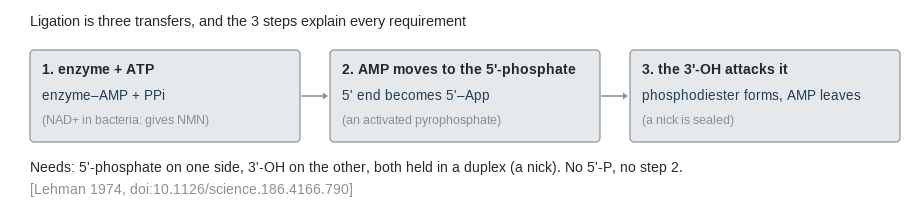
- Step 2 needs a 5’-phosphate. No phosphate, no activation, no joining, and no error
- Step 3 needs a 3’-OH next to it, in a duplex or otherwise held in place
- DNA ligases of phages use ATP; bacterial ones use NAD+. That is a column on the chart
Lehman 1974, doi:10.1126/science.186.4166.790
A ligase chart reads by donor and by substrate
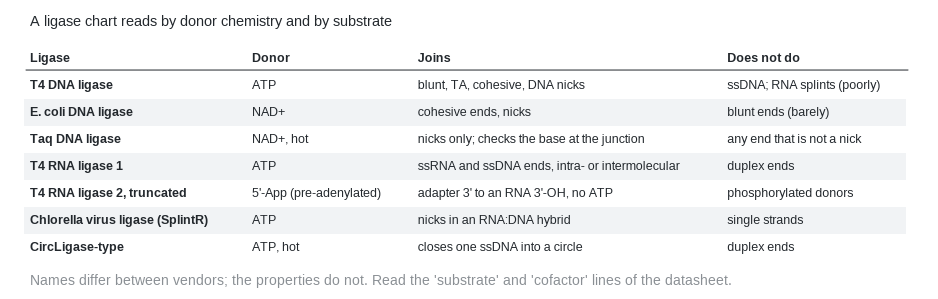
- Donor: ATP, NAD+, or a pre-adenylated 5’ end that makes the enzyme need no cofactor
- Joins: what the enzyme accepts as a substrate
- Rows with the same donor can differ completely in substrate: that is where choices are made
DNA ends for T4 DNA ligase
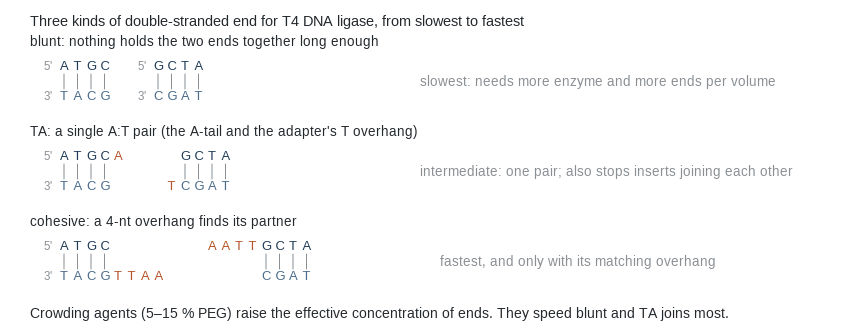
- Blunt is slow and unselective: any end joins any end, including insert to insert
- TA is the compromise that dominates library prep: some pairing, and neither partner can ligate to itself (attaching a handle)
- Cohesive is the fastest and the most specific, and is why restriction cloning works well
Adapter ligation: which strands get joined
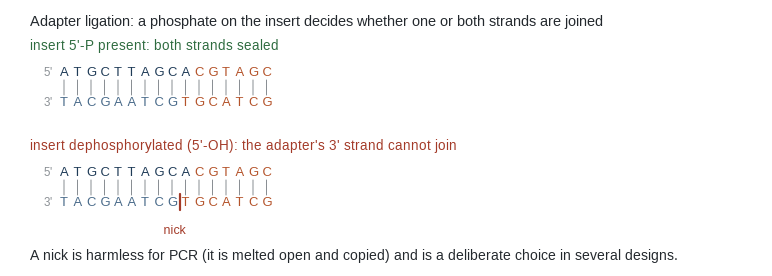
- Each junction has two strands, and each needs its own 5’-phosphate
- If the insert has no 5’-phosphate (it was dephosphorylated), only the adapter’s 5’-P strand joins: a nick remains on the other strand
- A nick does not stop PCR, and it is a feature in some designs and a bug in others
Ligating RNA: the pre-adenylated 3’ adapter
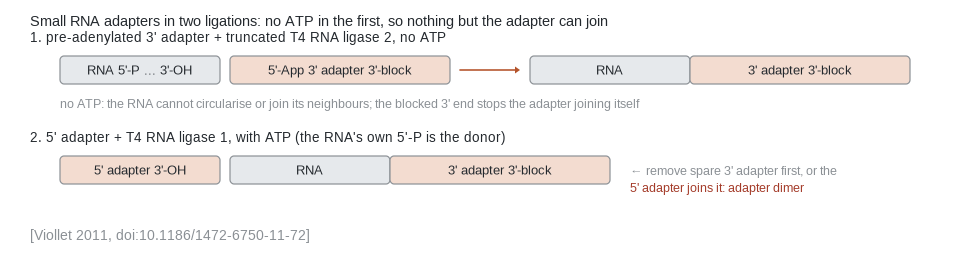
- A truncated T4 RNA ligase 2 cannot use ATP, so it needs the donor already adenylated
- With no ATP, the RNA’s own 5’-P cannot be activated: no circularisation, no concatemers
- A 3’ block on the adapter (a dideoxy or amino end) stops the adapter joining itself
- Spare adapter must be removed before the 5’ ligation, or it becomes adapter dimer: the dominant failure of small-RNA libraries
Viollet 2011, doi:10.1186/1472-6750-11-72
Splinted ligation
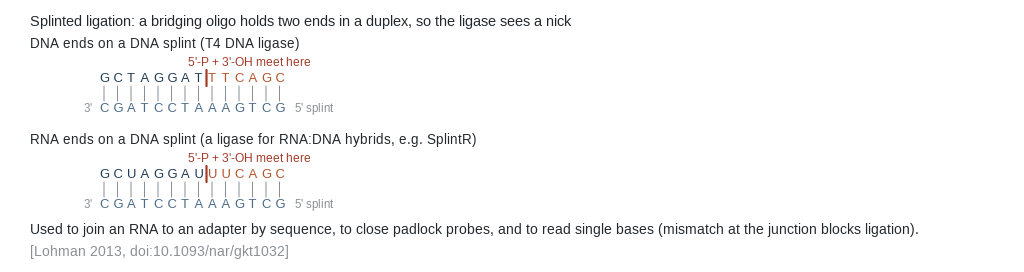
- Two ends that are not in a duplex cannot be joined by a DNA ligase. A bridging oligo makes them one
- Because the splint pairs with both ends, ligation is sequence-specific and works at low concentration: this is how split-and-pool adds one barcode per round (combinatorial indexing)
- A ligase for RNA:DNA hybrids lets the same trick join RNA, which standard T4 DNA ligase does poorly
Lohman 2013, doi:10.1093/nar/gkt1032
Circularisation
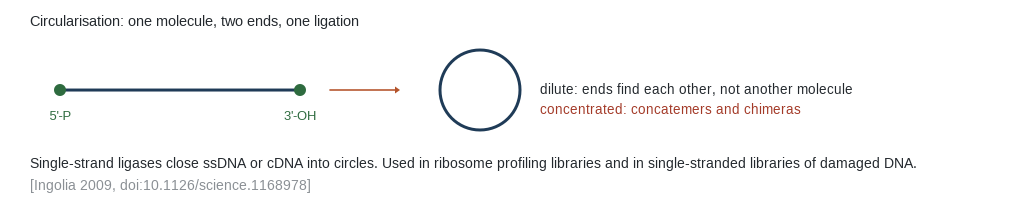
- A single-strand ligase closes one molecule into a circle when the ends find each other before they find another molecule
- Dilute the reaction to favour the circle; concentrate it for the opposite
- Circles resist exonucleases, so a circle can be separated from everything that failed to close (selection)
Kinases: giving an end a phosphate
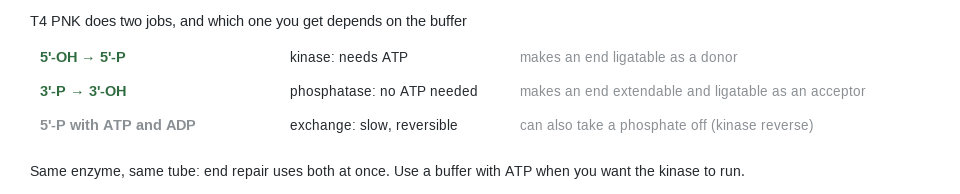
- T4 PNK moves the γ-phosphate of ATP onto a 5’-OH: the end can now be a ligation donor
- It also removes a 3’-phosphate, which lets a blocked end be extended or ligated
- In end repair the kinase and the repair polymerase work in one tube
Control which ends can ligate
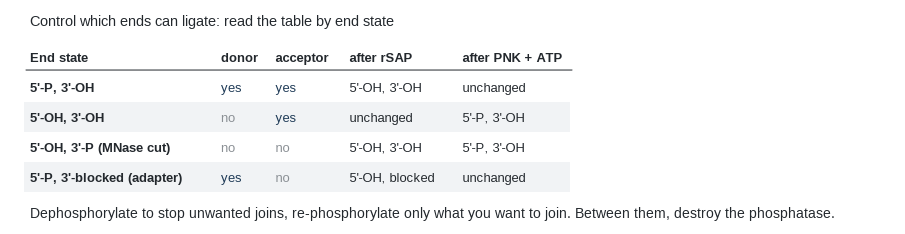
- The recipe is two steps: remove every phosphate, then add one back where you want a join
- This is how a library designer makes ligation one-sided: a molecule that has no 5’-P and no usable 3’-OH is inert, and one that has both is a partner
- Read the table as a state machine: end in, enzyme, end out
A phosphatase that survived

- The sequence is correct on paper and still gives nothing
- The warning sign is zero yield after a step whose reagents were all present
- Remedy: verify the inactivation step, or purify the DNA between the phosphatase and the ligation