The trick catalogue, 1: ligation, clean-up, handles and the read
Tricks · NGS library preparation
D1. A ligase cannot tell what you meant
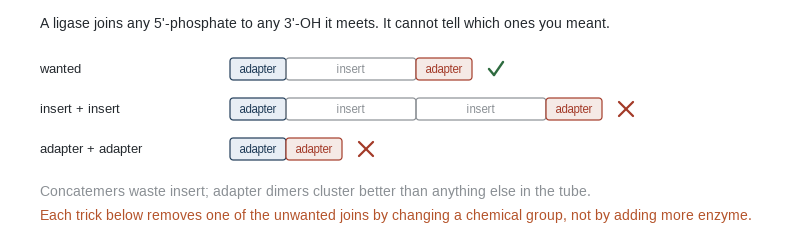
- T4 DNA ligase joins any 5’-phosphate to any 3’-OH on adjacent, annealed ends (what a ligase actually requires)
- Insert concentration, adapter concentration and ends decide the product mixture
- Every trick in D1 changes an end so that one unwanted join becomes impossible
Block one strand: dephosphorylate
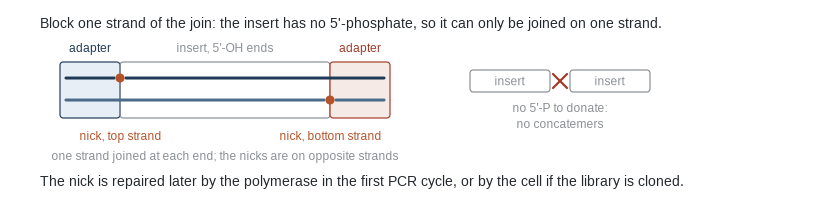
- Problem: inserts join each other into concatemers
- Trick: remove the 5’-phosphate (alkaline phosphatase); only the adapter supplies a phosphate (phosphatases and kinases)
- Reason: ligation needs a 5’-P donor and a 3’-OH acceptor; without the donor the join is impossible on that strand
- Used in: RNA adapter ligation in eCLIP, where RNA ends are dephosphorylated first
A single base is enough: A-tails and T-overhangs
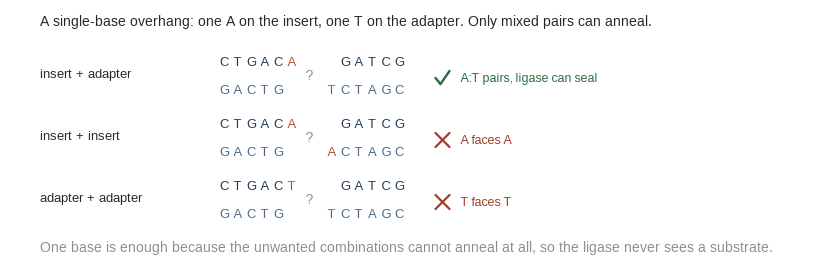
- Problem: blunt ligation joins everything to everything, and slowly
- Trick: A-tail the inserts (an exo-minus polymerase adds one A) and give the adapters a T overhang
- Reason: identical ends cannot pair: A faces A, T faces T. Mixed pairs anneal, which also raises the local concentration for the ligase (which polymerase adds the A)
- Used in: TruSeq DNA PCR-Free, NEBNext Ultra II, ONT ligation kit
A hairpin is ligated once, then cut open
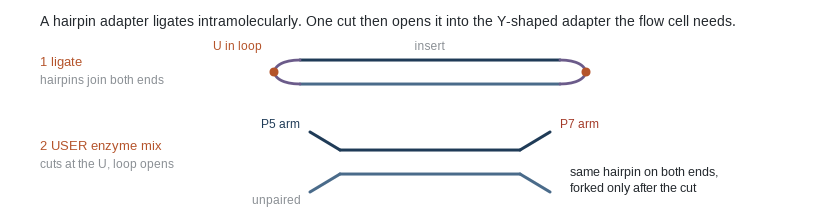
- Problem: a Y-shaped adapter is two annealed oligos, and mixing them makes mismatched pairs
- Trick: ligate one hairpin that carries a uracil, then cleave the U with USER (UDG plus endonuclease VIII) (hairpin adapters and dU)
- Reason: the hairpin ligates as one molecule, and opens only after it is on the insert
- Used in: NEBNext Ultra II (USER adaptor)
A splint brings the ends together
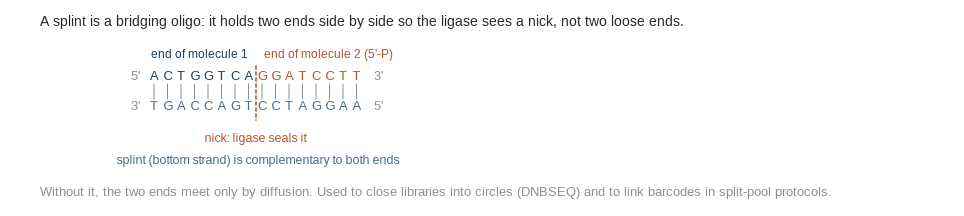
- Problem: two single-stranded ends, or two ends that are not blunt, will not meet on their own
- Trick: an oligo complementary to both holds them side by side; ligase then sees a nick (splinted ligation)
- Reason: nick sealing is fast, joining two loose ends is not
- Used in: circularisation for DNBSEQ; barcode rounds in SPLiT-seq
Dilute ligation makes circles
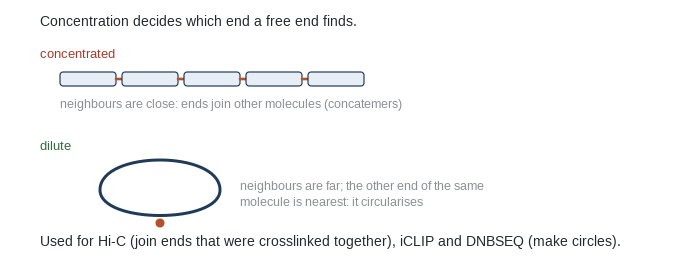
- Problem: you want an end to join its own other end (circle) or the end it was crosslinked to, not a stranger (proximity ligation)
- Trick: dilute the DNA until the other end of the same molecule is the nearest end
- Reason: the effective local concentration of the partner end on the same molecule is fixed by its length; dilute below it and intramolecular joins win
- Used in: Hi-C Lieberman-Aiden et al. 2009, doi:10.1126/science.1181369; iCLIP
D2. The adapter dimer
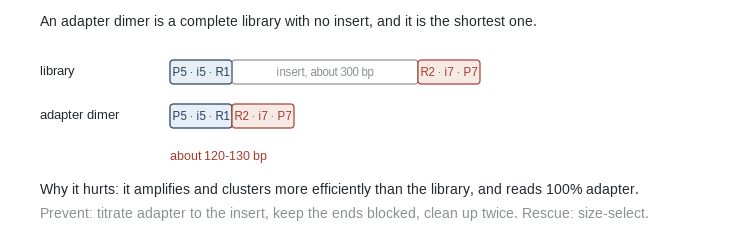
- Problem: with low input and excess adapter, adapters ligate to each other and carry both flow-cell ends
- Trick: match adapter amount to insert amount; use blocked ends so adapters cannot join; clean up twice; run a size selection before PCR (bead size selection)
- Reason: prevention removes the joins; selection exploits the 150 bp gap in size
Suppression PCR
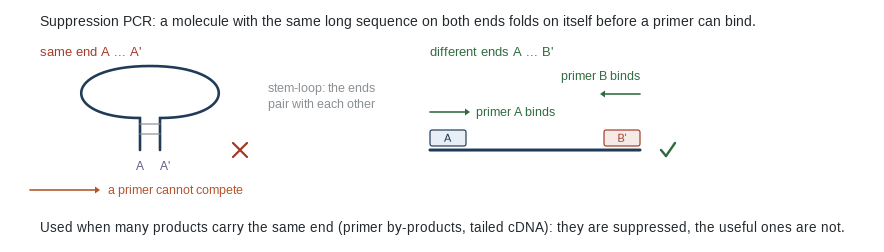
- Problem: molecules with the same end on both sides amplify as well as the useful ones
- Trick: a long adapter, so those molecules form a stem-loop on denaturation (also used as a selection)
- Reason: intramolecular annealing beats primer annealing, so a molecule with identical ends is not copied
- Quietly, it is what makes Nextera work: Tn5 loads its two tags at random, and the A/A and B/B halves panhandle, so the PCR is spent on A/B
- Partial by design: nanoCAGE weakens it deliberately — semi-suppressive PCR, a shorter stem that lets some of the suppressed species through Plessy et al. 2010, doi:10.1038/nmeth.1470
- Used in: Quartz-Seq Sasagawa et al. 2013, doi:10.1186/gb-2013-14-4-r31
Exonuclease clean-up of what did not react
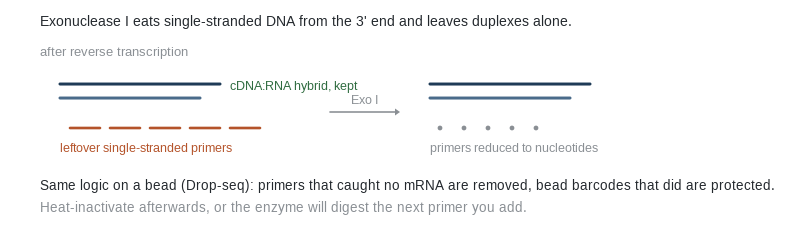
- Problem: unextended primers carry on into PCR and make primer dimers
- Trick: Exonuclease I digests single-stranded DNA from the 3’ end, and does not touch a duplex (exonucleases)
- Used in: Quartz-Seq after reverse transcription; Drop-seq on beads Macosko et al. 2015, doi:10.1016/j.cell.2015.05.002
- Always heat-kill it: a surviving exonuclease will remove the next primer you add
RNase H depletion of abundant RNA
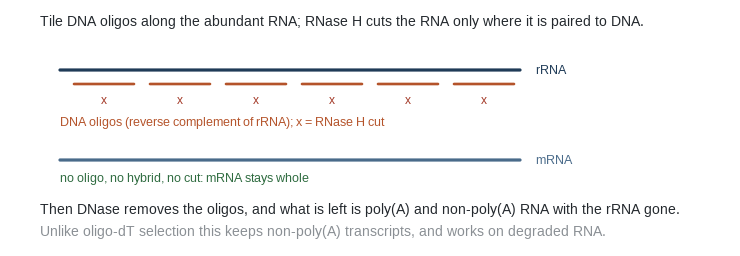
- Problem: about 80% of total RNA is ribosomal; sequencing it wastes most of the run
- Trick: hybridise DNA oligos along the rRNA, cut the RNA in those hybrids with RNase H, remove the oligos with DNase (rRNA depletion in practice)
- Reason: RNase H cleaves only the RNA strand of an RNA:DNA hybrid
- Source: Morlan et al. 2012, doi:10.1371/journal.pone.0042882
Cas9 depletion of a finished library
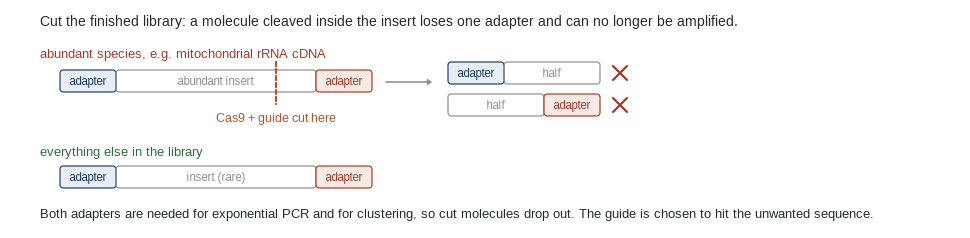
- Problem: a few species, such as mitochondrial rRNA, take up the reads even after library construction
- Trick: Cas9 and guides cut those molecules inside the insert; a cut molecule has one adapter and cannot form a cluster
- Reason: PCR and clustering need both ends, so the rest of the library is untouched (the same enzyme aimed at enrichment instead)
- Used in: DASH on human RNA-seq libraries Gu et al. 2016, doi:10.1186/s13059-016-0904-5
Methylation-sensitive digestion
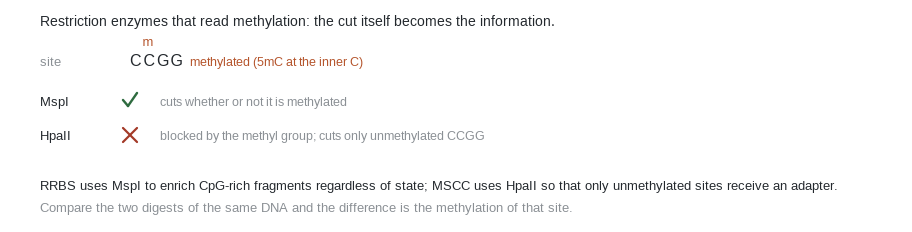
- Problem: you want only CpG-rich DNA, or only the unmethylated fraction (reduced representation)
- Trick: an enzyme whose cut depends on the methyl group; its isoschizomer cuts either way
- Used in: RRBS with MspI Meissner et al. 2008, doi:10.1038/nature07107; MSCC with HpaII Ball et al. 2009, doi:10.1038/nbt.1533
D3. Template switching
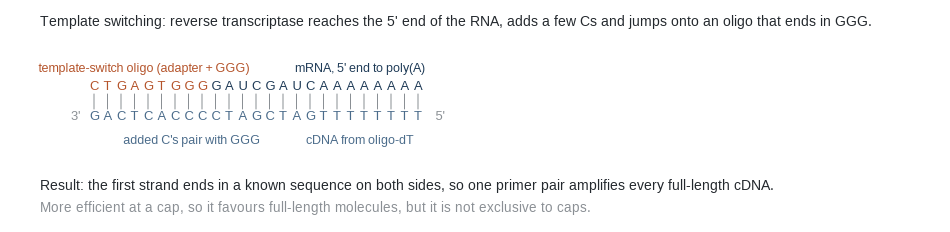
- Problem: reverse transcription makes a first strand with a known 3’ end (the primer) but an unknown 5’ end
- Trick: supply an oligo ending in GGG; when the enzyme falls off the template it adds a few Cs and moves onto the oligo (designing the TSO)
- Reason: the added Cs pair with the GGG. Moloney-murine-leukaemia-virus RT has this activity, and it is stronger at a cap
- Used in: SMART-seq2 Picelli et al. 2013, doi:10.1038/nmeth.2639; 10x 3’ v3; Zhu et al. 2001, doi:10.2144/01304pf02
Tailing with terminal transferase
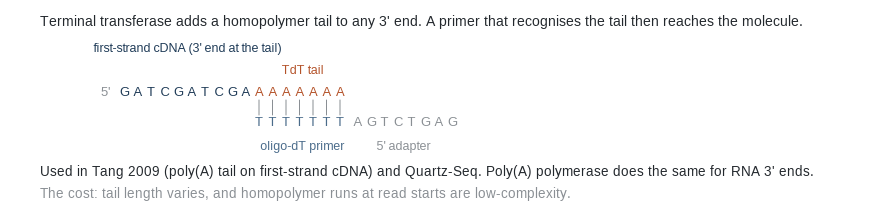
- Problem: the 3’ end of first-strand cDNA has no sequence to prime on
- Trick: add a homopolymer tail with TdT (or poly(A) polymerase for RNA); a primer anneals to the tail (tails without a template)
- Reason: TdT needs no template and takes any 3’-OH
- Used in: Tang 2009 Tang et al. 2009, doi:10.1038/nmeth.1315; Quartz-Seq
Single-strand ligation
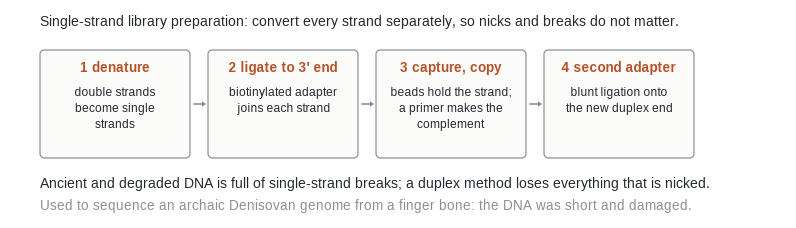
- Problem: damaged DNA has nicks and overhangs, so duplex end repair and ligation lose most molecules (degraded and ancient DNA)
- Trick: denature, ligate an adapter to every single strand, copy it, then ligate the second adapter
- Used in: Single-stranded ancient DNA Gansauge and Meyer 2013, doi:10.1038/nprot.2013.038, behind the Denisovan genome Meyer et al. 2012, doi:10.1126/science.1224344
Cap trapping
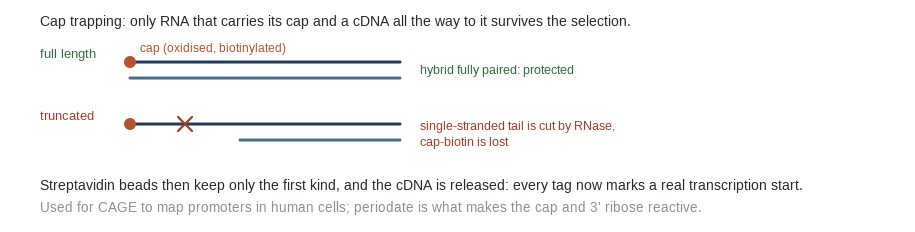
- Problem: most cDNA is truncated; you want molecules that begin at the true 5’ end (TSS mapping)
- Trick: oxidise the cap diol — the two neighbouring free hydroxyls on the cap’s ribose, which the body of the chain does not have — with periodate, attach biotin, digest unprotected single-stranded RNA, pull down on streptavidin
- Reason: only a fully paired hybrid with its cap intact keeps biotin and survives
- Used in: CAGE Takahashi et al. 2012, doi:10.1038/nprot.2012.005
Circularise to make an end internal
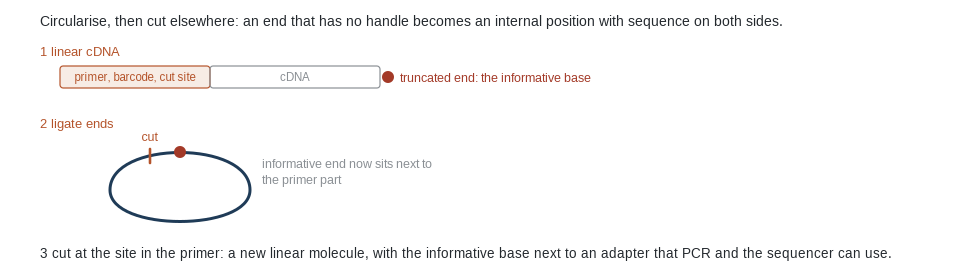
- Problem: the informative end (a truncated cDNA, a cut site) has no adapter on it
- Trick: ligate the ends of the single-stranded molecule together, then open the ring elsewhere
- Reason: the end now has known sequence on one side and an adapter at the cut (the same move as inverse PCR on genomic DNA)
- Used in: iCLIP König et al. 2010, doi:10.1038/nsmb.1838
D4. Complete the adapter later
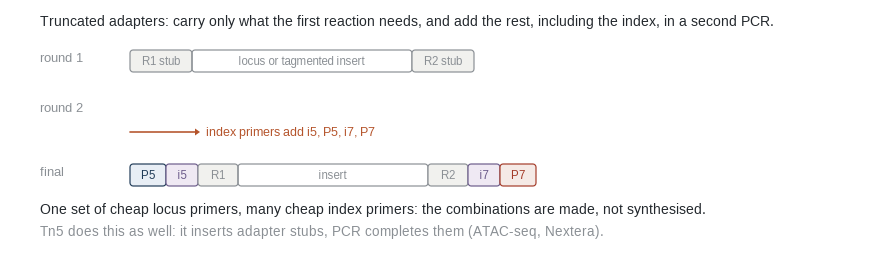
- Problem: full-length adapters with indexes are long and costly, one per sample per locus
- Trick: run the first reaction with stubs (read-primer sites only); add index, P5 and P7 in a second PCR
- Reason: the stubs are shared, so index combinations come from mixing two small primer sets
- Used in: Nextera XT DNA Library Prep, ATAC-seq, Moffat two-step; the one-step alternative is Joung one-PCR CRISPR screen readout
Inline barcode or index read?
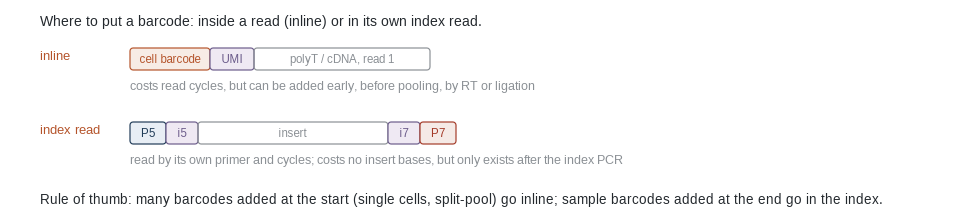
- Inline: costs read cycles but can be added by RT or ligation at the very start, so samples or cells can be pooled early
- Index read: costs no insert bases, but is only added in the last PCR (budgeting the read)
- Dual indexes on both ends protect against index hopping Kircher et al. 2012, doi:10.1093/nar/gkr771
Staggered primers
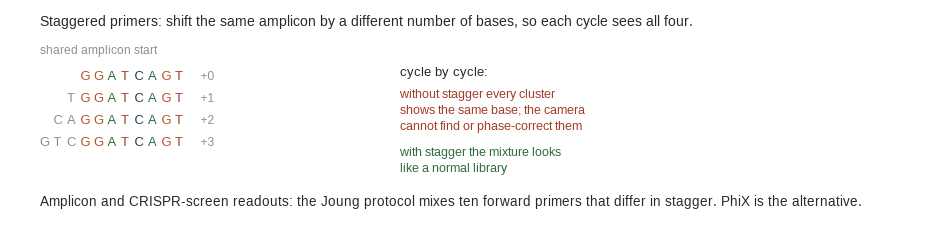
- Problem: every molecule starts with the same bases, so cycles 1 to 10 show one colour and the run fails
- Trick: a mix of primers that shift the amplicon by 0 to several bases
- Used in: CRISPR-screen readouts (Joung), amplicon panels; PhiX is the alternative (screen readouts)