Exercise: from a spectrum to three numbers
Before this unit: Day 12: Thresholding.
See also: Day 3: Bit depth and noise.
Goal
By the end of this exercise you should be able to:
- compute the three responses of an eye (or a camera) to a sampled spectrum,
- construct a metamer of a spectrum and say when a match breaks (another camera, a colour-blind viewer, another lamp),
- compute chromaticities, and locate a mixture of two lights on the chromaticity diagram,
- decide whether a colour is inside a display’s gamut triangle.
Do the pen-and-paper part first, then the demos. Questions marked (math) are for those who want the derivations; the concept questions do not depend on them.
Background
| Idea | What it means |
|---|---|
| Spectrum | power s(\lambda) at each wavelength; sampled, a vector \mathbf s |
| Cone (or filter) response | a weighted sum of the spectrum: L = \sum_\lambda \bar l(\lambda)\,s(\lambda); together \mathbf c = A\mathbf s |
| Metamers | spectra with the same three responses: A\mathbf s_1 = A\mathbf s_2 |
| Surface under a lamp | the light is lamp × reflectance, wavelength by wavelength |
| CIE XYZ | a standard basis of the three responses; Y = luminance; X, Y, Z \ge 0 for real light |
| Chromaticity | x = X/(X+Y+Z), y = Y/(X+Y+Z): the colour without its brightness |
| Gamut | the triangle of a display’s three primaries on the (x, y) diagram |
By hand
B1. A toy eye sees 5 wavelength bins with three cones (rows L, M, S): A = \begin{pmatrix} 0 & 0 & 1 & 2 & 1 \\ 0 & 1 & 2 & 1 & 0 \\ 1 & 2 & 1 & 0 & 0 \end{pmatrix}. (a) Compute the responses A\mathbf s to \mathbf s_1 = (1, 1, 1, 1, 1), \mathbf s_2 = (0, 2, 0, 2, 0) and \mathbf s_3 = (2, 0, 1, 0, 2). Which of them look identical to this eye? (b) The vectors \mathbf v_1 = (3, -2, 1, 0, -1) and \mathbf v_2 = (2, -1, 0, 1, -2) satisfy A\mathbf v = \mathbf 0. Check one of them. What happens to the responses if you add \mathbf v_1 to a spectrum? (c) Find a third metamer of \mathbf s_1 that is non-negative in every bin, using \mathbf v_1 - \mathbf v_2. For which multiples t of \mathbf v_1 - \mathbf v_2 does \mathbf s_1 + t(\mathbf v_1 - \mathbf v_2) stay a physical spectrum?
B2. A toy camera looks at the same bins with the filters A_\text{cam} = \begin{pmatrix} 0 & 0 & 0 & 1 & 2 \\ 0 & 1 & 2 & 1 & 0 \\ 2 & 1 & 0 & 0 & 0 \end{pmatrix}. (a) Compute its responses to \mathbf s_1 and \mathbf s_2 of B1. Do eye and camera agree that the two are the same colour? (b) A dichromat has only the L and S cones of A. Compute its responses to \mathbf s_1 and to \mathbf s_4 = (2, 1, 0, 1, 2). Does it see a difference? Does the trichromat eye?
B3. Light 1 has (X, Y, Z) = (20, 30, 50) and light 2 has (30, 15, 5). (a) Compute the chromaticities (x, y) of both. (b) Compute the chromaticity of their sum. Check that it lies on the line between the two, and say where: at what fraction of the way from light 1 to light 2? (c) Which light is brighter? Why does the mixture lie closer to light 1 although light 1 is not brighter?
B4. The sRGB primaries have chromaticities R (0.64, 0.33), G (0.30, 0.60), B (0.15, 0.06). A point is inside the triangle if it can be written as p = \alpha R + \beta G + \gamma B with \alpha + \beta + \gamma = 1 and all three \ge 0 (barycentric coordinates). (a) Find \alpha, \beta, \gamma for p = (0.30, 0.50). Is it inside? (b) The same for p = (0.20, 0.70), a saturated green. Can an sRGB screen show it?
B5. Explain in two sentences each: (a) why a photo of two fabrics that match to your eye may show them as different; (b) why a white LED and daylight can look the same white although their spectra differ.
B1. (a) A\mathbf s_1 = (4, 4, 4), A\mathbf s_2 = (4, 4, 4), A\mathbf s_3 = (3, 2, 3). \mathbf s_1 and \mathbf s_2 are metamers; \mathbf s_3 looks different. (b) A\mathbf v_1 = (1 + 0 - 1,\; -2 + 2 + 0,\; 3 - 4 + 1) = (0, 0, 0). Adding \mathbf v_1 does not change any response: the eye is blind to it. (c) \mathbf v_1 - \mathbf v_2 = (1, -1, 1, -1, 1), so \mathbf s_1 + t(\mathbf v_1 - \mathbf v_2) = (1 + t, 1 - t, 1 + t, 1 - t, 1 + t). It is non-negative for -1 \le t \le 1. For example t = 0.5 gives (1.5, 0.5, 1.5, 0.5, 1.5), with responses (4, 4, 4). t = -1 gives \mathbf s_2.
B2. (a) A_\text{cam}\mathbf s_1 = (3, 4, 3), A_\text{cam}\mathbf s_2 = (2, 4, 2). The camera sees two different colours where the eye sees one: its blind directions are different. (b) The dichromat’s responses (L, S): \mathbf s_1 \to (4, 4), \mathbf s_4 \to (0 + 0 + 0 + 2 + 2,\; 2 + 2 + 0 + 0 + 0) = (4, 4): no difference. The trichromat eye: A\mathbf s_4 = (4, 2, 4) against (4, 4, 4): the M cone sees it.
B3. (a) Light 1: total 100, (x, y) = (0.2, 0.3). Light 2: total 50, (0.6, 0.3). (b) Sum (50, 45, 55), total 150: (x, y) = (0.333, 0.3). Both lights have y = 0.3, so the line between them is y = 0.3, and x = 0.333 is (0.333 - 0.2)/(0.6 - 0.2) = 1/3 of the way from light 1. The weight of light 2 is its total divided by the sum of totals: 50/150 = 1/3. (c) Light 1 has luminance Y = 30, light 2 has Y = 15: light 1 is twice as bright. The position along the line is weighted by X + Y + Z (100 against 50), not by Y; here both ratios happen to be 2 : 1. In general they differ: a blue light has a large Z, so a little blue luminance pulls the mixture strongly.
B4. Solve \alpha(0.64, 0.33) + \beta(0.30, 0.60) + \gamma(0.15, 0.06) = p with \alpha + \beta + \gamma = 1 (three linear equations). (a) (\alpha, \beta, \gamma) = (0.067, 0.781, 0.152): all positive, inside. (b) (-0.308, 1.339, -0.031): two negative coordinates, outside. The screen would need negative red and blue light; it can only show a clipped, less saturated green.
B5. (a) The camera’s filters are different weighted sums of the spectrum from the cones; the two fabrics’ reflected spectra differ by something the cones cannot see but the camera’s filters can. (b) The LED spectrum (a blue peak plus a yellow hump) and daylight differ only by a change that all three cones are blind to: they are metamers, and LEDs are designed to be.
Math questions
B6. (math) Let A be 3 \times n with rank 3 and P = I - A^\top(AA^\top)^{-1}A. Show that AP = 0, that P^2 = P, and that P\mathbf v = \mathbf v for every \mathbf v \in \ker A. Why does AA^\top have an inverse?
B7. (math) Two lights have XYZ \mathbf C_1 and \mathbf C_2, totals S_i = X_i + Y_i + Z_i > 0 and chromaticities \mathbf p_i = (x_i, y_i). Show that their sum has chromaticity \frac{S_1}{S_1+S_2}\mathbf p_1 + \frac{S_2}{S_1+S_2}\mathbf p_2. Conclude that a mixture with non-negative amounts of three primaries lies inside their triangle.
B8. (math) The cones are \mathbf c = T\,\mathbf x with \mathbf x = (X, Y, Z) and an invertible 3 \times 3 matrix T; so A_\text{LMS} = T A_\text{XYZ}. Show that \ker A_\text{LMS} = \ker A_\text{XYZ}: metamers do not depend on the basis. Does the same argument work for a camera, A_\text{cam}?
B6. AP = A - AA^\top(AA^\top)^{-1}A = A - A = 0. P^2 = I - 2A^\top(AA^\top)^{-1}A + A^\top(AA^\top)^{-1}AA^\top(AA^\top)^{-1}A = I - A^\top(AA^\top)^{-1}A = P. If A\mathbf v = \mathbf 0 then P\mathbf v = \mathbf v - A^\top(AA^\top)^{-1}\mathbf 0 = \mathbf v. AA^\top is 3 \times 3 and \mathbf u^\top AA^\top\mathbf u = \|A^\top\mathbf u\|^2 > 0 for \mathbf u \ne \mathbf 0, because A^\top has rank 3 (independent columns): it is positive definite, hence invertible. So P projects onto \ker A, and \mathbf s + tP\mathbf v is a metamer of \mathbf s for any \mathbf v, t.
B7. The sum has XYZ \mathbf C_1 + \mathbf C_2 and total S_1 + S_2. Its chromaticity is (X_1 + X_2, Y_1 + Y_2)/(S_1 + S_2) = (S_1\mathbf p_1 + S_2\mathbf p_2)/(S_1 + S_2), since X_i = S_i x_i and Y_i = S_i y_i. The weights are non-negative and sum to 1: a convex combination, a point of the segment. For three primaries with amounts a_k \ge 0, the same argument gives \sum_k w_k\mathbf p_k with w_k = a_kS_k/\sum_j a_jS_j \ge 0, \sum w_k = 1: a point of the triangle.
B8. A_\text{LMS}\mathbf s = T A_\text{XYZ}\mathbf s = \mathbf 0 \iff A_\text{XYZ}\mathbf s = \mathbf 0 because T is invertible (T\mathbf u = \mathbf 0 \iff \mathbf u = \mathbf 0). So the null spaces agree. For a camera this works only if A_\text{cam} = T'A_\text{XYZ} for some invertible T', i.e. if the camera’s filter curves are linear combinations of the colour-matching functions (the Luther condition). Real cameras do not satisfy it exactly; that is why they see metamers differently.
Explore: from a spectrum to three numbers
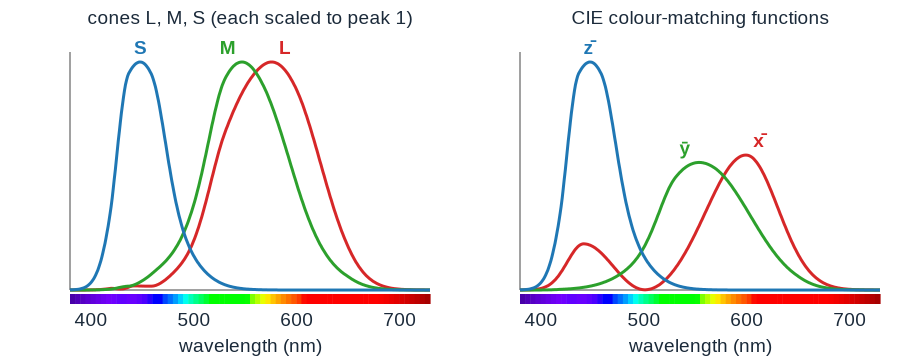
Top: one or two spectra A (black) and B (orange) from 380 to 730 nm, in 10 nm bins. Drag on the plot to draw (choose A or B under drag to draw). Middle: the three sensitivity curves of the chosen observer (eye: L, M, S cones; a synthetic camera: R, G, B; a deuteranope: L and S), each scaled to peak 1; the shaded areas are spectrum A times each curve, and their sums are the numbers. Right: the two colours as that observer sees them, and the numbers, each relative to the response to daylight (so daylight gives 1, 1, 1). In surfaces under a lamp, the curves are reflectances lit by the chosen lamp, and the numbers are relative to a white surface under the same lamp (the eye adapts to the lamp). Make a metamer adds a seeded random spectrum from the observer’s blind set.
E1. Preset daylight vs LED: same white. Describe the two spectra. What numbers does the eye give for each, and what chromaticity? Now choose camera: what does the camera report for the LED?
E2. Preset make a metamer. Click make a metamer a few more times. What changes, and what stays the same? Look at the shaded areas: how can the sums stay equal while the curves differ so much?
E3. Still with the metamer pair, choose camera. Give the camera’s numbers for A and B. Then choose deuteranope: does the pair still match?
E4. Preset metameric failure under tungsten. The curves are now reflectances. Compare the numbers for A and B under tungsten, then click daylight. Which lamp was the metamer made for? Try the fluorescent and white LED lamps: which one breaks the match most?
E5. Preset a dichromat sees more matches. Compare the numbers for the deuteranope, then for the eye. Which cone sees the difference, and how large is it?
E6. Preset 580 nm vs red + green: monochromatic yellow light (A) against a mixture of 540 nm and 640 nm light (B). Is it a match for the eye? Which number differs, and why can no mixture of these two lights fix it exactly?
E1. Daylight is smooth (about 50 to 117 across the range); the LED has a sharp blue peak (245 at 450 nm), almost nothing below 420 nm and a broad hump in the yellow–red. The eye gives 1.000, 1.000, 1.000 for both, and both have chromaticity (0.313, 0.329): the two swatches are the same white. The camera gives 1.000, 1.000, 1.000 for daylight but 0.905, 0.962, 0.900 for the LED: in the photo the LED light is darker and slightly green.
E2. B jumps around (in the preset it ranges from 8.8 to 249 in different bins), but the numbers stay 1.022, 0.931, 0.591 for both and the chromaticity stays (0.379, 0.372). Each cone curve is broad: where B has more light than A in one part of a curve’s range, it has less in another part, so the weighted sums are equal. The button chooses exactly such a change for all three curves at once.
E3. Camera: A gives 1.161, 0.853, 0.600 and B gives 1.251, 0.865, 0.666: the camera sees two different colours. For the deuteranope (L and S only) the pair still matches: it only needs fewer equations to hold.
E4. Under tungsten (2800 K): A 0.602, 0.545, 0.353; B 0.589, 0.555, 0.302: the swatches differ: B has less S response, so it looks yellower. Under daylight both are 0.560, 0.500, 0.351: the metamer was made for daylight. Fluorescent: 0.587, 0.533, 0.351 against 0.635, 0.607, 0.475, the largest difference; white LED: 0.561, 0.509, 0.350 against 0.584, 0.537, 0.296. The spiky fluorescent lamp re-weights the wavelengths most unevenly.
E5. Deuteranope: both give L 0.955, S 0.812: a match. Eye: L 0.955 and S 0.812 as well, but M is 0.972 for A and 0.693 for B: the M cones see a difference of about 29 % of the largest number. B was built by removing light in the M cones’ range in a way that L and S cannot see.
E6. Not quite: L 0.140 and M 0.115 agree, but S is 0.000 for the 580 nm light and 0.002 for the mixture (the demo reports 1.1 % of the largest number). Two lights give only two amounts to tune, while there are three numbers to match; the 540 nm light stimulates the S cones a little and the 580 nm light not at all. The chromaticities are close, (0.513, 0.486) against (0.511, 0.482): on the diagram, 580 nm lies almost (but not exactly) on the line between 540 and 640 nm.
Explore: the chromaticity diagram
The (x, y) chromaticity diagram with the spectral locus (wavelengths in nm) and the purple line, filled with approximate colours (outside the sRGB triangle a screen cannot show them, so they are clipped). Triangles: the gamuts of sRGB, Display P3 and Rec. 2020; the black dot is the D65 white. In mix two lights, drag A and B, set their brightness (luminance Y) and the share of B; the readout gives the mixture and its position on the line. In design a display, drag the primaries R, G, B, the white point W and a test colour T; the readout gives the display’s RGB → XYZ matrix and its inverse (see the next unit) and T’s barycentric coordinates.
C1. Preset mixing two lights (A = 470 nm, Y = 0.3; B = 580 nm, Y = 0.6; share of B 0.5). Where does the mixture lie on the line from A to B? Compute the share of B that puts the mixture halfway, then check it with the slider.
C2. Preset a dim blue and a bright yellow (Y_A = 0.1, Y_B = 1). Where is the mixture now, and what does it look like? Why is it so close to white?
C3. Drag A off the horseshoe, outside it. What does the demo say, and why?
C4. sRGB vs P3: is the test colour T = (0.21, 0.71) inside either gamut? Then a laser display (primaries at 635, 532 and 465 nm). Is T inside now? Compare the laser triangle with Rec. 2020.
C5. A primary outside the locus: what is wrong with this display? Drag G back inside the horseshoe and watch the matrix.
C1. At 0.189 of the way from A, at (0.196, 0.138), a blue-violet. A carries X + Y + Z = 5.28, B only 1.23, so A dominates although B is twice as bright. Halfway needs w \cdot 1.23 = (1 - w)\cdot 5.28, w = 5.28/(5.28 + 1.23) = 0.811.
C2. X + Y + Z is 1.76 for A and 2.06 for B; at share 0.5 the mixture is 0.539 of the way, at (0.333, 0.288): close to the white point, a slightly pinkish white. 470 nm and 580 nm are nearly complementary: the line between them passes close to white, so a suitable mixture of the two looks white (as in the white LED: blue plus yellow).
C3. “A outside the locus: not a real light”. No spectrum has that chromaticity: every real light is a non-negative mixture of monochromatic lights, so it lies inside the region they span (the horseshoe closed by the purple line).
C4. T has barycentric coordinates (-0.29, 1.35, -0.06) in sRGB and (-0.12, 1.08, 0.04) in P3: outside both. For the laser display, (0.09, 0.85, 0.06): inside. The laser primaries lie on the locus, so their triangle is almost as large as Rec. 2020, whose primaries are themselves (nearly) monochromatic.
C5. The green primary (0.05, 0.90) is outside the horseshoe: no light has that chromaticity, so the display cannot be built. The matrix can still be computed (scales 0.307, 0.613, 0.080), which shows that the algebra does not know about physics: the check that primaries are real lights must be made separately.
Code
Write the algorithms of this unit yourself, in Rust. Setup, and how to run and check your code: coding exercises: getting started. Your code goes in colour/src/colour_vision/exercise.rs. (This page already uses C1, C2, … for the chromaticity demo, so the code tasks are R1, R2, …)
R1. responses(a, s): the responses of an observer to a sampled spectrum, one weighted sum per row of the matrix A:
for every row i (cone or filter):
    c[i] = 0
    for every wavelength bin j:
        c[i] = c[i] + A[i][j] · s[j]
The checks are your answers to B1(a), B1(b) and B2(a).
R2. metamer(a, s, v, share): a metamer of the spectrum \mathbf s, built from any vector \mathbf v:
u = solution of (A Aᵀ) u = A v            # a 3 × 3 system
p = v − Aᵀ u                               # the part of v the observer cannot see
t_max = smallest s[j] / (−p[j]) over the bins with p[j] < 0
metamer = s + share · t_max · p
The check is B1(c), plus: for any \mathbf v the metamer must give the same responses, stay \ge 0, and (with share 1) touch 0 in some bin.
R3. chromaticity(xyz): (x, y) = (X, Y)/(X + Y + Z). The check is B3.
R4. barycentric(p, r, g, b): the coordinates (\alpha, \beta, \gamma) of a point in the triangle of three primaries:
solve  α (r − b) + β (g − b) = p − b     # two equations, two unknowns
γ = 1 − α − β
inside the gamut  ⇔  α, β, γ ≥ 0
The check is B4.
Then cargo run -p colour -- colour-vision and open the pictures in out/colour-vision/. The program uses the CIE colour-matching functions (sampled every 10 nm) as the eye, and a synthetic camera with three broad filters. It makes a metamer of the light of a 6500 K hot body (metamer.png: the light in black, the metamer in orange) and prints what the eye and the camera report for both. It then draws the chromaticity diagram (chromaticity.png): the horseshoe in approximate colours, the sRGB triangle found with your barycentric, and the part outside it darker.
R5. The eye’s numbers for the light and its metamer are equal. What does the camera report? Explain the difference with the null spaces of the two matrices (B2).
R6. What share of the horseshoe’s area does the sRGB triangle cover? The program prints the barycentric coordinates of four monochromatic lights. Which of them can an sRGB screen show, and what would it have to do to show 520 nm light?
The model solution is colour/src/colour_vision/solution.rs in the download.
R5. The eye gives (1.000, 1.000, 1.000) for both, relative to the light. The camera gives (1.036, 1.035, 1.070) for the metamer: the metamer looks 4–7 % brighter to it, and bluer. The change \mathbf s_2 - \mathbf s_1 lies in the null space of the eye’s matrix, but the camera’s filters are not a change of basis of the eye’s curves, so their null space is different, and they see part of the change. The orange curve in metamer.png jumps up and down although it looks the same as the smooth black one: the wiggles are exactly the kind of change the eye cannot see.
R6. The triangle covers 34.3 % of the horseshoe (areas 0.112 and 0.327). 460 nm light has coordinates (-0.00, -0.06, 1.06), 520 nm (-0.67, 1.74, -0.07), 580 nm (0.59, 0.49, -0.08) and 620 nm (1.15, -0.12, -0.03): each has a negative coordinate, so none is inside the triangle. Pure spectral light lies on the horseshoe, outside every display triangle. 520 nm would need a negative amount of red and of blue light. A screen can only clip or map it inwards, to a less saturated green. In the picture this is the large darker band along the green edge.
Where this leads
The three numbers of a pixel depend on the camera’s curves and on the lamp. The next unit, RGB: gamma, linear maps & white balance, asks what the numbers stored in an RGB file are: values for a particular display, gamma-encoded, related to XYZ by a 3 \times 3 matrix, and how a diagonal matrix undoes the lamp (white balance). The spectral unmixing day (day 47) returns to the linear model \mathbf c = A\mathbf s with many channels instead of three.