Analytical Chemistry
Use the lecture, quiz, exercise and embedded experiment together. Start with the chemical question, predict what a measurement should show, then use R to test and explain it.
Download the student project, extract it and open analyticalchem.Rproj. Work from that project root. The R reference retrieves the CSV, plotting and regression workflow from introductory computing. Student reports use R Markdown.
Topics
| Topic | Analytical question | Materials |
|---|---|---|
| From sample to answer | Define the chemical quantity before calculating it | Lecture · Quiz · Exercise · Demo |
| Sampling and preparation | Follow the material through sampling, extraction and dilution | Lecture · Quiz · Exercise · Demo |
| Error and uncertainty | Separate spread, bias and uncertainty in a result | Lecture · Quiz · Exercise · Demo |
| Calibration and quality control | Decide whether a signal can support a concentration | Lecture · Quiz · Exercise · Demo |
| Equilibrium and titration | Use reaction stoichiometry and a justified endpoint | Lecture · Quiz · Exercise · Demo |
| Electrodes and potentiometry | Read a logarithmic response without losing the chemistry | Lecture · Quiz · Exercise · Demo |
| UV and visible absorption | Measure iron through a specified coloured complex | Lecture · Quiz · Exercise · Demo |
| Matrix effects and recovery | Find why a good calibration can still give a biased sample result | Lecture · Quiz · Exercise · Demo |
| Atomic measurements | Report an element amount through atomisation and detection | Lecture · Quiz · Exercise · Demo |
| Separation principles | Connect phase exchange to retention, width and resolution | Lecture · Quiz · Exercise · Demo |
| GC and HPLC | Choose an introduction and separation, then calibrate peak area | Lecture · Quiz · Exercise · Demo |
| Choosing and defending a result | Build and defend the complete analytical argument | Lecture · Quiz · Exercise · Demo |
Follow a result back to its origin
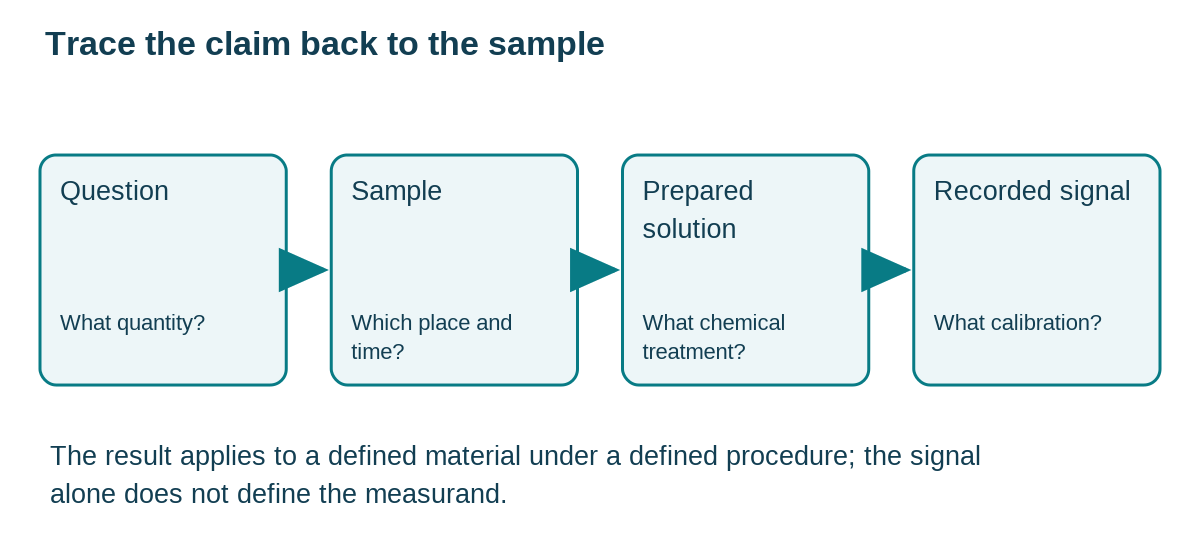 {fig-alt=“The analytical question, material, preparation and measured signal form a traceable measurement chain.”}
The examples use simulated data. Keep the original inputs, preparation records, R code, derived tables and report together. Read the data dictionary before interpreting a file. Use the glossary to distinguish terms such as precision, recovery and uncertainty.
Selected reading follows Harris and Lucy, Quantitative Chemical Analysis, by topic: sampling and preparation; error and calibration; equilibrium and titration; electrochemistry; spectroscopy; chromatography. Chapter numbering depends on the edition, which remains to be confirmed for the planned course.