Exercise: Complement a single base
Goal
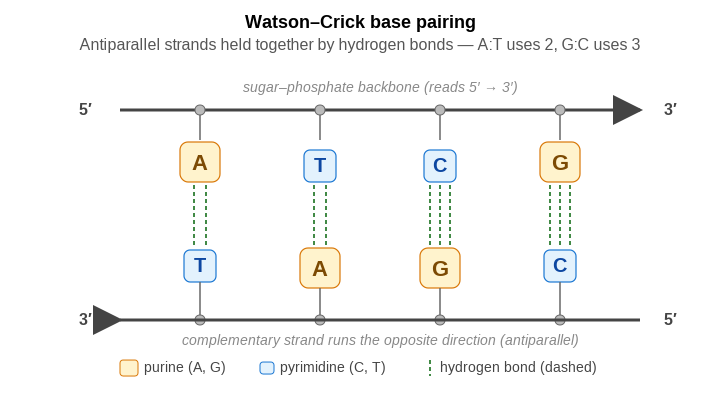
Write a function complement_base(base: u8) -> u8 that returns the Watson–Crick complement of a single DNA base. A pairs with T, C pairs with G, in both upper and lower case. N/n (unknown base) passes through unchanged. Any other byte should make the function panic with a clear message.
This is a single match expression — your first Rust function whose entire body is one expression with no ;.
Background
DNA is double-stranded. Wherever one strand has an A, the complementary strand has a T at the same position; wherever one strand has a C, the other has a G. The function you write today is the inner workhorse of “reverse complement”, which you will assemble on day 2.
The exercise
Open the starter project:
cd day1/ex-complementsrc/main.rs contains:
- A function
complement_base(base: u8) -> u8with a// TODObody - A
mainthat takes one character on the command line and prints its complement - Eight unit tests covering each base, lower case, the
Npassthrough, and the invalid-input panic
Make all the tests pass. Do not change the function signature, main, or the tests.
How to run
cargo test                 # one passes, the rest fail
cargo run -- A             # expected output: T
cargo run -- g             # expected output: c
cargo run -- N             # expected output: N
Hints
match as the whole function body
In Rust, match is an expression, not a statement. The whole match { ... } evaluates to one value, and you can return it directly from a function — no return, no ; at the end:
fn answer(x: u8) -> u8 {
    match x {
        1 => 10,
        2 => 20,
        _ => 0,
    }
}Byte literals are written b'A' (a single ASCII byte as u8). To catch every value not listed explicitly, use a name binding pattern — the pattern other matches anything and binds the matched value to the name other:
match base {
    b'A' => b'T',
    // ... other arms ...
    other => panic!("complement_base: unsupported base {:?}", other as char),
}
You could also use _ as the catch-all, but binding to a name lets you include the offending byte in the error message.
Use the panic! macro. It takes the same format string as println!. For today, panicking is the right way to express “this input violates the function’s contract”; on day 3 we will return a Result instead, which gives the caller a chance to recover.
The {:?} formatter prints values using their Debug form — useful when the value might be non-printable. other as char re-interprets a byte as its character (see as cast expressions).
Solution
fn complement_base(base: u8) -> u8 {
    match base {
        b'A' => b'T',
        b'T' => b'A',
        b'C' => b'G',
        b'G' => b'C',
        b'a' => b't',
        b't' => b'a',
        b'c' => b'g',
        b'g' => b'c',
        b'N' => b'N',
        b'n' => b'n',
        other => panic!("complement_base: unsupported base {:?}", other as char),
    }
}
Full reference implementation lives in day1/ex-complement-solution/src/main.rs.
Where this leads
- Day 2: lift this function to
reverse_complement(seq: &[u8]) -> Vec<u8>, which reverses the sequence and complements each base. We will discuss whether to return a newVec<u8>or write into a caller-provided buffer, and why both are useful. - Day 3: replace the panic with a
Resultso the caller can handle invalid input without crashing.